Skip to Content Facebook Feature Image

Global food prices rise for 2nd consecutive month in March amid Middle East conflict: FAO

HotTV

HotTV

HotTV

Global food prices rise for 2nd consecutive month in March amid Middle East conflict: FAO

2026-04-04 02:08 Last Updated At:04-05 11:41

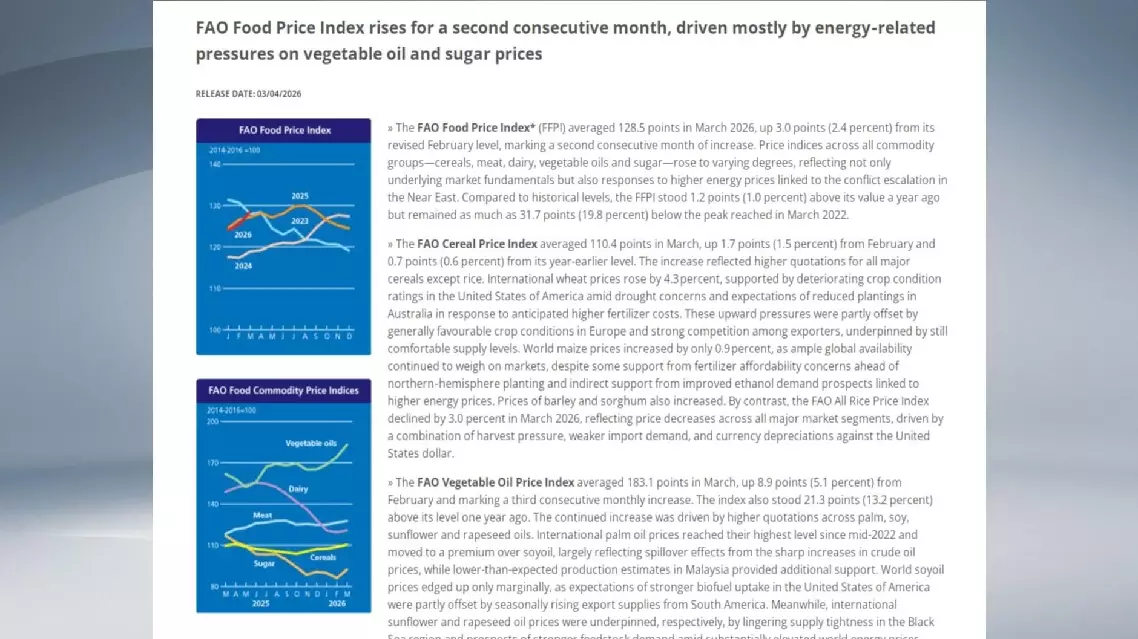
Global food commodity prices climbed for a second consecutive month in March, driven mainly by higher energy costs linked to escalating conflict in the Middle East, the Food and Agriculture Organization of the United Nations (FAO) said in report released on Friday.

The FAO Food Price Index, which tracks monthly changes in the international prices of a basket of globally traded food commodities, averaged 128.5 points in March, up 2.4 percent from February and 1.0 percent above its level a year ago.

According to the report, the FAO Vegetable Oil Index and Sugar Price Index showed the largest increases, up 5.1 percent and 7.2 percent, respectively.

The FAO Cereal Price Index increased by 1.5 percent from the previous month, driven primarily by higher world wheat prices, which rose 4.3 percent.

The FAO Meat Price Index rose by 1.0 percent from the previous month, and the FAO All-Rice Price Index declined by 3.0 percent in March, according to the report.

FAO stated that rising energy and fertilizer prices have been driving up agricultural input costs.

If the conflict stretches beyond 40 days, farmers will have to choose to farm the same with fewer inputs, plant less, or switch to less intensive fertilizer crops, according to FAO Chief Economist Maximo Torero.

These choices will hit future yields and shape food supply and commodity prices for the rest of this year and beyond, Torero said.
Global food prices rise for 2nd consecutive month in March amid Middle East conflict: FAO


Global food prices rise for 2nd consecutive month in March amid Middle East conflict: FAO

Global food prices rise for 2nd consecutive month in March amid Middle East conflict: FAO

Global food prices rise for 2nd consecutive month in March amid Middle East conflict: FAO

The Shanghai Futures Exchange on Thursday officially listed options contracts for hot-rolled coil, stainless steel, and low-sulfur fuel oil upon approval from the China Securities Regulatory Commission.

On their debut day, the three new commodity options saw a total of 236 contracts listed for trading. This included 48 contracts for hot-rolled coil options, 50 for stainless steel options, and 138 for low-sulfur fuel oil options.

China is the world's largest consumer of hot-rolled coil and stainless steel, as well as a major consumption market for low-sulfur fuel oil in the Asia-Pacific region.

The introduction of these commodity options will provide related enterprises with a broader array of tools and strategies to manage risks and ensure steady operations, according to analysts.

"China's futures and options product system has been further enriched, now offering comprehensive coverage across the major sectors of non-ferrous metals, ferrous metals, precious metals, and energy and chemicals. This enables investors to combine futures and options to separately manage directional price risks and price volatility risks, while allowing enterprises to manage the price risks they face with greater precision," said Huang Wei, director of the futures and derivatives department at the Shanghai Futures Exchange.

Shanghai Futures Exchange launches trading for hot-rolled coil, stainless steel, low-sulfur fuel oil

Shanghai Futures Exchange launches trading for hot-rolled coil, stainless steel, low-sulfur fuel oil

Recommended Articles