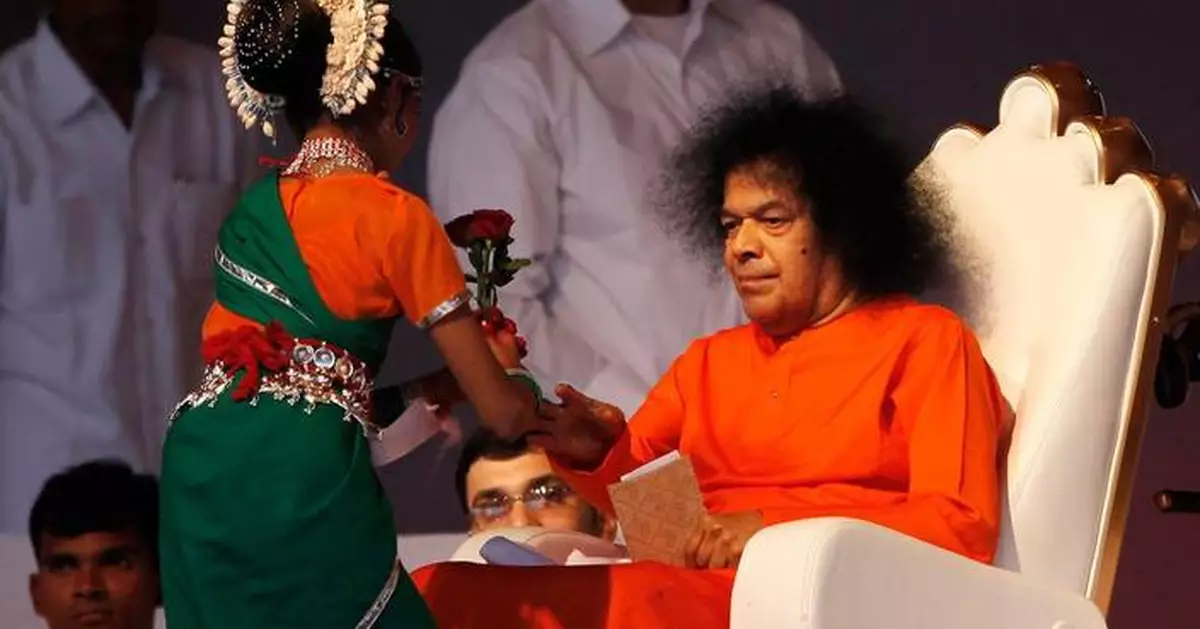
Venezuela’s former President Nicolás Maduro and current acting President Delcy Rodríguez — both raised Catholic in an overwhelmingly Christian country — have a deep reverence for an Indian spiritual leader who died in 2011.
Religious identity is complex in Venezuela, where it is common for people to blend multiple religious and spiritual practices. For Maduro and Rodríguez, that blend includes the teachings of Sathya Sai Baba, who has had a strong global following for over 50 years for his message of unity, love and spiritual oneness that transcends religious, social and cultural barriers.
Maduro frequently invoked Christ, the Holy Spirit and God in his speeches as president, framing his government’s struggles as a spiritual battle for Venezuela’s soul and sovereignty. Just weeks before his Jan. 3 capture by U.S. forces, he celebrated the centenary of Sai Baba in a social media post, expressing his hope that “the wisdom of this great teacher will continue to illuminate us in the mission of building a homeland of love, peace and high spirituality.”
Rodríguez visited Sai Baba’s ashram in southern India as recently as 2024. She said during her first presidential media briefing last month that the Venezuelan people faced “a new moment where coexistence, mutual respect, and recognition of others allow for the construction and building of a new spirituality.”
Rodríguez also said in an interview with the organization's official channel during a 2023 visit that she still feels the guru's presence in trying times.
“Many times, when I was in danger, I felt Baba with me, my family and also with my country,” she said. “He is always with us, teaching us … and showing a path for peace and love.”
The U.S. military seized Maduro and his wife, Cilia Flores, from their Caracas home Jan. 3 in a stunning operation that landed them in New York to face federal drug trafficking charges. Maduro called himself “a man of God” while pleading not guilty.
After Maduro’s capture, several news outlets in India published a 2005 photo that shows him and his wife seated at the feet of the Sai Baba, who had distinctive black, curly locks and wore a long saffron robe. It has been widely reported that Maduro displayed a large, framed photograph of Sai Baba in his office at Miraflores Palace in Caracas, alongside portraits of Latin America's liberator Simón Bolívar and former Venezuelan leader Hugo Chávez.
Maduro, who declared a national day of mourning upon Sai Baba’s death in 2011, marked the 2025 centenary by hailing the spiritual leader as “a being of light” and a “beacon of unconditional love, selfless service and truth.”
Videos posted by Sai Baba’s organization, which is still active and ubiquitous in India, have shown Rodríguez visiting its ashram and headquarters in Puttaparthi, a town in the southern Indian state of Andhra Pradesh. During visits in 2023 and 2024, she can be seen praying at the sanctum, the guru’s final resting place, which devotees believe radiates spiritual energy. She can also be seen interacting with R.J. Rathnakar, Sai Baba's nephew who currently heads the organization.
The Associated Press’ efforts to reach the Sai Baba organization in India and Venezuela for comment went unanswered.
Sai Baba’s organization came to Venezuela long before Maduro and other politicians sought out the guru. The organization opened its first center in Caracas on Aug. 22, 1974, started by Arlette Meyer, a devotee who wrote books in Spanish about the guru. In her apartment, she and a few other members sang devotional hymns and studied Sai Baba’s teachings — the organization’s first such center in Latin America.
The organization in Venezuela now appears to be centered in Abejales, a town in the state of Táchira, about 465 miles (750 kilometers) west of Caracas, where it runs a “Human Values School.” The town is the birthplace of former lawmaker Walter Márquez, who has maintained close ties with Sai Baba before and after serving as Venezuela’s ambassador to India. Márquez was honored by the Sai Baba organization in Venezuela late last year. Some estimates put the number of Sai Baba followers in Venezuela at about 200,000 and millions globally.
Faith in Venezuela is not monolithic, said Andrew Chesnut, professor of religious studies at Virginia Commonwealth University in Richmond. He said while Catholicism is still dominant, it coexists comfortably with evangelical Protestantism, Afro-Indigenous traditions and transnational religious figures, without requiring formal conversion or exclusive allegiance.
“This syncretic religious ecology helps explain how Nicolás Maduro can describe himself as a devotee of Sri Sathya Sai Baba while simultaneously cultivating close relationships with evangelical leaders who operate within a very different theological universe,” he said.
Religion is invoked rhetorically by Venezuelan politicians, rather than to dictate policy or shape laws, Chesnut said. Encounters with figures like Sai Baba “carry symbolic and performative weight rather than serving as drivers of political ideology or decision-making,” he said.
Sathya Sai Baba, who was born Ratnakaram Sathyanarayana Raju, claimed to be the reincarnation of Shirdi Sai Baba, a guru revered by Hindus and Muslims, who died in 1918. Sathya Sai Baba became popular in India and worldwide in the 1970s and 1980s as word spread of his miraculous abilities to materialize objects such as rings, necklaces and sacred ash. He is believed to have performed spontaneous healings and resurrections.
Sai Baba encouraged his followers to practice their own religions, often saying that God is one and that all paths led to the same truth. He was known for sayings that reflected his message of unity and service: “Love All, Serve All” and “Help Ever, Hurt Never.”
The guru was known for interacting with devotees, meeting them individually or in groups. Though he traveled just once outside India — in the 1960s to East Africa — the movement became global, establishing nearly 2,000 nondenominational centers in 120 countries, including 200 in the U.S, according to the organization's website.
Among his followers are Bollywood actors, cricketers, prominent business leaders and millions of average Indians who flock to Sai Baba centers for worship, prayer and singing bhajans or devotional songs, many in praise of the guru.
Sai Baba faced intense criticism from some corners, particularly rationalists and scientists, who accused him of faking his miraculous materializations. He also faced criminal allegations including accusations of fraud, sexual abuse and murder, but was never charged with any of those crimes. His followers dismissed those allegations as slander and propaganda.
Sai Baba still has ardent devotees like Dr. Samuel Sandweiss, a retired psychiatrist based in Southern California, who visited the guru nearly 80 times since 1972. He said he has seen the guru materialize everything from sacred ash called vibhuti to several golden rings.
Sandweiss is not surprised that Maduro and other Venezuelan leaders followed Sai Baba.
“I’ve seen him with all kinds of people from all walks of life — from the lowest to the highest,” he said. “His main message was that love transcends all religion and unites us all.”
Associated Press writers Jorge Rueda, in Caracas, Venezuela, and Sheikh Saaliq, in New Delhi, India, contributed to this report.
Associated Press religion coverage receives support through the AP’s collaboration with The Conversation US, with funding from Lilly Endowment Inc. The AP is solely responsible for this content.
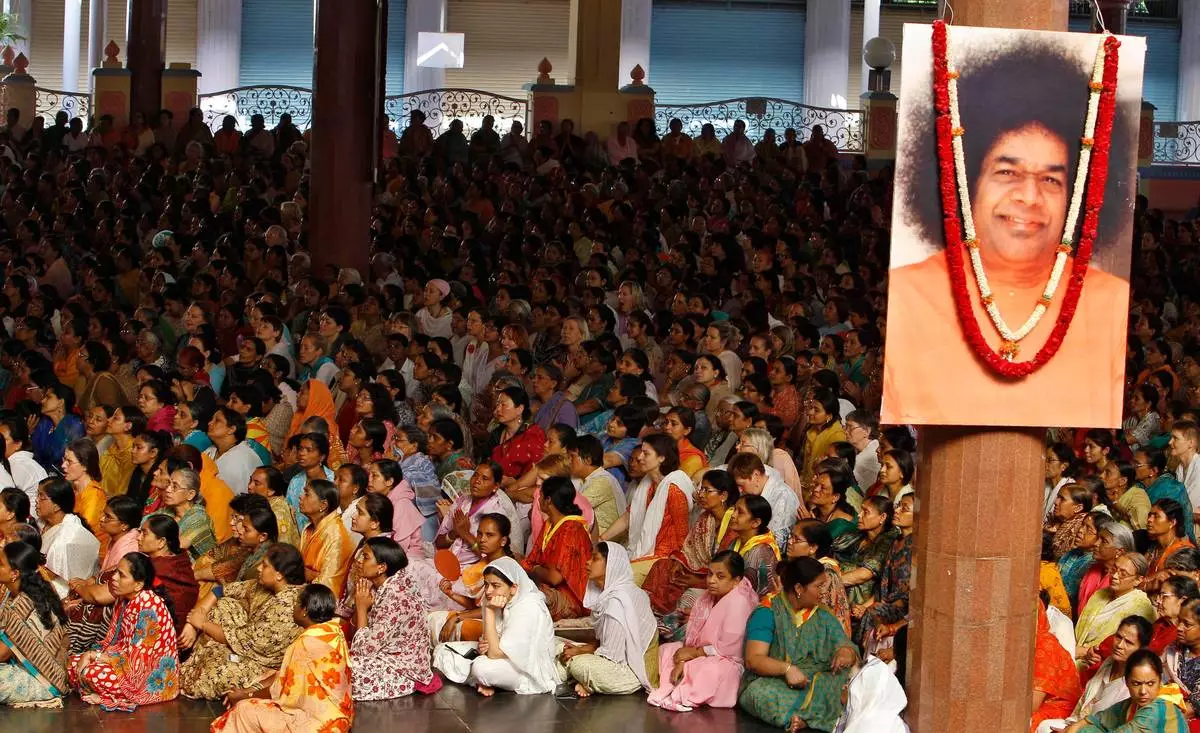
FILE - Devotees attend the last rites ceremony of Indian religious leader Sathya Sai Baba at the Prasanthi Nilayam Ashram in Puttaparti, India, April 27, 2011. (AP Photo/Aijaz Rahi, File)
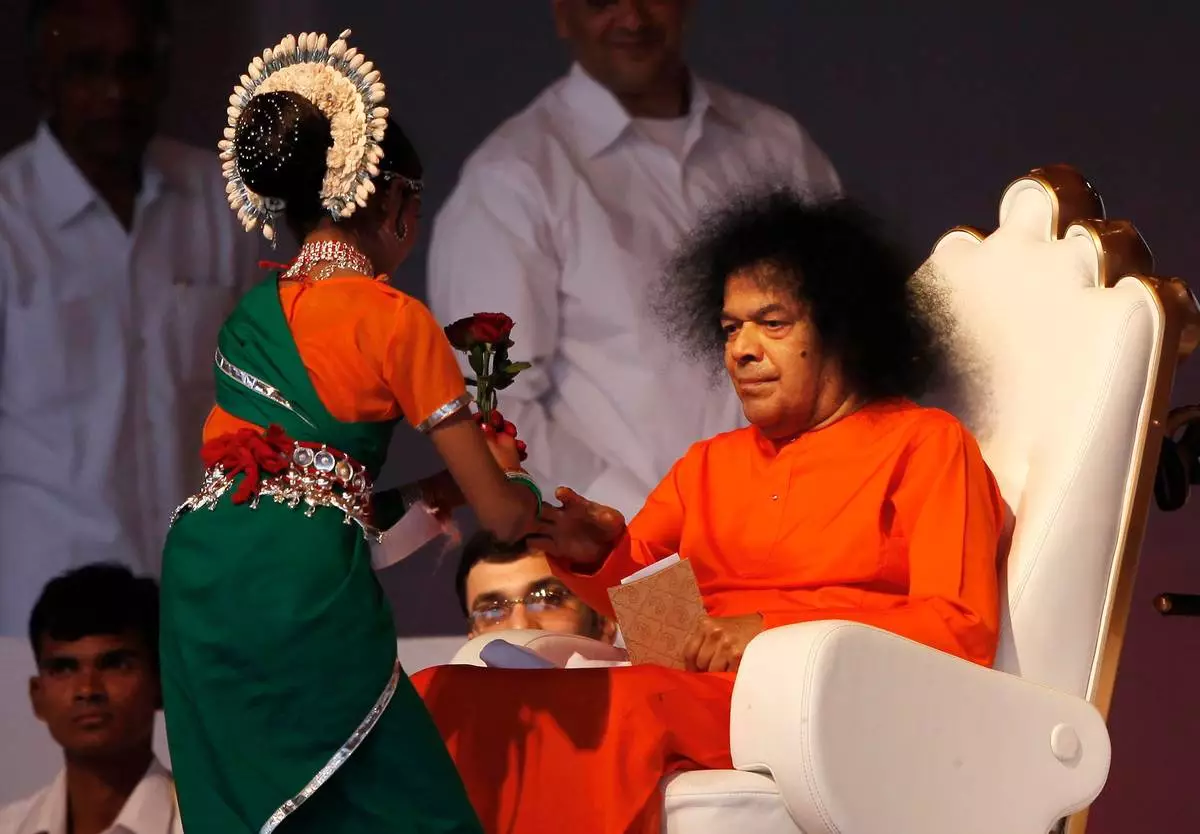
FILE - Indian spiritual leader Sathya Sai Baba, right, receives a flower from a girl at a function to meet his devotees in New Delhi, India, April 10, 2010. (AP Photo/Mustafa Quraishi, File)