Skip to Content Facebook Feature Image

Virginia Supreme Court strikes down Democrats' redrawn US House maps, giving Republicans a win

News

Virginia Supreme Court strikes down Democrats' redrawn US House maps, giving Republicans a win
News

News

Virginia Supreme Court strikes down Democrats' redrawn US House maps, giving Republicans a win

2026-05-08 23:42 Last Updated At:23:50

The Virginia Supreme Court on Friday struck down a voter-approved Democratic congressional redistricting plan, delivering another major setback to the party in a nationwide battle against Republicans for an edge in this year's midterm elections.

The court ruled 4-3 that the state's Democratic-led legislature violated procedural requirements when it placed the constitutional amendment on the ballot to authorize the mid-decade redistricting. Voters narrowly approved the amendment April 21, but the court's ruling renders the results of that vote meaningless.

Writing for the majority, Justice D. Arthur Kelsey wrote that the legislature submitted the proposed constitutional amendment to voters “in an unprecedented manner.”

“This violation irreparably undermines the integrity of the resulting referendum vote and renders it null and void," he wrote.

Democrats had hoped to win as many as four additional U.S. House seats under Virginia's redrawn U.S. House map as part of an attempt to offset Republican redistricting done elsewhere at the urging of President Donald Trump. That ruling, combined with a recent U.S. Supreme Court decision severely weakening the Voting Rights Act, has supercharged the Republicans' congressional gerrymandering advantage heading into this year's midterm elections.

Richard Hudson, chairman of the National Republican Congressional Committee said the ruling was another sign of GOP momentum heading into the midterms.

"We’re on offense, and we’re going to win,” he said in a statement.

Don Scott, the Democratic speaker of the Virginia House of Delegates, said Democrats respect the court’s opinion but lamented that it overturned the will of the voters: “They voted YES because they wanted to fight back against the Trump power grab.”

Suzan DelBene, chairwoman of the Democratic Congressional Campaign Committee, criticized the court majority for what she said was a decision that “cast aside the will of the voters,” but she said the people will have the final say.

“In November, they will, and they’ll power Democrats to the House majority,” she said in a statement.

Legislative voting districts typically are redrawn once a decade after each census to account for population changes. But Trump started an unusual flurry of mid-decade redistricting last year when he encouraged Republican officials in Texas to redraw districts in a bid to win several additional U.S. House seats and hold on to their party's narrow majority in the midterm elections.

California responded with new voter-approved districts drawn to Democrats' advantage, and Utah's top court imposed a new congressional map that also helps Democrats. Meanwhile, Republicans stand to gain from new House districts passed in Florida, Missouri, North Carolina, Ohio and Tennessee. They could add even more after the U.S. Supreme Court's ruling in the Voting Rights Act case, which has prompted some other Republican states to consider redrawing their maps in time for this year’s elections.

Virginia currently is represented in the U.S. House by six Democrats and five Republicans who were elected from districts imposed by a court after a bipartisan redistricting commission failed to agree on a map after the 2020 census. The new districts could have given Democrats an improved chance to win all but one of the state's 11 congressional seats.

The Supreme Court's majority was critical of the state’s redrawing of the congressional maps to benefit one political party. Those justices noted that 47% of the state’s voters supported GOP congressional candidates in 2024 but the new map could result in Democrats making up 91% of the state’s House delegation.

Under the Democratic-drawn map, five districts would have been anchored in the Democratic stronghold of northern Virginia, including one stretching out like a lobster to consume Republican-leaning rural areas. Revisions to four other districts across Richmond, southern Virginia and Hampton Roads would have diluted the voting power of conservative blocs in those areas. And a reshaped district in parts of western Virginia would have lumped together three Democratic-leaning college towns to offset other Republican voters.

The state Supreme Court’s seven justices are appointed by the state legislature, which has toggled back and forth between Democratic, Republican and split control over recent years. Legal experts say the body doesn’t have a set ideological profile

The case before the court focused not on the shape of the new districts but rather on the process the General Assembly used to authorize them.

Because the state’s redistricting commission was established by a voter-approved constitutional amendment, lawmakers had to propose an amendment to redraw the districts. That required approval of a resolution in two separate legislative sessions, with a state election sandwiched in between, to place the amendment on the ballot.

The legislature’s initial approval of the amendment occurred last October — while early voting was underway but before it concluded on the day of the general election. The legislature’s second vote on the amendment occurred after a new legislative session began in January. Lawmakers also approved a separate bill in February laying out the new districts, subject to voter approval of the constitutional amendment.

Judicial arguments focused on whether the legislature’s initial approval of the amendment came too late, because early voting already had begun for the 2025 general election.

Attorney Matthew Seligman, who defended the legislature, argued that the “election” should be defined narrowly to mean the Tuesday of the general election. In that case, the legislature’s first vote on the redistricting amendment occurred before the election and was constitutional, he told judges.

But, the Supreme Court said in its ruling, “this view appears to be wholly unprecedented in Virginia’s history.”

An attorney for the plaintiffs, Thomas McCarthy, argued that an “election” should be interpreted to cover the entire period during which people can cast ballots, which lasts several weeks in Virginia. If that’s the case, he told justices, then the legislature’s initial endorsement of the redistricting amendment came too late to comply with the state constitution.

The Supreme Court agreed with that argument, writing: “The General Assembly passed the proposed constitutional amendment for the first time well after voters had begun casting ballots during the 2025 general election.”

By the time lawmakers initially endorsed the constitutional amendment, statewide voters already had cast more than 1.3 million ballots in the general election, about 40% of the total votes ultimately cast, the court said.

The Supreme Court’s ruling affirms a decision by a judge in rural Tazewell County, in southwestern Virginia. The court had placed a hold on that ruling and allowed the redistricting vote to proceed before hearing arguments on the case.

In the dissent to Friday's ruling, Chief Justice Cleo Powell said the election for the purpose of considering the amendment does not include the early voting period.

“The majority’s definition creates an infinite voting loop that appears to have no established beginning,” she wrote, “only a definitive end: Election Day.”
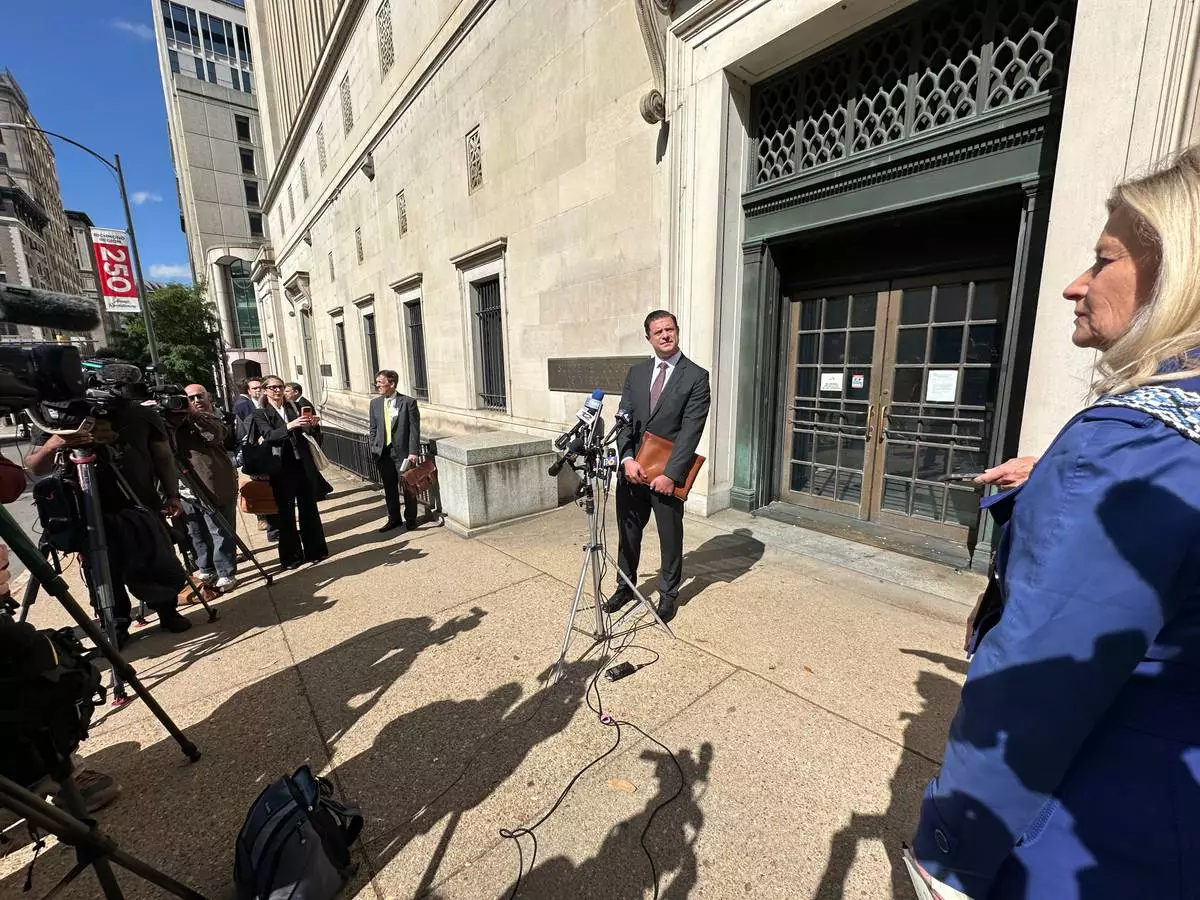
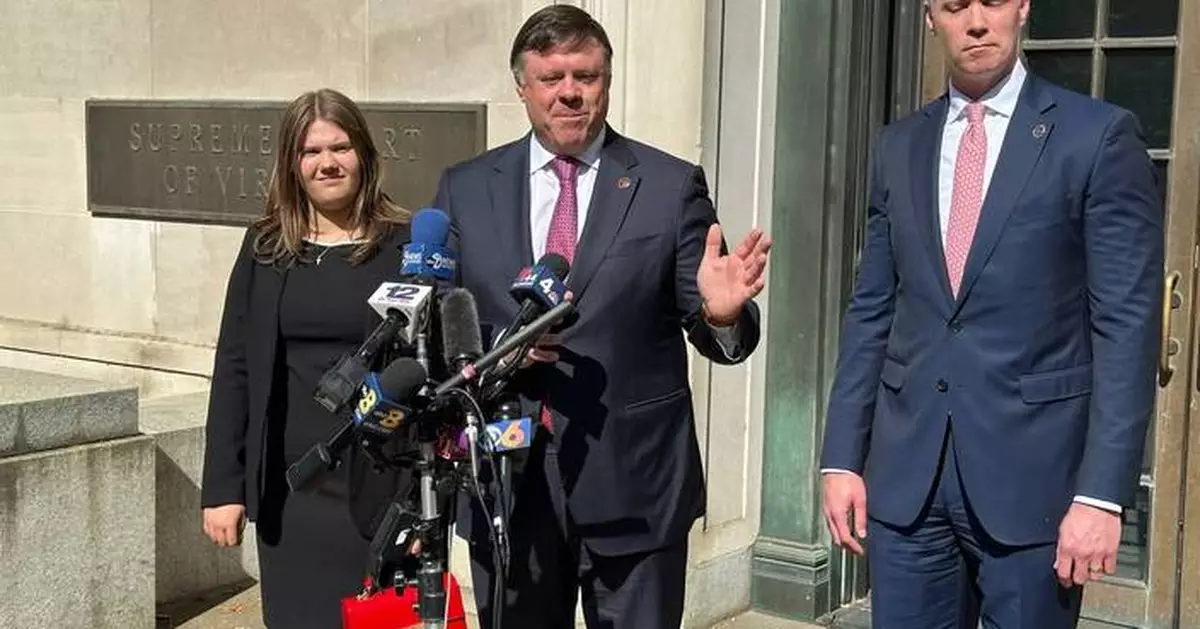
Attorney Matthew Seligman, representing Democratic state legislators, speaks with the media following a hearing on new congressional maps before the state Supreme Court in Richmond, Va., on Monday, April 27, 2026. (AP Photo/Allen G. Breed)
Attorney Matthew Seligman, representing Democratic state legislators, speaks with the media following a hearing on new congressional maps before the state Supreme Court in Richmond, Va., on Monday, April 27, 2026. (AP Photo/Allen G. Breed)

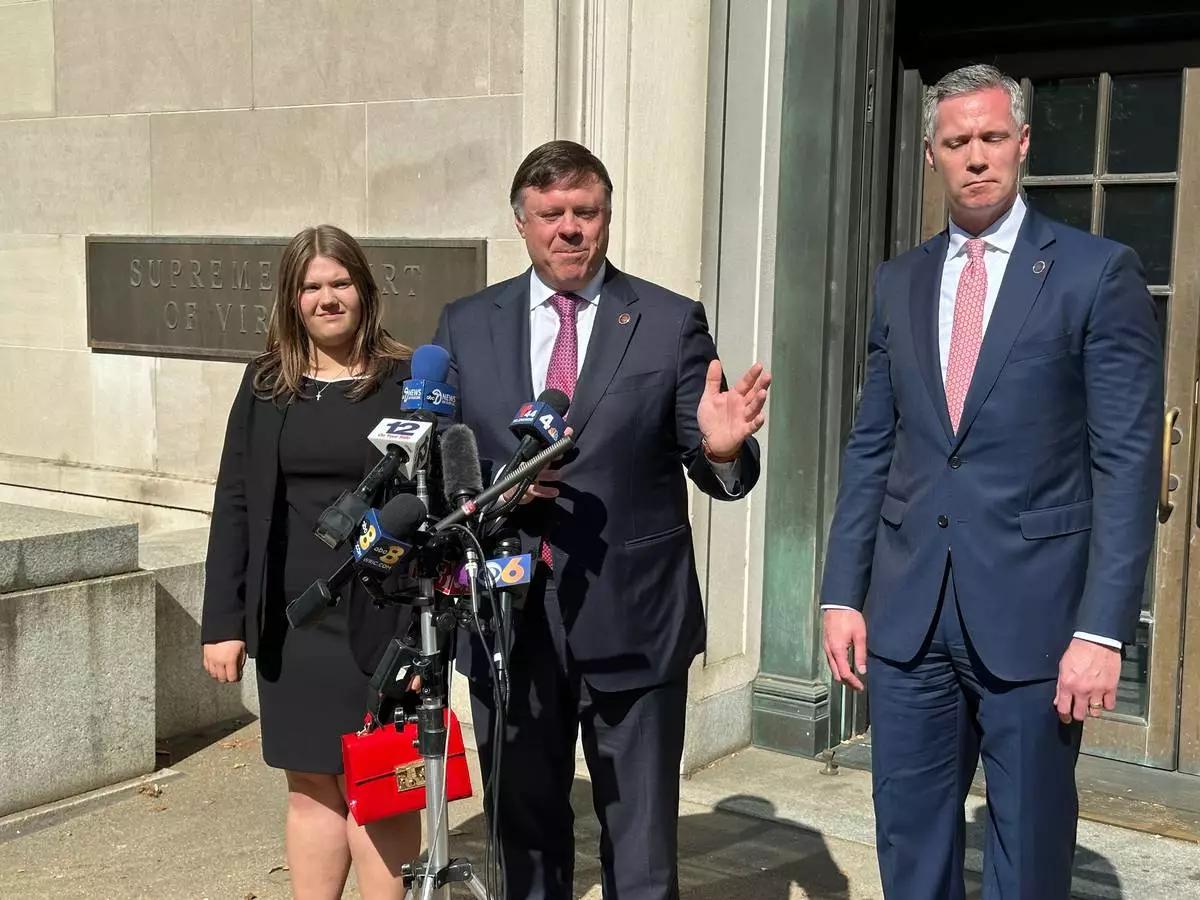
State Senate Minority Leader Ryan McDougle, center, speaks outside the Supreme Court of Virginia after arguments were heard in a redistricting-related case at the court in Richmond, Va., on Monday, April 27, 2026. (AP Photo/Allen G. Breed)

State Senate Minority Leader Ryan McDougle, center, speaks outside the Supreme Court of Virginia after arguments were heard in a redistricting-related case at the court in Richmond, Va., on Monday, April 27, 2026. (AP Photo/Allen G. Breed)
BETHLEHEM, West Bank (AP) — Mohamad Al-Assi ran beneath the concrete wall as the sun rose over Bethlehem. His Nikes pounded the gravel, his breath fogging the air as graffiti and paint splatter blurred past with each stride.

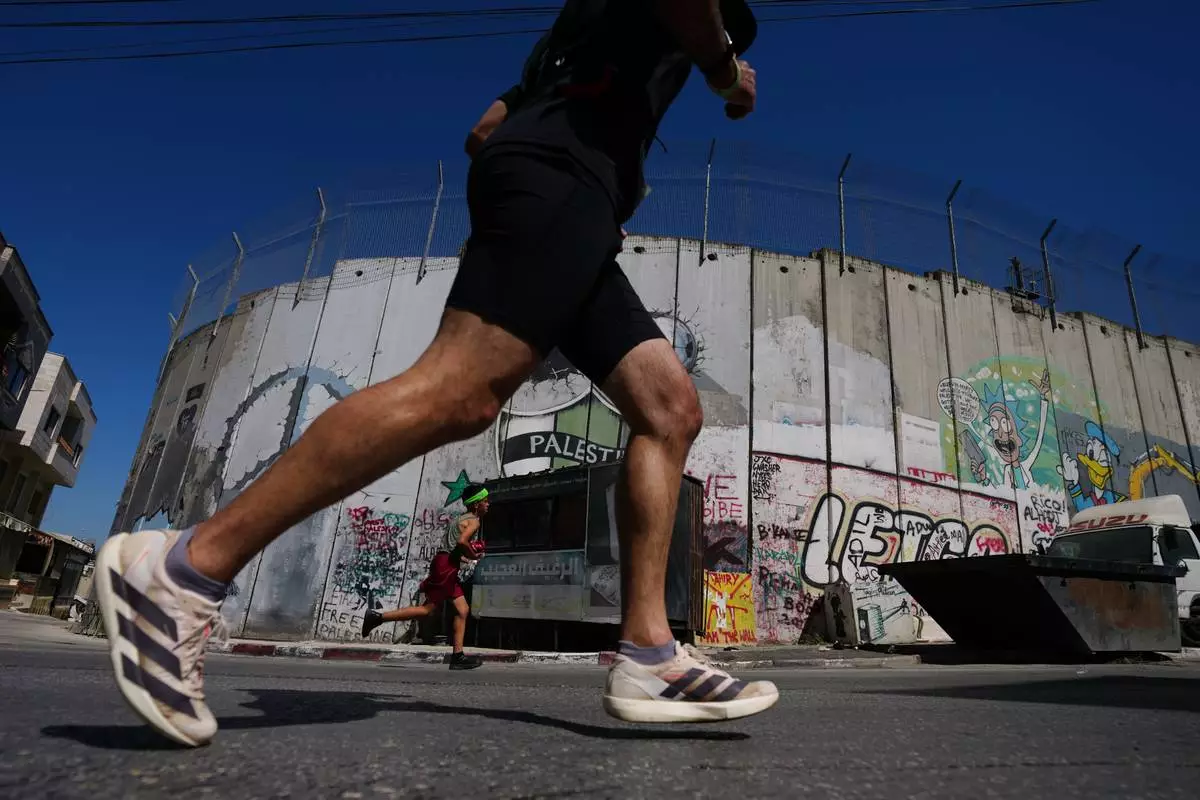
The road along the barrier separating Israel from the occupied West Bank makes up a stretch of a marathon route that Al-Assi and thousands of others ran on Friday. The event is open to people in other parts of the world running in solidarity with the Palestinians and another, shorter race was happening in Gaza.

The race, known as the Palestine Marathon, was held for the first time in three years and was among the first big international events in the West Bank since the start of the Israel-Hamas war. Festivals, conferences and holiday festivities that once drew thousands have been scaled back or canceled because of the war in Gaza and heightened Israeli restrictions.

It marked a turning point for Al-Assi, 27, who was released from Israeli detention six months ago. Video from that day shows him gaunt-faced and hollow-eyed, his once muscular legs weakened after more than two and a half years of prison.

He began training in December, gradually upping his mileage every month since. He ran 62 miles (100 kilometers) that first month, and in April reached 135 miles (217 kilometers), according to his account on the tracking app Strava.

He jogs in the morning after his mother wakes him up in their home in Dheisheh, a Palestinian refugee camp made up of graffiti-covered cinderblock homes in tangled alleyways.

“The main difficulties we face are the cars on the roads and the presence of Israeli security forces along the route where I train,” Al-Assi said.

He had to suspend his training several times because of military operations in the camp.

“I would return home feeling hopeless because I couldn't do what I had intended to do,” Al-Assi said.

In the West Bank, runners cannot complete a 26.2-mile (42.2-kilometer) course without hitting a checkpoint or military gate, which is why Friday's marathon route looped around the same circuit twice.

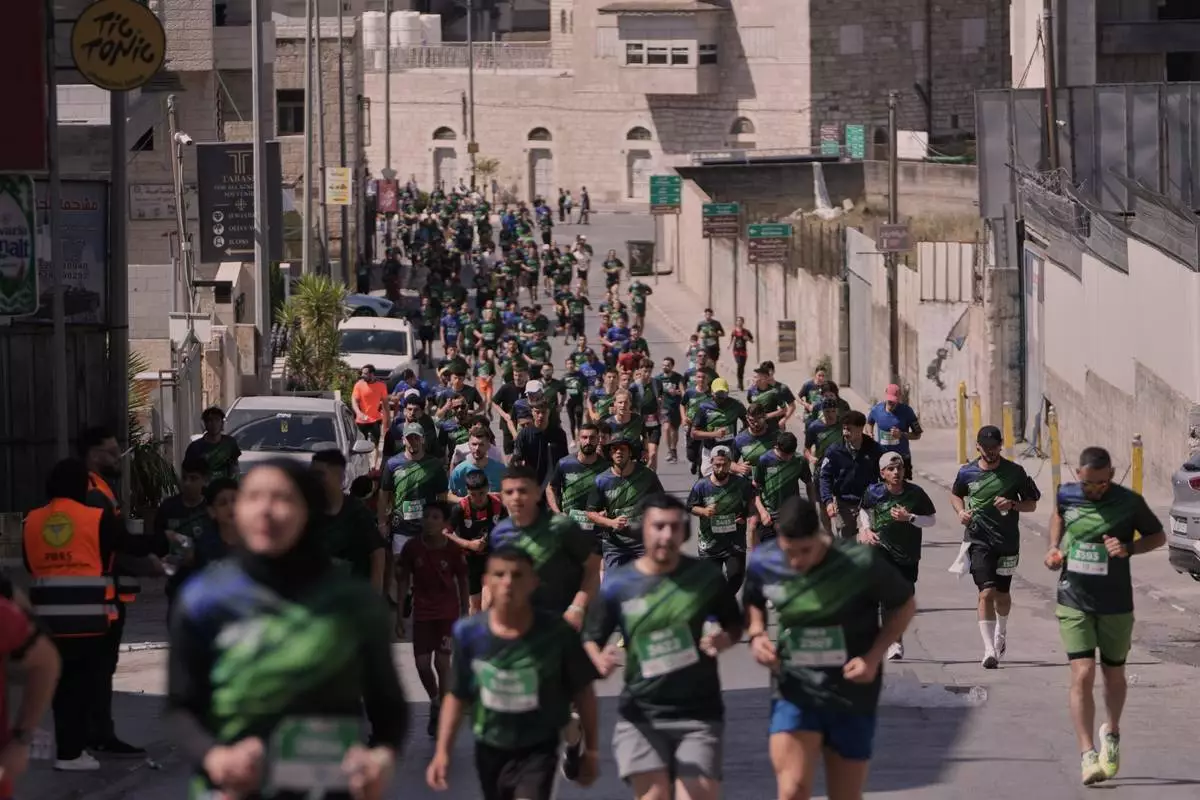
They ran up through the narrow streets of two Palestinian refugee camps and down to a farming town next to Bethlehem where fields are divided by the concrete wall, barbed wire and cameras. The course hooked back to finish at Bethlehem’s Manger Square.

Organizers say the race highlights restrictions facing Palestinians in the occupied West Bank, where checkpoints can disrupt even routine commutes and where open land for hiking, biking and running is increasingly taken by Israeli settlements and outposts.

“Marathon runners anywhere may ‘hit a wall’ under the physical and emotional strain of completing the 42-kilometer race course," they said on the marathon's website.

But in the West Bank, they added, "runners literally hit the Wall.”

At a time when the West Bank’s economy is struggling and in the shadow of Gaza's fragile ceasefire and stalled rebuilding efforts, the atmosphere in Bethlehem was celebratory. Crowds gathered near the Church of the Nativity to cheer runners at the race's early morning start and finish. Bagpipes blared and drummers pounded out traditional rhythms through streets along the route.

On a beachside road in Nuseirat in central Gaza — which is roughly the length of a marathon — 15 disabled people, including amputees, ran a 2K, and a couple thousand of people ran a 5K. Thirteen years after the U.N. agency for Palestinian refugees, known as UNRWA, canceled a 2013 marathon because Hamas forbade women from participating, the women were back.

Haya Alnaji, a 22-year-old woman who ran in the 5K, said the number of people taking part reflected that Palestinians in Gaza were determined to live and persevere despite the devastation wrought by more than two years of war.

“All of Gaza loves sports,” she said.

Al-Assi was arrested in April 2023, and imprisoned under administrative detention, which allows Israel to hold detainees for months without charge. Between 3,000 and 4,000 Palestinians are being held under that system, according to Israeli rights groups and the Palestinian Prisoners Society.

In October 2023, Al-Assi was sentenced for transferring money to suspicious entities, a charge he denies. Israel closely monitors money transfers — particularly to Gaza — for fear that funds could end up in the hands of militants. Palestinians, however, say donations and charitable contributions are often swept up in the dragnet. Israel’s military, Shin Bet and Prison Service did not answer questions about Al-Assi's charges.

In Israeli prisons — where detainees routinely complain of inadequate diets — Al-Assi said nearly everyone goes hungry. The weight he lost eroded the endurance built through 10 years of training.

“I have more muscle mass than fat, so when I lost weight, the loss came from my muscles rather than fat,” he said. “This had a major impact on my physical fitness.”

He also had to regain the mental fortitude to run a marathon.

“I was emotionally shattered after spending such a long period in prison,” he said.

On Friday, he collapsed to his knees, bowing and thanking God after finishing second overall, as supporters and journalists encircled him. He dedicated his run to Palestinians still in Israeli detention.

“After 32 months in prison, Mohamad Al-Assi is first in his class!” he shouted through tears, raising his hands and looking up to the sky.

__ Imad Isseid contributed from Bethlehem, West Bank and Abdel Kareem Hana from Nuseirat, Gaza Strip.

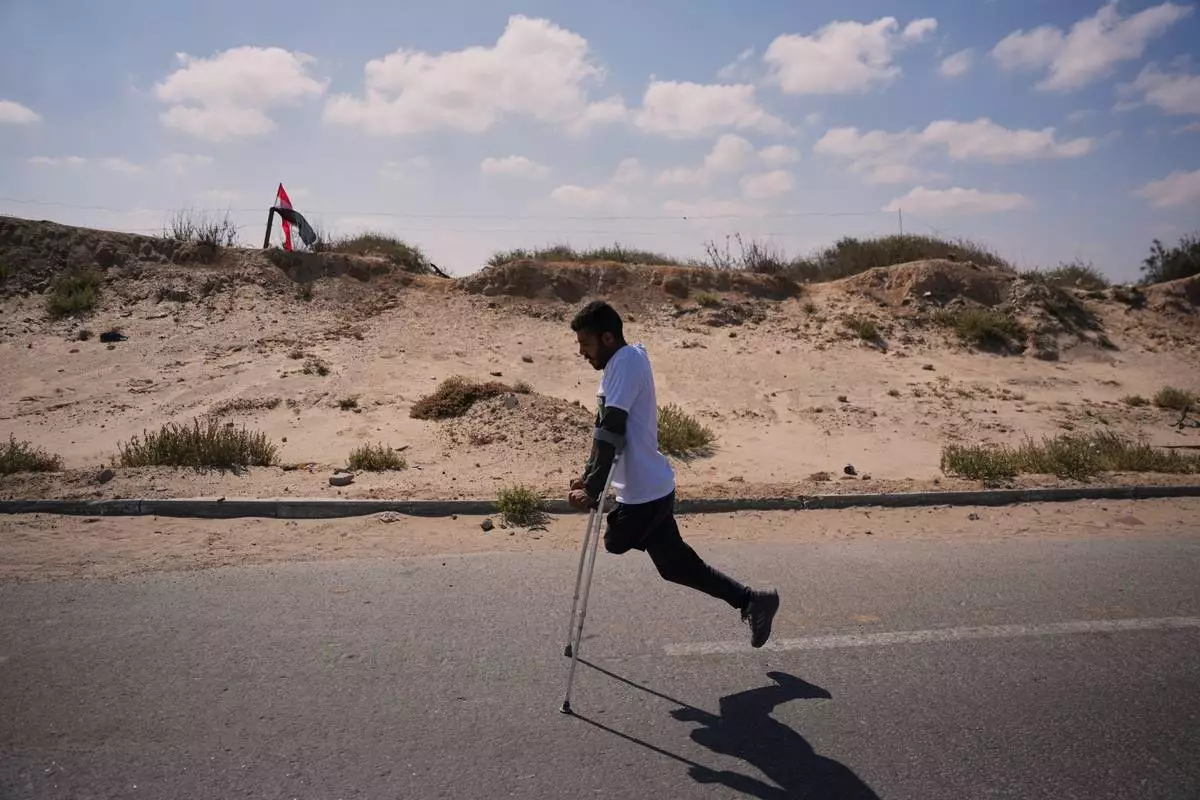
A Palestinian amputee runner takes part in the 2-kilometer Palestine Marathon along the coastal road near Nuseirat in the central Gaza Strip, Friday, May 8, 2026. (AP Photo/Abdel Kareem Hana)

A Palestinian amputee runner takes part in the 2-kilometer Palestine Marathon along the coastal road near Nuseirat in the central Gaza Strip, Friday, May 8, 2026. (AP Photo/Abdel Kareem Hana)

Palestinian runners take part in the 5-kilometer Palestine Marathon along the coastal road near Nuseirat in the central Gaza Strip, Friday, May 8, 2026. (AP Photo/Abdel Kareem Hana)

Palestinian runners take part in the 5-kilometer Palestine Marathon along the coastal road near Nuseirat in the central Gaza Strip, Friday, May 8, 2026. (AP Photo/Abdel Kareem Hana)

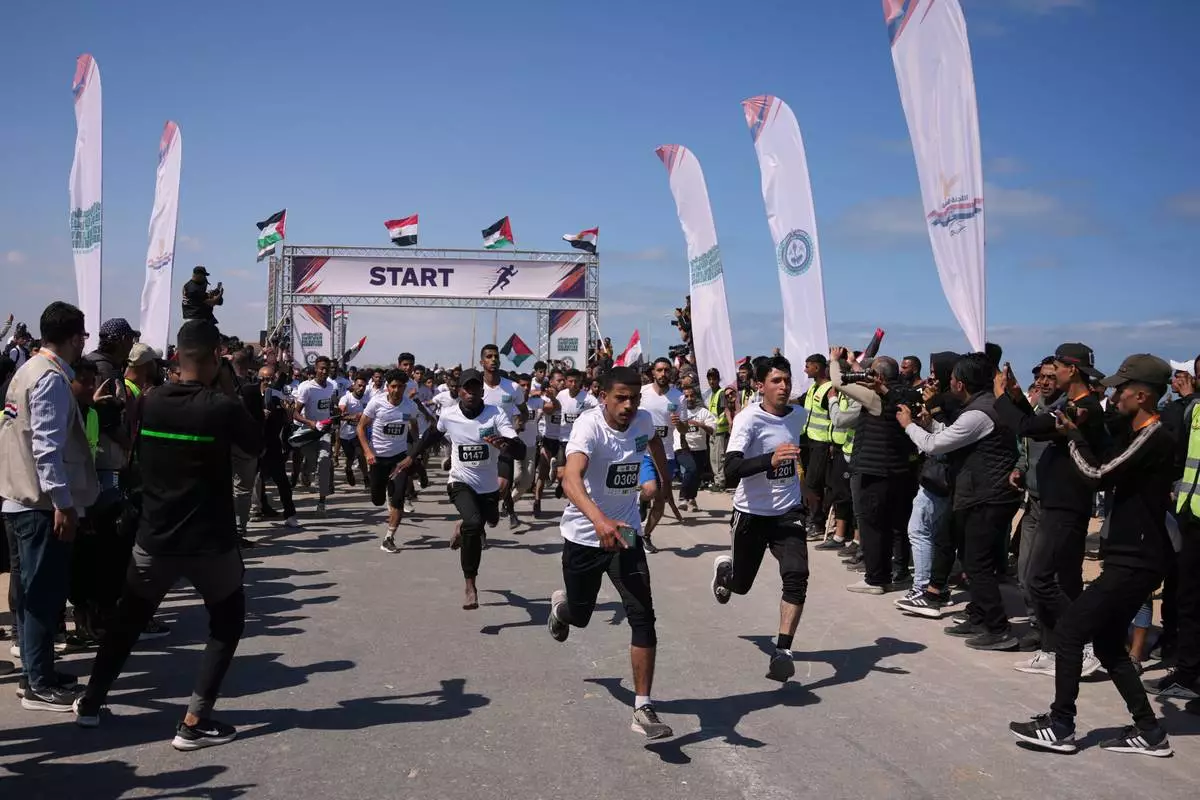
Runners participate in the Palestine Marathon in the West Bank city of Bethlehem, Friday, May 8, 2026. (AP Photo/Mahmoud Illean)

Runners participate in the Palestine Marathon in the West Bank city of Bethlehem, Friday, May 8, 2026. (AP Photo/Mahmoud Illean)

Runners pass by Israel's separation wall as they compete in the Palestine Marathon in the West Bank city of Bethlehem, Friday, May 8, 2026. (AP Photo/Mahmoud Illean)

Runners pass by Israel's separation wall as they compete in the Palestine Marathon in the West Bank city of Bethlehem, Friday, May 8, 2026. (AP Photo/Mahmoud Illean)

Palestinian Mohamad Al-Assi, who was released from Israeli detention six months ago, runs past Israel's separation wall as he trains ahead of the Palestine Marathon in the West Bank city of Bethlehem, Thursday, May 7, 2026. (AP Photo/Sam Metz)

Palestinian Mohamad Al-Assi, who was released from Israeli detention six months ago, runs past Israel's separation wall as he trains ahead of the Palestine Marathon in the West Bank city of Bethlehem, Thursday, May 7, 2026. (AP Photo/Sam Metz)

Recommended Articles