Washington Post publisher Will Lewis said Saturday that he’s stepping down, ending a troubled tenure three days after the newspaper said that it was laying off one-third of its staff.
Lewis announced his departure in a two-paragraph email to the newspaper's staff, saying that after two years of transformation, “now is the right time for me to step aside.” The Post's chief financial officer, Jeff D'Onofrio, was appointed temporary publisher.
Neither Lewis nor the newspaper's billionaire owner Jeff Bezos participated in the meeting with staff members announcing the layoffs on Wednesday. While anticipated, the cutbacks were deeper than expected, resulting in the shutdown of the Post's renowned sports section, the elimination of its photography staff and sharp reductions in personnel responsible for coverage of metropolitan Washington and overseas.
They came on top of widespread talent defections in recent years at the newspaper, which lost tens of thousands of subscribers following Bezos' order late in the 2024 presidential campaign pulling back from a planned endorsement of Kamala Harris, and a subsequent reorienting of its opinion section in a more conservative direction.
Martin Baron, the Post’s first editor under Bezos, condemned his former boss this week for attempting to curry favor with President Donald Trump and called what has happened at the newspaper “a case study in near-instant, self-inflicted brand destruction.”
The British-born Lewis was a former top executive at The Wall Street Journal before taking over at The Post in January 2024. His tenure has been rocky from the start, marked by layoffs and a failed reorganization plan that led to the departure of former top editor Sally Buzbee.
His initial choice to take over for Buzbee, Robert Winnett, withdrew from the job after ethical questions were raised about both he and Lewis' actions while working in England. They include paying for information that produced major stories, actions that would be considered unethical in American journalism. The current executive editor, Matt Murray, took over shortly thereafter.
Lewis didn't endear himself to Washington Post journalists with blunt talk about their work, at one point saying in a staff meeting that they needed to make changes because not enough people were reading their work.
This week's layoffs have led to some calls for Bezos to either increase his investment in The Post or sell it to someone who will take a more active role. Lewis, in his note, praised Bezos: “The institution could not have had a better owner,” he said.
“During my tenure, difficult decisions have been taken in order to ensure the sustainable future of The Post so it can for many years ahead publish high-quality nonpartisan news to millions of customers each day,” Lewis said.
The Washington Post Guild, the union representing staff members, called Lewis' exit long overdue.
“His legacy will be the attempted destruction of a great American journalism institution,” the Guild said in a statement. “But it’s not too late to save The Post. Jeff Bezos must immediately rescind these layoffs or sell the paper to someone willing to invest in its future.”
Bezos did not mention Lewis in a statement saying D'Onofrio and his team are positioned to lead The Post into “an exciting and thriving next chapter.”
“The Post has an essential journalistic mission and an extraordinary opportunity,” Bezos said. “Each and every day our readers give us a roadmap to success. The data tells us what is valuable and where to focus.”
D'Onofrio, who joined the paper last June after jobs at the digital ad management company Raptive, Google, Zagat and Major League Baseball, said in a note to staff that "we are ending a hard week of change with more change.
“This is a challenging time across all media organizations, and The Post is unfortunately no exception,” he wrote. “I've had the privilege of helping chart the course of disrupters and cultural stalwarts alike. All faced economic headwinds in changing industry landscapes, and we rose to meet those moments. I have no doubt we will do just that, together.”
David Bauder writes about the intersection of media and entertainment for the AP. Follow him at http://x.com/dbauder and https://bsky.app/profile/dbauder.bsky.social.
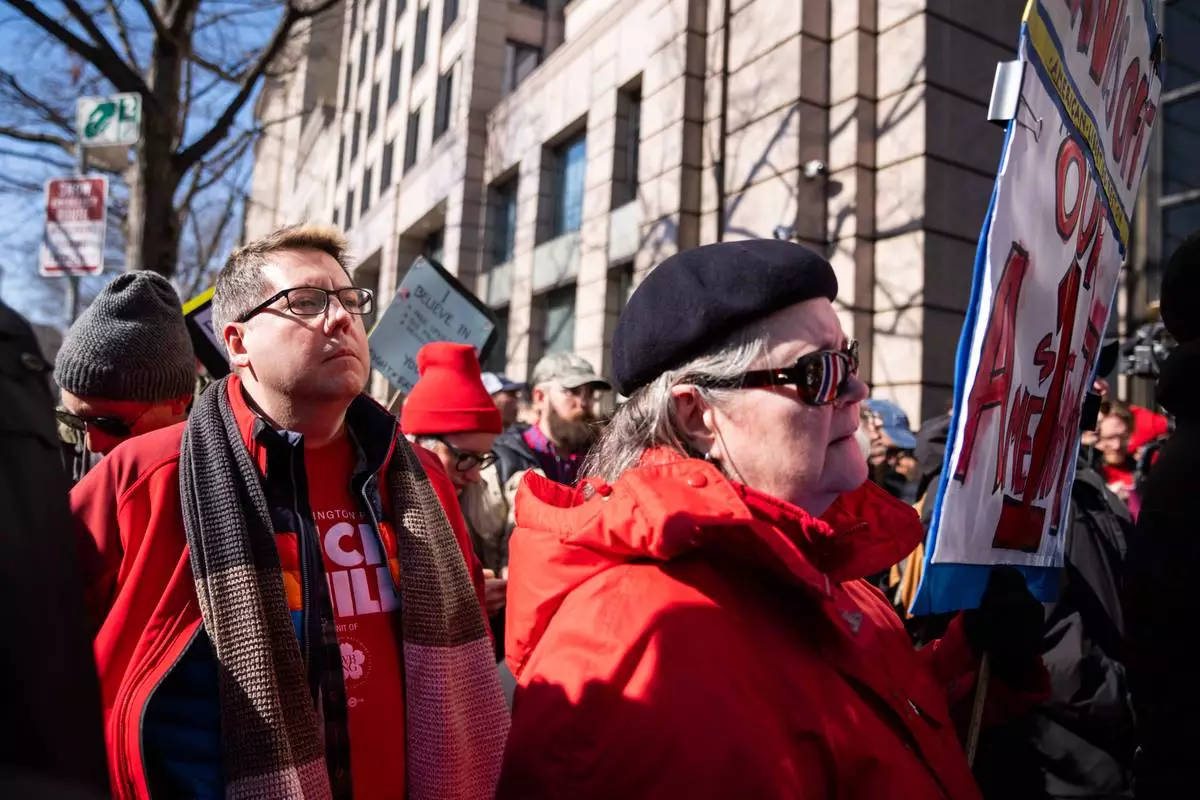
Protesters outside of the Washington Post office demonstrate following a mass layoff, Thursday, Feb. 5, 2026, in Washington. (AP Photo/Allison Robbert)
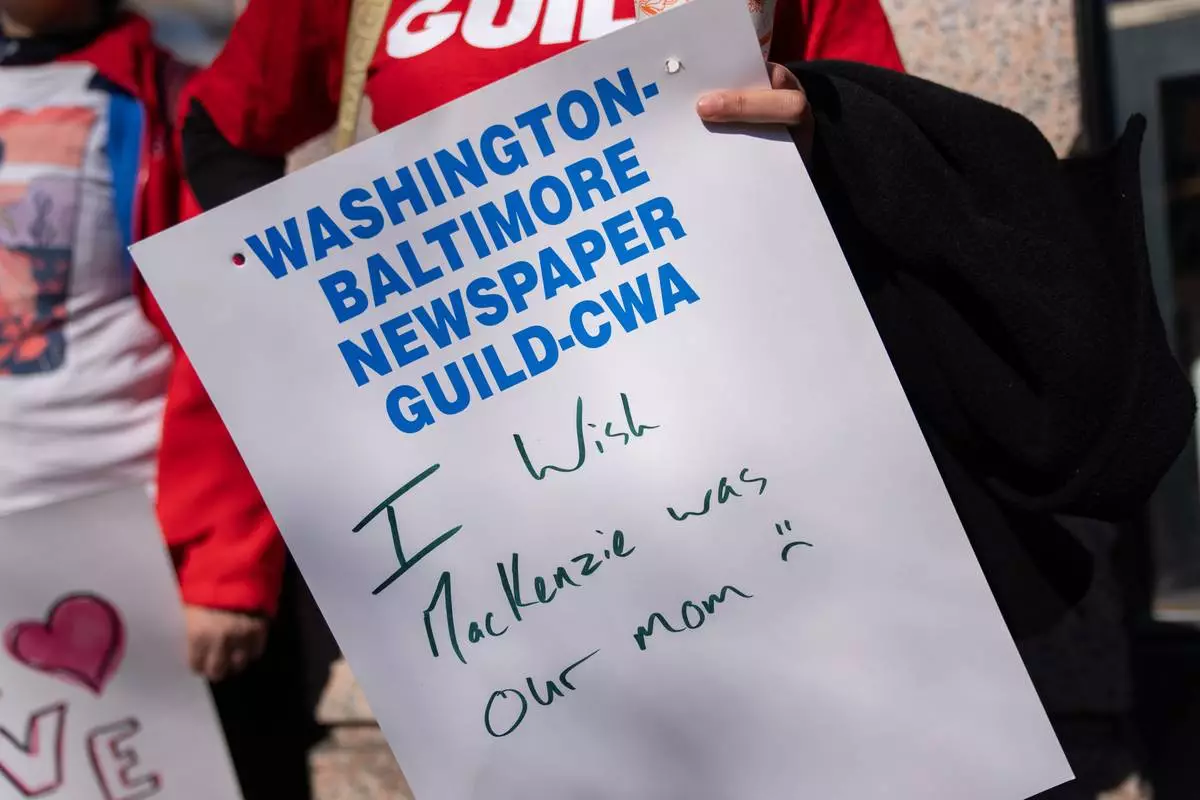
Protesters outside of the Washington Post office demonstrate following a mass layoff, Thursday, Feb. 5, 2026, in Washington. (AP Photo/Allison Robbert)

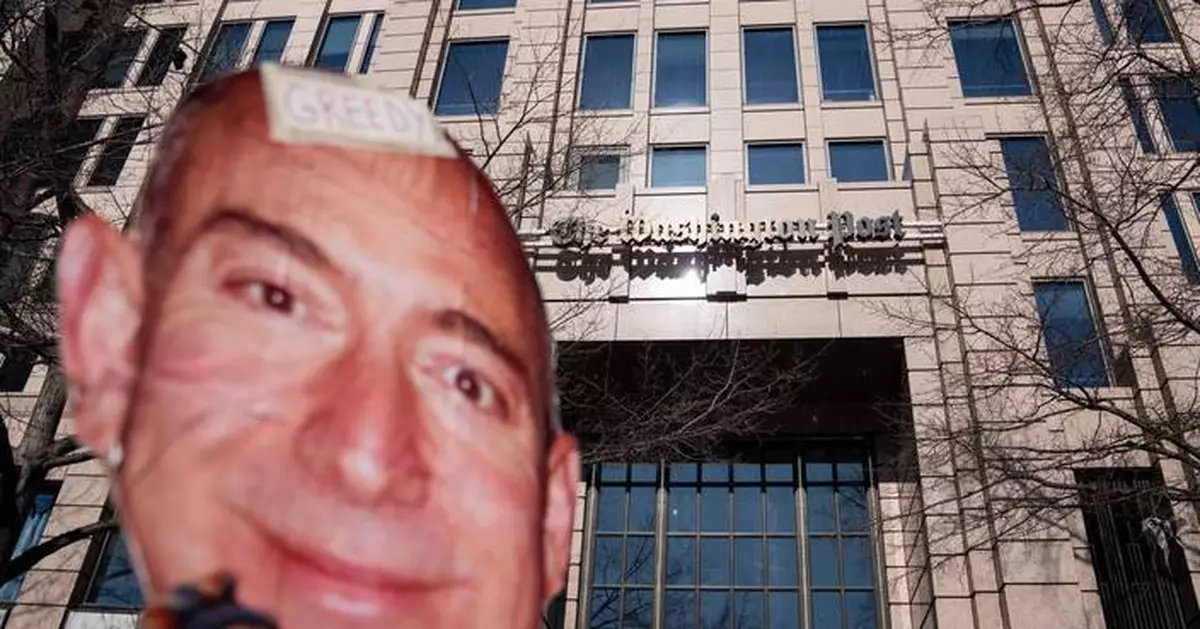
A protester holds a cutout of Jeff Bezos' face outside of the Washington Post office following a mass layoff, Thursday, Feb. 5, 2026, in Washington. (AP Photo/Allison Robbert)
A super typhoon steadily battered a pair of remote U.S. islands in the Pacific Ocean with ferocious winds and relentless rains, shredding tin roofs and forcing residents to take cover from flying tree limbs.
Super Typhoon Sinlaku pounded the Northern Mariana Islands for hours before daybreak Wednesday, slowing just to inflict more damage across the islands of Tinian and Saipan, home to nearly 50,000 people.
In the village Susupe on Saipan, resident Dong Min Lee said it was still too dangerous to head outside to thoroughly inspect for damage at daybreak Wednesday. From his apartment windows he could see a car sitting on top of two others in his building’s parking lot below. The winds also tore off part of his balcony railing.
“I hope people will take an interest and help. The damage is really huge here,” Lee said in a Facebook message.
The tropical typhoon — the strongest on Earth this year — was packing sustained winds of up to 150 mph (240 kph) when it made landfall on the islands, the National Weather Service said.
Tropical force winds and torrential rainfall also led to flash flooding on Guam, a U.S. territory to the south with several U.S. military installations and about 170,000 residents, the weather service said.
“I’m guessing anything that was made of wood and tin did not survive this,” said Glen Hunter, who grew up on Saipan and watched at least three tin roofs fly past his yard.
Hunter, who has weathered numerous typhoons, told The Associated Press this felt like the strongest yet. Rain was seeping into every crevice of his concrete home, he said.
“It was a losing battle because the rain was coming through everywhere,” he said. “Every house is just flooded with water, no matter what type of structure you’re in."
While wind gusts did slow a bit on the Mariana Islands early Wednesday and the storm started tracking to the north, the conditions did not improve right away, the weather service reported.
Ed Propst, a former lawmaker in Saipan who works in the governor’s office, said he heard “banging and clanging through the night.”
“We haven’t heard of any — knock on wood — deaths so far,” he said, attributing that to residents heeding warnings to take shelter if they weren't in a concrete home.
The monster storm slowed to a crawl as it approached the islands.
“This is not going to be an easy night for anyone across Tinian or Saipan. This is going to be a loud night,” said Landon Aydlett, a meteorologist with the weather service. Many people “will wake up to a different island,” he said during a Facebook video broadcast.
Saipan is the largest of the Northern Mariana Islands as well as its capital, known for its resorts, snorkeling and golf.
Mayor Ramon “RB” Jose Blas Camacho said late Tuesday that the heavy rain and wind around Saipan made it tough to reach people needing to be rescued.
“Objects are just flying left and right,” he said.
The worst of the storm hit during darkness and was expected to continue until at least sunrise Wednesday, the weather service said. While it’s expected to weaken slightly over the next few days, Sinlaku was crossing the islands as a Category 4 typhoon.
In Guam, where Typhoon Mawar knocked out power for days in 2023, U.S. military officials warned personnel to shelter in place. The military controls about one-third of the land on Guam, a critical hub for U.S. forces in the Pacific.
Before turning toward the Northern Marianas, the storm left significant damage to the outer islands and atolls of Chuuk in the Federated States of Micronesia, Aydlett said from his weather service station on Guam.
Tourism-dependent Saipan — the site of one of World War II’s bloodiest battles in the Pacific — was still recovering from 2018’s Super Typhoon Yutu when the coronavirus pandemic hit, Hunter said. The economy has yet to rebound, he said.
Yutu destroyed 85% of the Saipan campus of Northern Marianas College, said the school's president, Galvin Deleon Guerrero. The institution secured $100 million in grant funding to rebuild.
“Just as we were finally beginning to recover and rebuild, we get hit with this,” he said. “Climate change is real.”
He said he worries about people still suffering from the post-traumatic stress of Yutu.
“We are an incredibly resilient people,” he said, noting that he’s Chamorro, the Indigenous people of the Mariana Islands. “But just people we’re resilient doesn’t mean that we should be subjected to this on this frequent basis.”
President Donald Trump approved emergency disaster declarations ahead of the latest storm for Guam and the Mariana Islands. The Federal Emergency Management Agency said it was coordinating support across multiple agencies, dispatching nearly 100 FEMA staff as well as other personnel.
Super typhoons are the equivalent of Category 4 or 5 hurricanes in the Atlantic, with winds of at least 150 mph (240 kph). There have been more than 300 super typhoons identified over the past 80 years by the Joint Typhoon Warning Center in Guam.
Typhoons are “very common” in the Pacific, but the peak season is similar to the Atlantic hurricane season, which runs from summer to fall, said Jason Nicholls, AccuWeather’s lead international forecaster.
“As we’ve seen this year, you can get tropical systems in the West Pacific any time of year,” Nicholls said. “But getting them in April is a little unusual.”
Associated Press writers Patrick Whittle in Portland, Maine, Audrey McAvoy in Honolulu and Seth Borenstein in Washington contributed to this report.
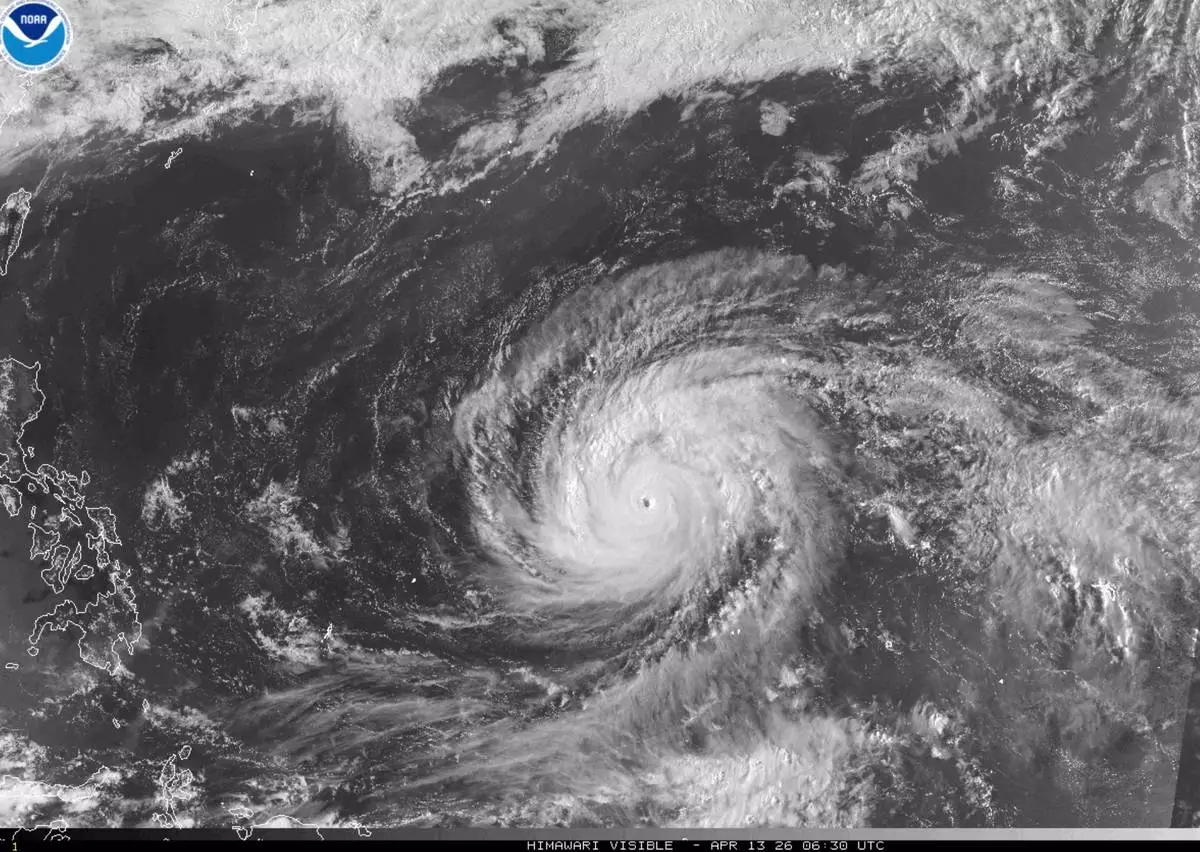
This satellite image provided by the National Oceanographic and Atmospheric Administration (NOAA) shows super typhoon Sinlakua in the Pacific Ocean, Monday, April 13, 2026. (NOAA via AP)