China's Shenzhou-21 astronauts carried out multiple in-orbit tasks in a well-organized manner, including scientific experiments, space station upkeep, equipment maintenance, and health management over the past week, according to the China Manned Space Agency (CMSA).
The crew consists of mission commander Zhang Lu and astronauts Wu Fei and Zhang Hongzhang. They have spent over three months in orbit, and are all in good condition. In the field of space medicine, the trio collected blood samples, which will be used to study the patterns of change and adaptation mechanisms in astronauts' bones, nerves, and cerebral vessels during long-duration spaceflight. Using laptops, the crew also conducted experiments related to the effects of long-term exposure to microgravity on upper and lower visual field differences and their cognitive neural mechanisms. In the realm of microgravity physical science, the three astronauts cleaned samples in non-container experimental chambers, performed electrode maintenance, cleaned lens covers, disassembled and reassembled fluid dynamics experimental modules and replaced experimental samples.
In terms of onboard environmental monitoring and equipment maintenance, they used a dew point meter to monitor the thermal environment inside the cabin and conducted air cleanliness tests. They also sorted supplies and cleaned the cabin.
For health management, the astronauts utilized devices with adsorption force to keep their leg muscles strong and completed eye, vision and optic nerve tests.
The Shenzhou-21 manned spacecraft was launched from the Jiuquan Satellite Launch Center in northwest China on Oct 31, 2025. The crew onboard completed their mission's first series of extravehicular activities on Dec 9.
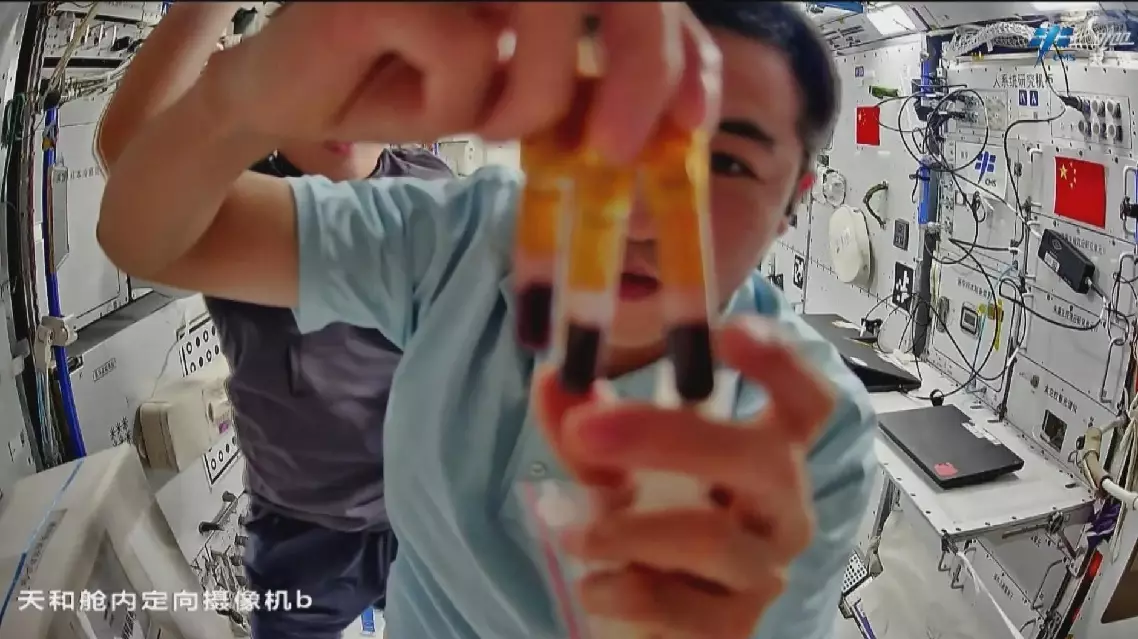
Shenzhou-21 crew proceeds with planned in-orbit tasks smoothly