SANTA FE, N.M. (AP) — A trial focused on the dangers of child sexual exploitation on social media and whether Meta misrepresented the safety of its platforms is set to start in New Mexico with opening statements Monday.
It's the first stand-alone trial from state prosecutors in a stream of lawsuits against major social media companies, including Meta, over harm to children, and one that is likely to highlight explicit online content and its effects.
New Mexico Attorney General Raúl Torrez sued Meta in 2023. His team built the case by posing as kids through social media accounts, then documenting the arrival of sexual solicitations as well as the response by Meta, the owner of Facebook, Instagram and WhatsApp.
Prosecutors say they’ll provide evidence and testimony that Meta’s algorithms and account features enticed and addicted young people to social media, while also creating a “breeding ground” for predators who target children for sexual exploitation. Prosecutors allege Meta failed to disclose what it knew about those harmful effects, in violation of state consumer protection laws. Meta also is accused of creating a public nuisance.
“Meta knowingly exposes children to the twin dangers of sexual exploitation and mental health harm,” the lawsuit states. “Meta’s motive for doing so is profit.”
Meta denies any legal violations and says prosecutors are cherry-picking evidence to make sensationalist arguments. On Sunday, Meta called the state’s investigation “ethically compromised” in its use of child photos on proxy accounts, delays in reporting child sexual abuse material and the disposal of data from devices used in the investigation, in social media posts on X by company spokesperson Andy Stone.
The company says lawsuits are attempting to place the blame for teen mental health struggles on social media companies in a way that oversimplifies matters. Meta says it has a longstanding commitment to supporting young people, highlighting a steady addition of account settings and tools — including safety features that give teens more information about the person they’re chatting with and content restrictions based on PG-13 movie ratings.
“For over a decade, we’ve listened to parents, worked with experts and law enforcement, and conducted in-depth research to understand the issues that matter most," the company said in a statement. “We’re proud of the progress we’ve made."
It's unclear whether Meta CEO Mark Zuckerberg will testify at trial. New Mexico limits the ability to compel out-of-state witnesses to testify in person, while prosecutors can present testimony by Zuckerberg from a deposition.
Personal opinions of Zuckerberg and evolving attitudes toward social media loomed over jury selection from a pool of more than 200 residents of Santa Fe County, including several educators, young adults who grew up with social media and others who never signed up.
“Quite frankly, he's the tech bro making money off of all of us," one person said of Zuckerberg.
An attorney for the state warned that there would be “very sensitive and very explicit material discussed in terms of safety to children” during the trial.
More than 40 state attorneys general have filed lawsuits against Meta, claiming it is deliberately designing features that addict children to its platforms. The majority filed their lawsuits in federal court, and New Mexico's case against Meta is the first to reach trial.
Opening statements have been postponed in a bellwether trial underway in California against social video companies, including Meta’s Instagram and Google’s YouTube, that focuses on a 19-year-old who claims her use of social media from an early age addicted her to technology and exacerbated depression and suicidal thoughts. TikTok and Snapchat parent company Snap Inc. settled claims in the case.
Torrez, a Democrat seeking reelection this year to a second term, has urged Meta to implement more effective age verification and remove bad actors from its platform. He’s also seeking changes to algorithms that can serve up harmful material and criticizing end-to-end privacy encryption that can prevent the monitoring of communications with children for safety.
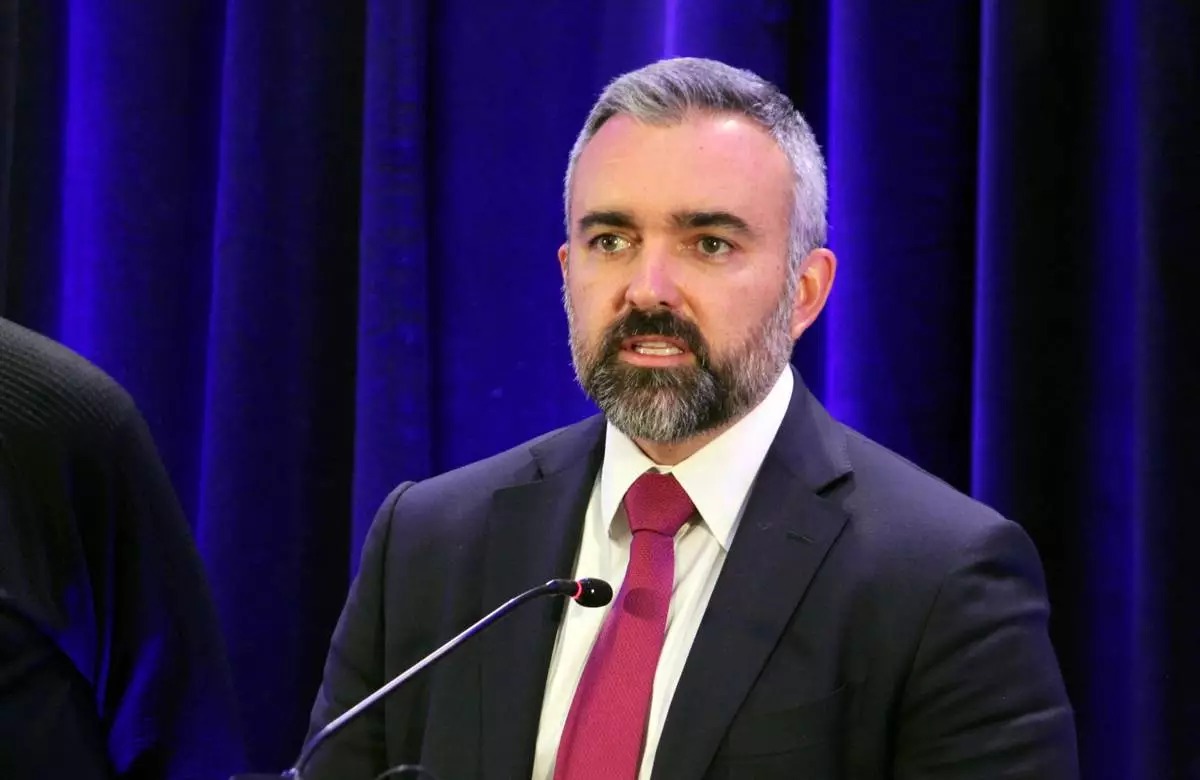
FILE - New Mexico Attorney General Raúl Torrez discusses the nexus of public safety, mental health and adverse child experiences during a news conference following a summit in Albuquerque, N.M., Nov. 3, 2023. (AP Photo/Susan Montoya Bryan, File)

FILE - Meta CEO Mark Zuckerberg speaks during an event at the Biohub Imaging Institute in Redwood City, Calif., Nov. 5, 2025. (AP Photo/Jeff Chiu, File)

FILE -A Meta logo is shown on a video screen at LlamaCon 2025, an AI developer conference, in Menlo Park, Calif., April 29, 2025. (AP Photo/Jeff Chiu, File)

CAIRO (AP) — U.S. President Donald Trump's appeal to China, France, Japan, South Korea, Britain and others to send warships to keep the Strait of Hormuz “open and safe” brought no commitments on Sunday as oil prices soar during the Iran war.
Iran's Foreign Minister Abbas Araghchi told CBS that Tehran has been “approached by a number of countries” seeking safe passage for their vessels, “and this is up to our military to decide.” He said a group of vessels from “different countries” had been allowed to pass, without providing details.
Iran has said the strait, through which one-fifth of global oil exports normally pass, is open to all except the United States and its allies.
“We don’t see any reason why we should talk with Americans” about finding a way to end the war, Araghchi added, noting that Israel and the U.S. started the fighting with coordinated attacks on Feb. 28 during indirect U.S.-Iran talks on Iran's nuclear program. Araghchi also said Tehran had “no plan to recover” enriched uranium that is under rubble following U.S. and Israeli attacks last year.
U.S. Energy Secretary Chris Wright told NBC he has been “in dialogue” with some of the countries Trump mentioned, and said he expected China “will be a constructive partner” in reopening the strait.
But countries made no promises.
A spokesperson for China’s embassy to the U.S., Liu Pengyu, said “all parties have the responsibility to ensure stable and unimpeded energy supply” and that China would “strengthen communication with relevant parties” for de-escalation.
“We are intensively looking with our allies at what can be done, because it’s so important that we get the strait reopened,” U.K. Energy Secretary Ed Miliband told Sky News, adding that ending the war is the “best and surest” way to do it.
South Korea’s Foreign Ministry said it “takes note” of Trump’s call and that it “will closely coordinate and carefully review” the situation with the U.S.
Expectations are high that Trump will ask Japan directly when Prime Minister Sanae Takaichi meets him on Thursday at the White House.
France previously said it is working with countries — President Emmanuel Macron mentioned partners in Europe, India and Asia — on a possible international mission to escort ships through the strait but has stressed it must be when “the circumstances permit,” when fighting has subsided.
Foreign Minister Johann Wadephul of Germany, which was not mentioned in Trump's call, told ARD television: “Will we soon be an active part of this conflict? No.”
Meanwhile, emergency oil stocks “will soon start flowing to global markets,” the International Energy Agency said Sunday, describing the collective action to lower prices “by far the largest ever.”
It updated last week’s announcement of 400 million barrels to nearly 412 million. Asian member countries plan to release stocks “immediately,” and reserves from Europe and the Americas will be released “from the end of March.”
Gulf Arab states including Saudi Arabia, Kuwait and Bahrain reported new missile or drone attacks a day after Iran called for the evacuation of three major ports in the United Arab Emirates — the first time it has threatened a neighboring country’s non-U.S. assets.
Tehran has accused the U.S. of launching Friday's strikes on Kharg Island, home to Iran’s primary oil terminal, from the UAE, without providing evidence. It has threatened to attack U.S.-linked “oil, economic and energy infrastructures” if its oil infrastructure is hit.
U.S. Central Command said it had no response to Iran’s claim, and Anwar Gargash, a diplomatic adviser to the UAE president, rejected it. Gulf countries that host U.S. bases have denied allowing their land or airspace to be used for military operations against Iran.
Iran has fired hundreds of missiles and drones at Arab Gulf neighbors during the war, causing significant damage and rattling economies even as most are intercepted. Tehran says it targets U.S. assets, even as Iranian strikes are reported at civilian sites such as airports and oil fields.
Iranian strikes have killed at least a dozen civilians in Gulf countries, most of them migrant workers.
In Iran, the International Committee for the Red Cross said more than 1,300 people have been killed. Iran’s Health Ministry said 223 women and 202 children are among the dead, according to Mizan, the judiciary’s official news agency.
Iran’s government on Sunday showed journalists buildings damaged by strikes in Tehran on Friday. A police station was hit and surrounding buildings were damaged. Some apartments’ outer walls had been stripped away.
“God had mercy on all of us,” said Elham Movagghari, a resident. Other Iranians are leaving the country.
In Israel, 12 people have been killed by Iranian missile fire and more have been injured, including three on Sunday. At least 13 U.S. military members have been killed, six in a plane crash in Iraq last week.
At least 820 people have been killed in Lebanon, according to its Health Ministry, since Iran-backed Hezbollah hit Israel and Israel responded with strikes and sent additional troops into southern Lebanon. In just 10 days, more than 800,000 people — nearly one out of every seven residents of Lebanon — have been displaced.
Israel said it continued to strike Iran. Iran fired missiles toward Israel.
Several strikes hit central Israel and the Tel Aviv area, where they caused damage at 23 sites and sparked a small fire. Magen David Adom, Israel’s rescue service, released video showing a large crater in a street and shrapnel damage to an apartment building.
Israel’s military says Iran is firing cluster bombs that can evade some air defenses and scatter submunitions across multiple locations.
Metz reported from Ramallah, West Bank, Frankel from Jerusalem and Anna from Lowville, New York. Associated Press journalists Sally Abou AlJoud and Fadi Tawil in Beirut, John Leicester in Paris and Fatima Hussein and Tia Goldenberg in Washington contributed to this report.
This version corrects to say Araghchi was speaking to CBS, not NBC as previously reported.
People walk past tents sheltering people displaced by Israeli airstrikes at a public space along the Beirut waterfront at sunset in Beirut, Lebanon, Sunday, March 15, 2026. (AP Photo/Hassan Ammar)
People gather outside an apartment building damaged by an Iranian missile strike in Bnei Brak, Israel, Sunday, March 15, 2026. (AP Photo/Oded Balilty)
People shout slogans during an anti U.S. and Israeli rally outside the U.S. consulate in Istanbul, Turkey, Sunday, March 15, 2026. The sign reads in Turkish: "Leave NATO, close the bases." (AP Photo/Emrah Gurel)
Heavy rain falls over tents sheltering people displaced by Israeli airstrikes in southern Lebanon and Dahiyeh, Beirut's southern suburbs, along the Beirut waterfront in Beirut, Lebanon, Sunday, March 15, 2026. (AP Photo/Hassan Ammar)
Israeli air defense system fires to intercept missiles during an Iranian attack over Tel Aviv, Israel, early Sunday, March 15, 2026. (AP Photo/Ohad Zwigenberg)
Volunteers clean debris from a residential building damaged when a nearby police station was hit Friday in a U.S.-Israeli strike in Tehran, Iran, Sunday, March 15, 2026. (AP Photo/Vahid Salemi)
A cargo ship sails in the Arabian Gulf towards Strait of Hormuz in United Arab Emirates, Sunday, March 15, 2026. (AP Photo/Altaf Qadri)
Firefighters extinguish fire at a site damaged during an Iranian missile strike in Tel Aviv, Israel, Sunday, March 15, 2026. (AP Photo/Ohad Zwigenberg)
Volunteers clean debris from a residential building damaged when a nearby police station was hit Friday in a U.S.-Israeli strike in Tehran, Iran, Sunday, March 15, 2026. (AP Photo/Vahid Salemi)
Home Front Command officer works at an apartment damaged after an Iranian strike in Bnei Brak, Israel, Sunday, March 15, 2026. (AP Photo/Oded Balilty)
Smoke rises from the rubble of buildings destroyed in an Israeli airstrike in Dahiyeh, Beirut's southern suburbs, Lebanon, Sunday, March 15, 2026. (AP Photo/Hassan Ammar)
A man photographs the rubble of buildings destroyed in an Israeli airstrike in Dahiyeh, Beirut's southern suburbs, Lebanon, Sunday, March 15, 2026. (AP Photo/Hassan Ammar)
Israeli air defense system fires to intercept missiles during an Iranian attack over Tel Aviv, Israel, early Sunday, March 15, 2026. (AP Photo/Ohad Zwigenberg)
Smoke rises from the U.S. embassy building in Baghdad, Iraq, Saturday, March 14, 2026. (AP Photo/Ali Jabar)
Mourners react during the funeral ceremony for Gen. Ali Shamkhani, secretary of Iran's Defense Council and a senior adviser to the Supreme Leader who was killed in a strike, at the courtyard of the Imamzadeh Saleh shrine in Tehran, Iran, Saturday, March 14, 2026. (AP Photo/Vahid Salemi)
Two men ride their motorbike past a billboard of the Iranian Supreme Leader Ayatollah Mojtaba Khamenei in downtown Tehran, Iran, Saturday, March 14, 2026. (AP Photo/Vahid Salemi)
Fire and plumes of smoke rise from an oil facility in Fujairah, United Arab Emirates, Saturday, March 14, 2026. (AP Photo/Altaf Qadri)
A man chants slogan while the body of Gen. Ali Shamkhani, secretary of Iran's Defense Council and a senior adviser to the Supreme Leader who was killed in a strike, is being buried at the courtyard of the Imamzadeh Saleh shrine in Tehran, Iran, Saturday, March 14, 2026. (AP Photo/Vahid Salemi)