NEW YORK (AP) — The operator of roughly 180 Eddie Bauer stores across the U.S. and Canada has filed for Chapter 11 bankruptcy protection, blaming declining sales and a litany of other industry headwinds.
The bankruptcy filing marks the third time in a little over two decades for the storied-but-now-tired brand that began as a Seattle fishing shop, later outfitted the first American to climb Mount Everest and made thousands of newfangled down jackets and sleeping bags for the military during World War II.
Eddie Bauer LLC said Monday it had entered into a restructuring pact with its secured lenders as it made the filing in the U.S. Bankruptcy Court for the District of New Jersey.
Most Eddie Bauer retail and outlet stores in the U.S. and Canada will remain open as the company winds down certain locations. It noted that it will conduct a court-supervised sales process, and if a sale can't be executed, it will begin a wind-down of its U.S. and Canadian operations.
“This is not an easy decision,” said Marc Rosen, CEO of Catalyst Brands, which maintains the license to operate Eddie Bauer stores in the U.S. and Canada. “However, this restructuring is the best way to optimize value for the retail company’s stakeholders and also ensure Catalyst Brands remains profitable and with strong liquidity and cash flow.”
Eddie Bauer’s stores outside of the U.S. and Canada are operated by other licensees, are not included in the Chapter 11 filings, and will stay open, according to the release.
Authentic Brands Group continues to own the intellectual property associated with the Eddie Bauer brand and may license the brand to other operators, the company said. The operations of other brands in the Catalyst Brands portfolio are not affected by this filing and will continue in the normal course, according to the company.
Eddie Bauer’s e-commerce and wholesale operations will also not be impacted by the wind down, as they are operated by a company called Outdoor 5, LLC. That was a transition it made in January and became effective Feb. 2.
Eddie Bauer joins a growing list of U.S. retailers this year that are closing stores, as companies reorganize under bankruptcy protection or pare down their operations to focus on the most profitable businesses.
The parent company of Saks Fifth Avenue said last month that it was seeking bankruptcy protection, buffeted by rising competition and the massive debt it took on to buy its rival in the luxury sector, Neiman Marcus, just over a year ago. A few days later, the parent company said it was closing most of its Saks Off 5th stores.
Amazon said earlier this month that it was closing almost all of its Amazon Go and Amazon Fresh locations within days as it narrows its focus on food delivery and its grocery chain, Whole Foods Market.
Eddie Bauer’s namesake founder — an avid outdoorsman — started the company in Seattle in 1920 as Bauer’s Sports Shop, according to the brand’s website. In 1945, after making more than 50,000 jackets for the military, it launched a mail-order catalog.
“Bauer’s Sports Shop was not just a place where people purchased clothing and gear, it was a community hub where folks gathered to share their wisdom, learn, and talk about their experiences in the outdoors,” the website says.
The company created an American goose-down insulated jacket, known as the “Skyliner,” in 1936, and it became the company’s first patented jacket. It also outfitted the first American to climb Mount Everest — James W. Whittaker — with an Eddie Bauer parka in 1963.
After Bauer retired in 1968 and sold the business to his partner, the outdoor brand shifted more toward casual apparel and was bought by General Mills Inc. in 1971 and then by Spiegel Inc. in 1988. After Spiegel filed for bankruptcy in 2003 and most of its assets were sold, the remainder of the company was reorganized in 2005 as Eddie Bauer Holdings Inc.
In June 2009, Eddie Bauer filed bankruptcy and was acquired by Golden State Capital, the following month. In 2021, it was acquired by Authentic Brands and SPARC Group LLC.
A year ago, Catalyst was formed by the merger of SPARC and JCPenney, which Simon Property Group and fellow mall landlord Brookfield bought out of bankruptcy.
Rosen noted that even prior to the inception of Catalyst Brands last year, Eddie Bauer was in a “challenged situation.”
“Over the past year, these challenges have been exacerbated by various headwinds, including increased costs of doing business due to inflation, ongoing tariff uncertainty, and other factors,” he said.
He noted that while Catalyst's leadership was able to make improvements in product development and marketing, those changes could not be implemented fast enough to fully address the problems created over several years.
Eddie Bauer had nearly 600 stores at its peak in 2001, according to CoStar Group Inc., a commercial real estate data firm.
In a note published earlier this month, Neil Saunders, managing director of GlobalData Retail, wrote that while the Eddie Bauer name is “well known”, the brand hasn’t kept pace with rivals like Swedish outdoor brand Fjallraven and Canadian label Arc'teryx. He also cited issues with quality deteriorating, which, for an outdoor brand measured by the performance of its products, is very problematic.
“And for many younger shoppers, the brand is seen as somewhat old-fashioned and a bit irrelevant, ” he noted.
This story has been corrected to show that Eddie Bauer outfitted the military during World War II, not World War I.
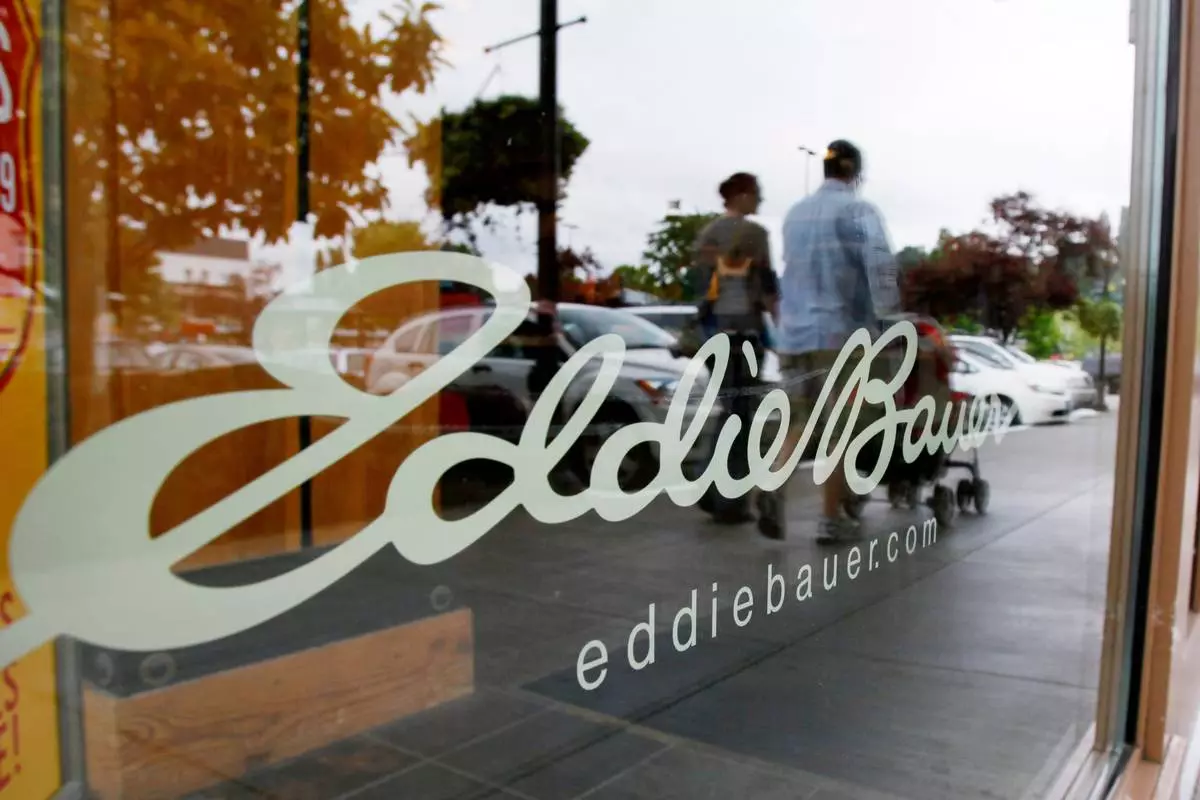
FILE - In this June 17, 2009, file photo, shoppers are reflected in the window as they walk past an Eddie Bauer store, in Seattle. (AP Photo/Elaine Thompson, File)

DUBAI, United Arab Emirates (AP) — Iran targeted the world’s busiest international airport Wednesday and attacked commercial ships as U.S. and Israeli strikes rocked Tehran, while the United Nations' most powerful body demanded a halt to the Islamic Republic’s strikes on its Gulf neighbors that threaten global oil supplies.
The latest attacks marked an escalation in Iran's campaign aimed at generating enough global economic pain to pressure the United States and Israel to end the war that started 12 days ago. But there were no signs that the conflict was letting up.
The first week of war with Iran cost the United States $11.3 billion, according to the Pentagon, which provided the estimate to Congress in a briefing earlier this week, according to a person familiar with the situation who spoke on condition of anonymity to discuss the private meeting. The military reported spending $5 billion on munitions alone in the war's first weekend.
Both sides have dug in, hoping to outlast the other as the conflict upends trade routes, chokes supplies of fuel and fertilizer coming out of the Gulf and threatens air traffic through one of the world’s most-traveled regions.
Iran has targeted oil fields and refineries in Gulf Arab nations and effectively stopped cargo traffic through the narrow Strait of Hormuz, through which a fifth of all traded oil passes.
In response, the International Energy Agency agreed to release 400 million barrels of oil, the largest volume of emergency oil reserves in its history, in a bid to counter the war's effects on energy markets. The U.S. planned to release 172 million barrels of oil next week from its Strategic Petroleum Reserve to combat steep prices.
The U.N. Security Council voted Wednesday to approve a resolution demanding a halt to Iran’s “egregious attacks” on its Gulf neighbors.
Among the most recent attacks, four people were wounded after two Iranian drones hit near Dubai International Airport in the United Arab Emirates, though flights continued, the Dubai Media Office said. Firefighters extinguished a blaze early Thursday at a luxury apartment tower in Dubai Creek Harbor after an Iranian drone strike.
Bahrain’s Ministry of Interior said Iranian-linked attacks targeted fuel tanks at a facility in Muharraq Governorate, northeast of the country’s capital, Manama, while crews at Oman’s Port of Salalah battled a blaze at fuel storage tanks there, according to the Oman News Agency.
“The international community is resolute in rejecting these Iranian attacks against sovereign countries that are threatening the stability of the peoples, especially in a region of strategic importance to global economy, energy, security and security of global trade,” said Bahrain’s U.N. ambassador, Jamal Alrowaiei.
The 13-0 vote in the U.N.’s most powerful body reflects Iran’s isolated position as it has aggressively responded to Israeli and U.S. strikes. China and Russia — two Iranian allies — abstained from the vote.
Their U.N. ambassadors called the proposal “extremely unbalanced” in not mentioning the strikes against Tehran that began the war.
Russia’s U.N. ambassador, Vassily Nebenzia, said it might leave the impression that Iran, “on its own volition and out of malice, conducted an unprovoked attack on Arab states.” Iranian U.N. Ambassador Amir Saeid Iravani said the resolution “deliberately ignores the root causes of the current crisis.”
Meanwhile, more attacks in Gulf countries were reported.
Drones were launched toward the cities of Irbil and Sulaymaniyah in Iraq’s Kurdistan region, while in the southern part of the country, an oil vessel flying the Australian flag was struck near Khor Al-Zubair Port, according to two Iraqi navy officials who also spoke on condition of anonymity because they were not authorized to comment publicly.
The official said 25 members of the crew were rescued. It was not immediately clear whether any others were missing.
On Thursday, sirens wailed and loud explosions were heard shortly after midnight in Jerusalem and other parts of Israel. The Israeli military said it was responding with another “wide-scale wave of strikes” in Tehran.
The fallout across the Middle East widened as Israel also struck what it said were targets connected to Iran-backed Hezbollah militants in Lebanon.
An Israeli strike hit a car Thursday in Ramlet al-Bayda, a major seaside tourist area on the eastern side of Beirut where dozens of displaced people have been sheltering. Seven people were killed and 21 others were wounded, the Lebanese Health Ministry said. Israel’s military did not immediately respond to a request for information.
Blasts shook Beirut’s southern suburbs Wednesday, producing fires and plumes of smoke. Israel's military said the strikes were in response to Hezbollah firing dozens of rockets fired simultaneously across northern Israel. It marked some of the heaviest fighting between the two since the war began.
One rocket hit a house near the Israeli town of Karmiel, lightly injuring two people, according to Israeli rescue services.
At least 634 people have been killed in Lebanon since the latest fighting began, the Lebanese Health Ministry said Wednesday.
The U.N. refugee agency said at least 759,000 people have been internally displaced in Lebanon.
Iranian authorities say more than 1,300 people have been killed there, and Israel has reported 12 people dead. The U.S. has lost seven soldiers while another eight have suffered severe injuries.
The United States has pledged to keep the strait open and has led intense airstrikes targeting Iran's navy and the port city of Bandar Abbas. The U.S. military said Tuesday it destroyed 16 Iranian minelayers near the strait.
At least 12 incidents involving vessels around the strait have been confirmed since fighting began, according to two global trackers, and at least seven mariners have been killed.
A projectile hit a Thai cargo ship off the coast of Oman in the strait, setting it ablaze. Authorities are searching for three missing crew members from the Mayuree Naree after 20 were rescued by the Omani navy, according to Thailand’s Marine Department.
This story has been corrected to fix a misspelling of the first name of Bahrain's U.N. ambassador.
Abou AlJoud reported from Beirut. Mascaro reported from Washington. Associated Press writer Sam Mednick in Tel Aviv, Israel, also contributed to this report, along with AP journalists around the world.
A man, left, carries the body of his son, Kassem Younis, who was killed in an Israeli airstrike, during his funeral procession in the southern village of Chehabiyeh, Lebanon, Wednesday, March 11, 2026. (AP Photo/Mohammed Zaatari)
Flames rise from an Israeli airstrike in Dahiyeh, Beirut's southern suburbs, Wednesday, March 11, 2026. (AP Photo/Hassan Ammar)
Children and adults play on swings on the beach as oil tankers and cargo ships line up in the Strait of Hormuz near Khor Fakkan, United Arab Emirates, Wednesday, March 11, 2026. (AP Photo/Altaf Qadri)
A man holds a picture of late Defense Minister Aziz Nasirzadeh beside his coffin as mourners attend the funeral procession for senior Iranian military officials and civilians killed during the U.S.-Israel campaign in Tehran, Iran, Wednesday, March 11, 2026. (AP Photo/Vahid Salemi)
A mourner holds a poster depicting Ayatollah Mojtaba Khamenei, right, the successor to his late father Ayatollah Ali Khamenei, left, as supreme leader, during the funeral procession for senior Iranian military officials and civilians killed during the U.S.-Israel campaign in Tehran, Iran, Wednesday, March 11, 2026. (AP Photo/Vahid Salemi)
Smoke rises from a building following an Israeli airstrike in Dahiyeh, Beirut's southern suburb, Wednesday, March 11, 2026. (AP Photo/Hassan Ammar)
Mourners attend the funeral procession for senior Iranian military officials and some civilians killed during the U.S.-Israel campaign, in Tehran, Iran, Wednesday, March 11, 2026. (AP Photo/Vahid Salemi)
FILE - A plume of smoke rises after a strike in Tehran, Iran, Monday, March 2, 2026. (AP Photo/Mohsen Ganji, File)

Rescue workers gather at the site where Israeli airstrikes hit apartments in Beirut, Lebanon, Wednesday, March 11, 2026. (AP Photo/Hussein Malla)

People take shelter in an underground metro station as air raid sirens warn of incoming Iranian missile strike, in Ramat Gan, Israel, Tuesday, March 10, 2026. (AP Photo/Oded Balilty)
A man passes in front of a destroyed building that housed a branch of Al-Qard Al-Hassan, a non-bank financial institution run by Hezbollah, which was hit by an Israeli airstrike in Dahiyeh, Beirut's southern suburbs, Lebanon, Tuesday, March 10, 2026. (AP Photo/Hussein Malla)
People walk past closed shops at the nearly empty traditional main bazaar in Tehran, Iran, Tuesday, March 10, 2026. (AP Photo/Vahid Salemi)
Motorbikes drive past a billboard depicting Iran’s late Supreme Leader Ayatollah Ali Khamenei, center, handing the country’s flag to his son and successor Ayatollah Mojtaba Khamenei, right, as the late revolutionary founder Ayatollah Ruhollah Khomeini stands at left, in a square in downtown Tehran, Iran, Tuesday, March 10, 2026. (AP Photo/Vahid Salemi)
Smoke rises from an Israeli airstrike in Dahiyeh, Beirut's southern suburbs, Lebanon, Tuesday, March 10, 2026. (AP Photo/Bilal Hussein)