TORONTO--(BUSINESS WIRE)--Feb 9, 2026--
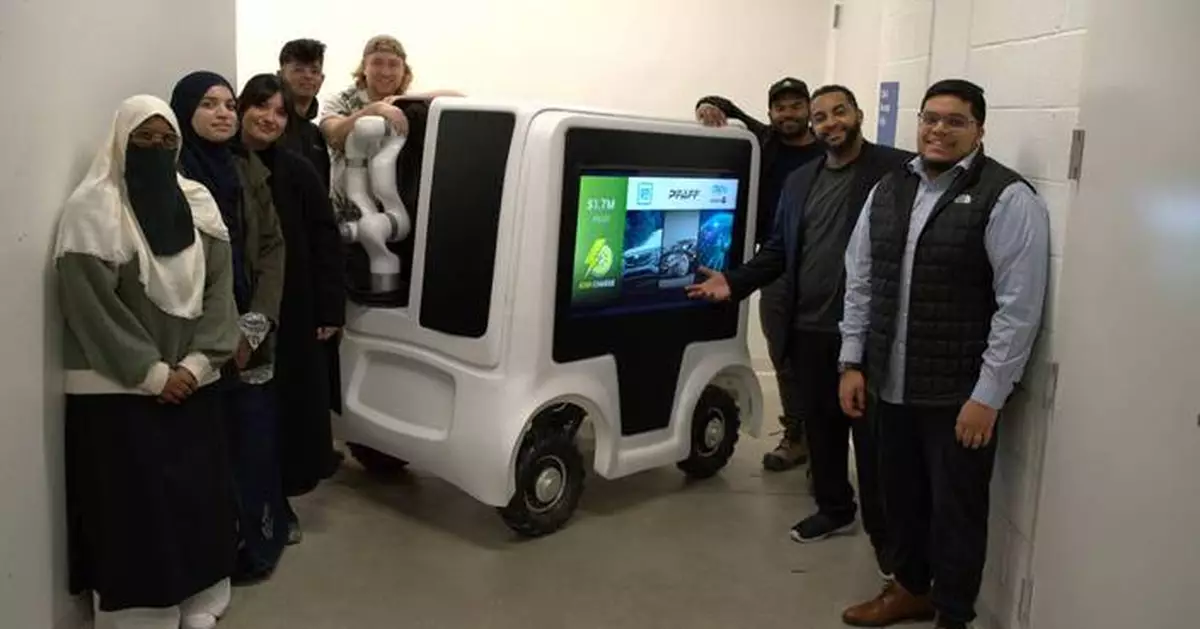
Robotics and AI startup Kiwi Charge today announced the launch of its autonomous electric vehicle (EV) charging project with the backing of the Government of Ontario through the Ontario Vehicle Innovation Network (OVIN), and support from General Motors Canada and Pfaff Automotive. The project represents a total investment of $1.7 million to fund the development of mobile EV charging solutions that combine artificial intelligence (AI), robotics, and electrification to close a critical gap in EV charging infrastructure. The investment includes a $500,000 grant through the OVIN R&D Partnership Fund and $1.2 million in funding from industry partners. As part of this milestone, Kiwi Charge will unveil the latest version of its autonomous charging robot at the Canadian International AutoShow from February 13 to 22, where it will be showcased alongside Project Arrow, Canada’s first zero-emissions concept vehicle developed by the Automotive Parts Manufacturers’ Association (APMA).
This press release features multimedia. View the full release here: https://www.businesswire.com/news/home/20260209099134/en/
The goal of the Kiwi Charge project is to develop scalable solutions that solve real-world EV charging challenges in public and private spaces such as older condominiums and rental buildings that often require costly electric upgrades and hardwired infrastructure to offer EV charging capabilities. Kiwi Charge will use the funding to rapidly prototype and test its flagship autonomous charging units, technology that would otherwise take significantly longer and more capital to bring to market. It will also enable the startup to run pilots with real estate and automotive dealership partners, hire talent, and leverage Ontario’s rapidly growing AI ecosystem to iterate quickly.
Kiwi Charge reimagining EV charging for buildings
In urban centers, 30% of EV owners live in multi-tenant buildings where installing fixed chargers is often cost-prohibitive. Kiwi Charge addresses this by combining robotic mobility, AI-based fleet intelligence, and on-demand EV charging in a compact autonomous unit. These mobile chargers operate without rewiring parking garages and can dynamically serve multiple EVs to maximize utilization and reduce grid strain. Kiwi Charge aims to make it possible to electrify older buildings faster, cheaper, and smarter in alignment with the Province of Ontario’s climate, housing, and innovation priorities.
For automotive dealerships, Kiwi Charge is developing a manual mobile unit to keep EVs charged on busy lots without disrupting operations, with the goal of increasing turnover efficiency and allowing for seamless fleet management.
Quotes
“This project is about more than just EV charging; it’s about reshaping urban infrastructure by leveraging our strength and expertise in robotics and artificial intelligence. The support we have from OVIN and our industry partners gives us the credibility and platform we need to accelerate the development of our high-impact technology that will enable buildings to leapfrog outdated models and adopt clean, flexible EV charging at scale. It’s an Ontario-made solution for a global problem.”
- Abdel Ali, CEO, Kiwi Charge
“GM Canada’s support of Kiwi Charge reflects our commitment to innovative thinking in sustainable mobility. We strive to leverage our expertise as active participants in the automotive startup ecosystem to help encourage EV adoption and improve the ownership experience.”
- Regan Dixon, Senior Manager, General Motors Canadian Technical Centres
“As the shift towards electric vehicles gains momentum around the world, Ontario continues to pioneer EV adoption and an all-electric future. By empowering homegrown companies to accelerate the journey of next-generation EV charging solutions from concept to market, our province is not only leading the EV revolution, but also bringing made-in-Ontario innovations to global value chains and unleashing their boundless economic potential.”
- Raed Kadri, Head of OVIN
“Ontario is home to some of the most exciting advancements in electric and autonomous technologies, and Kiwi Charge is a standout example of that momentum. By applying robotics, AI, and smart design to one of the biggest barriers in EV adoption, they are building a made-in-Ontario solution with global potential. OVIN is proud to support innovators who are accelerating our transition to cleaner, smarter mobility while strengthening Ontario’s leadership in EV and battery innovation."
- Claudia Krywiak, President & CEO, Ontario Centre of Innovation
About Kiwi Charge
Kiwi Charge Inc. is a Canadian robotics and AI company reimagining EV charging for buildings. Its autonomous charging robots deliver flexible, on-demand service without costly infrastructure upgrades to enable fast, affordable electrification in dense urban environments at 40% of the cost of current solutions. For additional information, visit kiwicharge.ca.
About General Motors Canada
General Motors of Canada is headquartered in Oshawa, Ontario and is part of a global company that is committed to delivering safer, better, and more sustainable ways for people to get around. In Canada, General Motors markets Chevrolet, Buick, GMC and Cadillac vehicles through our strong Canadian network of dealers, as well as OnStar services. More information can be found at www.gm.ca or by following @GMCanada on Instagram.
About OVIN
The Ontario Vehicle Innovation Network (OVIN) is an initiative of the Government of Ontario, led by the Ontario Centre of Innovation (OCI), designed to reinforce Ontario’s position as a North American leader in advanced automotive technology and smart mobility solutions such as connected vehicles, autonomous vehicles and electric and low-carbon vehicle technologies.
Though resources such as research and development (R&D) support, talent and skills development, technology acceleration, business and technical supports, and demonstration grounds, OVIN provides a competitive advantage to Ontario-made automotive and mobility technology companies.
For additional information, please visit: https://www.ovinhub.ca/
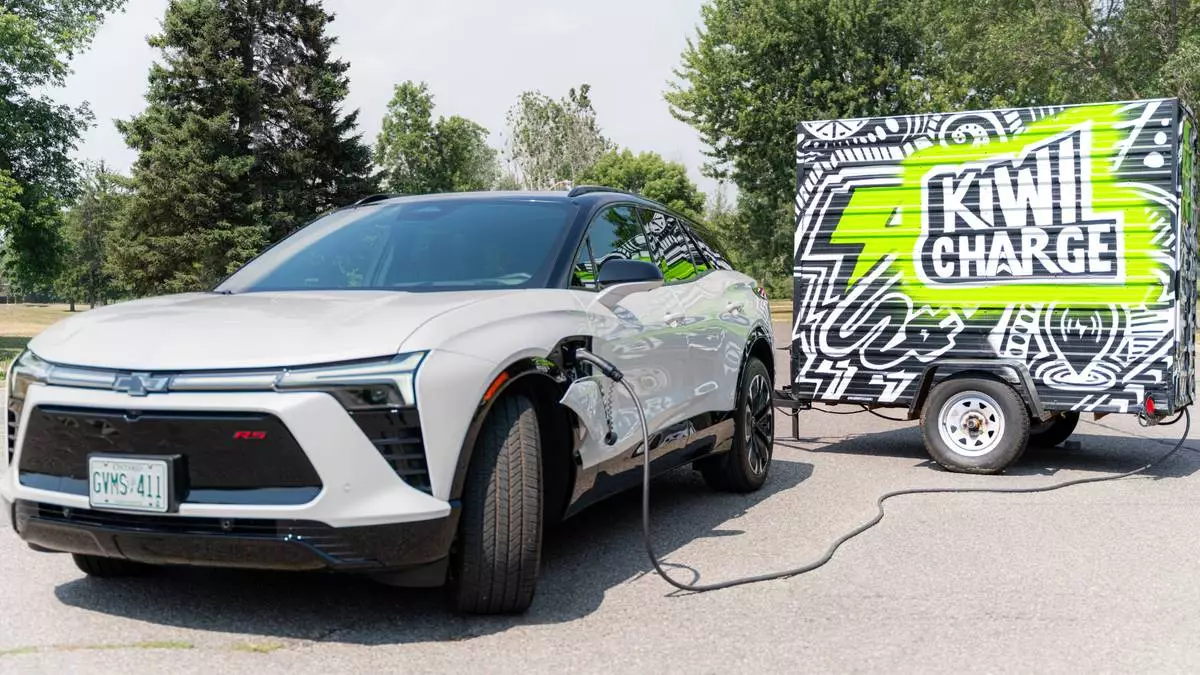
Charging the Chevrolet Blazer EV with Kiwi Charge’s innovative pop-up charging trailer
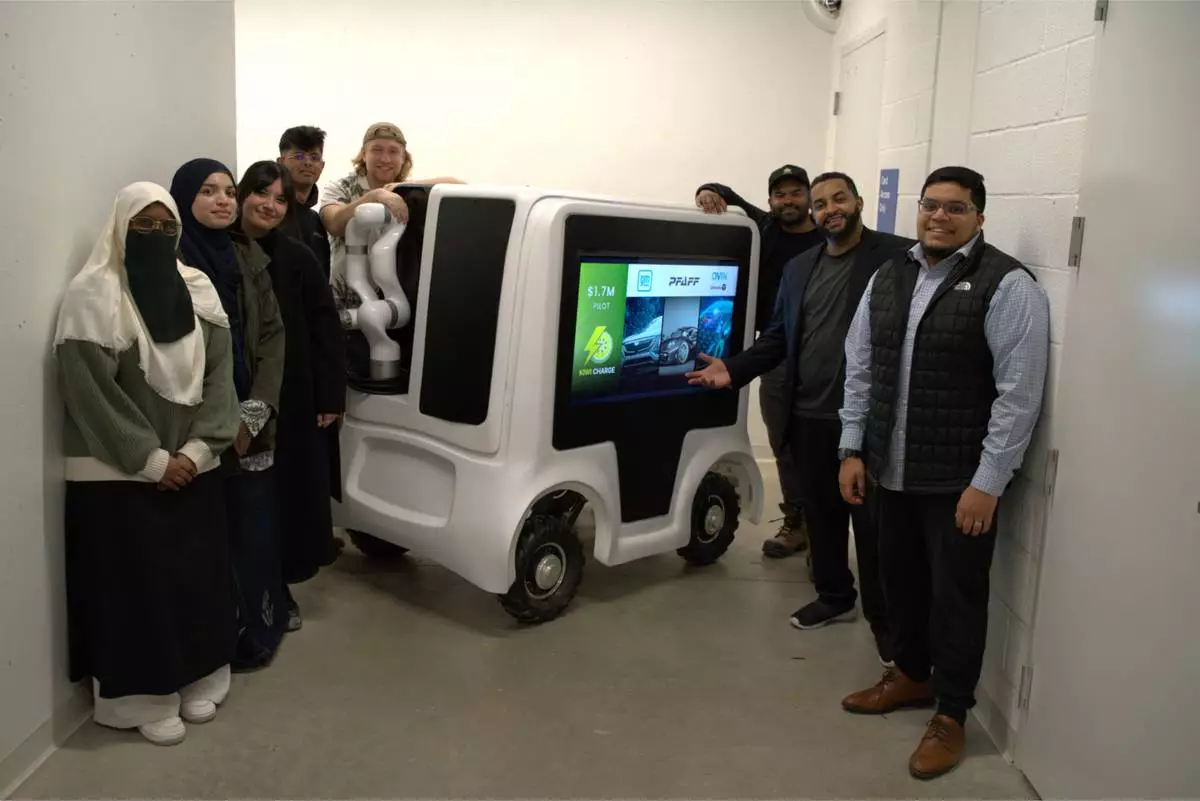
Version 2 of the Kiwi Charge Robot, pictured with the team