Foreign ministers from eight Arab and Islamic countries have condemned in the strongest terms recent "illegal" Israeli decisions and measures aimed at entrenching settlement activity and Israeli control in the West Bank.
In a joint statement, the foreign ministers of Qatar, Jordan, the United Arab Emirates, Indonesia, Pakistan, Türkiye, Egypt and Saudi Arabia reaffirmed their position that Israel has no sovereignty over occupied Palestinian territory.
They warned against the continued "expansionist Israeli policies" and illegal measures pursued by the Israeli government in the occupied West Bank, voicing "absolute rejection of these illegal actions."
The ministers said Israeli measures constitute a blatant violation of international law and undermine the two-state solution, adding that such actions also undermine the ongoing efforts for peace and stability in the region.
The statement urged the international community to fulfill its legal and moral responsibilities to compel Israel to halt its dangerous escalation in the occupied West Bank.
On Sunday, Israel's security cabinet approved several decisions aimed at altering the legal and civil status of the West Bank and strengthening Israeli control over the territory.
Among the controversial measures approved, the cabinet decided to repeal a law banning land sales to Jews, to remove the requirement for special transaction permits, and to revive a state land acquisition committee that had been inactive for about two decades.
Israel captured the West Bank and East Jerusalem in the 1967 Middle East War. The settlements it has built there and its ongoing military occupation are widely regarded as illegal under international law.
Palestinian officials have repeatedly warned that measures expanding settlements and extending Israeli civilian authority in the West Bank undermine prospects for establishing an independent Palestinian state.
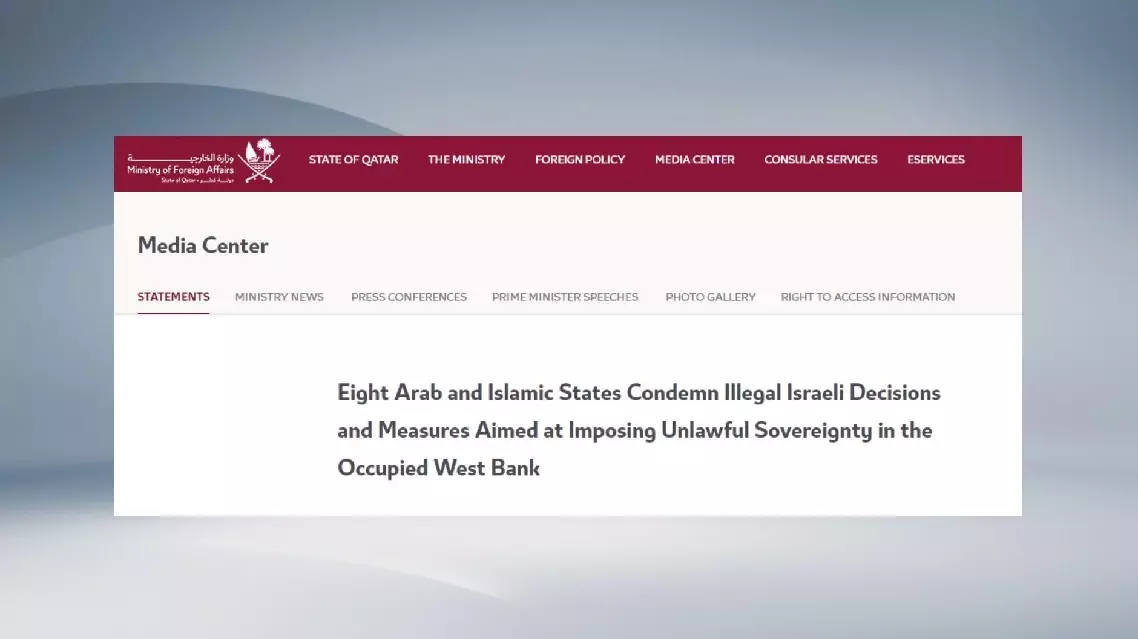
Arab, Islamic countries condemn Israeli measures to deepen control in West Bank

The recent strikes on Kharg Island have not put pressure on Iran but will affect American and European-linked oil companies, a former commander in the Islamic Revolutionary Guard Corps (IRGC) said on Saturday.
Speaking in an exclusive interview with China Global Television Network (CGTN) on Saturday, Hossein Kanani Moghaddam, who is also a military analyst, said that Iran had made preparations in advance to reduce dependence on the Strait of Hormuz, well before the U.S. strikes on Iranian islands, including the Kharg, which was targeted and hit by the U.S. forces.
"As you know, these measures date back many years; after the Iran-Iraq war, we took steps to reduce our dependence on the Strait of Hormuz and on exporting oil from the islands. To achieve this, we built oil pipelines in different regions so that we can export oil easily by land and sea without relying on the Strait of Hormuz. Even if they strike, as they have already done by attacking Abu Musa, they will gain nothing from it. On the contrary, it will intensify the oil crisis. Once the region enters into war, we have already declared that we would target all ports, as well as American banks and companies. In a way, this has given us a freer hand to take broader action, and that process has already begun," said Moghaddam.
"For this reason, they think that by striking Kharg or some of the islands, they can put pressure on us. On the contrary, all the pressure will fall on the U.S. and European-linked oil companies. That's why we face no problem in this regard. Even if they were to seize Kharg, we would respond as it is our territory, but in reality, it would not create any obstacle for our oil exports," he added.
Kharg Island lies about 25 km off Iran's northwestern Gulf coast. Roughly 6 km long and 3 km wide, it handles about 90 percent of Iran's crude exports.
The island contains storage tanks, pipelines, and deep-water jetties that allow supertankers to load crude. Many facilities are concentrated and exposed, making them vulnerable to attack.
On Friday, U.S. President Donald Trump said that the U.S. forces had carried out heavy strikes on Kharg Island while deliberately sparing its oil facilities.
Trump warned that any interference with shipping through the Strait of Hormuz, by Iran or any other party, would prompt him to "immediately reconsider" that decision, leaving open the possibility of future strikes on the island's energy infrastructure.
Striking Kharg Island only affects US, European-linked oil companies: former IRGC commander