|
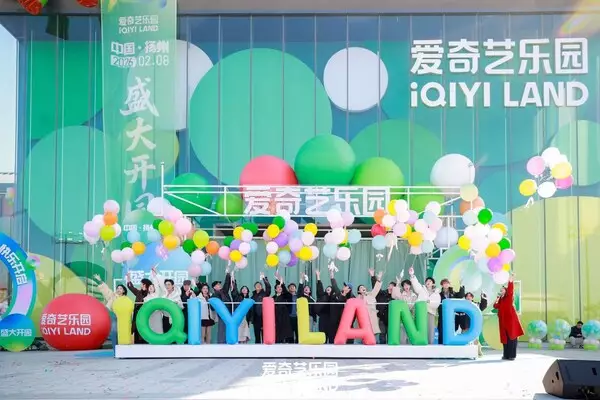
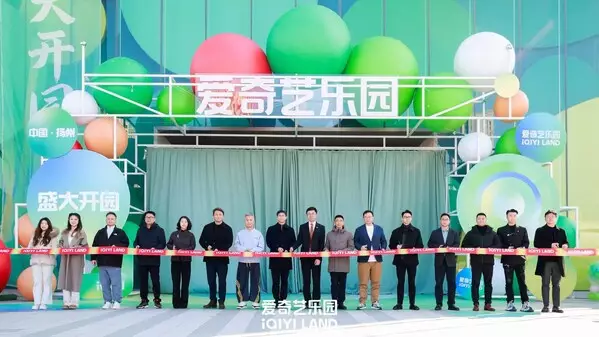
BEIJING, Feb. 10, 2026 /PRNewswire/ -- On February 8, iQIYI, China's leading online entertainment platform, officially opened iQIYI LAND, its first global offline theme park, in Yangzhou, a city in central Jiangsu Province in eastern China. As China's first immersive indoor theme park developed by a streaming platform, the launch marks a significant milestone in iQIYI's strategy to integrate technology with creativity, expand the value of its IP beyond streaming, and bring its content ecosystem to life through physical, immersive experiences.
"At iQIYI, we have spent 15 years forging emotional bonds online," said Yu GONG, Founder and CEO of iQIYI. "With iQIYI LAND, we're bringing that connection into the real world. By blending original Chinese IP with immersive technologies such as VR and AI, we are pioneering a next-generation, interactive theme park deeply tied to our content. As demand for offline entertainment surges, we see iQIYI LAND as a new driver for our long-term growth."
iQIYI executives, local partners, industry leaders, celebrities, and member representatives gathered for the opening ceremony. Leading cast members from hit dramas made surprise appearances in themed zones, bringing their on-screen stories to life. In the "Strange Tales of Tang Dynasty" zone, principal cast members engaged with visitors; in the "The Knockout"zone, one actor returned to the recreated "Old Factory Street"; and in the "Mysterious Lotus Casebook," a performer appeared on the immersive stage. Their presence marked the transformation of beloved screen narratives into interactive experiences, welcoming the park's first guests from across China.
Covering approximately 10,000 square meters, iQIYI LAND Yangzhou features a compact, high-efficiency indoor design for year-round operation and rapid IP cycles. Unlike traditional outdoor theme parks, it leverages digital production and immersive engineering to enable fast iteration and seamless content integration.
The park features seven core experience zones:
Immersive Theaters: A flagship immersive ride combining VR, motion systems, scent, wind, sound and real actors. Visitors enter story worlds such as "Strange Tales of Tang Dynasty", participating directly in plotlines through interactive missions. Fans of "Strange Tales of Tang Dynasty" relive climactic moments through original voice acting synced with motion platforms, scents, and touch effects (walking treacherous cliffs, soaring through skies, battling mythical human-faced eagle monsters).
Light-and-Shadow Spaces: A digital technology to recreate cinematic scenes such as the grasslands of "To the Wonder" or fantasy cloud worlds from "Love Between Fairy and Devil". Visitors walk inside dynamic visual environments and trigger story elements through movement.
Immersive Stage Performances: Live theatrical productions integrating LED screens, rotating stages, projections and real actors. For example, "Mysterious Lotus Casebook" features martial arts choreography and cinematic effects, blending drama and technology.
Iconic Film-and-TV Scene Photo Spots: Highly recognizable drama locations reconstructed for visitors, such as Gao Qiqiang's house from "The Knockout", Zhang Fengxia's grocery store from "To the Wonder" and Canal teahouse scenes from "Northward".
Live Character Interactions: Professional performers act as IP characters, creating surprise storylines and role-play interactions. Visitors can unlock hidden plots and experience "being inside the drama."
Social Games: Multiplayer interactive game zones and competitions projected onto LED screens creating social entertainment and spectator engagement.
IP-Exclusive Retail and Dining: Themed restaurants and merchandise shops with IP-inspired menus and limited-edition collectibles. Dining is designed as part of storytelling rather than simple food service.
iQIYI LAND aims to extend IP lifecycles and deepen fan engagement through immersive experiences and consumer products, supporting future content releases. New parks in Kaifeng, a city in eastern Henan Province in central China, and in Beijing, China's capital in the north, are in development, blending local culture with storytelling. By merging digital innovation with Chinese narratives, iQIYI is creating destinations that attract audiences beyond the screen and fuel growth in China's cultural tourism sector.
Contact:
iQIYI Press
press@qiyi.com
BEIJING, Feb. 10, 2026 /PRNewswire/ -- On February 8, iQIYI, China's leading online entertainment platform, officially opened iQIYI LAND, its first global offline theme park, in Yangzhou, a city in central Jiangsu Province in eastern China. As China's first immersive indoor theme park developed by a streaming platform, the launch marks a significant milestone in iQIYI's strategy to integrate technology with creativity, expand the value of its IP beyond streaming, and bring its content ecosystem to life through physical, immersive experiences.
"At iQIYI, we have spent 15 years forging emotional bonds online," said Yu GONG, Founder and CEO of iQIYI. "With iQIYI LAND, we're bringing that connection into the real world. By blending original Chinese IP with immersive technologies such as VR and AI, we are pioneering a next-generation, interactive theme park deeply tied to our content. As demand for offline entertainment surges, we see iQIYI LAND as a new driver for our long-term growth."
iQIYI executives, local partners, industry leaders, celebrities, and member representatives gathered for the opening ceremony. Leading cast members from hit dramas made surprise appearances in themed zones, bringing their on-screen stories to life. In the "Strange Tales of Tang Dynasty" zone, principal cast members engaged with visitors; in the "The Knockout"zone, one actor returned to the recreated "Old Factory Street"; and in the "Mysterious Lotus Casebook," a performer appeared on the immersive stage. Their presence marked the transformation of beloved screen narratives into interactive experiences, welcoming the park's first guests from across China.
Covering approximately 10,000 square meters, iQIYI LAND Yangzhou features a compact, high-efficiency indoor design for year-round operation and rapid IP cycles. Unlike traditional outdoor theme parks, it leverages digital production and immersive engineering to enable fast iteration and seamless content integration.
The park features seven core experience zones:
Immersive Theaters: A flagship immersive ride combining VR, motion systems, scent, wind, sound and real actors. Visitors enter story worlds such as "Strange Tales of Tang Dynasty", participating directly in plotlines through interactive missions. Fans of "Strange Tales of Tang Dynasty" relive climactic moments through original voice acting synced with motion platforms, scents, and touch effects (walking treacherous cliffs, soaring through skies, battling mythical human-faced eagle monsters).
Light-and-Shadow Spaces: A digital technology to recreate cinematic scenes such as the grasslands of "To the Wonder" or fantasy cloud worlds from "Love Between Fairy and Devil". Visitors walk inside dynamic visual environments and trigger story elements through movement.
Immersive Stage Performances: Live theatrical productions integrating LED screens, rotating stages, projections and real actors. For example, "Mysterious Lotus Casebook" features martial arts choreography and cinematic effects, blending drama and technology.
Iconic Film-and-TV Scene Photo Spots: Highly recognizable drama locations reconstructed for visitors, such as Gao Qiqiang's house from "The Knockout", Zhang Fengxia's grocery store from "To the Wonder" and Canal teahouse scenes from "Northward".
Live Character Interactions: Professional performers act as IP characters, creating surprise storylines and role-play interactions. Visitors can unlock hidden plots and experience "being inside the drama."
Social Games: Multiplayer interactive game zones and competitions projected onto LED screens creating social entertainment and spectator engagement.
IP-Exclusive Retail and Dining: Themed restaurants and merchandise shops with IP-inspired menus and limited-edition collectibles. Dining is designed as part of storytelling rather than simple food service.
iQIYI LAND aims to extend IP lifecycles and deepen fan engagement through immersive experiences and consumer products, supporting future content releases. New parks in Kaifeng, a city in eastern Henan Province in central China, and in Beijing, China's capital in the north, are in development, blending local culture with storytelling. By merging digital innovation with Chinese narratives, iQIYI is creating destinations that attract audiences beyond the screen and fuel growth in China's cultural tourism sector.
Contact:
iQIYI Press
press@qiyi.com
** The press release content is from PR Newswire. Bastille Post is not involved in its creation. **
iQIYI Opens First Tech-Enabled Immersive Theme Park, Bringing Chinese IP to Real Life
iQIYI Opens First Tech-Enabled Immersive Theme Park, Bringing Chinese IP to Real Life

iQIYI Opens First Tech-Enabled Immersive Theme Park, Bringing Chinese IP to Real Life
|
Announced alongside M Series Smart Assist Module launch on Kickstarter
NEW YORK, April 4, 2026 /PRNewswire/ -- Yarbo, a company focused on intelligent yard robotics, today announced the Yarbo Open Platform, a long-term initiative currently under development and planned for release in early 2027. Designed to expand Yarbo's modular yard robot system across both software and hardware, the platform is intended to support deeper customization, broader smart home connectivity, and new forms of user and developer-driven functionality over time. The announcement coincides with the launch of the Smart Assist Module (SAM) for the M Series on Kickstarter.
The Open Platform is not available today. Instead, it reflects Yarbo's roadmap for how its ecosystem may evolve over time, including a three-layer software architecture built around an Open API, SDK, and no-code Automation Editor, as well as a hardware expansion framework designed to support future user-built and developer-built modules.
A Structured Approach to Software Integration and Automation
The Yarbo Open Platform is structured to accommodate different levels of technical expertise, from everyday users to experienced developers. It is designed to provide multiple entry points into the Yarbo ecosystem, enabling both software-driven automation and hardware-level expansion.
On the software side, the platform consists of three layers:
- Yarbo Open API — intended to enable connectivity between Yarbo devices and external platforms, allowing them to participate in broader home automation scenarios.
- Yarbo SDK — a set of development tools, including code libraries and documentation, designed for developers building custom features or integrations.
- Yarbo Automation Editor — a visual, drag-and-drop interface within the Yarbo app that allows users to create automation workflows without writing code.
Together, these components are intended to make automation accessible to a wide range of users, while also supporting more advanced development use cases.
The platform is also designed to support compatibility with widely used smart home ecosystems, including Home Assistant, Google Home, and Amazon Alexa, enabling users to incorporate Yarbo into existing connected home setups.
Extending Capability Through Hardware
In addition to software capabilities, the Open Platform introduces a hardware expansion approach designed to extend Yarbo's functionality beyond its existing modules.
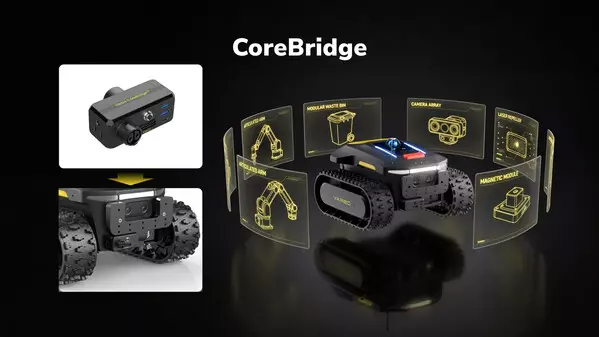
At the center of this is CoreBridge, a standardized hardware interface currently in development that is intended to provide access to Yarbo's mechanical mounting points, power system, and data connections. It is designed to support third-party development and user-built extensions, allowing new types of functionality beyond pre-defined modules.
One example of this extensibility is an electromagnet-based module, which can be attached via CoreBridge to enable Yarbo to latch onto and move objects such as garbage bins. In a potential use scenario, this could enable automated movement of a bin to the curb on collection day and its return afterward.
This combination of software and hardware openness reflects an effort to expand the role of outdoor robotics beyond fixed-function devices.
Smart Assist Module Launch on Kickstarter
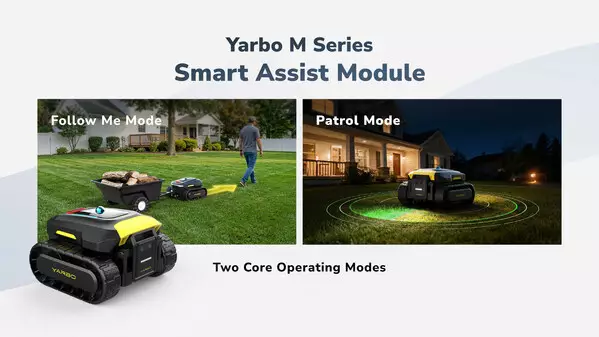
Alongside the Open Platform announcement, Yarbo is launching the Smart Assist Module (SAM) for the M Series on Kickstarter.
The module introduces two primary features designed to expand how users interact with their yard robot in everyday use:
- Follow Me Mode — enabling Yarbo to move alongside the user while carrying tools or materials, reducing the need for manual transport during yard work.
- Patrol Mode — allowing Yarbo to move along customizable routes around the property, with features such as remote live view, app-based alerts, and optional audio notifications via its built-in speaker, providing an added layer of awareness and convenience for users managing outdoor spaces.
The Smart Assist Module is positioned as part of Yarbo's broader effort to extend the practical use cases of its modular system.
Looking Ahead
The Yarbo Open Platform is planned for release in early 2027 and is being developed to support both the Y Series and M Series. By introducing a framework that combines software integration, developer tools, and hardware extensibility, Yarbo aims to enable a broader range of applications while allowing users to define how the system evolves over time.
Further details will be shared as development progresses.
About Yarbo
Yarbo is defining a new category of outdoor robotics with its Modular Yard Robot. Known for its automated snow blower robots, Yarbo introduced a modular system designed for year-round use. Powered by a single intelligent core unit, the system supports interchangeable modules for mowing, leaf blowing, snow clearing, and more—creating a more efficient approach to outdoor maintenance for homeowners.
Announced alongside M Series Smart Assist Module launch on Kickstarter
NEW YORK, April 4, 2026 /PRNewswire/ -- Yarbo, a company focused on intelligent yard robotics, today announced the Yarbo Open Platform, a long-term initiative currently under development and planned for release in early 2027. Designed to expand Yarbo's modular yard robot system across both software and hardware, the platform is intended to support deeper customization, broader smart home connectivity, and new forms of user and developer-driven functionality over time. The announcement coincides with the launch of the Smart Assist Module (SAM) for the M Series on Kickstarter.
The Open Platform is not available today. Instead, it reflects Yarbo's roadmap for how its ecosystem may evolve over time, including a three-layer software architecture built around an Open API, SDK, and no-code Automation Editor, as well as a hardware expansion framework designed to support future user-built and developer-built modules.
A Structured Approach to Software Integration and Automation
The Yarbo Open Platform is structured to accommodate different levels of technical expertise, from everyday users to experienced developers. It is designed to provide multiple entry points into the Yarbo ecosystem, enabling both software-driven automation and hardware-level expansion.
On the software side, the platform consists of three layers:
- Yarbo Open API — intended to enable connectivity between Yarbo devices and external platforms, allowing them to participate in broader home automation scenarios.
- Yarbo SDK — a set of development tools, including code libraries and documentation, designed for developers building custom features or integrations.
- Yarbo Automation Editor — a visual, drag-and-drop interface within the Yarbo app that allows users to create automation workflows without writing code.
Together, these components are intended to make automation accessible to a wide range of users, while also supporting more advanced development use cases.
The platform is also designed to support compatibility with widely used smart home ecosystems, including Home Assistant, Google Home, and Amazon Alexa, enabling users to incorporate Yarbo into existing connected home setups.
Extending Capability Through Hardware
In addition to software capabilities, the Open Platform introduces a hardware expansion approach designed to extend Yarbo's functionality beyond its existing modules.
At the center of this is CoreBridge, a standardized hardware interface currently in development that is intended to provide access to Yarbo's mechanical mounting points, power system, and data connections. It is designed to support third-party development and user-built extensions, allowing new types of functionality beyond pre-defined modules.
One example of this extensibility is an electromagnet-based module, which can be attached via CoreBridge to enable Yarbo to latch onto and move objects such as garbage bins. In a potential use scenario, this could enable automated movement of a bin to the curb on collection day and its return afterward.
This combination of software and hardware openness reflects an effort to expand the role of outdoor robotics beyond fixed-function devices.
Smart Assist Module Launch on Kickstarter
Alongside the Open Platform announcement, Yarbo is launching the Smart Assist Module (SAM) for the M Series on Kickstarter.
The module introduces two primary features designed to expand how users interact with their yard robot in everyday use:
- Follow Me Mode — enabling Yarbo to move alongside the user while carrying tools or materials, reducing the need for manual transport during yard work.
- Patrol Mode — allowing Yarbo to move along customizable routes around the property, with features such as remote live view, app-based alerts, and optional audio notifications via its built-in speaker, providing an added layer of awareness and convenience for users managing outdoor spaces.
The Smart Assist Module is positioned as part of Yarbo's broader effort to extend the practical use cases of its modular system.
Looking Ahead
The Yarbo Open Platform is planned for release in early 2027 and is being developed to support both the Y Series and M Series. By introducing a framework that combines software integration, developer tools, and hardware extensibility, Yarbo aims to enable a broader range of applications while allowing users to define how the system evolves over time.
Further details will be shared as development progresses.
About Yarbo
Yarbo is defining a new category of outdoor robotics with its Modular Yard Robot. Known for its automated snow blower robots, Yarbo introduced a modular system designed for year-round use. Powered by a single intelligent core unit, the system supports interchangeable modules for mowing, leaf blowing, snow clearing, and more—creating a more efficient approach to outdoor maintenance for homeowners.
** This press release is distributed by PR Newswire through automated distribution system, for which the client assumes full responsibility. **
Yarbo Introduces Open Platform Strategy, Opening Its Robotics System to Developers and Smart Home Ecosystems
Yarbo Introduces Open Platform Strategy, Opening Its Robotics System to Developers and Smart Home Ecosystems