WASHINGTON (AP) — Congressional leaders said Tuesday that a deal was still possible with the White House on Homeland Security Department funding before it expires this weekend. But the two sides were still far apart as Democrats demanded new restrictions on President Donald Trump’s immigration crackdown.
After federal agents fatally shot two protesters in Minneapolis last month, Democrats say U.S. Immigration and Customs Enforcement needs to be “dramatically” reined in and are prepared to let Homeland Security shut down if their demands aren't met. On Tuesday, Senate Democratic Leader Chuck Schumer and House Democratic Leader Hakeem Jeffries said they had rejected a White House counteroffer that “included neither details nor legislative text” and does not address “the concerns Americans have about ICE’s lawless conduct.”
“We simply want ICE to follow the same standards that most law enforcement agencies across America already follow,” Schumer said Tuesday. “Democrats await the next answer from our Republican counterparts.”
The Democrats’ rejection of the Republican counteroffer comes as time is running short, with a shutdown of the Homeland Security Department threatening to begin Saturday. Among the Democrats’ demands are a requirement for judicial warrants, better identification of DHS officers, new use-of-force standards and a stop to racial profiling.
Finding agreement on the charged, partisan issue of immigration enforcement will be exceedingly difficult. But even as lawmakers in both parties were skeptical, a White House official said that the administration was having constructive talks with both Republicans and Democrats. The official, granted anonymity to speak about ongoing deliberations, stressed that Trump wanted the government to remain open and for Homeland Security services to be funded.
Senate leaders also expressed some optimism.
“There’s no reason we can’t do this” by the end of the week, Senate Democratic Leader Chuck Schumer said after meeting with his caucus on Tuesday.
Senate Majority Leader John Thune, R-S.D., said there have been “some really productive conversations.”
Schumer and Jeffries have said they want immigration officers to remove their masks, to show identification and to better coordinate with local authorities. They have also demanded a stricter use-of-force policy for the federal officers, legal safeguards at detention centers and a prohibition on tracking protesters with body-worn cameras.
Among other asks, Democrats say Congress should end indiscriminate arrests, “improve warrant procedures and standards,” ensure the law is clear that officers cannot enter private property without a judicial warrant and require that before a person can be detained, it’s verified that the person is not a U.S. citizen.
Democrats made the demands for new restrictions on ICE and other federal law enforcement after ICU nurse Alex Pretti was shot and killed by a U.S. Border Patrol officer in Minneapolis on Jan. 24, and some Republicans suggested that new restrictions were necessary. Renee Good was shot by ICE agents on Jan. 7.
Many Democrats said they won’t vote for another penny of Homeland Security funding until enforcement is radically scaled back.
“Dramatic changes are needed at the Department of Homeland Security before a DHS funding bill moves forward,” Jeffries said. “Period. Full stop.”
Jeffries said Tuesday that the White House’s offer “walked away from” their proposals for better identification of ICE agents, for more judicial warrants and for a prohibition on excessive use of force. Republicans also rejected their demand for an end to racial or ethnic profiling, Jeffries said.
“The White House is not serious at this moment in dramatically reforming ICE,” Jeffries said.
Republican lawmakers have also pushed back on the requests. Oklahoma Sen. Markwayne Mullin, a close ally of Trump, said Tuesday that he’s willing to discuss more body cameras and better training — both of which are already in the Homeland spending bill — but that he would reject the Democrats’ most central demands.
“They start talking about judicial warrants? No. They start talking about demasking them? No, not doing that. They want them to have a photo ID with their name on it? Absolutely not,” Mullin said.
Republicans have said ICE agents should be allowed to wear masks because they are more frequently targeted than other law enforcement officials.
“People are doxing them and targeting them,” said House Speaker Mike Johnson, R-La., on Monday. “We’ve got to talk about things that are reasonable and achievable.”
Some Republicans also have demands of their own, including the addition of legislation that would require proof of citizenship before Americans register to vote and restrictions on cities that they say do not do enough to crack down on illegal immigration.
At a House hearing on Tuesday, the acting director of ICE, Todd Lyons, said his agency is “only getting started” and would not be intimidated as his officers carry out Trump's mass deportation agenda.
Congress is trying to renegotiate the DHS spending bill after Trump agreed to a Democratic request that it be separated out from a larger spending measure that became law last week and congressional Republicans followed his lead. That package extended Homeland Security funding at current levels only through Feb. 13, creating a brief window for action as the two parties discuss new restrictions on ICE and other federal officers.
But even as he agreed to separate the funding, Trump has not publicly responded to the Democrats’ specific asks or suggested any areas of potential compromise.
White House press secretary Karoline Leavitt said late last week that the Trump administration is willing to discuss some items on the Democrats’ list, but “others don’t seem like they are grounded in any common sense, and they are nonstarters for this administration.”
Thune said Tuesday that “there are certain red lines that I think both sides have, things they are not going to negotiate on, but there are some things they are going to negotiate on, and that's where I think the potential deal space is here.”
It was, so far, unclear what those issues were.
“We are very committed to making sure that federal law enforcement officers are able to do their jobs and to be safe doing them,” Thune said of Republicans.
In addition to ICE and U.S. Customs and Border Protection, the homeland security bill includes funding for the Federal Emergency Management Agency and the Transportation Security Administration, among other agencies. If DHS shuts down, Thune said last week, “there’s a very good chance we could see more travel problems” similar to the 43-day government closure last year.
Thune has said Republicans will try to pass a two- to four-week extension of the Homeland Security funding while negotiations continue.
Many Democrats are unlikely to vote for another extension. But Republicans could potentially win enough votes in both chambers from Democrats if they feel hopeful about negotiations.
“The ball is in the Republicans’ court,” Jeffries said Monday.
Associated Press writers Matt Brown, Joey Cappelletti and Lisa Mascaro contributed to this report.
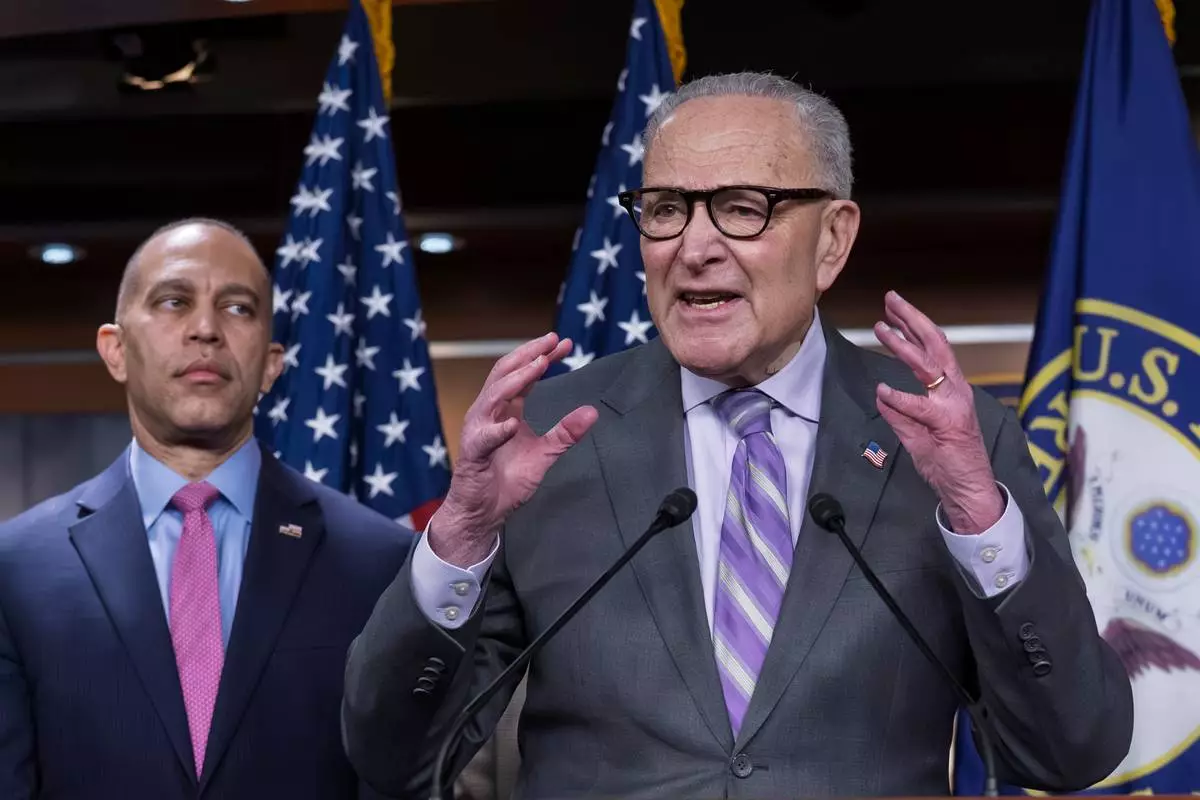
Senate Minority Leader Chuck Schumer, D-N.Y., center, speaks during a news conference as House Minority Leader Hakeem Jeffries, D-N.Y. listens, at the Capitol in Washington, Wednesday, Feb. 4, 2026. (AP Photo/J. Scott Applewhite)