New York (AP) — To better understand some of the significance of Bad Bunny's historic Super Bowl halftime performance on Sunday night, start at the end.
“God Bless America,” were the first and few English-language words uttered by the Spanish-language performer, who then proceeded to list countries in the Americas, including the United States and Canada. Behind him, a screen read: “The only thing more powerful than hate is love,” a direct reference to his speech at the 2026 Grammy Awards where the Puerto Rican superstar took home the top prize.
Click to Gallery
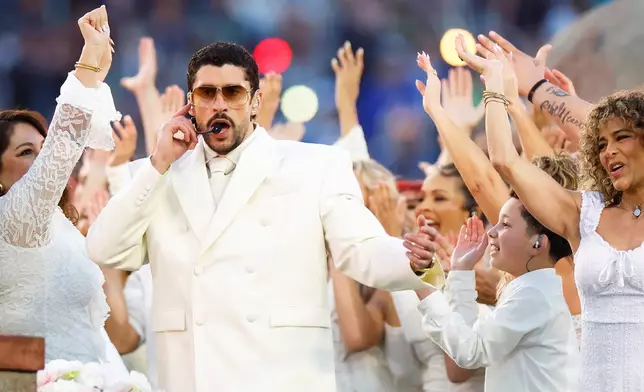
Bad Bunny performs during the halftime show of Super Bowl 60 between the Seattle Seahawks and New England Patriots in Santa Clara, Calif., Sunday, Feb. 8, 2026. (Carlos Avila Gonzalez/San Francisco Chronicle via AP)
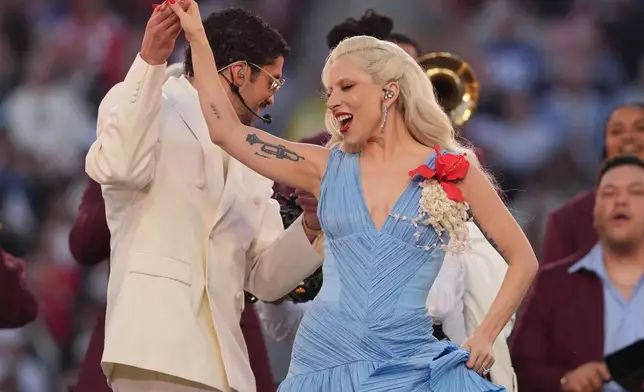
Bad Bunny and Lady Gaga perform during halftime of the NFL Super Bowl 60 football game between the New England Patriots and the Seattle Seahawks, Sunday, Feb. 8, 2026, in Santa Clara, Calif. (AP Photo/Matt Slocum)
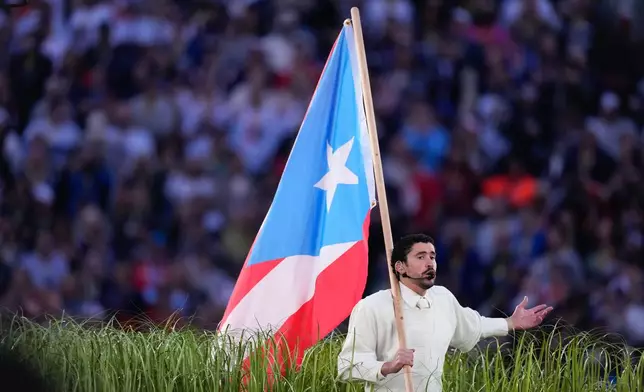
Bad Bunny performs during halftime of the NFL Super Bowl 60 football game between the New England Patriots and the Seattle Seahawks, Sunday, Feb. 8, 2026, in Santa Clara, Calif. (AP Photo/Mark J. Terrill)
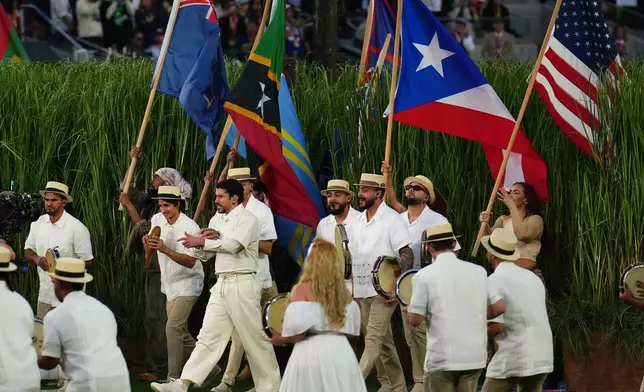
Bad Bunny performs during halftime of the NFL Super Bowl 60 football game between the New England Patriots and the Seattle Seahawks, Sunday, Feb. 8, 2026, in Santa Clara, Calif. (AP Photo/Godofredo A. Vásquez)
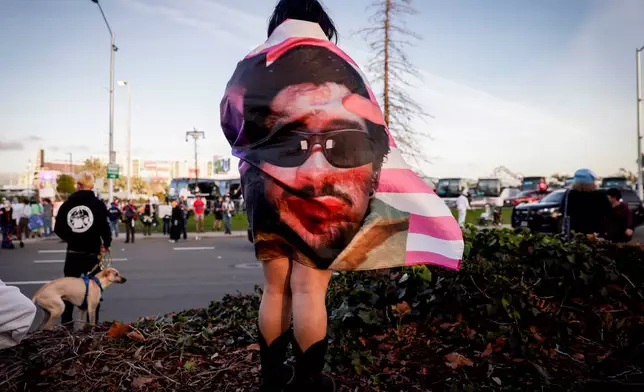
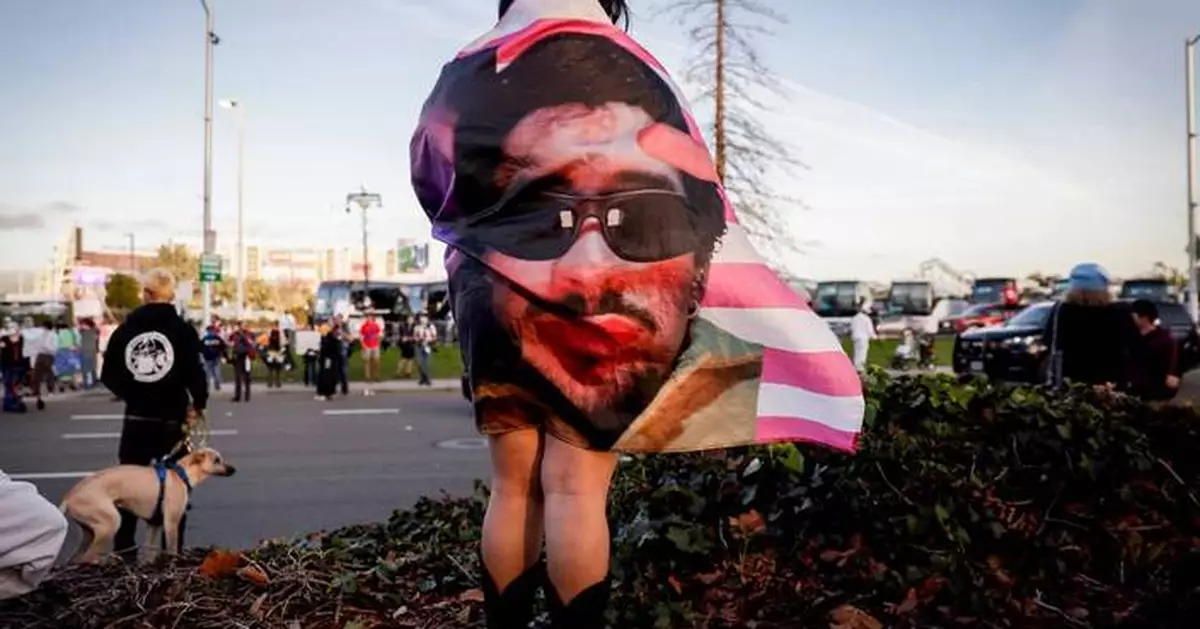
Kenia Medal wears a Bad Bunny flag while waiting to watch the halftime show outside Levi's Stadium during the NFL Super Bowl 60 football game between the Seattle Seahawks and the New England Patriots in Santa Clara, Calif., Sunday, Feb. 8, 2026. (Brontë Wittpenn/San Francisco Chronicle via AP)
America, he seemed to be reminding his global audience including viewers in the U.S., makes up a number of countries in the Western Hemisphere.
It was a poignant gesture for an artist whose performance was politicized the moment it was announced, labeled un-American by his detractors despite the fact that Puerto Ricans are U.S. citizens. Most recently President Donald Trump described his set as “an affront to the Greatness of America.”
In the final moments of his performance, Bad Bunny was joined by a crowd waving flags of different countries in the Americas, but also “territories of other countries like Bonaire or the U.S. Virgin Islands, ” said Petra Rivera-Rideau, associate professor of American studies at Wellesley College and co-author of “P FKN R: How Bad Bunny Became the Global Voice of Puerto Rican Resistance.”
He was also surrounded by plena musicians — a Puerto Rican genre associated with community and protest — and held a football that read, “Together, we are America.”
“This is a really profound statement of Latino belonging in the United States and immigrant belonging in the United States,” Rivera-Rideau said. “Bad Bunny is obviously very aware of the backlash against this halftime show. And a lot of that backlash has to do with this assumption that because it’s in Spanish, it’s somehow excluding people. And I think what we saw last night with Bad Bunny’s halftime show is that he was actually including people, inviting people into his world and at the same time, making a case that immigrants and Latinos are as much a fabric of the United States as anything else.”
Simultaneously, he made the argument for “America” as a larger, hemispheric identity.
“He is trying to reframe America as this continent-spanning container,” said Reanna Cruz, music critic and senior producer for Vox Media’s music podcast Switched on Pop. “The main takeaway I have from the performance is the highlight of community. … If we have nothing else in times of hardship, we have community and we have joy, and a way to access that is to not shut out your fellow humans in whatever country it may be. The reframing of America as something that spans half the globe is really radical.”
There's a long history of that idea. “Everyone from Rubén Lárez to Los Tigres del Norte have created songs that have used this idea of all of the Americas coming together … of America being a kind of a cohesive unit,” said Rivera-Rideau. “But I think what it really boils down to is a statement that Latinos, Latin Americans, Caribbean people, immigrants, they belong and they’re just as American as anybody else.”
“He’s presenting a very capacious definition of what it is to be American,” said Christopher Campo-Bowen, assistant professor of musicology at Virginia Tech. “And within that, the idea of Puerto Rican sovereignty.
“He is presenting everything that he finds that makes Puerto Rico unique. And what makes Puerto Rico an autonomy culture and actor in the hemisphere — and presenting it all at once — and then also broadcasting this unifying message of ‘We are all Americans,'” he added. “He’s encouraging us all to recognize that uniqueness but not to let that difference become a source of enmity or hatred.”
Puerto Ricans are Americans in both ways Bad Bunny’s show explored — they are U.S. citizens, and the island nation is situated in the Americas. But it is complicated: Puerto Ricans are U.S. citizens no matter where they are born and have been since 1917. But Puerto Ricans who live on the island have limited citizenship rights; they cannot vote for President, they have no representation in Congress and they can be drafted into the military.
“What it boils down to is that Puerto Rico is a territory,” said Rivera-Rideau, an idea she says Bad Bunny explored when he waved the Puerto Rican flag with a light blue triangle, a color repeated on Lady Gaga's dress.
“That’s considered the original Puerto Rican flag. And once the U.S. takes over Puerto Rico in 1898, they change the color blue to match the U.S. flag. And so that light blue color on the Puerto Rican flag has become affiliated with Puerto Rican independence,” she explained. “So, I think we saw him commenting on this colonial relationship at the same time that he’s insisting on full recognition in the United States as a Latino, as an American, in the continental sense. Both things are happening in that halftime show.”
That is also reflected in the music of Puerto Rico, and of course, Bad Bunny. Think of the genre salsa as an example, which “represents the kind of unique status of Puerto Rico vis-a-vis the mainland United States, in that salsa would not have been possible without this relationship,” said Campo-Bowen. He noted that in the late 1940s and early '50s, Puerto Ricans migrated to New York in large numbers because of massive changes on the island. "They start communities there, encounter other people from Latin America, and then salsa comes about out of that mixture.
“It is based in the long history of colonialism and that carries those issues with it. But despite that, Puerto Rico has developed this unique culture with these unique musical signifiers which Bad Bunny is more than happy to draw on and celebrate.”
Bad Bunny's “God Bless America” contrasts certain conservative messaging of American identity. Consider the fact that there was an alternative halftime performance, organized by Turning Point USA and headlined by Kid Rock, called the “all-American Halftime show.”
“Bad Bunny turns this upside down and he says, ‘No, ‘God bless America’ and ‘America’ is all of these Latin American and Caribbean nations and the U.S. and Canada. We're all a part of it,” said Vanessa Díaz, associate professor of Chicano and Latino studies at Loyola Marymount University and co-author of “P FKN R.”
“It was about unity, but it was also about staking Latinos' claim in this country,” she said, particularly in a charged political moment as Trump’s immigration policies and executive actions have vastly expanded who is eligible for deportation, routine hearings have turned into deportation traps for migrants, detentions are prolonged and opposition for the Trump administration’s immigration crackdown grows.
In her view, Bad Bunny's performance was “profoundly political” — just as it was when he said “ICE Out” at the 2026 Grammys — but on this stage, for its message of joy and unity.
“It was wildly imaginative and extremely educational. And yet we had fun and we danced and we cried,” Díaz said of the performance. “It was Bad Bunny at his best, being super specific about his homeland and its history and also welcoming people in to let themselves see themselves reflected in Puerto Rican culture and history.”
“Joy is resistance and dancing is resistance,” Cruz said. “For people in the Latino community, the show is very clear in how political it is.”
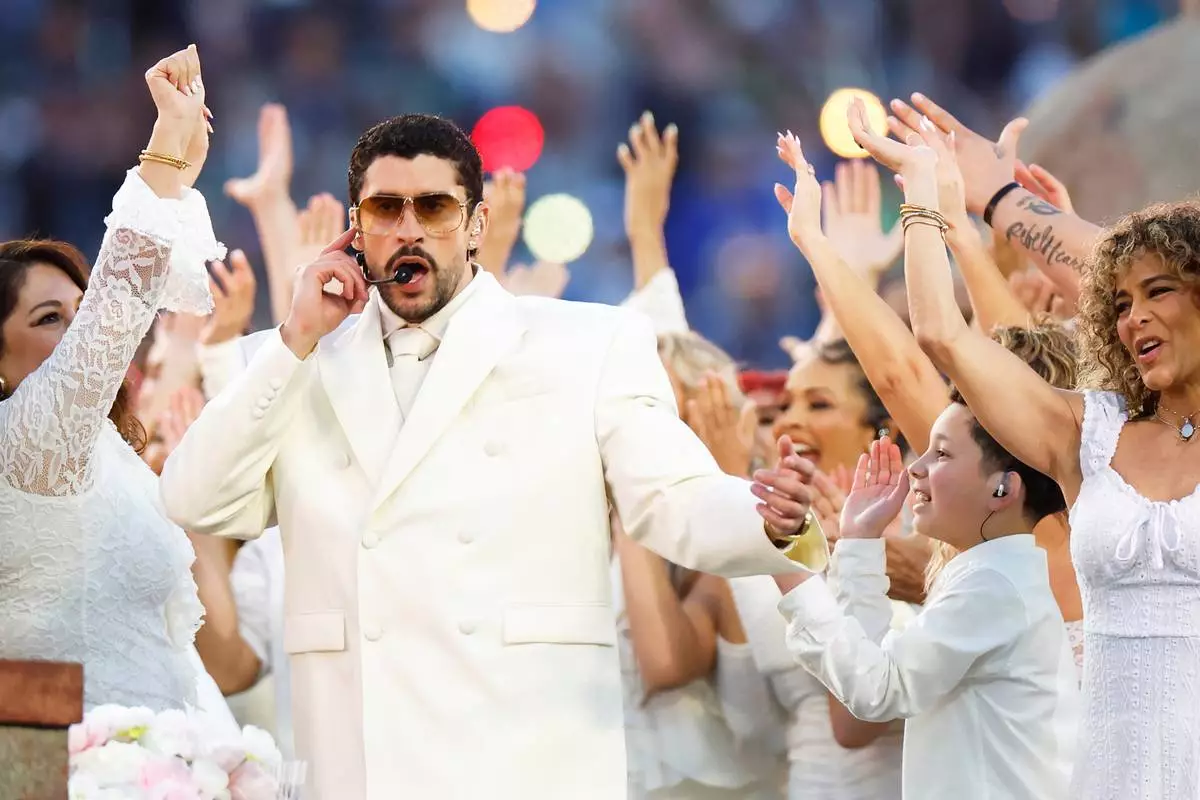
Bad Bunny performs during the halftime show of Super Bowl 60 between the Seattle Seahawks and New England Patriots in Santa Clara, Calif., Sunday, Feb. 8, 2026. (Carlos Avila Gonzalez/San Francisco Chronicle via AP)
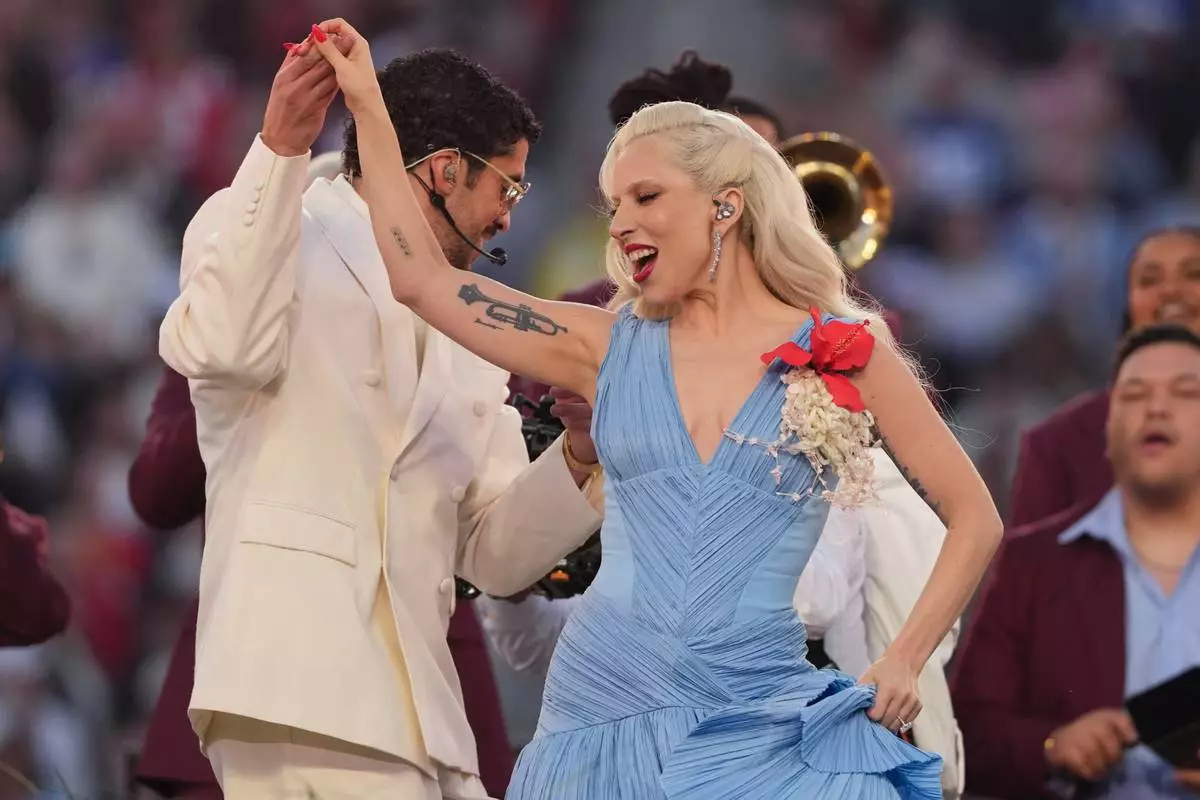
Bad Bunny and Lady Gaga perform during halftime of the NFL Super Bowl 60 football game between the New England Patriots and the Seattle Seahawks, Sunday, Feb. 8, 2026, in Santa Clara, Calif. (AP Photo/Matt Slocum)
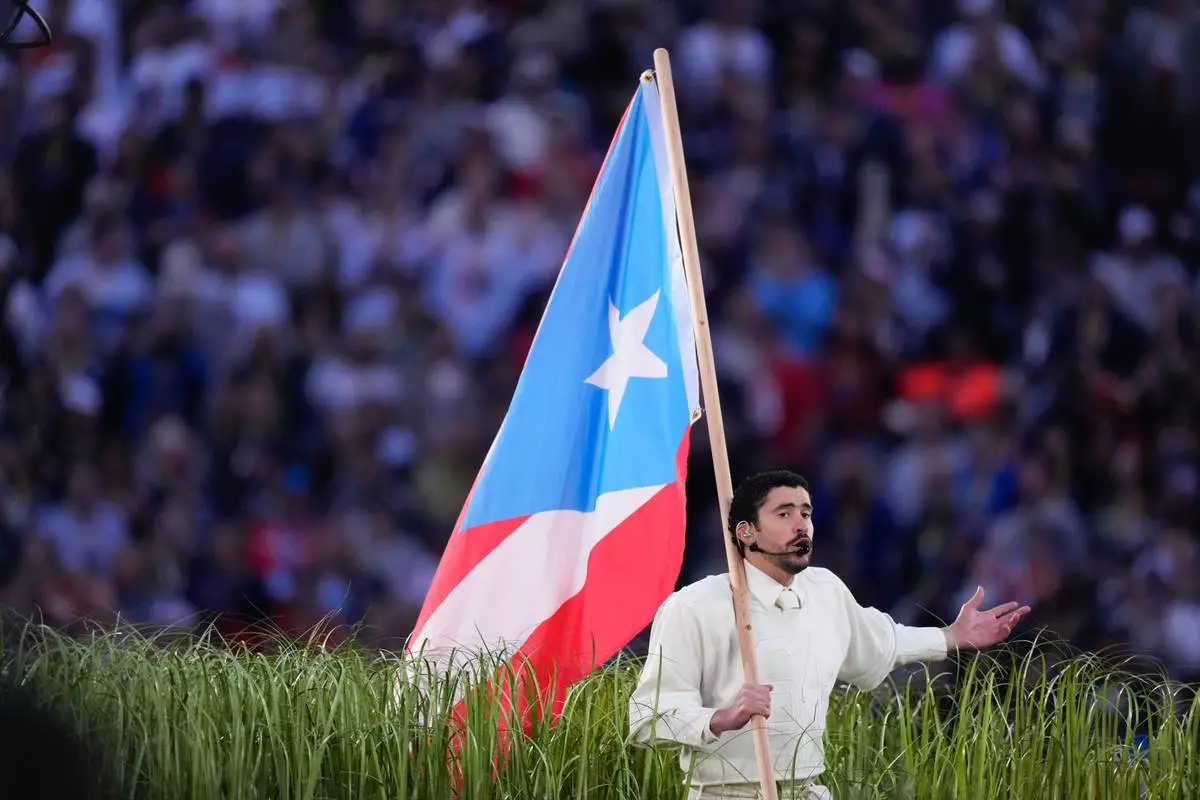
Bad Bunny performs during halftime of the NFL Super Bowl 60 football game between the New England Patriots and the Seattle Seahawks, Sunday, Feb. 8, 2026, in Santa Clara, Calif. (AP Photo/Mark J. Terrill)
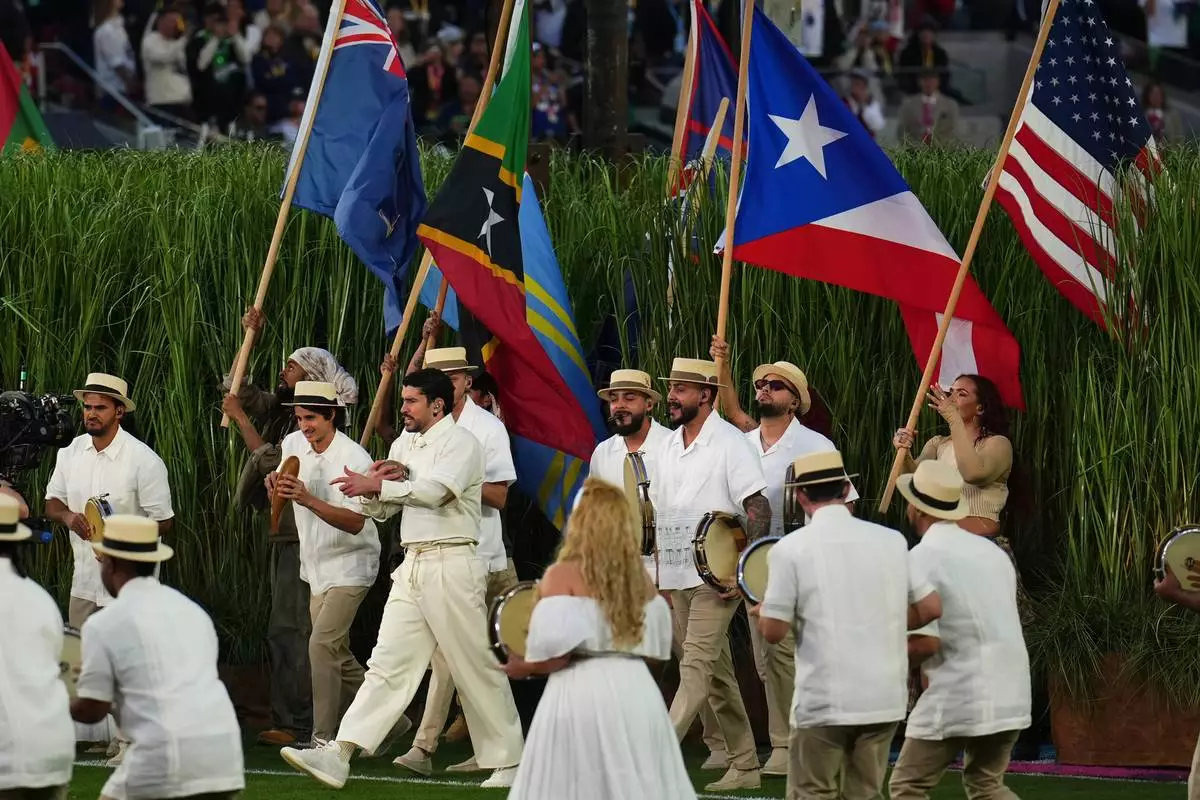
Bad Bunny performs during halftime of the NFL Super Bowl 60 football game between the New England Patriots and the Seattle Seahawks, Sunday, Feb. 8, 2026, in Santa Clara, Calif. (AP Photo/Godofredo A. Vásquez)
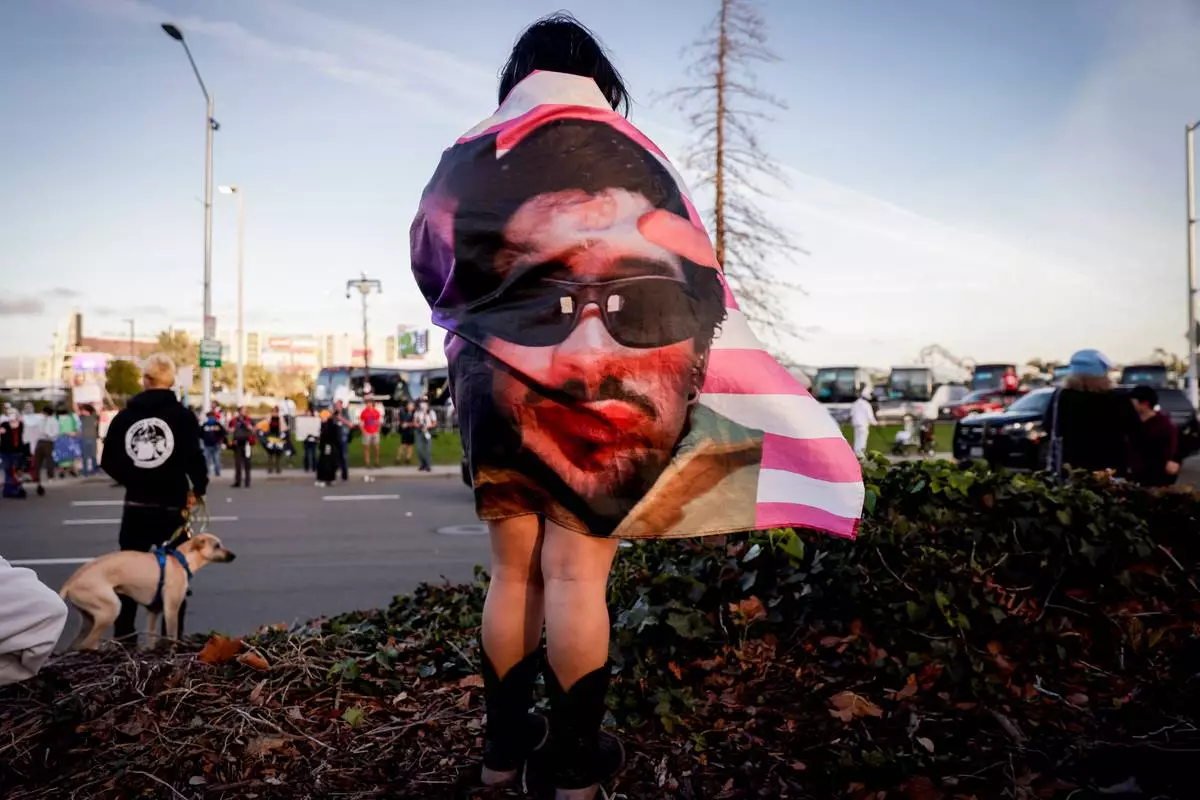
Kenia Medal wears a Bad Bunny flag while waiting to watch the halftime show outside Levi's Stadium during the NFL Super Bowl 60 football game between the Seattle Seahawks and the New England Patriots in Santa Clara, Calif., Sunday, Feb. 8, 2026. (Brontë Wittpenn/San Francisco Chronicle via AP)