LILLE, France & PARIS--(BUSINESS WIRE)--Feb 10, 2026--
4Moving Biotech (4MB), a clinical-stage biotechnology company and a spin-off of 4P-Pharma, developing a first-in-class disease-modifying osteoarthritis drug (DMOAD) for knee osteoarthritis, today announced the closing of a €12 million financing, completed through a structured and coordinated funding process.
This press release features multimedia. View the full release here: https://www.businesswire.com/news/home/20260209500141/en/
This financing was secured from a pool of private investors and family offices, who chose to reinforce their commitment by investing directly at the subsidiary level in 4MB. The round includes a combination of equity and loans, reflecting a flexible capital structure aligned with long-term value creation.
This closing forms a natural continuum following the €7.6 million France 2030 i-Démo grant announced last year, and the very recent transatlantic extension of the INFLAM-MOTION Phase 2a clinical study to the US, reinforcing 4MB’s runway to execute its lead DMOAD program addressing a major unmet medical need in knee osteoarthritis.
“With this closing in place, we are well equipped to reach the next value creation milestone by delivering robust Phase 2a data, reaching a proof-of-concept inflection point, and creating strategic optionality for subsequent stages of development to address the needs of the 374 million patients suffering from osteoarthritis worldwide,” said Luc Boblet, CEO of 4MB.
Founded in 2020, 4MB has now received approximately €30 million in total funding to date, combining private financing and non-dilutive public support. This trajectory illustrates a strong long-term strategy led by 4P-Pharma and built on its proprietary drug regeneration model, addressing untreated serious diseases and implemented independently by each of its subsidiaries.
“The arrival of new investors in 4MB reflects the strength and coherence of the 4P-Pharma group’s platform, built on disciplined capital allocation and scientific rigor,” addedRevital Rattenbach, CEO of 4P-Pharma and co-founder of 4MB. “By enabling our subsidiaries to independently define and execute their own trajectories, 4P-Pharma demonstrates the relevance of its start-up studio model.”
In the coming months, 4MB will focus on executing its clinical strategy in preparation for future regulatory agency interactions and on facilitating patient access to its molecule for those who need it most.
About 4Moving Biotech
Founded in 2020 as a spin-off of 4P-Pharma, 4Moving Biotech is a clinical-stage biotechnology company developing disease-modifying drugs for osteoarthritis, one of the world’s most burdensome chronic diseases, affecting more than 600 million people and lacking approved therapies that alter disease course. Headquartered on the Pasteur Institute campus in Lille, 4MB aims to deliver safe, sustainable therapeutic solutions for patients with high unmet medical needs.
Website: www.4movingbiotech.com
LinkedIn: https://www.linkedin.com/company/4moving-biotech/?viewAsMember=true
X : https://x.com/4Moving_Biotech

Francis Berenbaum (Left) Luc Boblet, Revital Rattenbach, Jérôme Vailland (Right)
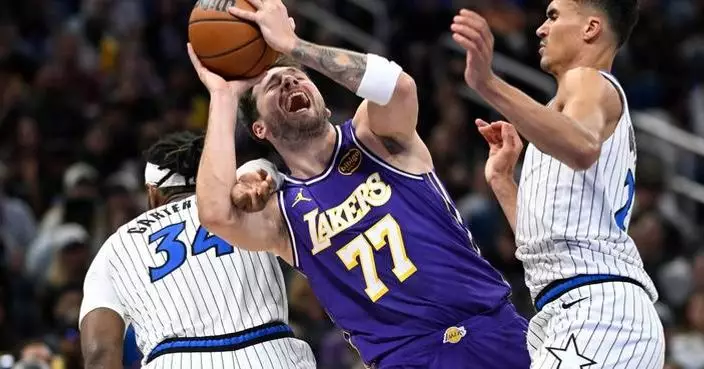
Luka Doncic is almost certainly going to win the NBA scoring title this season. And it's now very possible that he doesn't make the All-NBA team.
That's rare, but it might be this season's reality.
The roster of award-caliber players who won't be winning awards this season continues to grow, with Doncic — the Los Angeles Lakers standout guard and MVP candidate — now out with a Grade 2 left hamstring strain that will force him to miss the rest of the regular season. Minnesota guard Anthony Edwards is certain to miss the league's 65-game award eligibility threshold as well after he was held out Thursday because of illness.
Doncic has played 64 games, one shy of the threshold. It's worth noting that BetMGM Sportsbook, among others, took Doncic off the list of MVP betting options following his injury Thursday.
“At this juncture of the season, it’s the last thing you want to see,” Lakers star LeBron James told reporters in Oklahoma City after Thursday's game, long before an MRI was performed Friday to determine the extent of Doncic's injury. “Especially anybody on our team, but when you have an MVP candidate on your team, the last thing you want to see is somebody go down with a hamstring injury."
Edwards can now only reach a maximum of 64 games as well, so he won’t be on the ballot for most major NBA awards either.
It was collectively bargained — meaning the league and the players association agreed on the terms — and this is the third season of it being part of the NBA rules.
It applies to player eligibility for five awards — MVP, Defensive Player of the Year, Most Improved Player, the All-NBA Team and the All-Defensive Team. Players have to either play in 65 regular-season games (with some minutes-played minimums in there as well), or at least 62 games before suffering a “season-ending injury."
But even with Doncic's hamstring hurt badly enough that he'll miss the rest of the regular season, it wouldn't be classified as “season-ending” unless a doctor — jointly selected by the NBA and the National Basketball Players Association — says he wouldn't be able to play again through May 31.
There is a grievance process and even a way to challenge the rule citing extraordinary circumstances, but neither would be easily utilized.
Five of the league's six highest-paid players this season — Golden State's Stephen Curry and Jimmy Butler, Philadelphia's Joel Embiid, Milwaukee's Giannis Antetokounmpo and Boston's Jayson Tatum — aren't eligible for awards. Denver's Nikola Jokic is the exception on the highest-paid list, and he'd likely be ineligible if he misses more than one more game down the stretch.
There were 23 players on the list of those winning MVP, MIP, DPOY, All-NBA and All-Defense last season. Of those, at least 10 are out of the running for honors this season: Antetokounmpo, Curry, Edwards, James, Tatum, Detroit's Cade Cunningham, Indiana teammates Tyrese Haliburton and Ivica Zubac, Utah's Jaren Jackson Jr. and Oklahoma City's Jalen Williams. (Most of those 10 have been out of the awards mix because of injuries for some time; Tatum and Haliburton both tore Achilles in last season's playoffs and it was obvious then that they wouldn't hit 65-game marks this year.)
Another four award winners from a year ago — Jokic, Oklahoma City's Lu Dort, Golden State's Draymond Green and Cleveland's Evan Mobley — aren't at 65 games yet this season but, for now anyway, seem on pace to get there.
Never say never. The union wants changes to the policy, and it's certain to come up in their conversations with the league office. But many players — and even Andre Iguodala, now the head of the players' association — have said in recent years that the 65-game rule is a good thing.
The league doesn't seem inclined to make a change based solely on what would appear to be an extraordinary number of award candidates not hitting the threshold in one year.
“I think it is working,” NBA Commissioner Adam Silver said last month. “I think if you look at the numbers, the pre-implementation of this rule, numbers were going in the wrong direction. I may have this a little bit off: I think the three years before we adopted this rule, almost a third of the All-NBA players had not played 80% of the games. That was a huge issue for the league.”
As we said, it's rare, but it has happened. Twice, to be exact.
— 1968-69: Elvin Hayes won the scoring title as a rookie, then wasn't even All-NBA — and didn't win Rookie of the Year, either.
— 1975-76: Bob McAdoo won his third consecutive scoring title and was second in the MVP race — but didn't make All-NBA. Players voted for MVP in those days, and McAdoo was an extremely close second behind Kareem Abdul-Jabbar. Dave Cowens was third in the MVP vote but got the second-team All-NBA nod at center, with Abdul-Jabbar the first-team pick.
Doncic now seems likely to join that list. It's not mathematically certain yet that he wins the scoring title, but it would take something extraordinary for it not to happen.
He's averaging 33.5 points per game, with Gilgeous-Alexander at 31.6 per game. For Gilgeous-Alexander — last season's scoring champion — to overtake Doncic, he would need to go on an unbelievable run. An example: He'd need to score 292 points over the final five games to take over the top spot, and nobody other than Wilt Chamberlain has had a five-game run like that.
Of the previous 79 scoring champions, 64 were first-team All-NBA and 13 were second-team.
Jokic is going to win the league's rebounding and assist titles, while averaging a triple-double yet again. But he's also not assured yet of being on the award ballots.
The thresholds are different.
While the award mandate is 65 games in most cases, players are eligible for most statistical awards if they play in 58 games (or 70% of the season). There are different standards for some stat awards, such as field-goal percentage (minimum 300 made), free-throw percentage (minimum 125 made) and 3-point percentage (minimum 82 made).
A player can win a stat award while appearing in less than 58 games.
For example, last season, San Antonio's Victor Wembanyama played only 46 games but still won the blocked shot title. Even if he played in the minimum 58 games and recorded no blocks in the 12 games needed to reach that number he still would have been ahead of the runner-up, Utah's Walker Kessler.
AP NBA: https://www.apnews.com/hub/NBA
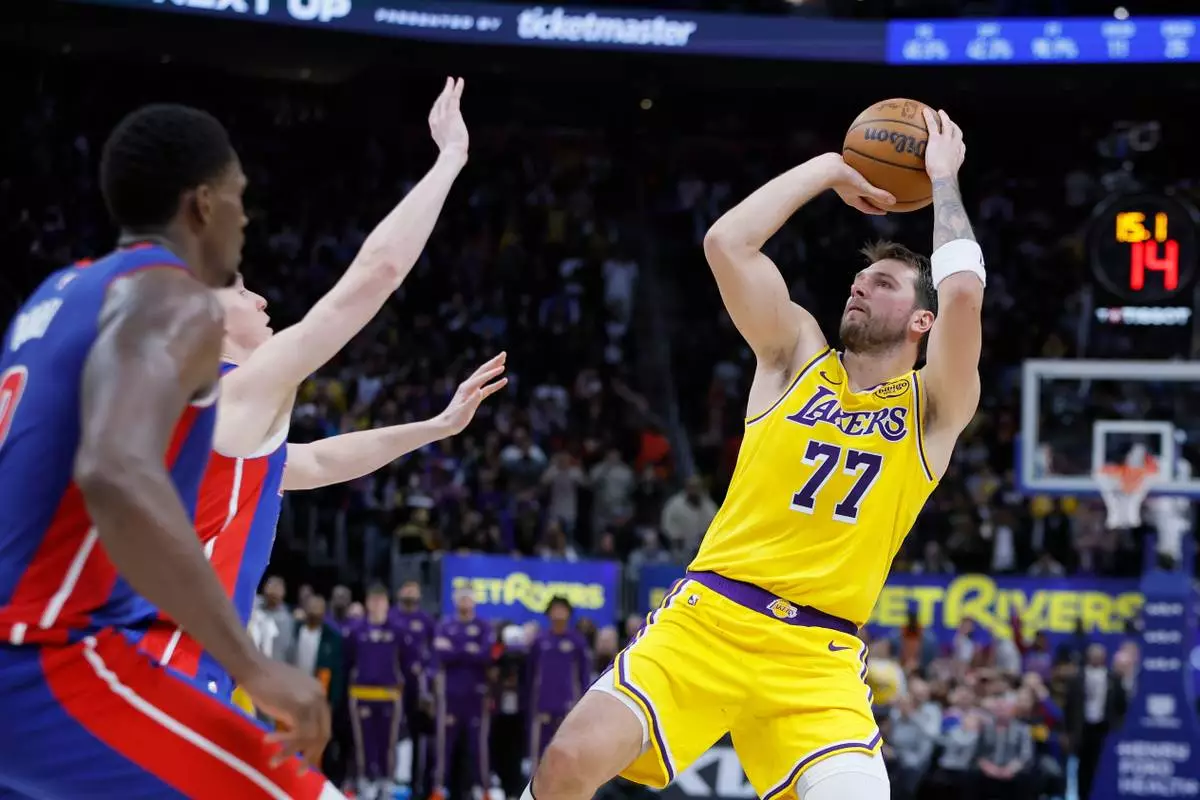
Los Angeles Lakers guard Luka Doncic (77) looks to make a shot-attempt in the fourth quarter of a loss to the Detroit Pistons in an NBA basketball game Monday, March 23, 2026, in Detroit. (AP Photo/Duane Burleson)
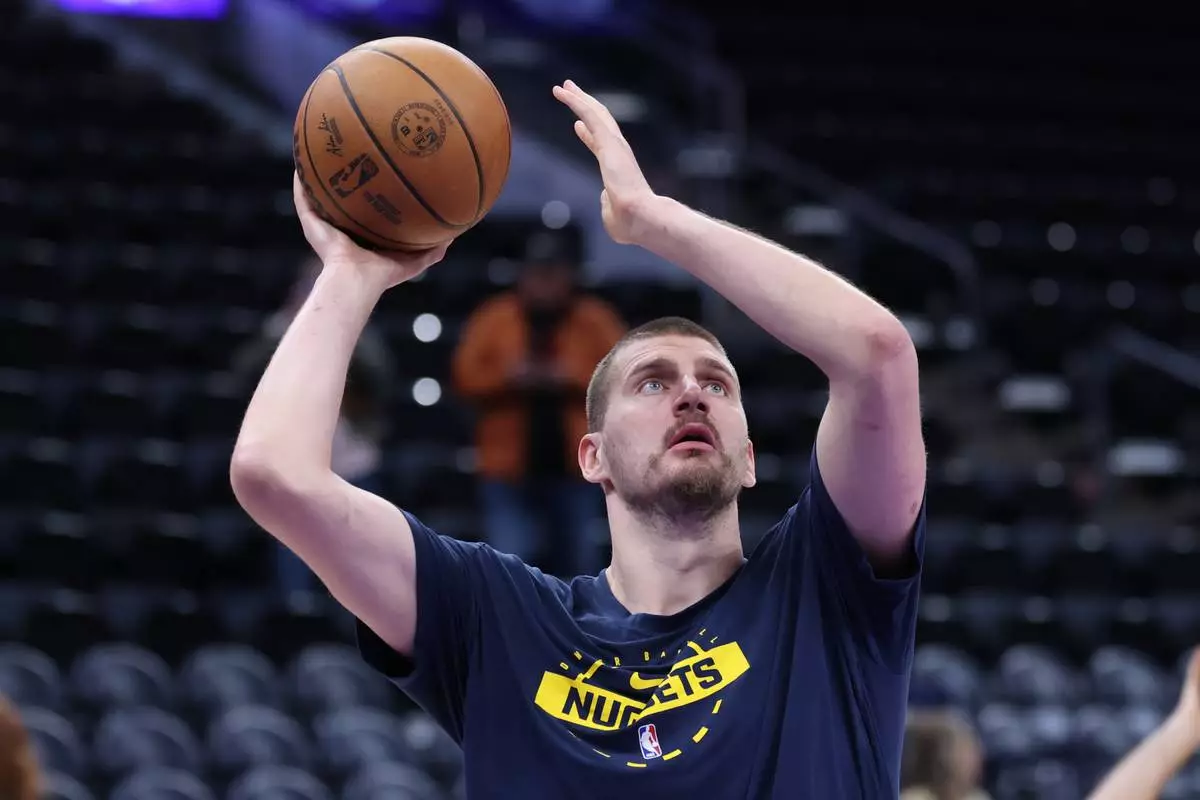
Denver Nuggets center Nikola Jokic warms up before an NBA basketball game against the Utah Jazz, Wednesday, April 1, 2026, in Salt Lake City. (AP Photo/Rob Gray)
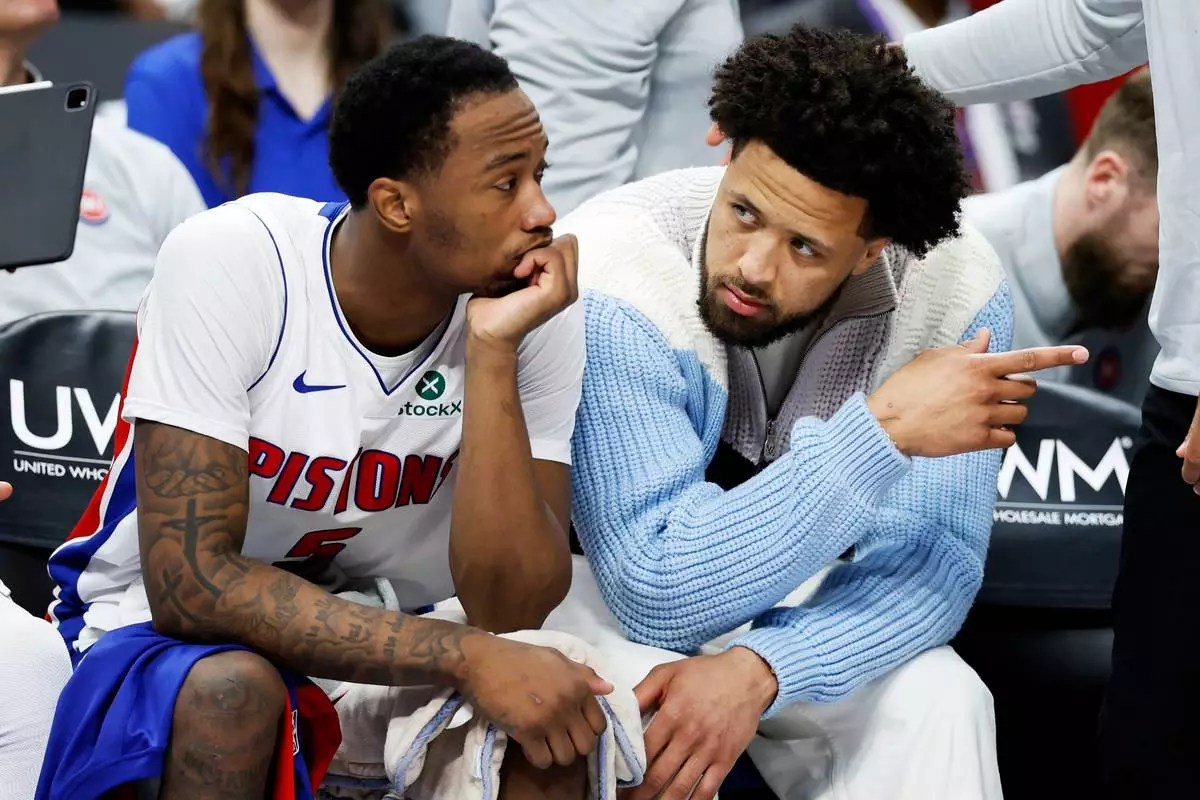
Detroit Pistons forward Ronald Holland II (5) talks with guard Cade Cunningham (2), who did not play due to an injury, during the second half of an NBA basketball game against the Toronto Raptors Tuesday, March 31, 2026, in Detroit. (AP Photo/Duane Burleson)
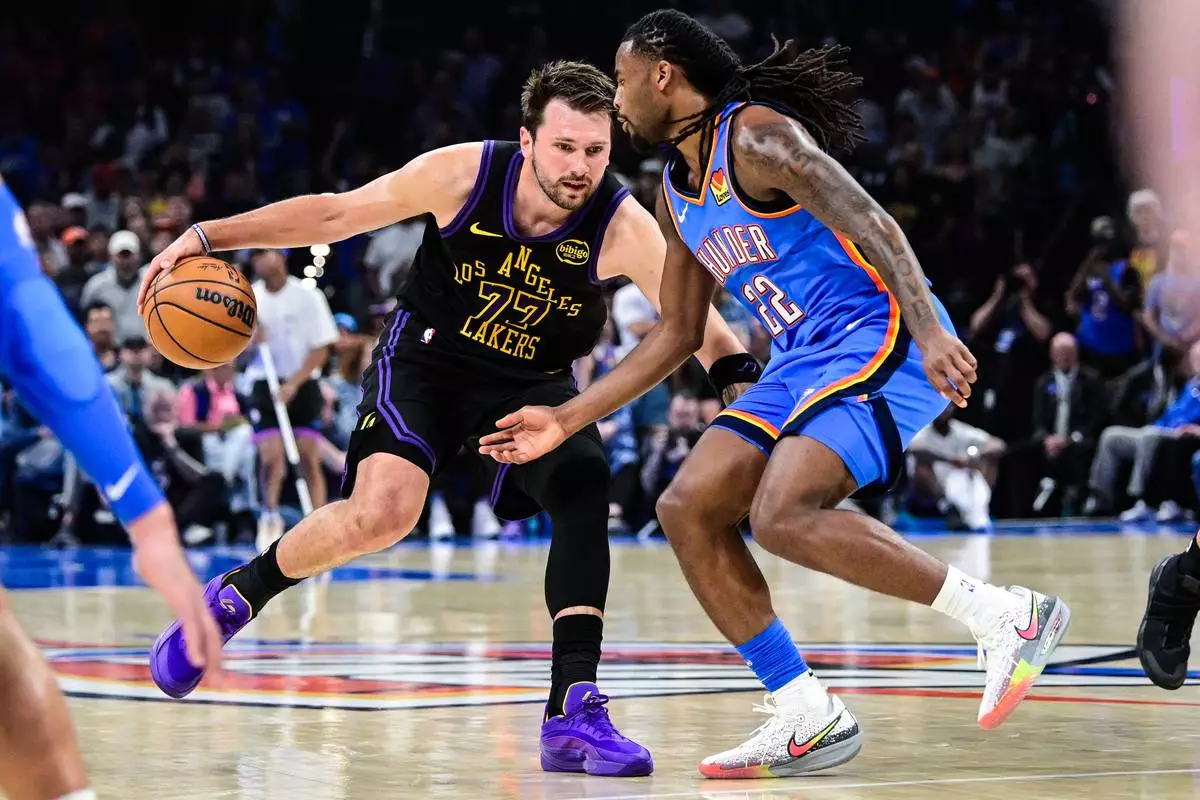
Los Angeles Lakers forward/guard Luka Dončić (77) drives against Oklahoma City Thunder guard Cason Wallace (22) during the first half of an NBA basketball game Thursday, April. 2, 2026, in Oklahoma City. (AP Photo/Gerald Leong)