BERLIN (AP) — Established democracies' efforts against public-sector corruption appear to be flagging, according to a survey released Tuesday that serves as a barometer of perceived corruption worldwide. It raised concern about developments in the United States and the impact elsewhere of U.S. funding cuts.
Transparency International's Corruption Perceptions Index for 2025 gave top place to Denmark, with 89 points out of 100, followed by Finland and Singapore. At the bottom were South Sudan and Somalia with nine points apiece, followed by Venezuela. The leading trio was unchanged, and the last three only in that South Sudan gained a point to draw level with Somalia.
The group said most countries are failing to keep corruption under control, with 122 out of the 182 nations and territories surveyed scoring less than 50 points. The global average last year was 42, down one point to the lowest in over a decade. Only five countries scored above 80 in the 2025 report, down from 12 a decade ago.
The report lamented that “too often, we are seeing a failure of good governance and accountable leadership.”
It also pointed to “a worrying trend of democracies seeing worsening perceived corruption.”
Among those, it pointed even to high-scoring New Zealand, down two points at 81, and Sweden, unchanged on 80; as well as Canada, the United Kingdom, France and the United States, which scored 75, 70, 66 and 64 points respectively.
The U.S. was down one point from 2024 for its worst showing yet under the methodology Transparency started using for its global ranking in 2012, putting it in 29th place in the first year of President Donald Trump's second term.
“While the data has yet to fully reflect developments in 2025, the use of public office to target and restrict independent voices such as NGOs and journalists, the normalization of conflicted and transactional politics, the politicization of prosecutorial decision making, and actions that undermine judicial independence, among many others, all send a dangerous signal that corrupt practices are acceptable,” the report said.
Transparency International also argued that the U.S. decision "to temporarily freeze and then degrade enforcement of its Foreign Corrupt Practices Act ... sends a dangerous signal that bribery and other corrupt practices are acceptable."
Trump said a year ago, when he froze enforcement of the 1977 law that prohibits people or companies operating in the U.S. from giving money or gifts to foreign officials to win or retain deals in those countries, that “it sounds good on paper but in practicality, it's a disaster.” To its detractors, the act has unfairly hobbled American companies while foreign rivals swoop in.
Separately, Transparency said that "U.S. aid cuts to funding for overseas civil society groups that scrutinize their governments has undermined anti-corruption efforts around the world.” It contended that “political leaders in various countries have also taken this as a cue to further target and restrict independent voices, such as NGOs and journalists.”
The organization measures experts' perception of public-sector corruption around the world according to 13 data sources, including the World Bank, the World Economic Forum and private risk and consulting companies.
Fifty countries' scores have declined significantly since 2012, it said — with Hungary, now on 40 points; Turkey, on 31; and Nicaragua, on 14, among the biggest fallers.
At the same time, it said 31 countries have improved significantly, highlighting Estonia (76 points), the Seychelles (68) and South Korea (63).
Russia remained close to the bottom of the index with an unchanged score of 22, with Transparency International citing "fully centralized, opaque governance that suppresses media, civil society and political opposition."
Nearly four years into Russia's full-scale invasion, Ukraine was up one point at 36 after an energy-sector corruption scandal forced high-level resignations. Transparency said that civil-society mobilization protected key anti-corruption institutions and investigations were increased, though “further reforms are needed to protect defense and reconstruction funds from misuse.”
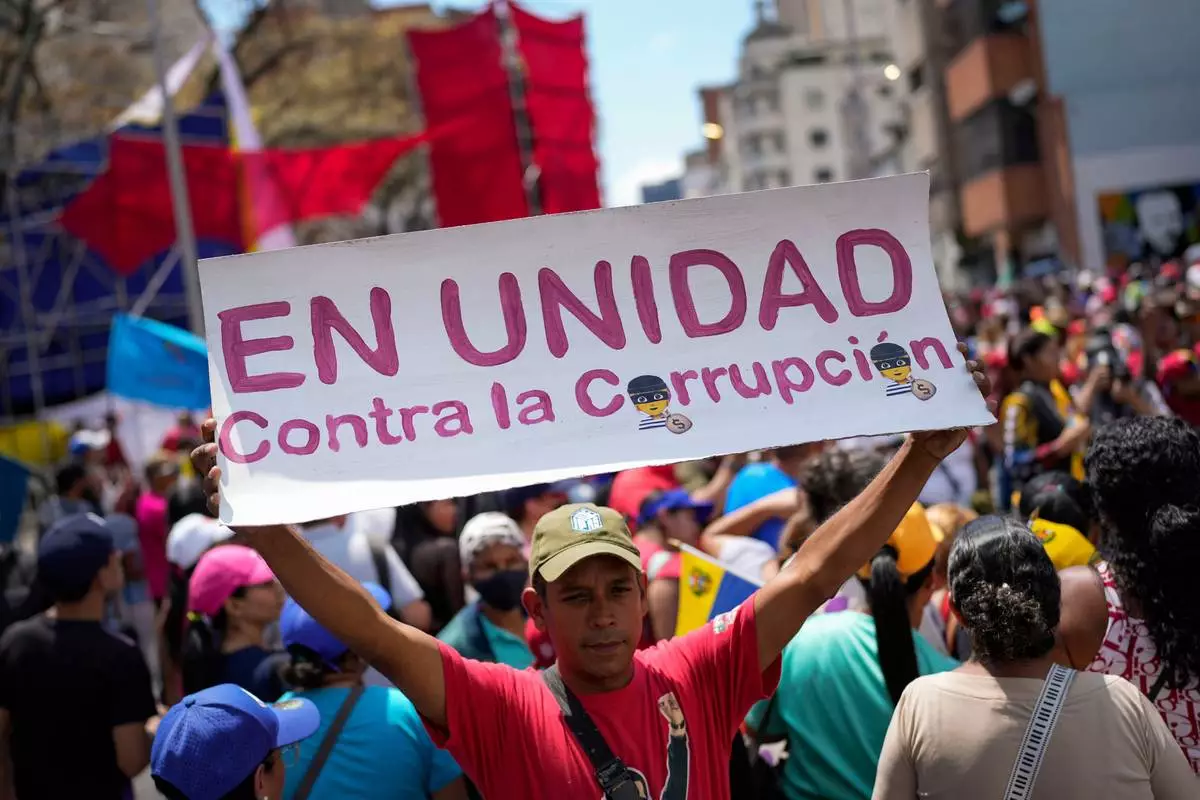
FILE - A government supporter holds a sign with a message that reads in Spanish: "In unity against corruption", during a rally against corruption, in Caracas, Venezuela, Saturday, March 25, 2023. (AP Photo/Matias Delacroix, File)
LAS VEGAS (AP) — The Las Vegas Review-Journal announced Friday that it will no longer print its rival the Las Vegas Sun for the first time in decades, sharpening a legal dispute over the nation’s last joint operating agreement stemming from a 1970 law designed to preserve newspapers.
Readers “will not find a printed Las Vegas Sun insert inside,” the Review-Journal said in an editorial, noting the Sun maintains a website, has a few hundred thousand followers across social media platforms, and is free to produce its own newspaper.
“We encourage them to do so. The Review-Journal competes with countless sources of news and entertainment, but we would welcome one more. We just don’t want to foot the bill. It is time the Sun stood up on its own two feet,” the editorial said, without specifying the cost.
The two publications will be in court Friday and the Sun hopes a judge will order printing to immediately resume, attorney Leif Reid said in an email. It will be the first day in 76 years that the Sun hasn’t been printed, he said.
“This does irreparable harm to our community, as no one benefits when a local newspaper is prevented from being published,” he said.
The now-rare joint operating agreement required the Sun to be printed as a daily insert in the Review-Journal, while both companies remained editorially independent with separate newsrooms and websites.
A lower court had found the agreement was unenforceable because a 2005 update was never signed by the U.S. attorney general, and in February the U.S. Supreme Court declined to hear an appeal by the Sun.
The Review-Journal editorial called the Supreme Court decision a decisive victory, saying that halting publication of the Sun on Friday was “a result of 6½ years of litigation between the newspapers, precipitated by the Sun.”
Such agreements between rival publications have dwindled as part of a "long, slow goodbye of newspapers as we knew them,” said Ken Doctor, a news business analyst. The Detroit Free Press and the Detroit News ended a 40-year agreement last year. USA Today Co., which owns the Detroit Free Press, recently announced its plans to purchase the Detroit News.
In 1950, the Sun was founded in response to the Review-Journal’s refusal to negotiate with typesetters from the International Typographical Union. The union started its own newspaper and reached out to businessman Hank Greenspun for financial backing. The Greenspuns still own the paper.
The Review-Journal has been publishing since 1909, first as the Clark County Review. It is owned by the Adelson family, casino magnates and mega GOP donors, and remains the state’s largest newspaper.
The Review-Journal’s editorials lean more conservative, while the Sun’s lean liberal. The 1970 law signed by then President Richard Nixon, called the Newspaper Preservation Act, was designed to save newspapers costs while maintaining competition and editorial variety in cities as newspapers began to financially struggle.
The papers first entered into a joint operating agreement in 1989 when the Sun was struggling to stay afloat financially. The agreement made the Sun an afternoon newspaper during weekdays and a section within the Review-Journal on weekend mornings, while the Review-Journal handled production, distribution and advertising. The Review-Journal also collected all revenue and was required to pay the Sun monthly to cover the Sun’s news and editorial expenses.
In 2005 the agreement was amended to make the Sun an insert in the Review-Journal every morning.
Review-Journal owners sought to end the agreement in 2019, and in response the Sun’s owners filed a lawsuit alleging that ending the agreement violated anti-trust laws.
The 1970 law allowing such agreements was signed at a time when news options weren't as prevalent and there was more concern over news monopolies.
Las Vegas — and Nevada as a whole — today have more strong, independent news organizations compared to other places, said Stephen Bates, a journalism and media professor at the University of Nevada, Las Vegas.
The Sun also publishes online. But it has argued in court that losing its print product could make it harder to recruit staff, cause a loss in readers, and even force it to close.
Genelle Belmas, a journalism professor at the University of Kansas who specializes in media law, said it would be disappointing if the last joint operating agreement in the country ends. During visits to Vegas, she's enjoyed being able to pick up the Review-Journal and see the Sun folded inside, offering two differing points of view in one place. Online news outlets make it easier for consumers to stay in their echo chambers, she said.
“Every local news outlet we lose — and that includes big towns, small towns, whatever — is a loss of perspective and a loss of a potential alternative view,” Belmas said.
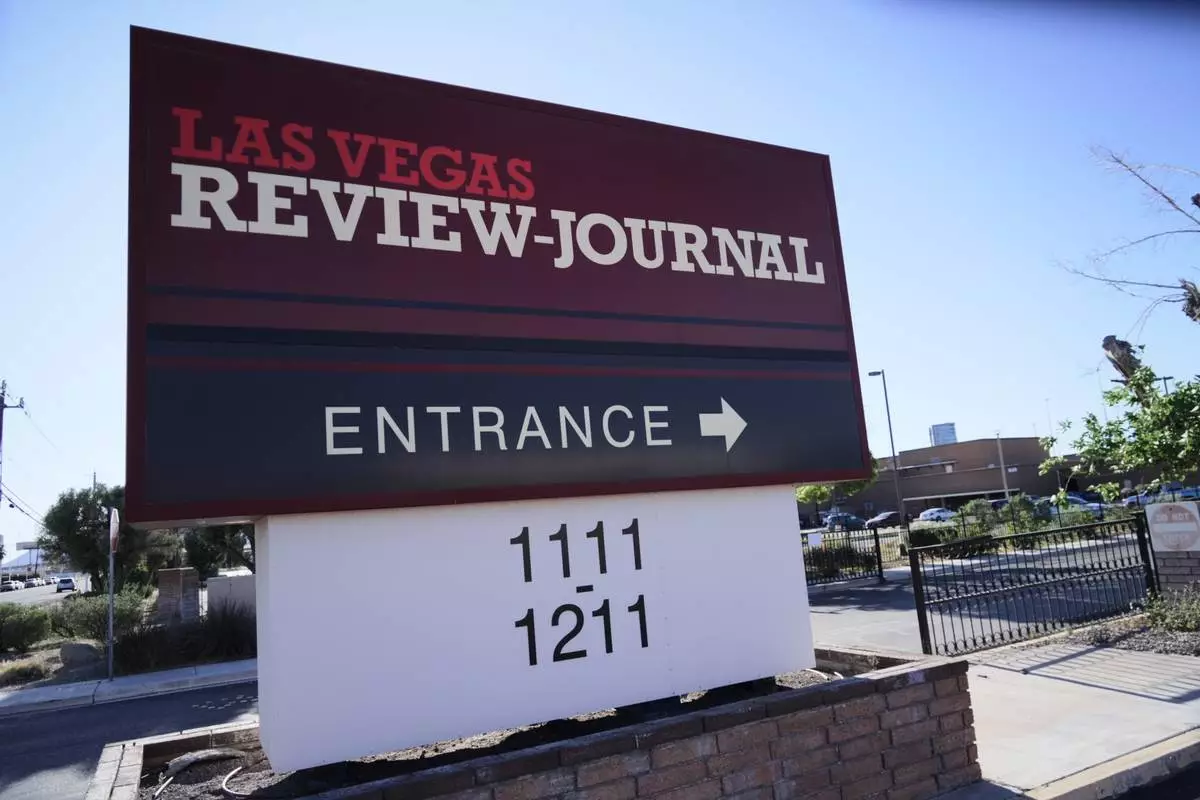
The exterior of the Las Vegas Review-Journal is shown Friday, April 3, 2026, in Las Vegas (AP Photo/Ty Oneil)
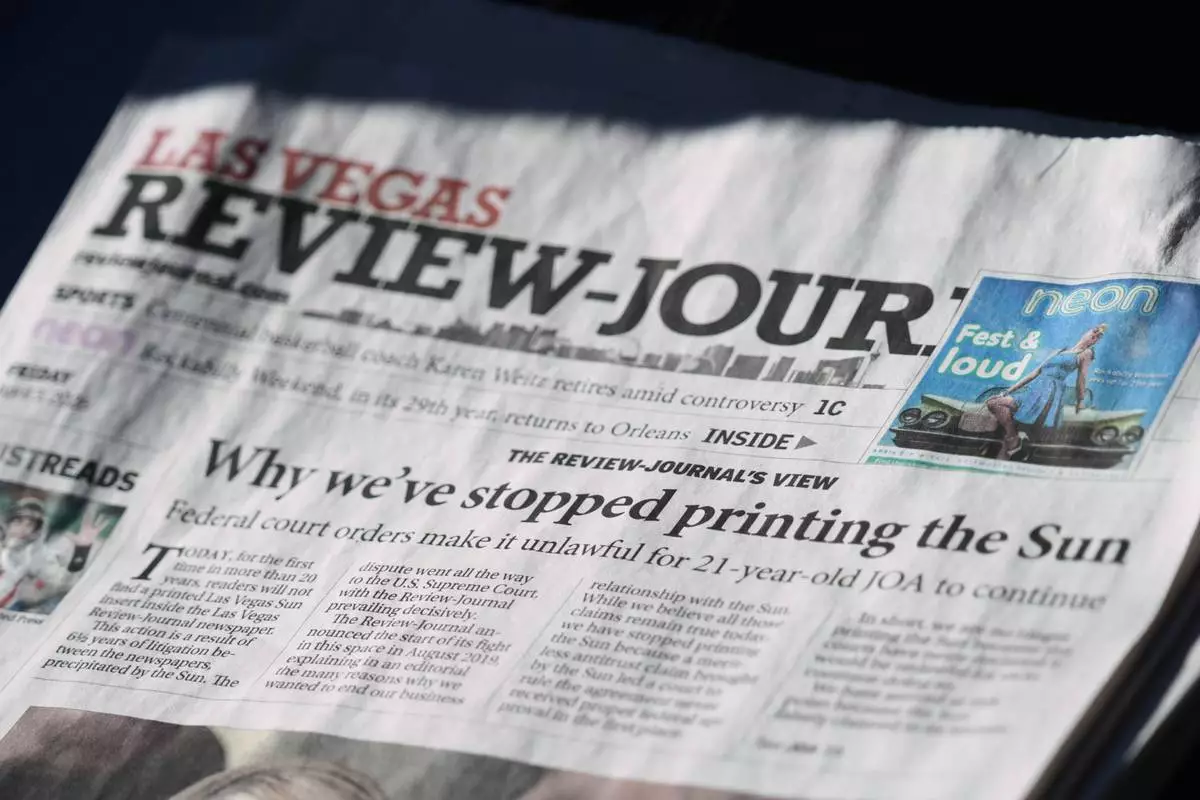
The front page of the Las Vegas Review-Journal is shown Friday, April 3, 2026, in Las Vegas (AP Photo/Ty Oneil)
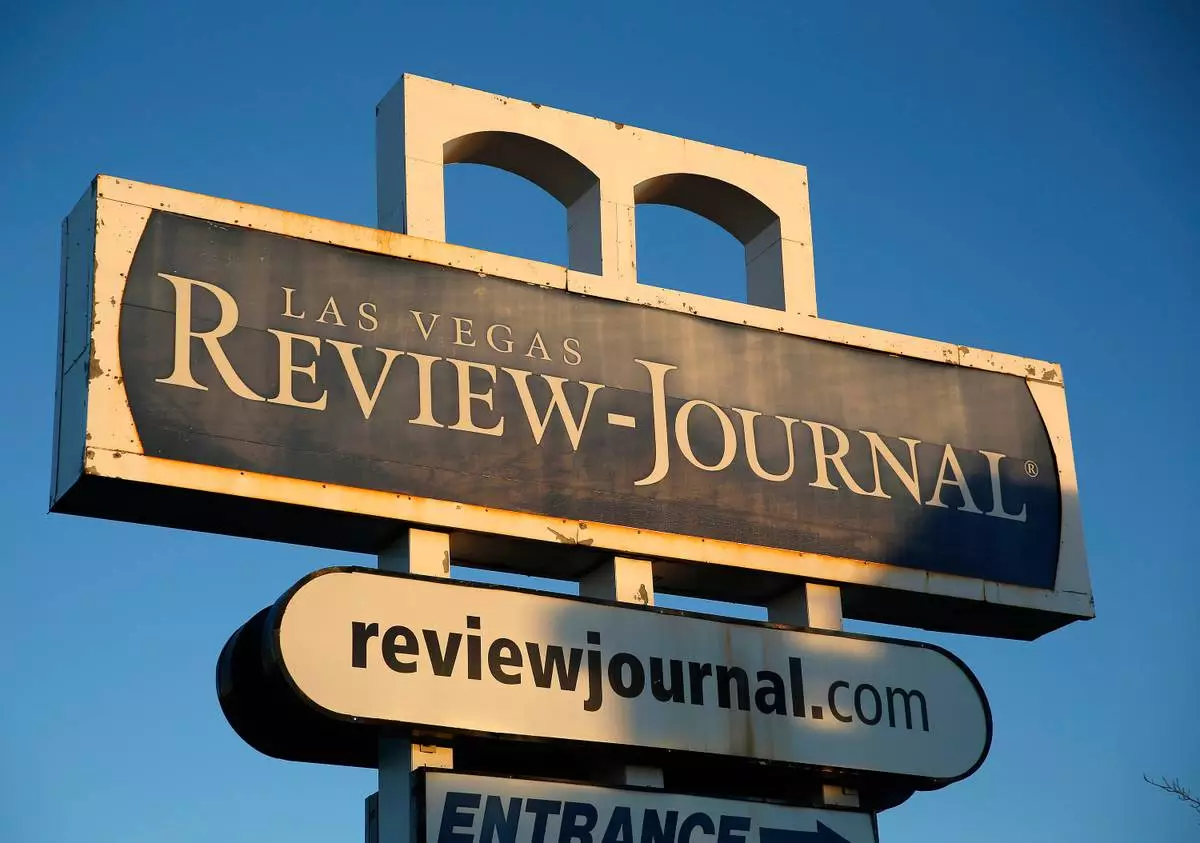
FILE - This Dec. 17, 2015 file photo shows a sign outside the building housing the Las Vegas Review-Journal in Las Vegas. AP Photo/John Locher, File)