|
Shipments Increase in 2025 Amid Strong AI-driven Demand, While Revenue Softens
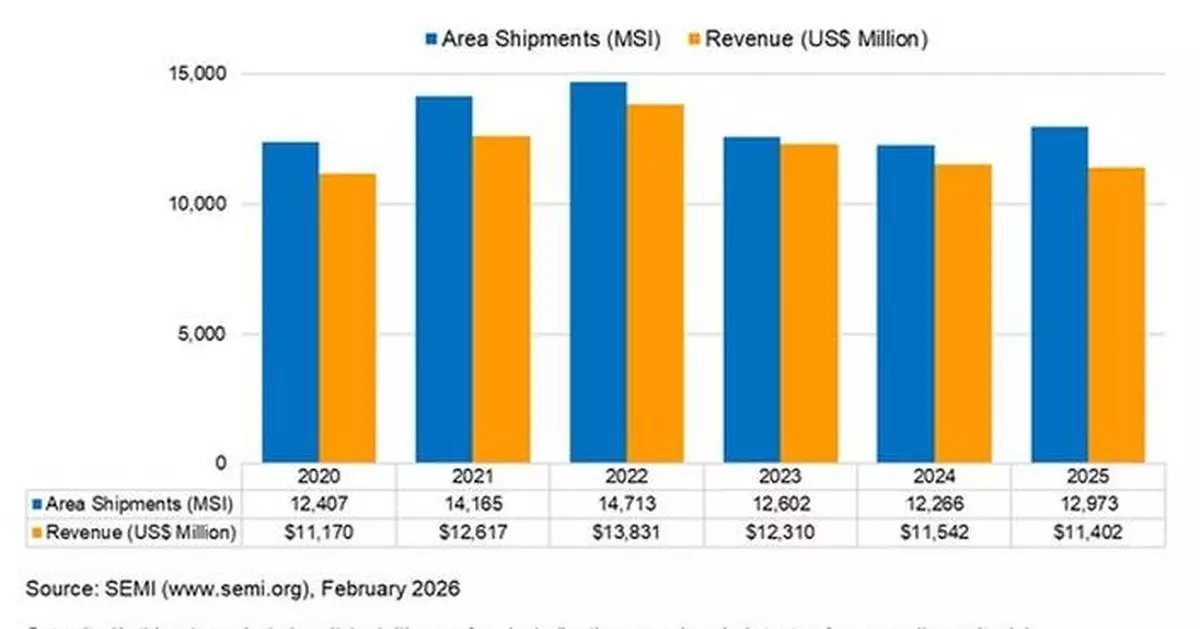
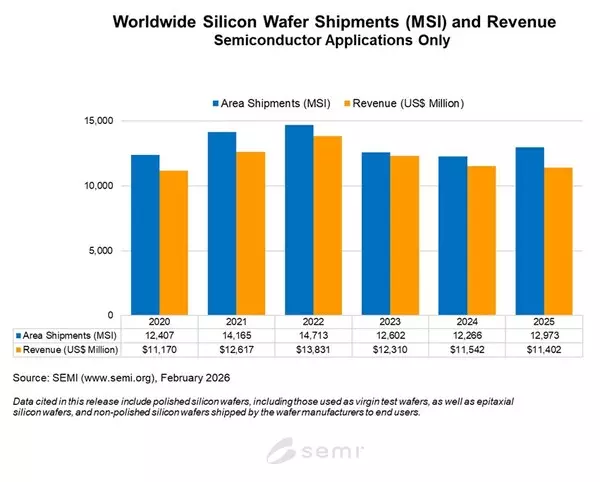
MILPITAS, Calif., Feb. 10, 2026 /PRNewswire/ -- Worldwide silicon wafer shipments in 2025 increased 5.8% to 12,973 million square inches (MSI) while wafer revenue slipped 1.2% to $11.4 billion over the same period, the SEMI Silicon Manufacturers Group (SMG) reported in its year-end analysis of the silicon wafer industry.
2025 marks an inflection year for wafer shipments, with silicon MSI resuming growth supported by strong demand for advanced epitaxial wafers in logic and polished wafers for high-bandwidth memory (HBM), driven by AI applications. Softness in wafer revenue is mostly attributed to the slow momentum in traditional semiconductor applications where the demand and pricing environment are yet to improve.
"The 2025–2026 wafer market is shaped by diverging trends across technology nodes," said Ginji Yada, Chairman of SEMI SMG and Executive Office Deputy General Manager, Sales and Marketing Division at SUMCO Corporation. "Demand for 300mm wafers remains strong in advanced applications, particularly in AI-driven logic and high-bandwidth memory (HBM), supported by the ongoing adoption of sub-3nm processes. These technology transitions are driving increased requirements for wafer quality and consistency, reinforcing the need for advanced material solutions. Investments in data centers and generative AI continue to underpin demand in leading-edge segments, where performance and reliability are critical.
"In contrast, the legacy semiconductor segment shows gradual signs of stabilization. Wafer and chip inventory levels in mature-node applications—such as automotive, industrial, and consumer electronics—have begun to normalize after extended inventory adjustments. While supply-demand conditions are improving sequentially, the pace of recovery remains moderate, with demand recovery still sensitive to macroeconomic factors and end-market dynamics. As a result, the overall market outlook reflects a two-track trajectory: sustained demand and technical advancement in advanced nodes, alongside a cautious and incremental rebound for demand in mature technology segments."
Silicon wafers are the fundamental building material for the majority of semiconductors, which are vital components of all electronic devices. The highly engineered thin disks are produced in diameters of up to 300 mm and serve as the substrate material on which most semiconductors are fabricated.
The SMG is a sub-committee of the SEMI Electronic Materials Group (EMG) and is open to SEMI members involved in manufacturing polycrystalline silicon, monocrystalline silicon or silicon wafers (e.g., as cut, polished, epitaxial). The SMG facilitates collective efforts on issues related to the silicon industry, including the development of statistics about the silicon industry.
For more information, visit SEMI Worldwide Silicon Wafer Shipment Statistics or contact the SEMI Market Intelligence Team at mktstats@semi.org. Additional details on SEMI market data are available at SEMI Market Intelligence.
Follow SEMI
About SEMI
SEMI® is the global industry association connecting over 3,000 member companies and 1.5 million professionals worldwide across the semiconductor and electronics design and manufacturing supply chain. We accelerate member collaboration on solutions to top industry challenges through Advocacy, Workforce Development, Sustainability, Supply Chain Management and other programs. Our SEMICON® expositions and events, technology communities, standards and market intelligence help advance our members' business growth and innovations in design, devices, equipment, materials, services and software, enabling smarter, faster, more secure electronics. Visit www.semi.org, contact a regional office, and connect with SEMI on LinkedIn and X to learn more.
Association Contacts
Sherrie Gutierrez/SEMI
Phone: 1-831-889-3800
Email: sgutierrez@semi.org
Stephanie Quinn/Kiterocket (Media Inquiries)
Phone: 1-480-316-8370
Email: squinn@kiterocket.com
Shipments Increase in 2025 Amid Strong AI-driven Demand, While Revenue Softens
MILPITAS, Calif., Feb. 10, 2026 /PRNewswire/ -- Worldwide silicon wafer shipments in 2025 increased 5.8% to 12,973 million square inches (MSI) while wafer revenue slipped 1.2% to $11.4 billion over the same period, the SEMI Silicon Manufacturers Group (SMG) reported in its year-end analysis of the silicon wafer industry.
2025 marks an inflection year for wafer shipments, with silicon MSI resuming growth supported by strong demand for advanced epitaxial wafers in logic and polished wafers for high-bandwidth memory (HBM), driven by AI applications. Softness in wafer revenue is mostly attributed to the slow momentum in traditional semiconductor applications where the demand and pricing environment are yet to improve.
"The 2025–2026 wafer market is shaped by diverging trends across technology nodes," said Ginji Yada, Chairman of SEMI SMG and Executive Office Deputy General Manager, Sales and Marketing Division at SUMCO Corporation. "Demand for 300mm wafers remains strong in advanced applications, particularly in AI-driven logic and high-bandwidth memory (HBM), supported by the ongoing adoption of sub-3nm processes. These technology transitions are driving increased requirements for wafer quality and consistency, reinforcing the need for advanced material solutions. Investments in data centers and generative AI continue to underpin demand in leading-edge segments, where performance and reliability are critical.
"In contrast, the legacy semiconductor segment shows gradual signs of stabilization. Wafer and chip inventory levels in mature-node applications—such as automotive, industrial, and consumer electronics—have begun to normalize after extended inventory adjustments. While supply-demand conditions are improving sequentially, the pace of recovery remains moderate, with demand recovery still sensitive to macroeconomic factors and end-market dynamics. As a result, the overall market outlook reflects a two-track trajectory: sustained demand and technical advancement in advanced nodes, alongside a cautious and incremental rebound for demand in mature technology segments."
Silicon wafers are the fundamental building material for the majority of semiconductors, which are vital components of all electronic devices. The highly engineered thin disks are produced in diameters of up to 300 mm and serve as the substrate material on which most semiconductors are fabricated.
The SMG is a sub-committee of the SEMI Electronic Materials Group (EMG) and is open to SEMI members involved in manufacturing polycrystalline silicon, monocrystalline silicon or silicon wafers (e.g., as cut, polished, epitaxial). The SMG facilitates collective efforts on issues related to the silicon industry, including the development of statistics about the silicon industry.
For more information, visit SEMI Worldwide Silicon Wafer Shipment Statistics or contact the SEMI Market Intelligence Team at mktstats@semi.org. Additional details on SEMI market data are available at SEMI Market Intelligence.
Follow SEMI
About SEMI
SEMI® is the global industry association connecting over 3,000 member companies and 1.5 million professionals worldwide across the semiconductor and electronics design and manufacturing supply chain. We accelerate member collaboration on solutions to top industry challenges through Advocacy, Workforce Development, Sustainability, Supply Chain Management and other programs. Our SEMICON® expositions and events, technology communities, standards and market intelligence help advance our members' business growth and innovations in design, devices, equipment, materials, services and software, enabling smarter, faster, more secure electronics. Visit www.semi.org, contact a regional office, and connect with SEMI on LinkedIn and X to learn more.
Association Contacts
Sherrie Gutierrez/SEMI
Phone: 1-831-889-3800
Email: sgutierrez@semi.org
Stephanie Quinn/Kiterocket (Media Inquiries)
Phone: 1-480-316-8370
Email: squinn@kiterocket.com
** The press release content is from PR Newswire. Bastille Post is not involved in its creation. **
SEMI Reports 2025 Annual Worldwide Silicon Wafer Shipments and Revenue Results
SEMI Reports 2025 Annual Worldwide Silicon Wafer Shipments and Revenue Results
|
Delivering valuable insights, practical guidance, and seasonal strategies, the Aiper Pro Club simplifies pool and Lawn care for modern homeowners
ATLANTA, May 21, 2026 /PRNewswire/ -- Aiper, a global leader in cordless robotic pool cleaning and the smart yard ecosystem, today announced the launch of the Aiper Pro Club, a new expert-led initiative designed to help homeowners navigate smart pool and backyard care with confidence. As summer approaches and more consumers spend time outdoors, the program aims to address the growing reliance on trial-and-error maintenance methods, outdated routines and inconsistent advice across pool and yard care.
Designed as an educational content hub and community platform, the Aiper Pro Club offers homeowners direct access to professional insights, practical maintenance tips, and seasonal guidance tailored to help with problems homeowners face day to day. From step-by-step pool care strategies to smarter lawn and irrigation practices, the platform is designed to make outdoor upkeep more approachable, efficient, and ultimately more enjoyable.
Through curated content and ongoing programming, homeowners will gain access to:
- Useful tutorials and how-to guides
- Seasonal maintenance checklists and best practices
- Insider tips for optimizing pool and lawn performance
- Insights into emerging smart yard technologies and trends
- Personalized advice and recommendations for your pool and yard
Expert Voices Behind the Initiative
At the core of the Aiper Pro Club is a growing network of 20+ trusted experts across pool care, lawn care, and outdoor living.
Leading the lawn and garden category is Chip Wade, an Emmy Award-winning host, designer, and executive producer known for his work with HGTV, FOX, Food Network, and DIY Network. Recognized for his creative direction and use of innovative technologies, Wade brings a practical, design-forward perspective to outdoor living, helping homeowners rethink how their spaces function and feel.
Pool cleaning expert voices include thep00lguy, featuring content such as "How to Open Your Pool After Winter," Complementing the pool care perspective, lawn care expert Pest and Lawn Ginja shares practical guidance through videos including "5 Early Spring Lawn Care Mistakes. Together, these experts will create a well-rounded resource designed to support homeowners at every stage of their backyard care journey.
"I've partnered with Aiper today to help you upgrade your pool experience, so it feels less like maintenance and more like something you actually enjoy," said Chip Wade, Producer and Aiper Pro Club Expert. "Most people think upgrading your pool means adding flashy features or chasing all the design trends, but real upgrades are not about adding more—they're about making simple."
It's Time to Bring in the Experts
For Aiper, the launch of the Aiper Pro Club represents a natural evolution of its mission to make pool and backyard ownership easier and more enjoyable. While technology plays a critical role in reducing manual effort and creating beautiful outdoor spaces.
Confidence in homeownership comes from understanding, not just automation, and sometimes projects need a level of expertise only veterans can provide. With that in mind, Aiper's goal is to simplify the process for homeowners, helping them to spend less guessing and more time enjoying their outdoor spaces.
As Aiper continues to expand its backyard ecosystem, from cognitive AI-powered pool cleaners to smart irrigation solutions, the Aiper Pro Club serves as a bridge between innovation and everyday usability, reinforcing the idea that a truly carefree backyard care starts with both the right tools and the right knowledge. Because pool ownership should always feel effortless.
For more information, visit aiper.com or follow Aiper on LinkedIn, Facebook, Instagram and X.
About Aiper
Aiper is the No.1 smart robotic pool cleaner brand and a leader in reliable, intelligent solutions for the smart yard ecosystem. From crystal-clear pools to balanced water and smarter irrigation, Aiper's ecosystem simplifies care across your entire yard. Trusted by more than 3 million users worldwide, Aiper is available in over 7,000 stores across 50+ countries and regions. Renowned for excellence, Aiper products have earned prestigious honors including the Red Dot Design Award, the iF Design Award, and editorial awards from USA Today and TWICE, and have been recognized as a CES Innovation Awards Honoree from 2023 through 2026. Driven by smart automation, adaptive AI, and sustainable design, Aiper delivers a truly carefree experience, giving you more time to enjoy life's best moments.
[1] Euromonitor International Co., Ltd., in terms of 2025 manufacturer sales volume (units) in the world. Smart robotic pool cleaner is defined as: intelligent service robots integrating mechanical, electronic, software algorithm and sensor technologies. They autonomously or with minimal human intervention perform pool cleaning and maintenance tasks, typically featuring smart navigation, path planning, and multiple cleaning modes. Research completed in 2026/3.
Delivering valuable insights, practical guidance, and seasonal strategies, the Aiper Pro Club simplifies pool and Lawn care for modern homeowners
ATLANTA, May 21, 2026 /PRNewswire/ -- Aiper, a global leader in cordless robotic pool cleaning and the smart yard ecosystem, today announced the launch of the Aiper Pro Club, a new expert-led initiative designed to help homeowners navigate smart pool and backyard care with confidence. As summer approaches and more consumers spend time outdoors, the program aims to address the growing reliance on trial-and-error maintenance methods, outdated routines and inconsistent advice across pool and yard care.
Designed as an educational content hub and community platform, the Aiper Pro Club offers homeowners direct access to professional insights, practical maintenance tips, and seasonal guidance tailored to help with problems homeowners face day to day. From step-by-step pool care strategies to smarter lawn and irrigation practices, the platform is designed to make outdoor upkeep more approachable, efficient, and ultimately more enjoyable.
Through curated content and ongoing programming, homeowners will gain access to:
- Useful tutorials and how-to guides
- Seasonal maintenance checklists and best practices
- Insider tips for optimizing pool and lawn performance
- Insights into emerging smart yard technologies and trends
- Personalized advice and recommendations for your pool and yard
Expert Voices Behind the Initiative
At the core of the Aiper Pro Club is a growing network of 20+ trusted experts across pool care, lawn care, and outdoor living.
Leading the lawn and garden category is Chip Wade, an Emmy Award-winning host, designer, and executive producer known for his work with HGTV, FOX, Food Network, and DIY Network. Recognized for his creative direction and use of innovative technologies, Wade brings a practical, design-forward perspective to outdoor living, helping homeowners rethink how their spaces function and feel.
Pool cleaning expert voices include thep00lguy, featuring content such as "How to Open Your Pool After Winter," Complementing the pool care perspective, lawn care expert Pest and Lawn Ginja shares practical guidance through videos including "5 Early Spring Lawn Care Mistakes. Together, these experts will create a well-rounded resource designed to support homeowners at every stage of their backyard care journey.
"I've partnered with Aiper today to help you upgrade your pool experience, so it feels less like maintenance and more like something you actually enjoy," said Chip Wade, Producer and Aiper Pro Club Expert. "Most people think upgrading your pool means adding flashy features or chasing all the design trends, but real upgrades are not about adding more—they're about making simple."
It's Time to Bring in the Experts
For Aiper, the launch of the Aiper Pro Club represents a natural evolution of its mission to make pool and backyard ownership easier and more enjoyable. While technology plays a critical role in reducing manual effort and creating beautiful outdoor spaces.
Confidence in homeownership comes from understanding, not just automation, and sometimes projects need a level of expertise only veterans can provide. With that in mind, Aiper's goal is to simplify the process for homeowners, helping them to spend less guessing and more time enjoying their outdoor spaces.
As Aiper continues to expand its backyard ecosystem, from cognitive AI-powered pool cleaners to smart irrigation solutions, the Aiper Pro Club serves as a bridge between innovation and everyday usability, reinforcing the idea that a truly carefree backyard care starts with both the right tools and the right knowledge. Because pool ownership should always feel effortless.
For more information, visit aiper.com or follow Aiper on LinkedIn, Facebook, Instagram and X.
About Aiper
Aiper is the No.1 smart robotic pool cleaner brand and a leader in reliable, intelligent solutions for the smart yard ecosystem. From crystal-clear pools to balanced water and smarter irrigation, Aiper's ecosystem simplifies care across your entire yard. Trusted by more than 3 million users worldwide, Aiper is available in over 7,000 stores across 50+ countries and regions. Renowned for excellence, Aiper products have earned prestigious honors including the Red Dot Design Award, the iF Design Award, and editorial awards from USA Today and TWICE, and have been recognized as a CES Innovation Awards Honoree from 2023 through 2026. Driven by smart automation, adaptive AI, and sustainable design, Aiper delivers a truly carefree experience, giving you more time to enjoy life's best moments.
[1] Euromonitor International Co., Ltd., in terms of 2025 manufacturer sales volume (units) in the world. Smart robotic pool cleaner is defined as: intelligent service robots integrating mechanical, electronic, software algorithm and sensor technologies. They autonomously or with minimal human intervention perform pool cleaning and maintenance tasks, typically featuring smart navigation, path planning, and multiple cleaning modes. Research completed in 2026/3.
** This press release is distributed by PR Newswire through automated distribution system, for which the client assumes full responsibility. **
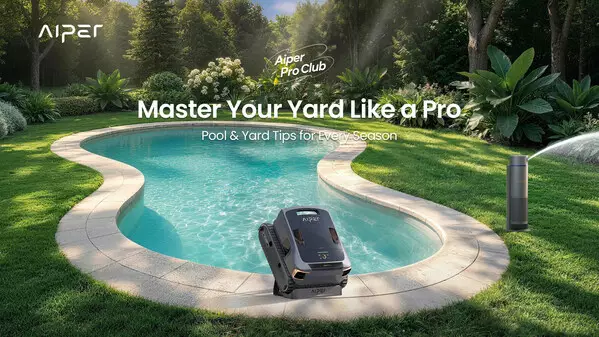
Aiper Builds Expert-Led Backyard Care Community Through New Aiper Pro Club Initiative