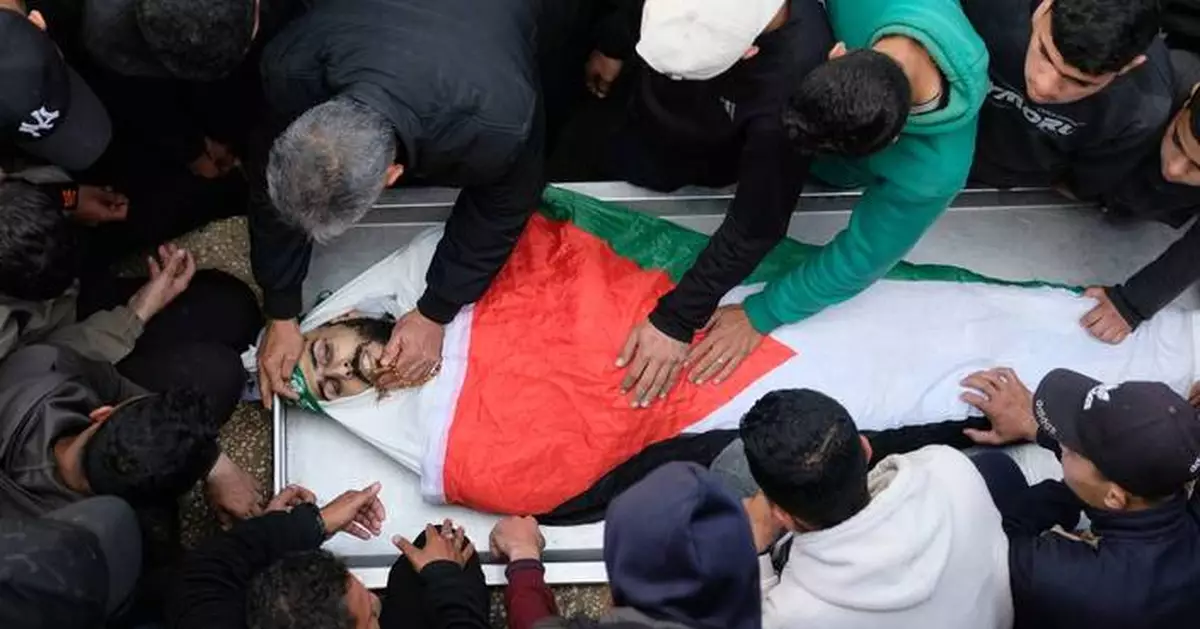
DEIR AL-BALAH, Gaza Strip (AP) — An Israeli drone strike killed two Palestinians on bicycles Tuesday, hospital officials said, marking the latest deaths since an October ceasefire that hasn't halted deadly attacks in the Gaza Strip.
Al-Aqsa Martyrs Hospital said the two men were hit near the ceasefire line that divides Gaza, with one half under Israeli military control. They were hit in eastern Deir al-Balah, the hospital said, adding that it also received the body of a woman who was killed by Israeli gunfire in central Maghazi refugee camp.
Israel's military did not immediately respond to questions about either strike. It has previously said its forces respond to ceasefire violations or attacks on its soldiers.
Gaza's Health Ministry on Tuesday reported 586 Palestinians had been killed since the start of the ceasefire, bringing the cumulative toll to 72,037 killed since the start of Israel's offensive. The ministry, which is part of the Hamas-led government, maintains detailed casualty records that are seen as generally reliable by U.N. agencies and independent experts. But it does not not give a breakdown of civilians and militants.
Deadly Israeli strikes have repeatedly disrupted the truce since it took effect on Oct. 10. The escalating Palestinian toll has prompted many in Gaza to say it feels like the war has continued unabated.
Yet parts of the agreement outlined in last year’s ceasefire are moving forward. After a chaotic first week, officials say more Palestinians are entering and leaving Gaza for Egypt via the reopened Rafah crossing. Plans for an international peacekeeping force meant to provide security in Gaza are also beginning to take shape.
Indonesia — the world's most populous Muslim-majority country — said Tuesday that its military had begun training personnel to serve in Gaza, specifically for reconstruction and humanitarian response. Its army chief of staff said between 5,000 and 8,000 troops were preparing to deploy.
Vahd Nabyl Achmad Mulachela, a spokesperson for Indonesia’s Foreign Affairs Ministry, said Indonesian troops would not take part in disarmament — one of the most contentious and unresolved elements of the peace plan.
Indonesia’s President Prabowo Subianto told the U.N. General Assembly in October that his country planned to contribute troops, even as details about the force’s role and mandate was unclear. The commitment came as Prabowo sought closer ties with U.S. President Donald Trump.
Israel and Hamas remain divided over the timeline and scope of Israel’s withdrawal and the demilitarization of the enclave after nearly two decades of Hamas rule.
The temporary International Stabilization Force outlined last year in Trump’s 20-point peace plan — among the key components of the demilitarization effort— is envisioned as a later phase of the plan.
The war began when Hamas-led militants stormed into southern Israel and killed around 1,200 people, mostly civilians, on Oct. 7, 2023. The 251 hostages taken in the attack were returned to Israel in various ceasefire agreements, with the remains of Israeli police officer Ran Gvili — the final body in Gaza — were found and returned in January, paving the way for the advance of the ceasefire agreement. The war has sparked worldwide protests and brought allegations of genocide that Israel denies.
Tarigan reported from Jakarta, Indonesia. Samy Magdy and Sam Metz contributed from Cairo and Ramallah, West Bank.
Find more of AP’s coverage at https://apnews.com/hub/israel-hamas-war
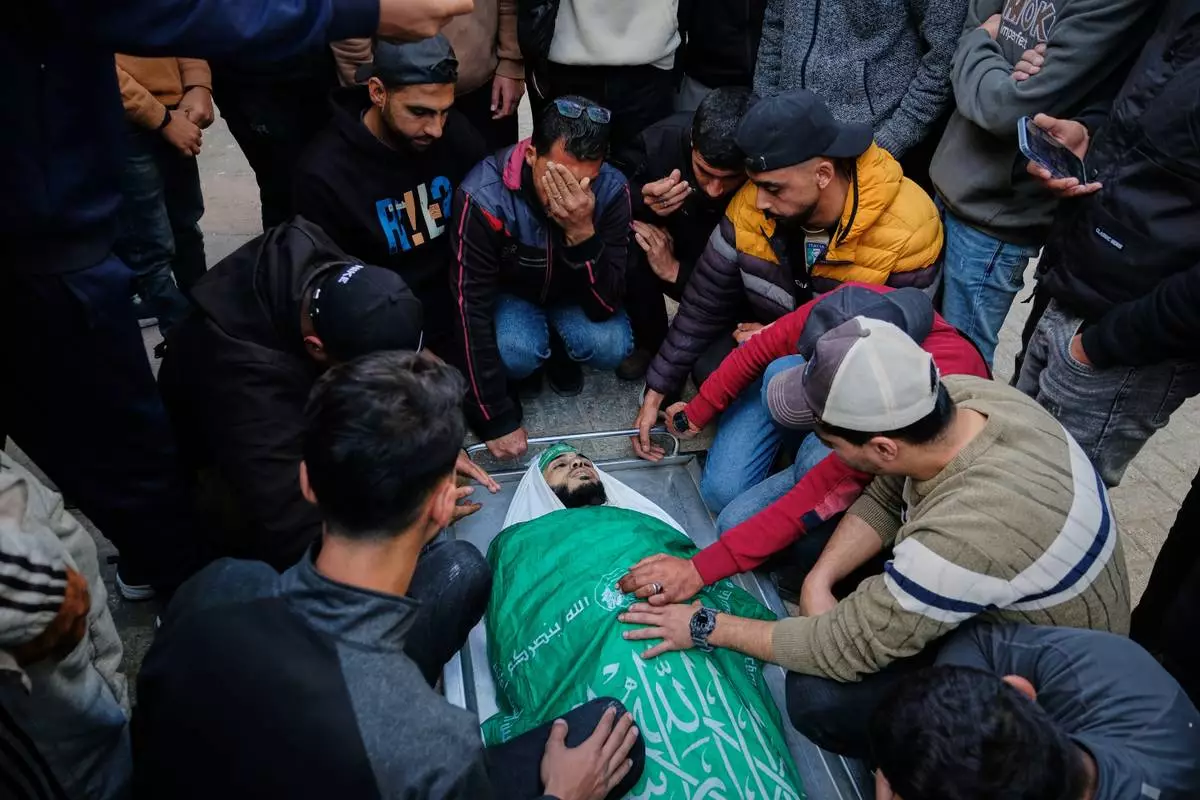
Palestinians mourn over the flag-draped body of a Hamas militant Ahmed Sweilem, killed in an Israeli army strike, during his funeral in Gaza City, Tuesday, Feb. 10, 2026. (AP Photo/Jehad Alshrafi)
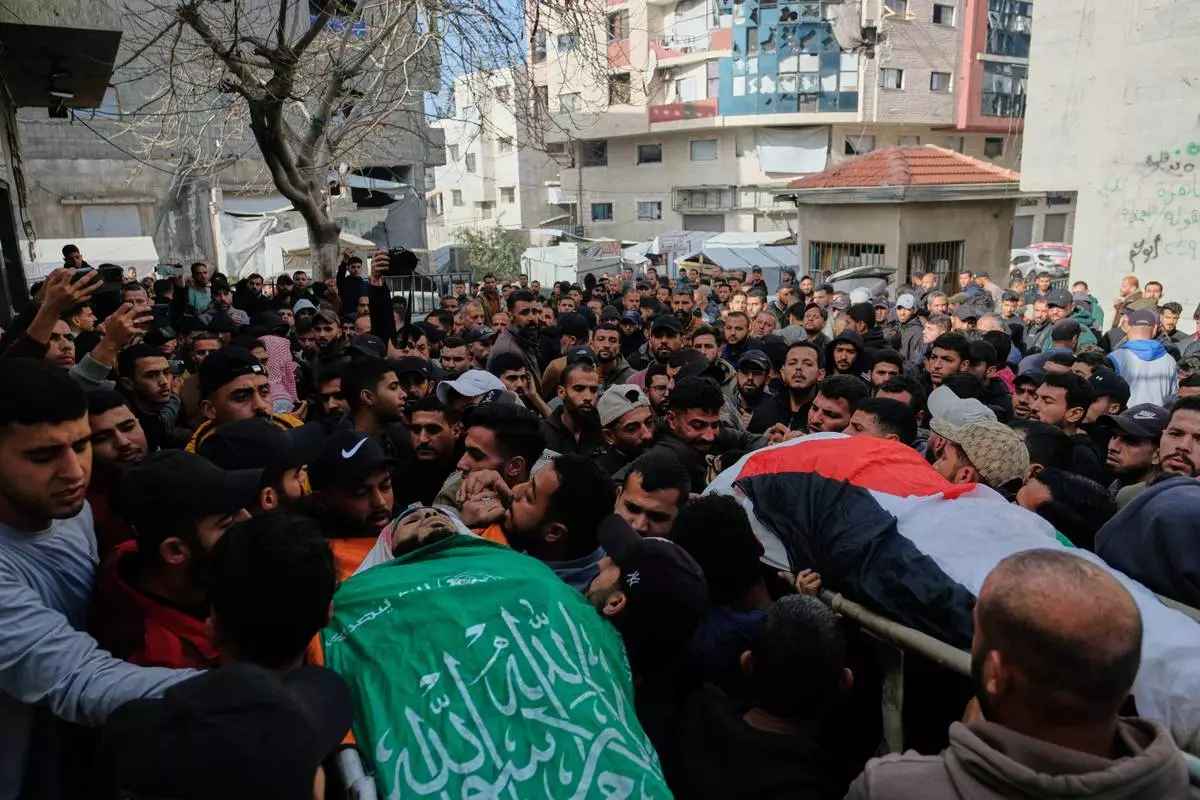
Palestinians carry the flag-draped bodies of two Hamas militants, Ahmed Sweilem, left, and Ibrahim Al-Za'anin, who were killed in an Israeli army strike, during their funeral in Gaza City, Tuesday, Feb. 10, 2026. (AP Photo/Jehad Alshrafi)
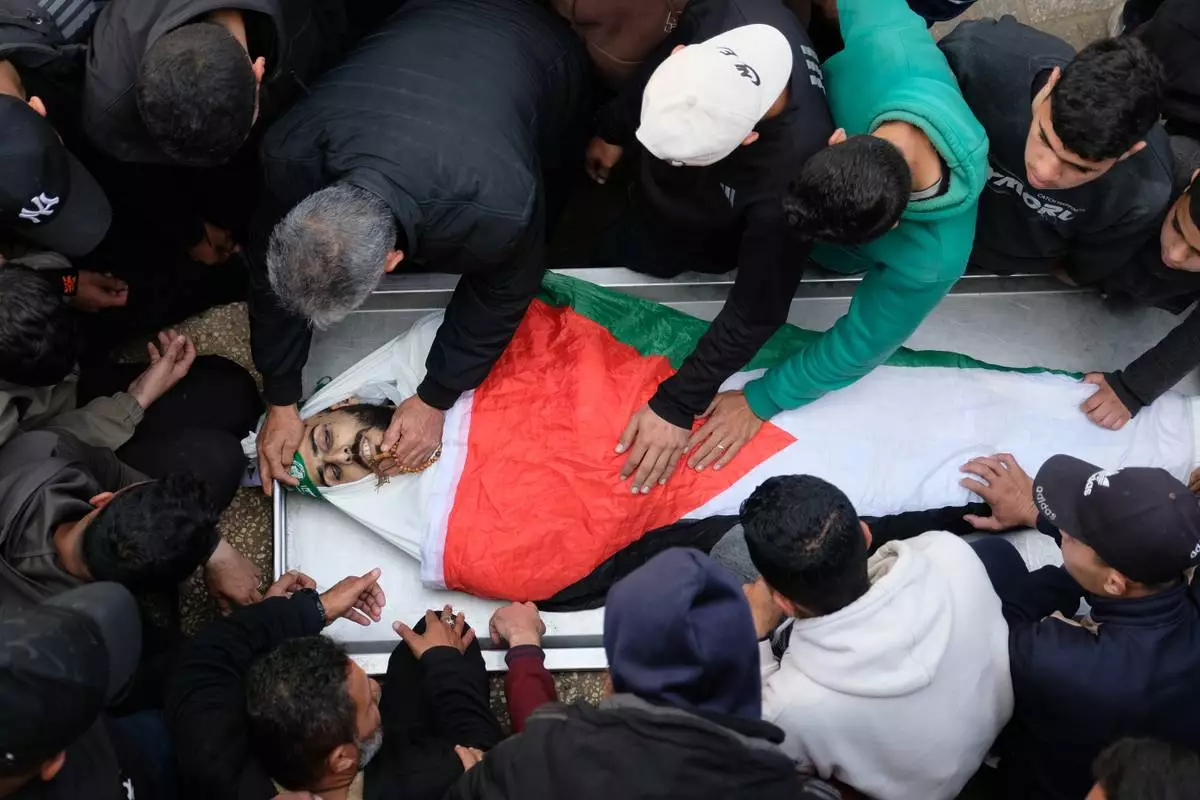
Palestinians mourn over the flag-draped body of a Hamas militant Ibrahim Al-Za'anin, killed in an Israeli army strike, during his funeral in Gaza City, Tuesday, Feb. 10, 2026. (AP Photo/Jehad Alshrafi)
PHOENIX (AP) — UConn's Geno Auriemma was not a happy man.
With the officiating. With his team's performance. With South Carolina coach Dawn Staley.
The Huskies coach ripped into the officiating during a live TV interview and then had a heated argument with Staley in the final seconds of their 62-48 loss to the Gamecocks. But a rough night for UConn stars Sarah Strong and Azzi Fudd was the main cause of the Huskies' poor showing in the national semifinals of the women's Final Four on Friday night.
A minute after his sideline blowup, Auriemma stalked off the floor alone, stewing over the nightmare performance.
Fudd — a senior — shouldered the blame, saying she felt she let the team down.
“I thought some of our shots were a little rushed, some of our offense was a little rushed, out of pace,” Fudd said. “But when we got a lot of good looks, a lot of shots in our offense, shots that we are used to taking, we just didn’t hit very many.”
The Huskies hadn't faced much on-court adversity this season, winning almost all of their previous 38 games by a lopsided margin. Once it hit on Friday, UConn wasn't able to respond.
Auriemma said the officiating didn't help.
“There were six fouls called that quarter — all of them against us," Auriemma said on the broadcast at the end of the third quarter. "And they’ve been beating the (expletive) out of our guys down there the entire game. I’m not making excuses, ’cause we haven’t been able to make a shot. But this is ridiculous.
“Their coach rants and raves on the sideline and calls the referee some names you don’t want to hear. And now we get 6 to 0, and I got a kid with a ripped jersey, and they go, ‘I didn’t see it.’ Come on, man. It’s for a national championship.”
Auriemma wasn't finished showing his displeasure. The 72-year-old coach walked toward Staley in the final seconds of the game before the two had an angry exchange, with assistants having to get in between them. Auriemma blamed the dustup on Staley not following the proper protocol for a pregame handshake.
Once the game finally ended, Auriemma slowly walked off the court and down the tunnel without a postgame handshake with the Gamecocks. The teams did shake hands.
UConn has relied all season on Strong and Fudd, a pair of All-America selections who were steady throughout the season. Against South Carolina, Strong finished with just 12 points on 4-of-16 shooting. Fudd scored eight on 3-of-15 shooting, including 2 of 9 from long range.
The Huskies' lone offensive bright spot came midway through the third quarter. Kayleigh Heckel, Blanca Quiñonez and Fudd each hit a 3-pointer in a 90-second span to cut the deficit to 40-39, but UConn was never able to take the lead. South Carolina took a 44-39 advantage into the fourth quarter and slowly pulled away.
UConn scored just nine points in the fourth, shooting 2 of 14 from the field. The 48 points were easily a season low. The Huskies were also dominated on the glass, with South Carolina holding a 47-32 advantage.
It's true that it was a physical game. Bodies were flying under the basket for the majority of the night for both teams. UConn was whistled for 17 fouls, while South Carolina was called for just eight.
The problem for Strong and Fudd was they couldn't hit shots even when they had a little space to operate. The 6-foot-2 Strong — AP's Player of the Year — was bothered by South Carolina's interior size, with several of her inside shots rattling in and out.
“Well, sometimes we do forget she’s a sophomore,” Auriemma said. “She’s carried a huge load for this team. An awful lot falls on her. Tonight she’ll be the first to tell you that she is not proud of how her game went today.”
Strong's teammates couldn't pick up the slack. Ashlynn Shade finished with 10 points and Quiñonez added seven. Heckel missed a layup late in the game and the broadcast showed her starting to cry walking back down the court.
Teammates encouraged her and one even lifted her chin, but the damage was done.
UConn’s 54-game winning streak is over.
AP March Madness bracket: https://apnews.com/hub/ncaa-womens-bracket and coverage: https://apnews.com/hub/march-madness
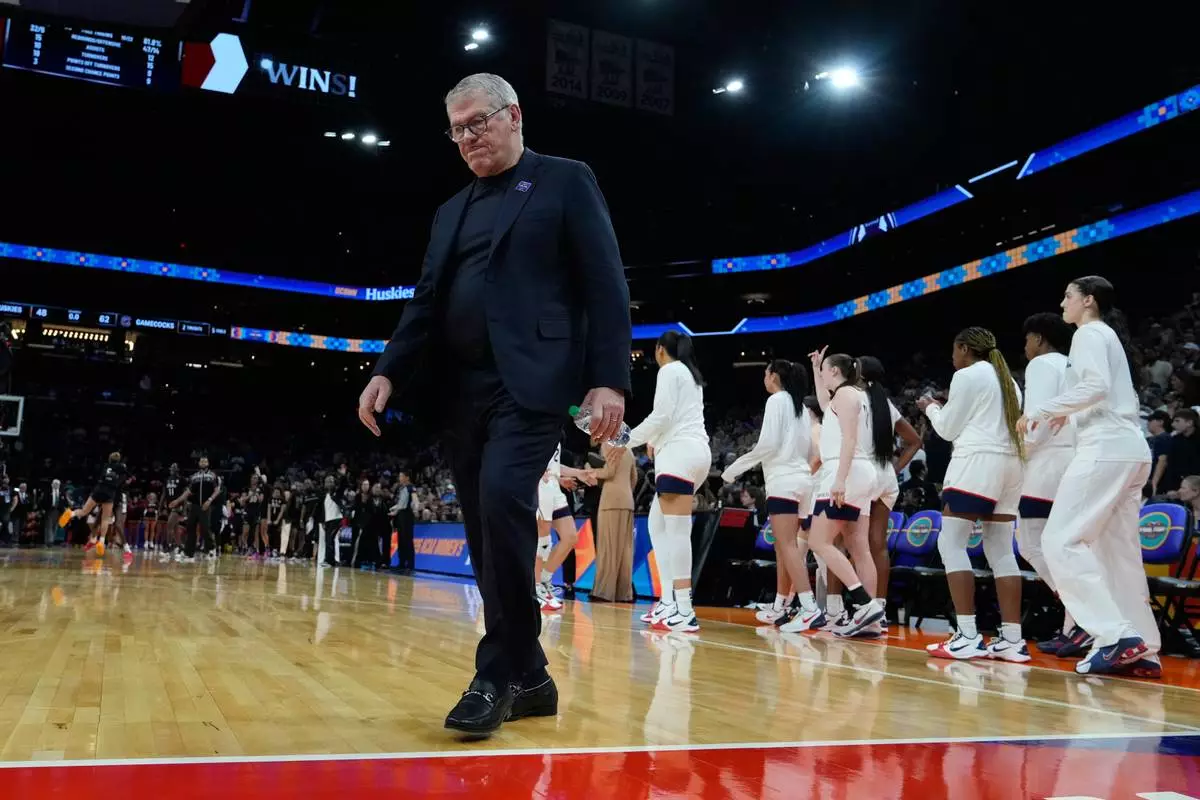
UConn head coach Geno Auriemma reacts after during the second half of a woman's NCAA college basketball tournament semifinal game between UConn and South Carolina at the Final Four, Friday, April 3, 2026, in Phoenix. (AP Photo/Ross D. Franklin)
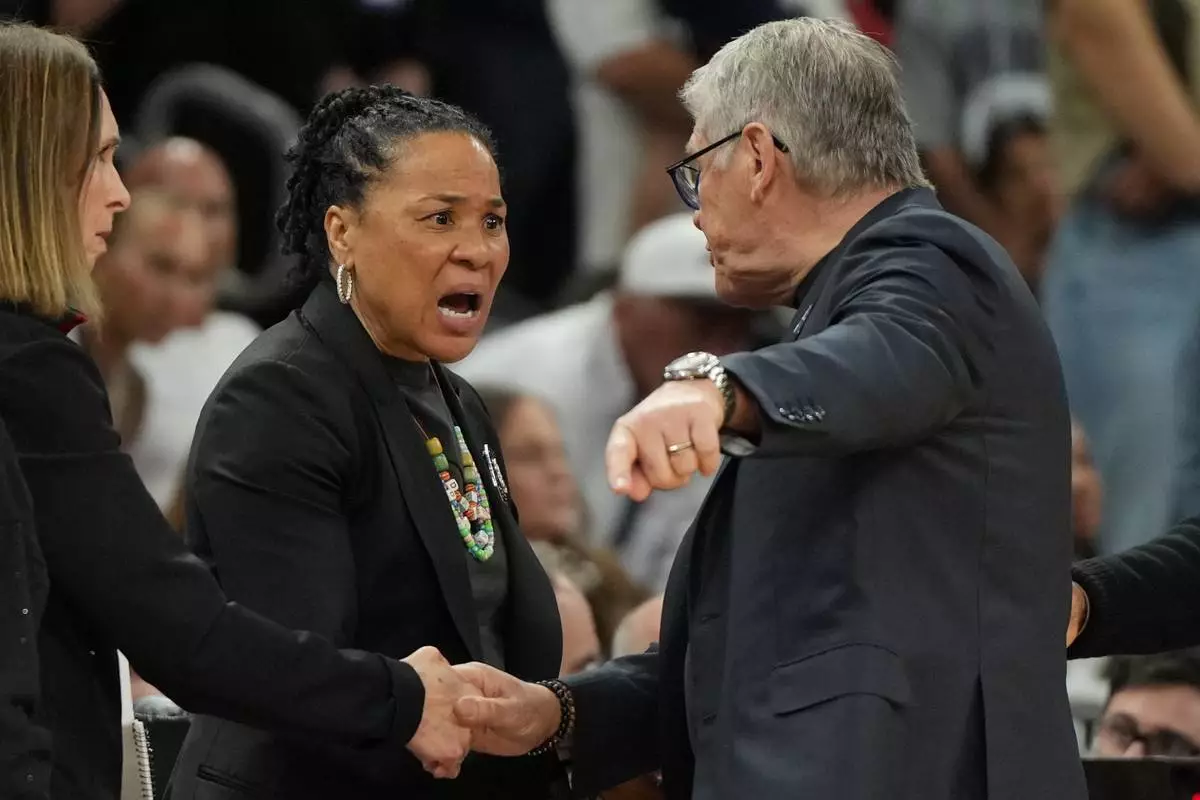
South Carolina head coach Dawn Staley, left, and UConn head coach Geno Auriemma argue after a woman's NCAA college basketball tournament semifinal game at the Final Four, Friday, April 3, 2026, in Phoenix. (AP Photo/Rick Scuteri)
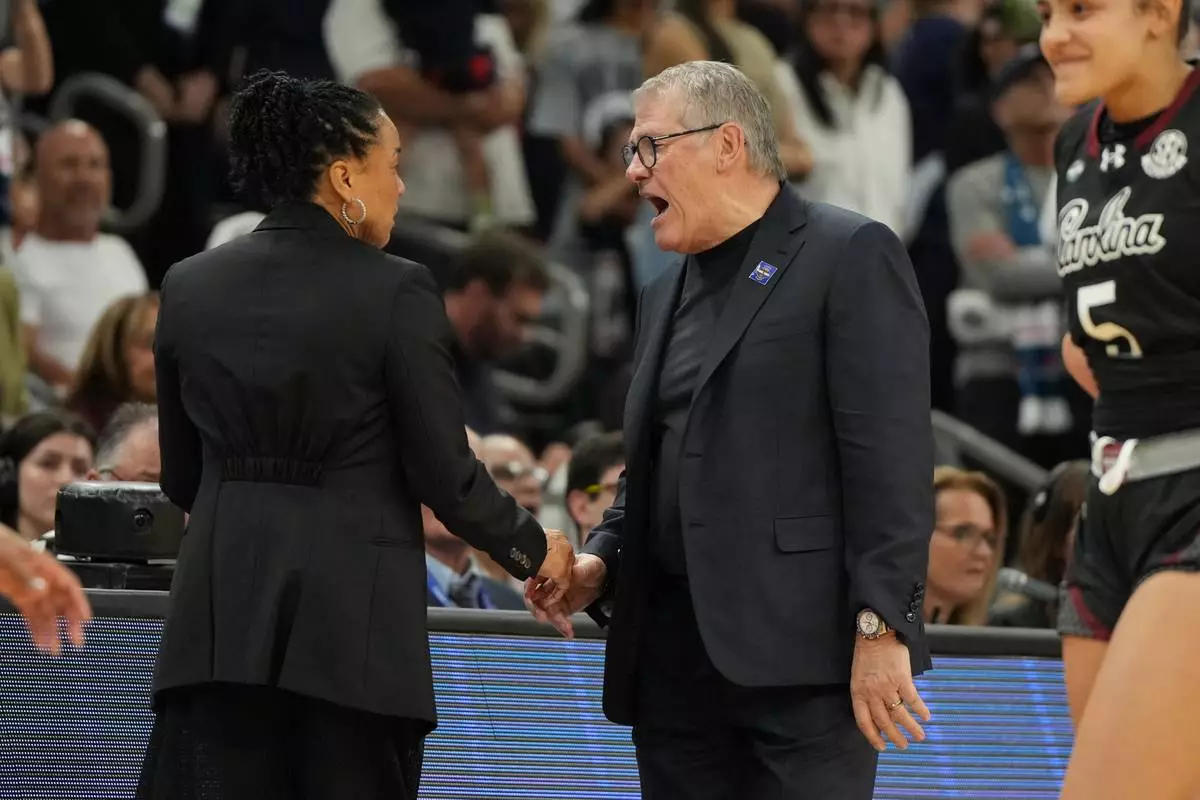
South Carolina head coach Dawn Staley, left, and UConn head coach Geno Auriemma argue after a woman's NCAA college basketball tournament semifinal game at the Final Four, Friday, April 3, 2026, in Phoenix. (AP Photo/Rick Scuteri)
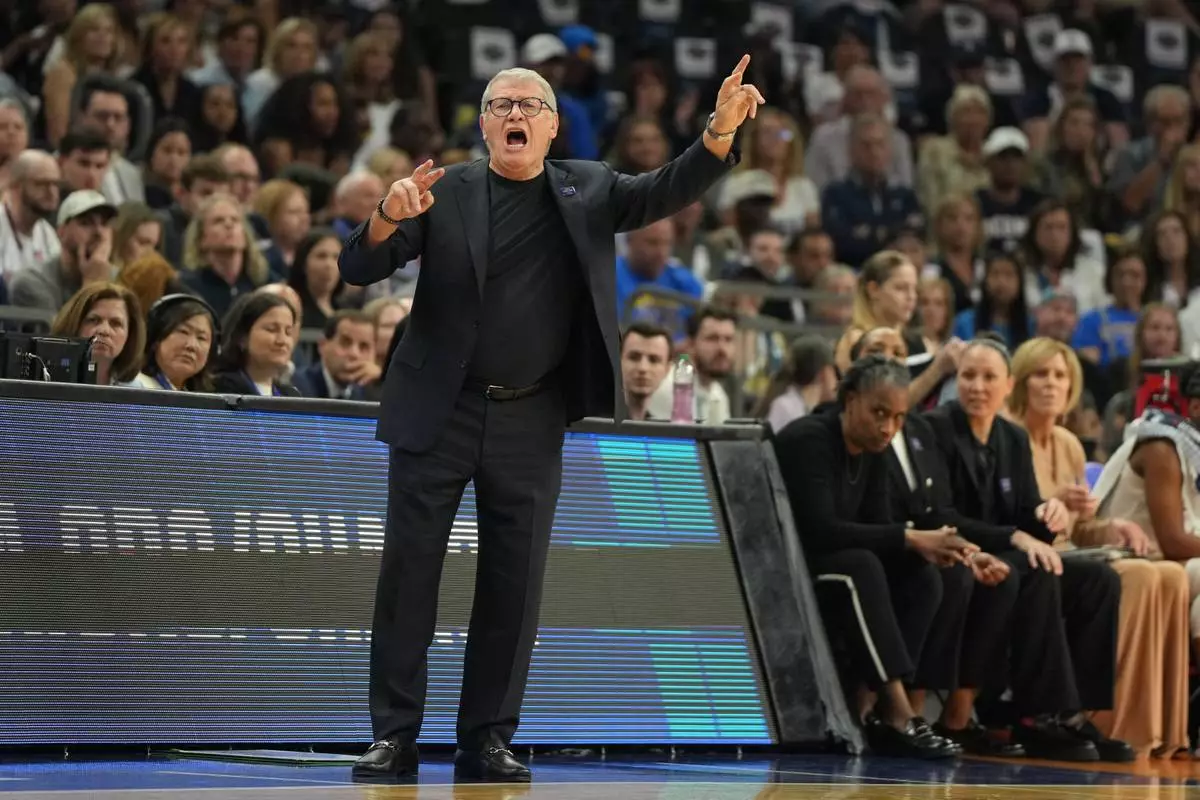
UConn head coach Geno Auriemma motions towards the court during the first half of a woman's NCAA college basketball tournament semifinal game between UConn and South Carolina at the Final Four, Friday, April 3, 2026, in Phoenix. (AP Photo/Rick Scuteri)
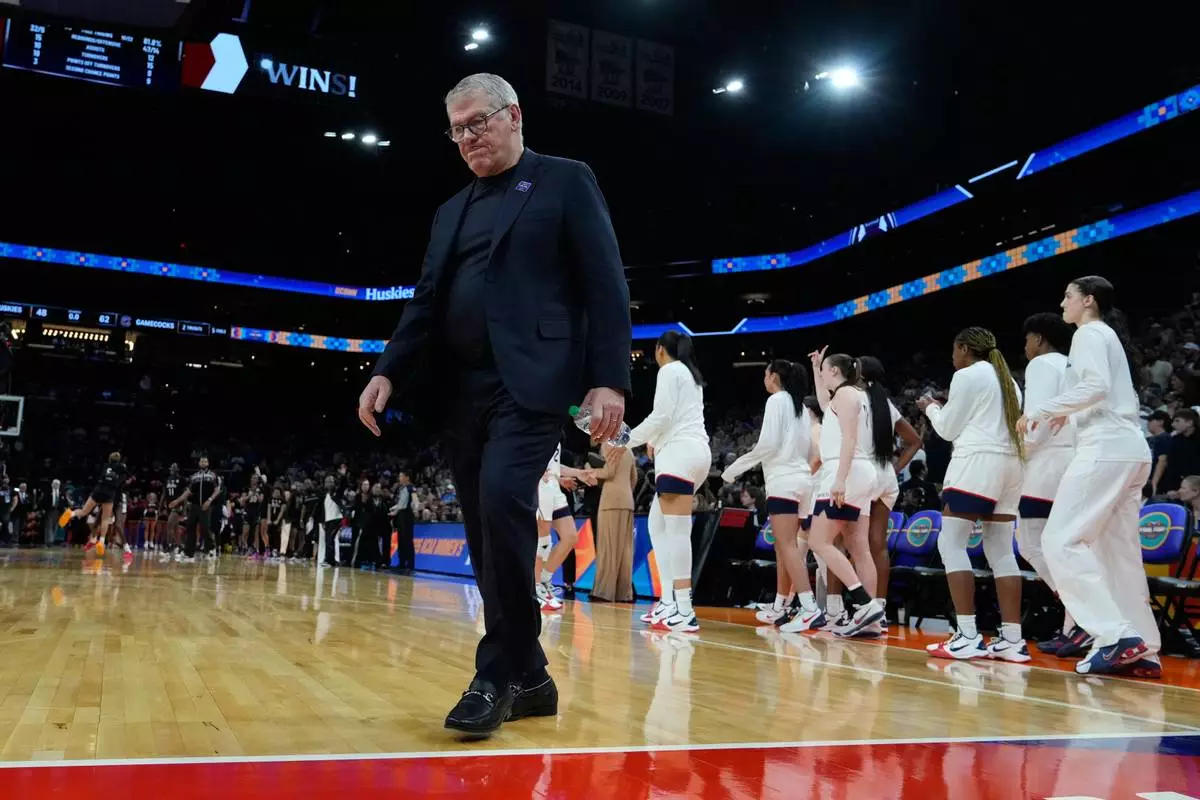
UConn head coach Geno Auriemma reacts after during the second half of a woman's NCAA college basketball tournament semifinal game between UConn and South Carolina at the Final Four, Friday, April 3, 2026, in Phoenix. (AP Photo/Ross D. Franklin)
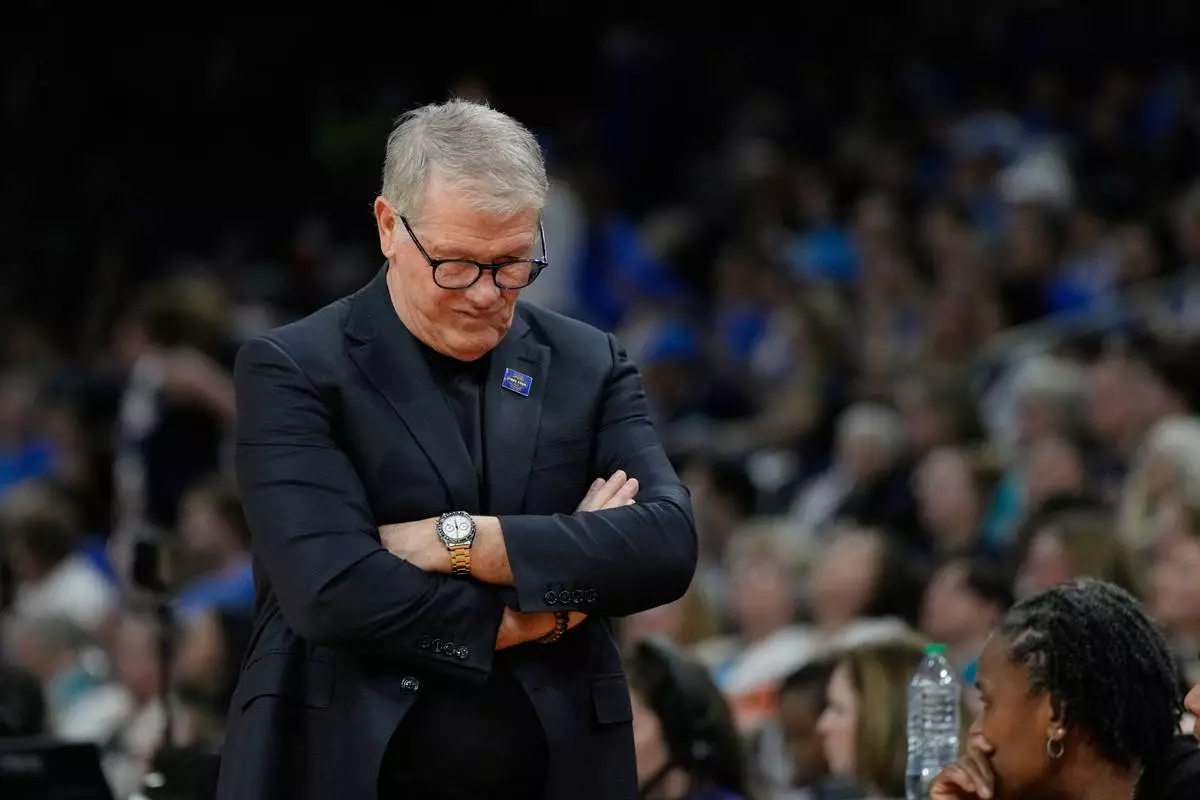
UConn head coach Geno Auriemma reacts during the second half of a woman's NCAA college basketball tournament semifinal game between UConn and South Carolina at the Final Four, Friday, April 3, 2026, in Phoenix. (AP Photo/Ross D. Franklin)
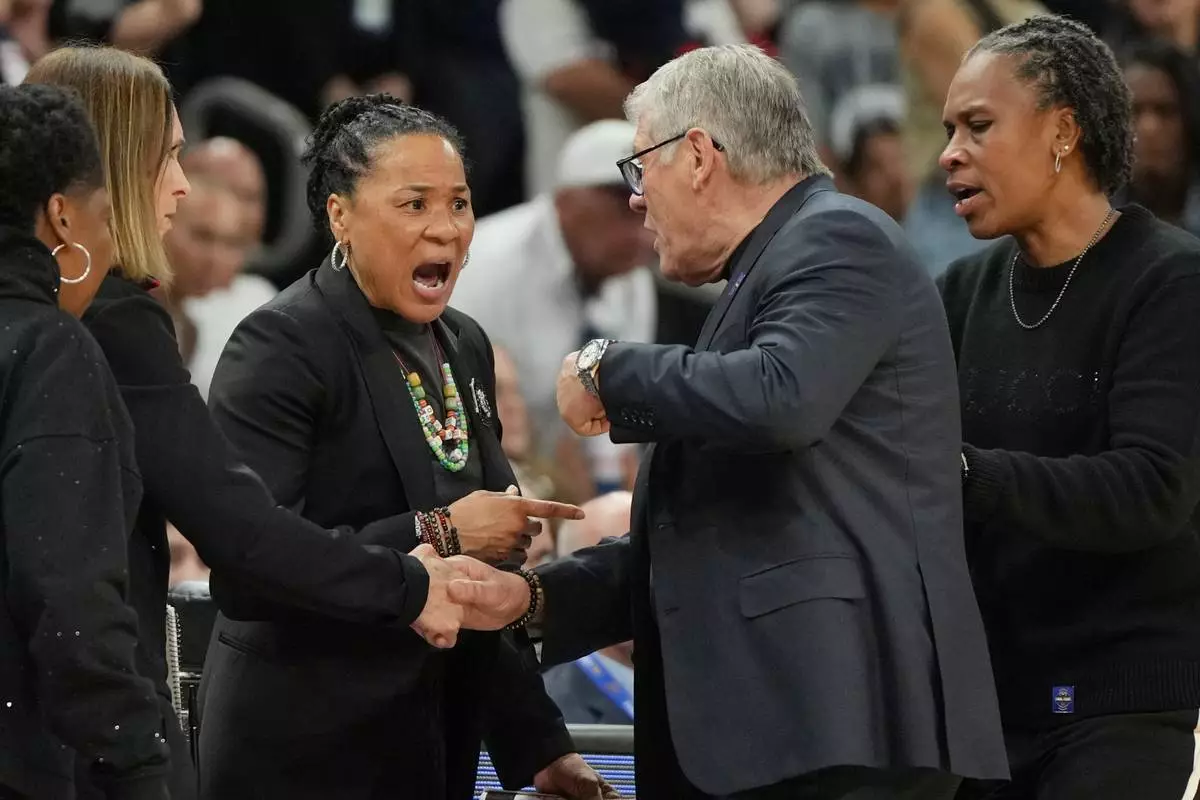
South Carolina head coach Dawn Staley, left, and UConn head coach Geno Auriemma argue after a woman's NCAA college basketball tournament semifinal game at the Final Four, Friday, April 3, 2026, in Phoenix. (AP Photo/Rick Scuteri)