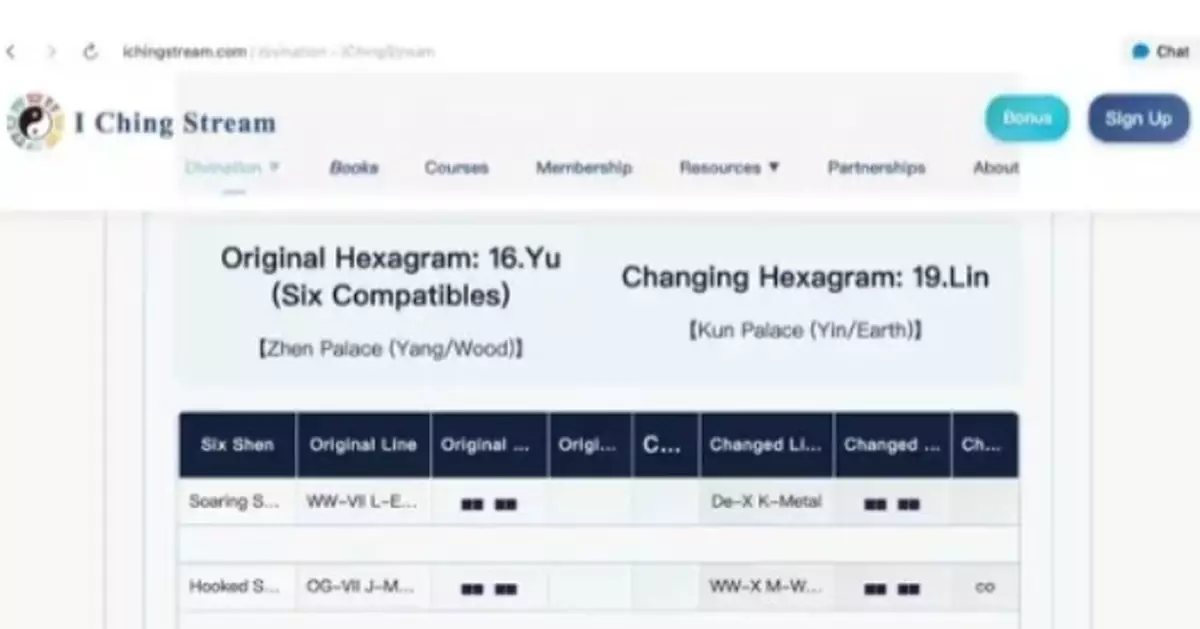
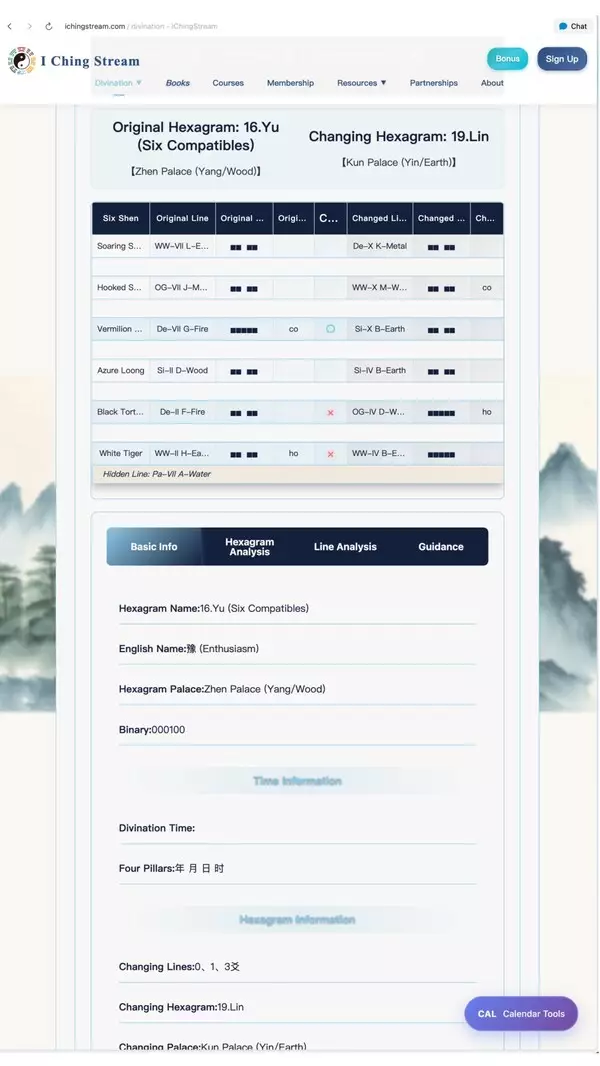
NEW YORK, Feb. 11, 2026 /PRNewswire/ -- I Ching Stream has launched its comprehensive English-language platform, ichingstream.com, offering international readers a structured pathway into the I Ching as it is actually practiced in China today. Founded by Xuan Wanyan, the platform addresses a longstanding gap in the field: the absence of a coherent, practice-oriented English library of core classics centered on the Na Jia method (Wen Wang Gua).
In the English-speaking world, modern engagement with these materials has historically been shaped by a small number of influential twentieth-century translations, including editions associated with Richard Wilhelm and James Legge. These works created an enduring entry point for many readers and remain important to the modern reception of the tradition. Within that early English-language lens, the best-known procedural layer has often been the Great Expansion yarrow-stalk method, documented and discussed in major translations and studies as a classical casting procedure.
In parallel, global interest in Chinese history and cultural systems has accelerated in recent years, including popular online discourse framed as "Very Chinese Time" or "Chinamaxxing." I Ching Stream responds to this momentum through a disciplined, source-based framework, emphasizing long-term study, structure, and editorial rigor rather than trend-driven appropriation.
However, beyond this well-documented layer, technically central materials preserved in Chinese sources have remained difficult to access in English as coherent systems. Among these, the Na Jia method (Wen Wang Gua), a core framework in mainstream practice, has long lacked comprehensive, system-based representation. English resources have often appeared as fragmented excerpts, secondary commentary, or inconsistent terminology, limiting readers' ability to track structure across long texts, follow recurring symbols, or compare parallel passages across multiple classics.
I Ching Stream addresses this structural gap through systematic translation and editorial organization of core Na Jia classics, alongside closely related technical works, presented as a unified English-language library grounded in primary sources. The goal is to transmit these sources as internally coherent systems that can be studied consistently in English.
A key obstacle in translation is the handling of cyclical symbols used throughout classical Chinese texts and the traditional Chinese calendar. To preserve their functional role while keeping the page readable in English, I Ching Stream publishes a standardized notation system: for Chinese calendar usage, the Ten Heavenly Stems are rendered as Roman numerals (Jia=I, Yi=II, Bing=III, Ding=IV, Wu=V, Ji=VI, Geng=VII, Xin=VIII, Ren=IX, Gui=X) and the Twelve Earthly Branches as stable letter codes (Zi=A, Chou=B, Yin=C, Mao=D, Chen=E, Si=F, Wu=G, Wei=H, Shen=J, You=K, Xu=L, Hai=M), applied consistently across editions.
"The difficulty is not vocabulary alone," said founder Xuan Wanyan. "These texts are highly structured. If translation loses structural consistency, readers lose the system. Our work focuses on preserving internal mechanics while presenting them in a form English readers can actually follow."
Xuan Wanyan is a Columbia University graduate and a U.S. CPA with an applied AI background and international experience. She has spent years studying traditional Chinese culture and previously held financial management roles at multinational companies. She founded I Ching Stream to build scalable English-language publishing infrastructure and notation standards for technically dense classical Chinese source literature.
Since launch, I Ching Stream has attracted readers across North America, Europe, and Latin America, including independent scholars, translators, educators, and serious learners. Additional translations and supporting study resources are planned throughout 2026 as the platform continues building a durable English-language foundation and a scalable publishing-and-tools infrastructure for global readers.
About I Ching Stream
I Ching Stream is an English-language platform dedicated to the systematic translation and presentation of classical Chinese texts centered on the Na Jia method (Wen Wang Gua), image-based analysis, and the Great Expansion method. Through source-based editions, consistent terminology, and standardized notation for calendar-based cyclical markers, the platform provides coherent access to materials that have long remained fragmented or unavailable in English. In addition, I Ching Stream offers a professional-grade charting (casting) and reference tool designed to support structured study and responsible use, similar in format to familiar consumer apps, but built for serious learners and technical accuracy. Learn more at: https://www.ichingstream.com
Contact
I Ching Stream
contact@ichingstream.com
** The press release content is from PR Newswire. Bastille Post is not involved in its creation. **
I Ching Stream Launches English-Language Platform and Publishes a Standardized Notation Framework for Classical Chinese Technical Texts


JAKARTA, Indonesia, June 19, 2026 /PRNewswire/ -- As global legal complexity intensifies alongside rapid digital transformation and rising international standards, the quality of Indonesia's legal profession is becoming an increasingly important determinant of the country's competitiveness. The message took center stage at the Hukumonline Practice Leaders 2026 and Top 100 Indonesian Law Firms 2026 awards ceremony held at Raffles Jakarta.
Syamsul Maarif, Chief of the Development Chamber of the Supreme Court of Indonesia, said the future of Indonesia's legal system would depend not merely on technological sophistication or an expanding regulatory framework, but on the integrity and professionalism of the entire legal ecosystem, including lawyers and law firms.
"In the legal profession, there are at least three forces that guide every decision we make: reason, instinct, and conscience," Maarif said in his keynote address, titled Dignified Justice: From Digital Innovation to Global Standards Amid Legal Complexity.
Maarif said reason allows legal professionals to approach legal issues with clarity and rational judgment, while instinct helps them navigate changing circumstances and contextual nuances. Conscience, meanwhile, serves as a moral compass, reminding practitioners that behind every legal matter are individuals whose lives may be affected by the decisions they make.
For that reason, he said, intellectual capability alone is insufficient. The effective use of knowledge and technology must be guided by wisdom, ethical judgment, and a commitment to human values.
At an event themed "Leading Beyond Complexity: Indonesia's Global Legal Edge," Maarif said Indonesia's legal system is increasingly aligned with global standards. He highlighted the Supreme Court's digital transformation initiatives, including e-Court, e-Litigation, and other integrated judicial services, as key measures aimed at improving transparency, accountability, and access to justice across the judiciary.
The Supreme Court and courts nationwide handled more than three million cases in 2025, resolving approximately 97 percent of them. Syamsul said the achievement underscores the growing maturity of the judiciary's digital transformation and its impact on the efficiency of court services.
However, he cautioned that modernization extends beyond the adoption of new technologies. Any transformation of the legal system, he said, must be grounded in integrity and guided by the principles of substantive justice.
Maarif also pointed to Indonesia's deepening integration with the international legal community. Developments such as the recognition of Indonesian court decisions in foreign jurisdictions, Indonesia's accession to the Hague Conference on Private International Law (HCCH), and plans to establish the Indonesia Financial Center (IFC) signal a more interconnected legal landscape and increasingly complex cross-border challenges for the country's legal profession.
In this increasingly interconnected environment, Indonesian law firms have a strategic role to play in raising service standards, strengthening specialist expertise, and developing the capabilities required to meet the evolving needs of clients at home and abroad.
"I congratulate all law firms recognized in this year's Practice Leaders and Top 100 Indonesian Law Firms rankings. This recognition reflects the professionalism, dedication, and hard work they have demonstrated," Maarif said.
He expressed hope that the recognition would encourage law firms to continue upholding professional integrity, enhancing service quality, and pursuing innovations that deliver meaningful benefits to society.
Hukumonline Chief Executive Officer Arkka Dhiratara said the awards ceremony was not merely a celebration of achievement, but also an opportunity to recognize the resilience and adaptability of Indonesian law firms as they respond to an increasingly dynamic and fast-changing landscape.
"Ultimately, a law firm's success is measured not only by its reputation or scale, but by its ability to earn trust, deliver solutions, and create meaningful value for clients," Dhiratara said.
Dhiratara said businesses and legal professionals are navigating an increasingly challenging landscape shaped by economic headwinds, geopolitical uncertainty, evolving global trade dynamics, and the rapid rise of artificial intelligence. As a result, clients are demanding more than technical legal expertise, expecting advice that is delivered with greater speed, strategic insight, and operational efficiency.
Despite the headwinds, Dhiratara said the outlook for Indonesia's legal profession remains strong. Growth in investment, the acceleration of digital transformation, and heightened demand for governance, compliance, and risk management are creating significant opportunities for law firms and legal professionals.
Hukumonline noted that an increasing number of Indonesian law firms are strengthening their market positions by deepening specialist expertise, investing in technology, and adopting service models that place greater emphasis on client needs. Collaboration has also become a defining feature of the legal market, with firms increasingly partnering on cross-border transactions, international disputes, and large-scale domestic matters.
Against this backdrop, Hukumonline continues to present its Practice Leaders and Top 100 Indonesian Law Firms awards, Dhiratara said. Now in its ninth year, the annual program recognizes legal professionals and law firms that have distinguished themselves through excellence in client service, professional leadership, and contributions to the development of Indonesia's legal sector.
** This press release is distributed by PR Newswire through automated distribution system, for which the client assumes full responsibility. **
Indonesia's Supreme Court Urges Lawyers to Uphold Reason, Instinct, and Conscience Amid Growing Legal Complexity