Skip to Content Facebook Feature Image

Dave & Cheryl Duffield Foundation Provides $1.9M Grant for Yes to Care Program, a Collaboration to Improve Access to Veterinary Care

Business

Dave & Cheryl Duffield Foundation Provides $1.9M Grant for Yes to Care Program, a Collaboration to Improve Access to Veterinary Care
Business

Business

Dave & Cheryl Duffield Foundation Provides $1.9M Grant for Yes to Care Program, a Collaboration to Improve Access to Veterinary Care

2026-02-12 18:17 Last Updated At:02-13 16:46

GRAND RAPIDS, Ohio--(BUSINESS WIRE)--Feb 12, 2026--

Open Door Veterinary Collective has announced a $1.9 Million grant from the Dave & Cheryl Duffield Foundation, a private charitable foundation based in Incline Village, Nevada, to develop and implement the Yes to Care program. This three-year unique collaborative pilot program will provide solutions for veterinary teams, and ultimately pet families, to address the rising cost of veterinary care.

This press release features multimedia. View the full release here: https://www.businesswire.com/news/home/20260212297121/en/

Open Door Veterinary Collective has partnered with Varidi and The myBalto Foundation to deliver the Yes to Care Program. Participating veterinary practices will be supported with training, tools and $5,000 to kickstart practices’ Angel Fund to help clients say yes to treatment recommendations:

Financial Barriers are Limiting Access to Care

A recent Gallup survey indicates that 94% of veterinarians say that clients’ financial considerations sometimes or often limit their ability to provide care. A second Gallup survey found 52% of U.S. pet owners skipped needed veterinary care in the past year, with 71% citing cost as the key factor. As a result, millions of pets go without care they need.

For Open Door Veterinary Collective, Varidi and The myBalto Foundation, the data underscores the need for additional support for veterinary teams as they navigate access to care challenges.

“Financial limitations don’t just affect clients, they directly impact clinical outcomes, professional fulfillment, and the sustainability of veterinary practices,” said Aimee St. Arnaud, founder of Open Door Veterinary Collective. “Our goal is to give veterinary teams the framework and proven, research-backed payment solutions to help their clients be able to say yes to more treatment recommendations. When teams have the right tools for conversations, it reduces stress and helps build trust.”

Robert Parkins, DVM, co-founder of myBalto Foundation and a veterinarian, understands this firsthand. “Veterinarians get into this profession to help pets and it causes stress when financial constraints limit care they’re able to provide.”

Varidi sees this all too often, “Care is the veterinary teams’ job, making it accessible is ours. Our tool is no interest, no credit checks, and no risk – just more Yes ,” said Andrew McDonald, Chief Sales Officer, Varidi, Inc.

Addressing these financial barriers requires investment in practical solutions that work for both veterinary teams and their clients. “Access to veterinary care isn’t about a single financial tool, it’s about making the right decisions at the right time,” said Elsa Patterson, Program Administrator, Dave & Cheryl Duffield Foundation. “The Yes to Care program reflects the kind of collaborative, practical approach we believe is needed to help practices create more intentional paths to care for their clients.”

How to Get Involved

Practices interested in taking part in the initiative or learning more should visit www.yestocare.org to fill out an application for consideration. Space is limited in this pilot program. Visit our booth #4565 at the Western Veterinary Conference in Las Vegas, February 16-18, 2026 to find out more.

About Open Door Veterinary Collective

Open Door Veterinary Collective is a non-profit organization with a focus on building a national network of financially friendly veterinary service available within 50 miles of every U.S. pet owner by 2034 through mentorship, online learning, research, and connecting pet parents to pet services through pethelpfinder.org.

About Varidi

Varidi is a risk-free, in-house payment plan platform that helps veterinary clinics say yes to care without turning pet parents into debtors. By guaranteeing clinic payments while keeping costs transparent and interest-free for families, Varidi removes financial friction in the moment it matters most.

About myBalto Foundation

The myBalto Foundation is a personalized Angel Fund for veterinary hospitals that enables them to provide a lifeline for pets in need. We specialize in creating unique fundraising strategies that provide sustainable community support.

About Duffield Foundation

The Dave & Cheryl Duffield Foundation (DCDF) carries forward the Duffield family's legacy of supporting transformational programs and services in three core areas: pairing Veterans with Service Dogs, expanding access to care for companion animals, and strengthening local public service organizations. Founded in 2016, DCDF is part of the Duffield Foundation Family, which also includes Maddie’s Fund—a national leader in advancing the well-being of companion animals—and Liberty Dogs, a new Service Dog training facility dedicated to providing life-changing support for Military Veterans living with PTSD.
The Dave & Cheryl Duffield Foundation (DCDF) carries forward the Duffield family's legacy of supporting transformational programs and services in three core areas: pairing Veterans with Service Dogs, expanding access to care for companion animals, and strengthening local public service organizations. Founded in 2016, DCDF is part of the Duffield Foundation Family, which also includes Maddie’s Fund—a national leader in advancing the well-being of companion animals—and Liberty Dogs, a new Service Dog training facility dedicated to providing life-changing support for Military Veterans living with PTSD. https://www.duffieldfoundation.org/
The Dave & Cheryl Duffield Foundation (DCDF) carries forward the Duffield family's legacy of supporting transformational programs and services in three core areas: pairing Veterans with Service Dogs, expanding access to care for companion animals, and strengthening local public service organizations. Founded in 2016, DCDF is part of the Duffield Foundation Family, which also includes Maddie’s Fund—a national leader in advancing the well-being of companion animals—and Liberty Dogs, a new Service Dog training facility dedicated to providing life-changing support for Military Veterans living with PTSD. https://www.duffieldfoundation.org/

The Yes to Care program is a three-year unique collaborative pilot program that will provide solutions for veterinary teams, and ultimately pet families, to address the rising cost of veterinary care. https://yestocare.org/

The Yes to Care program is a three-year unique collaborative pilot program that will provide solutions for veterinary teams, and ultimately pet families, to address the rising cost of veterinary care. https://yestocare.org/

CAIRO (AP) — Iranians began to regain internet access on Wednesday after authorities ended a monthslong shutdown. But users said service was slow and spotty in some areas, with apps like YouTube and Instagram heavily restricted, as they were before the cutoff began during nationwide protests in January.

Authorities justified the outage as a military imperative after the United States and Israel attacked Iran on Feb. 28. Their decision to lift some restrictions this week came as negotiators appeared to be closing in on a more permanent truce. But many Iranians feared access could be cut off again at a moment's notice.

Internet tracking company Netblocks said Iran’s connectivity, which measures the ability of devices to connect to the internet, is at around 86% of capacity from before the cutoff. Internet analysis firm Kentik said internet traffic, which measures the amount of data transferred and is a good illustration of usage, was at around 40%.

Amir Rashidi, an Iranian cybersecurity analyst, said there were still widespread disruptions. “It's too early to say the shutdown is over,” he wrote on X.

Iran’s roughly 90 million people have been cut off from the internet for most of 2026, one of the world’s longest and strictest national shutdowns. Young people with online careers saw their incomes evaporate. Job losses and the closure of online businesses added to the war's steep economic costs.

The cutoff made it difficult for Iranian families to communicate through months of unrest and war. At some points, phone lines were also cut off, though they were later restored.

A woman living in Tehran said that for months she was barely able to speak to her sons living abroad. She couldn't believe authorities had restored access, saying she had assumed they would find some justification to prolong the outage.

A taxi driver said service was restored but weak. He expressed hope it would improve so he could use messaging apps with family and friends. Both spoke on condition of anonymity for security reasons.

Prices spiked during the shutdown, with residents in Tehran at times paying around $7.50 per gigabyte. Prices are back down to around $2.25 for 30 gigabytes, roughly where they were before the protests.

Even then, Iran tightly controlled access to popular social media sites, leading many to rely on virtual private networks, or VPNs. The cost of those workarounds soared during the shutdown, making them unaffordable for many as the economy was battered.

Businesses have started reappearing online, announcing their return with posts on sites like Instagram and Telegram.

A gamer and tech influencer in the central city of Isfahan said the shutdown had caused him to lose a lot of his audience on YouTube and Instagram, where he had spent years building up a large following.

“All my views and interactions are way down. I’ve been erased from the algorithm,” he said in a voice note sent by WhatsApp, adding that his internet connection was still slower than before the shutdown.

“The situation is such that many content producers have had their income reduced to zero, have moved on to other jobs, or have been forced to sell their equipment to survive,” he said. He spoke on condition of anonymity for fear of reprisal.

Iranian authorities first shut down the internet in January during mass anti-government protests that were eventually stamped out in a violent crackdown. Thousands of people were killed and tens of thousands detained.

That cutoff was just starting to ease when the government imposed a complete internet blackout after the start of the war, when U.S. and Israeli strikes killed Iran's supreme leader and other top officials.

The government faced criticism for the prolonged shutdown, which caused even more harm to an economy devastated by inflation, strikes on key industries and a U.S. blockade on Iranian ports.

The internet cutoff cost an estimated $30-40 million daily, with indirect losses likely twice that much, a member of Iran’s Chamber of Commerce, Afshin Kolahi, told a local newspaper last month. About 10 million people have jobs that depend on internet connectivity, according to Communications Minister Sattar Hashemi.

Iranians still had access to a national net, but that has a far narrower reach, and users complained of poor service and heavy censorship. Senior government officials are given SIM cards granting them access to the global internet. Under pressure, the government expanded access to the SIM cards to some professions during the shutdown.

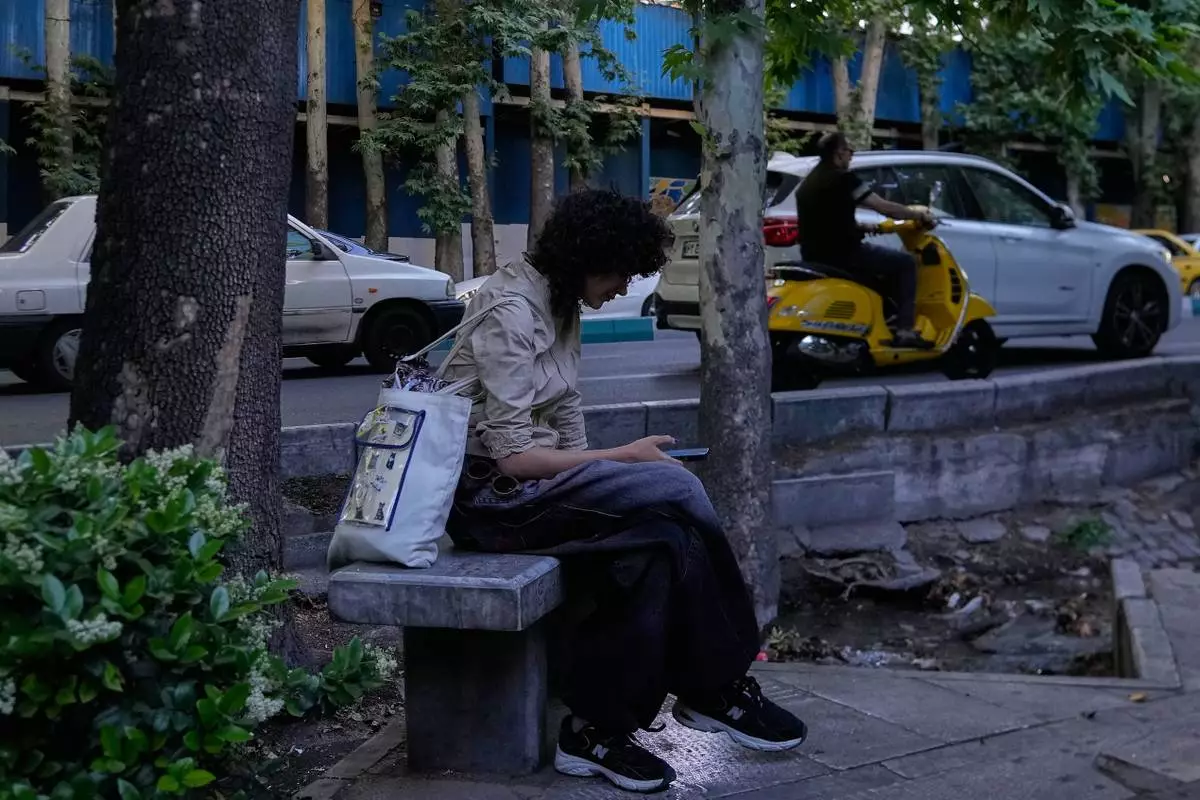
A woman checks her smartphone while sitting on a bench along a sidewalk in northern Tehran, Iran, Tuesday, May 26, 2026. (AP Photo/Vahid Salemi)

A woman checks her smartphone while sitting on a bench along a sidewalk in northern Tehran, Iran, Tuesday, May 26, 2026. (AP Photo/Vahid Salemi)

Recommended Articles