LONDON (AP) — The British economy barely grew in the final three months of 2025, official figures showed Thursday, with critics blaming uncertainty surrounding the government's budget for lower than anticipated business investment and consumption.
The Office for National Statistics said the British economy, the world's sixth-largest by many measures, expanded by only 0.1% on a quarterly basis, the same rate as that recorded in the third quarter.
The economy grew by 1.3% over the year as a whole, up from 1.1% the previous year. It's the highest annual level of growth since 2022.
Economists said uncertainty ahead of the Labour government's budget in late November meant businesses and consumers took a wait-and-see approach.
For much of the period, there had been expectations that Treasury chief Rachel Reeves would break key promises not to raise income tax levels. In the end, the tax rises were far more modest than anticipated.
“The underwhelming final quarter caps off another disheartening year for the U.K. economy with growth tailing off unnervingly quickly after the strong start to 2025, as rising taxes, heightened uncertainty and poor productivity increasingly squeezed activity,” said Suren Thiru, economics director at accounting body ICAEW.
Some recent economic indicators have pointed to a pickup in growth in the early part of 2026. However, growth is not expected to rise dramatically over the full year. Last week, the Bank of England cut its growth forecasts for the next two years, from 1.2% to 0.9% for 2026, and from 1.6% to 1.5% for 2027.
Britain’s Labour government, which has lost significant support since it won the general election in 2024 partly because of the economy, is hoping that with growth tepid and with inflation expected to fall sharply this year, the Bank of England will cut its main interest rate by a further quarter of a percentage point in March to 3.50%. Last week, the bank kept it unchanged at 3.75%.
“The task for 2026 is for the government to double down on its growth agenda to build a sustained economic recovery that will eventually flow into people’s pay packets," said Simon Pittaway, senior economist at the think tank Resolution Foundation.
This version corrects that the first paragraph refers to the final three months of 2025, not 2026.
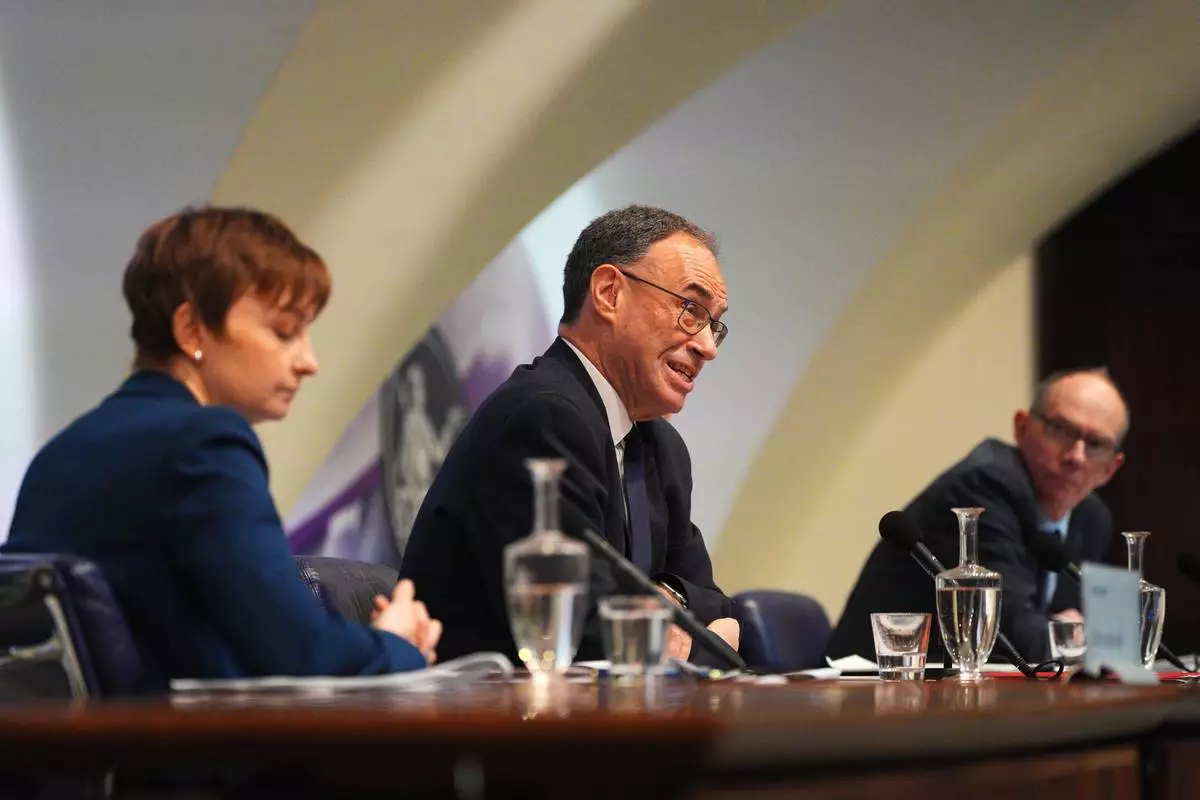
Governor of the Bank of England, Andrew Bailey, talks during a Bank of England Monetary Policy Report press conference in London, Thursday, Feb. 5, 2026. (Carl Court/Pool Photo via AP)
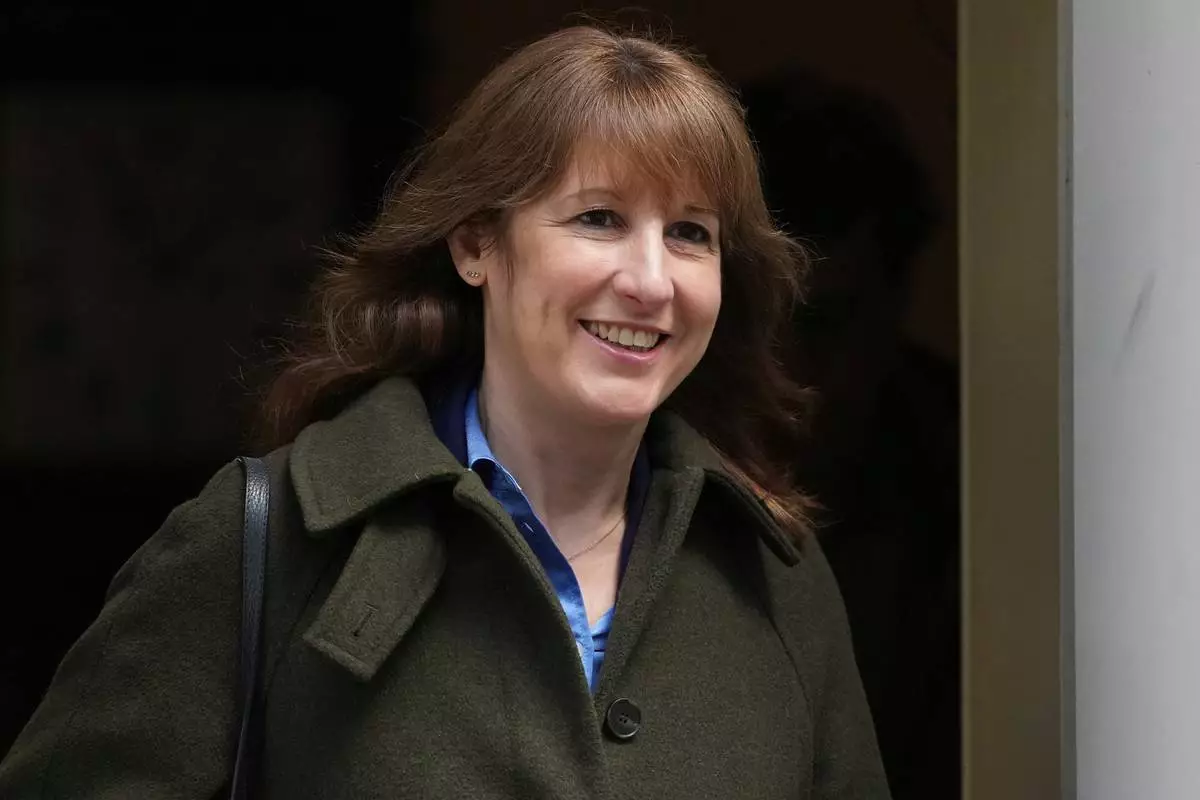
Britain's Chancellor of the Exchequer Rachel Reeves leaves 11 Downing Street for the House of Commons in London, Wednesday, Feb. 4, 2026. (AP Photo/Alastair Grant)

Russia has attempted to fully block WhatsApp in the country, the company said, the latest move in an ongoing government effort to tighten control over the internet.
A WhatsApp spokesperson said late Wednesday that the Russian authorities' action was intended to “drive users to a state-owned surveillance app,” a reference to Russia's own state-supported MAX messaging app that's seen by critics as a surveillance tool.
“Trying to isolate over 100 million people from private and secure communication is a backwards step and can only lead to less safety for people in Russia,” the WhatsApp spokesperson said. "We continue to do everything we can to keep people connected.”
Russia's government has already blocked major social media like Twitter, Facebook and Instagram and ramped up other online restrictions since Russia’s full-scale invasion of Ukraine in 2022.
Kremlin spokesman Dmitry Peskov said WhatsApp owner Meta Platforms should comply with Russian law to see it unblocked, according to the state Tass news agency.
Earlier this week, Russian communications watchdog Roskomnadzor said it will introduce new restrictions on the Telegram messaging app after accusing it of refusing to abide by the law. The move triggered widespread criticism from military bloggers, who warned that Telegram was widely used by Russian troops fighting in Ukraine and its throttling would derail military communications.
Despite the announcement, Telegram has largely been working normally. Some experts say it’s a more difficult target, compared with WhatsApp. Some Russian experts said that blocking WhatsApp would free up technological resources and allow authorities to fully focus on Telegram, their priority target.
Authorities had previously restricted access to WhatsApp before moving to finally ban it Wednesday.
Under President Vladimir Putin, authorities have engaged in deliberate and multipronged efforts to rein in the internet. They have adopted restrictive laws and banned websites and platforms that don’t comply, and focused on improving technology to monitor and manipulate online traffic.
Russian authorities have throttled YouTube and methodically ramped up restrictions against popular messaging platforms, blocking Signal and Viber and banning online calls on WhatsApp and Telegram. In December, they imposed restrictions on Apple’s video calling service FaceTime.
While it’s still possible to circumvent some of the restrictions by using virtual private network services, many of them are routinely blocked, too.
At the same time, authorities actively promoted the “national” messaging app called MAX, which critics say could be used for surveillance. The platform, touted by developers and officials as a one-stop shop for messaging, online government services, making payments and more, openly declares it will share user data with authorities upon request. Experts also say it doesn’t use end-to-end encryption.
Passengers look at their smartphones while on the subway in Moscow, Wednesday, Feb. 11, 2026. (AP Photo/Alexander Zemlianichenko)
A woman looks at her smartphone at a bus stop in St. Petersburg, Russia, Wednesday, Feb. 11, 2026. (AP Photo/Dmitri Lovetsky)
A young woman looks at her smartphone while on the subway in Moscow, Wednesday, Feb. 11, 2026. (AP Photo/Alexander Zemlianichenko)
People look at their smartphones at a bus stop in St. Petersburg, Russia, Wednesday, Feb. 11, 2026. (AP Photo/Dmitri Lovetsky)
FILE - A WhatsApp icon is displayed on an iPhone, Nov. 15, 2018, in Gelsenkirchen, Germany. (AP Photo/Martin Meissner, File)