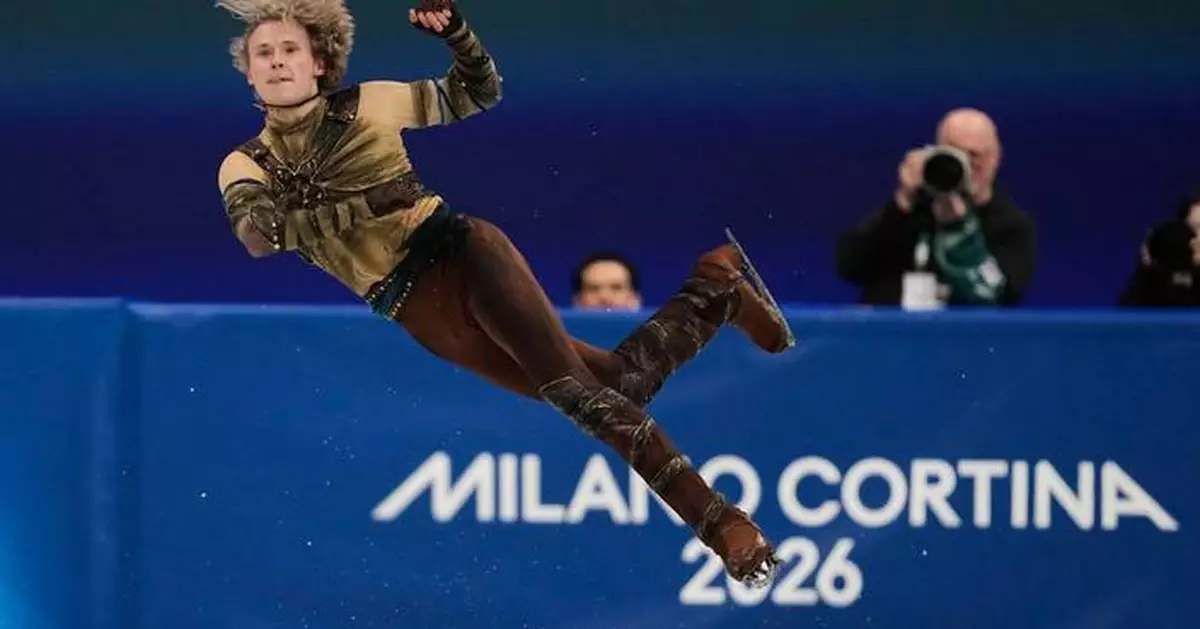
Skip to Content Facebook Feature Image

Will American 'Quad God' Ilia Malinin try hardest quad of all in his last skate at the Olympics?

Sport

Will American 'Quad God' Ilia Malinin try hardest quad of all in his last skate at the Olympics?
Sport

Sport

Will American 'Quad God' Ilia Malinin try hardest quad of all in his last skate at the Olympics?

2026-02-12 23:54 Last Updated At:02-13 00:00

MILAN (AP) — Ilia Malinin keeps teasing fans at the Milan Cortina Olympics by submitting program plans that have the American figure skating star attempting the quad axel, a 4 1/2-revolution jump so difficult nobody but him has ever landed it in competition.

Yet through two programs in the gold medal-winning team event and his individual short program Tuesday night, the “Quad God” has yet to attempt the hardest quadruple jump of all, opting instead for the safer triple axel everyone else is doing.

More Images
Ilia Malinin of the United States wobbles while competing during the figure skating men's team event at the 2026 Winter Olympics, in Milan, Italy, Sunday, Feb. 8, 2026. (AP Photo/Bernat Armangue)
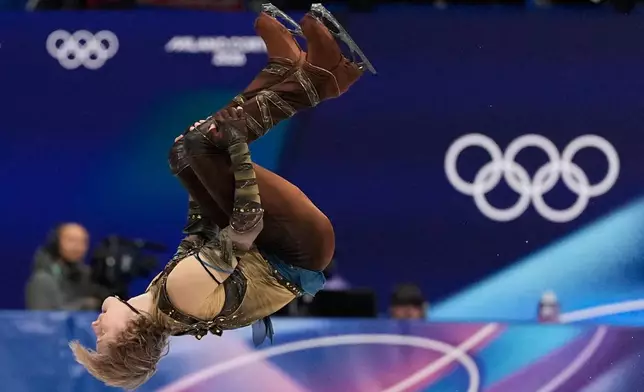
Ilia Malinin of the United States wobbles while competing during the figure skating men's team event at the 2026 Winter Olympics, in Milan, Italy, Sunday, Feb. 8, 2026. (AP Photo/Bernat Armangue)

Ilia Malinin of the United States does a back flip while competing during the men's figure skating short program at the 2026 Winter Olympics, in Milan, Italy, Tuesday, Feb. 10, 2026. (AP Photo/Ashley Landis)

Ilia Malinin of the United States does a back flip while competing during the men's figure skating short program at the 2026 Winter Olympics, in Milan, Italy, Tuesday, Feb. 10, 2026. (AP Photo/Ashley Landis)

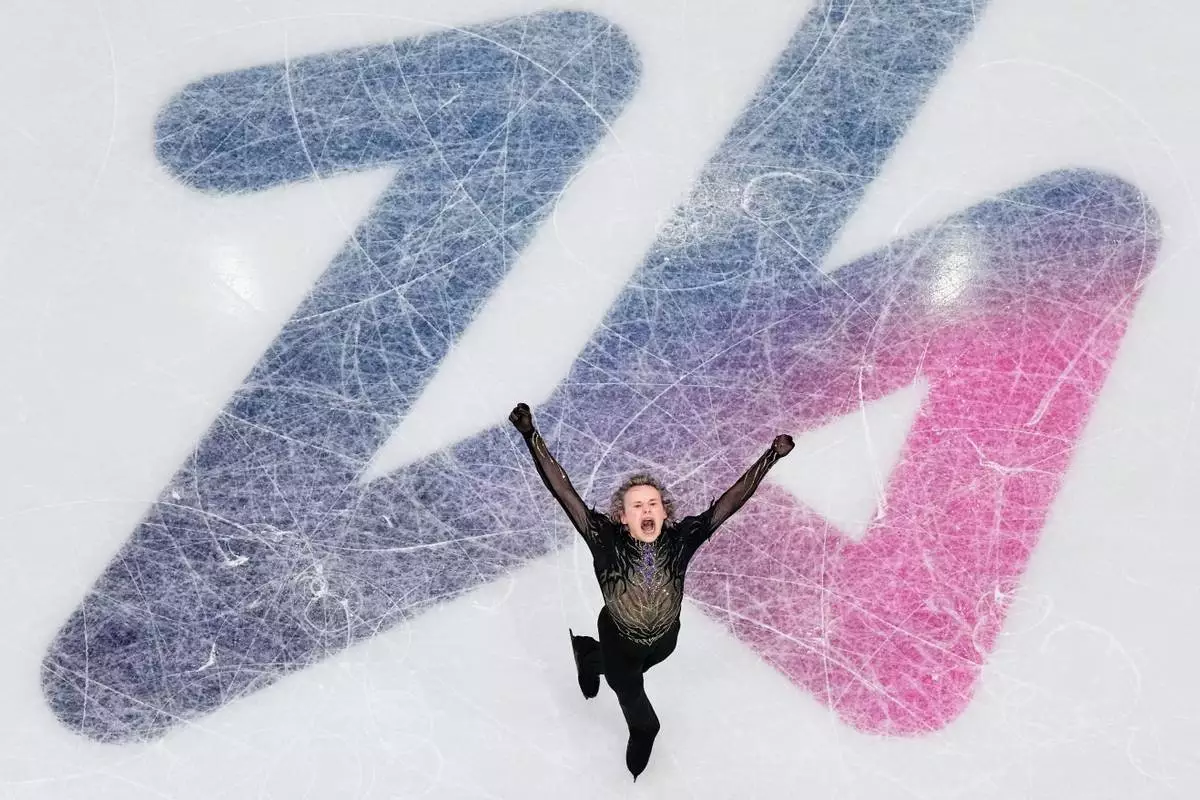
Ilia Malinin of the United States competes during the men's figure skating short program at the 2026 Winter Olympics, in Milan, Italy, Tuesday, Feb. 10, 2026. (AP Photo/Stephanie Scarbrough)

Ilia Malinin of the United States competes during the men's figure skating short program at the 2026 Winter Olympics, in Milan, Italy, Tuesday, Feb. 10, 2026. (AP Photo/Stephanie Scarbrough)

Ilia Malinin of the United States competes during the figure skating men's team event at the 2026 Winter Olympics, in Milan, Italy, Saturday, Feb. 7, 2026. (AP Photo/Francisco Seco)

Ilia Malinin of the United States competes during the figure skating men's team event at the 2026 Winter Olympics, in Milan, Italy, Saturday, Feb. 7, 2026. (AP Photo/Francisco Seco)

Ilia Malinin of the United States competes during the men's figure skating short program at the 2026 Winter Olympics, in Milan, Italy, Tuesday, Feb. 10, 2026. (AP Photo/Ashley Landis)

Ilia Malinin of the United States competes during the men's figure skating short program at the 2026 Winter Olympics, in Milan, Italy, Tuesday, Feb. 10, 2026. (AP Photo/Ashley Landis)

“My lazy part of me," Malinin said with a smirk, “just forgetting to change the planned elements.”

Or maybe Malinin is saving it for his grand finale.

He has a five-point lead over Japan's Yuma Kagiyama and France's Adam Siao Him Fa going into the free skate, a margin so big that it seems almost insurmountable, and one that gives him some wiggle room should he attempt the quad axel and fail.

The plan Malinin has submitted for Friday night includes it — naturally — part of what would be a record-tying seven quads in all.

“I’m hoping that I’ll feel good enough to do it,” Malinin said, more seriously. “But of course I always prioritize health and safety. So I really want to put myself in the right mindset where I’ll feel really confident to go into it”

Planned program content is just that: a plan. Skaters often deviate from it depending upon how they feel.

It may be they had a hard time with an element in practice and change it. Or, they might make a mistake in the midst of their routine — say, messing up the first jump on a combination pass — and they are forced to change their program on the fly.

What makes the quad axel so difficult is that the axel is the only one of figure skating's six primary jumps that starts facing forward, giving it an extra half revolution. In fact, the jump is so difficult even elite skaters struggle with the triple version of it.

“I never thought I’d see anybody do a quadruple axel,” admitted 1984 Olympic champion Scott Hamilton. “Not in my lifetime.”

Indeed, most people thought it was impossible.

Then Malinin proved it wasn't.

In September 2022, during the off-the-radar U.S. International Figure Skating Classic, he stunned the sport by setting down a near-perfect version of the quad axel as part of his winning free skate. Malinin was just 17 at the time.

How does he do it? By spinning at about 340 revolutions per minute, or about as fast as a ceiling fan set to high.

“Seeing what Ilia has done in the last three years has been mind-boggling,” 1994 Olympic champion Kristi Yamaguchi said. “I know several of us — Brian Boitano, Scott Hamilton — we’ve talked, saying, ‘We have never imagined we would be alive to see a quad axel performed and landed in competition,’ and here comes Ilia, just whipping it off like it’s nothing.'”

It's decidedly something. Whereas the triple axel has a base value of 8.0 points, the quad has a base of 12.5. Throw in the additional points Malinin could earn for the degree of execution and the quad axel gives him a massive scoring advantage.

At last year’s world championships in Boston, he landed it along with each of the other five quad jumps, propelling him to his second straight title with the second-largest margin of victory in its 130-year history.

So why would he ever take it out? Besides the inherent risk, the rest of Malinin's programs are so difficult he doesn't really need it. Kagiyama has a mere four quads planned for his free skate Friday night. So does Siao Him Fa.

“I want him to be a smart competitor,” said Boitano, the 1988 Olympic champion. “I know how much it can mean to a skater to have a clean performance in the Olympics, and I really want him to have a clean performance. Yes, technical — as technical as he wants to be. But if one of the quads he aspires to hit, he isn't feeling great that day, I want him to be solid.”

The son of Olympic skaters Tatiana Malinina and Roman Skorniakov loves nothing more than to raise the bar, though.

Malinin was among the first to incorporate a backflip into his choreography when its ban was lifted by the International Skating Union last year, for example, and the one he threw down in the team competition Sunday left tennis legend Novak Djokovic in awe.

Malinin even has created a signature jump of his own, a leaping, twirling fan-favorite known as the “raspberry twist.” He named it that because “malina,” from which his last name is derived, quite literally means “raspberry” in Russian.

“When I was younger,” he explained, “I loved to perform, whether it be I’d turn on some random music at home and just start skating a program that I’d do improv to and try doing triples, even though I could barely do doubles. I was really passionate about the performing aspect of skating, and that’s what helps me feel that energy and pressure and almost use it to my advantage.”

Malinin admitted to feeling a different level of pressure at the Olympics in the team event, though. Both of his performances were mediocre by his lofty standards. But he felt much more comfortable during his short program Tuesday night, and it was reflected on the ice, where his score of 108.16 was less than a point off his world-leading mark this season.

Now, Malinin has one more opportunity to perform during the Milan Cortina Olympics on Friday night.

One last chance to throw the quad axel, too.

AP Winter Olympics: https://apnews.com/hub/milan-cortina-2026-winter-olympics
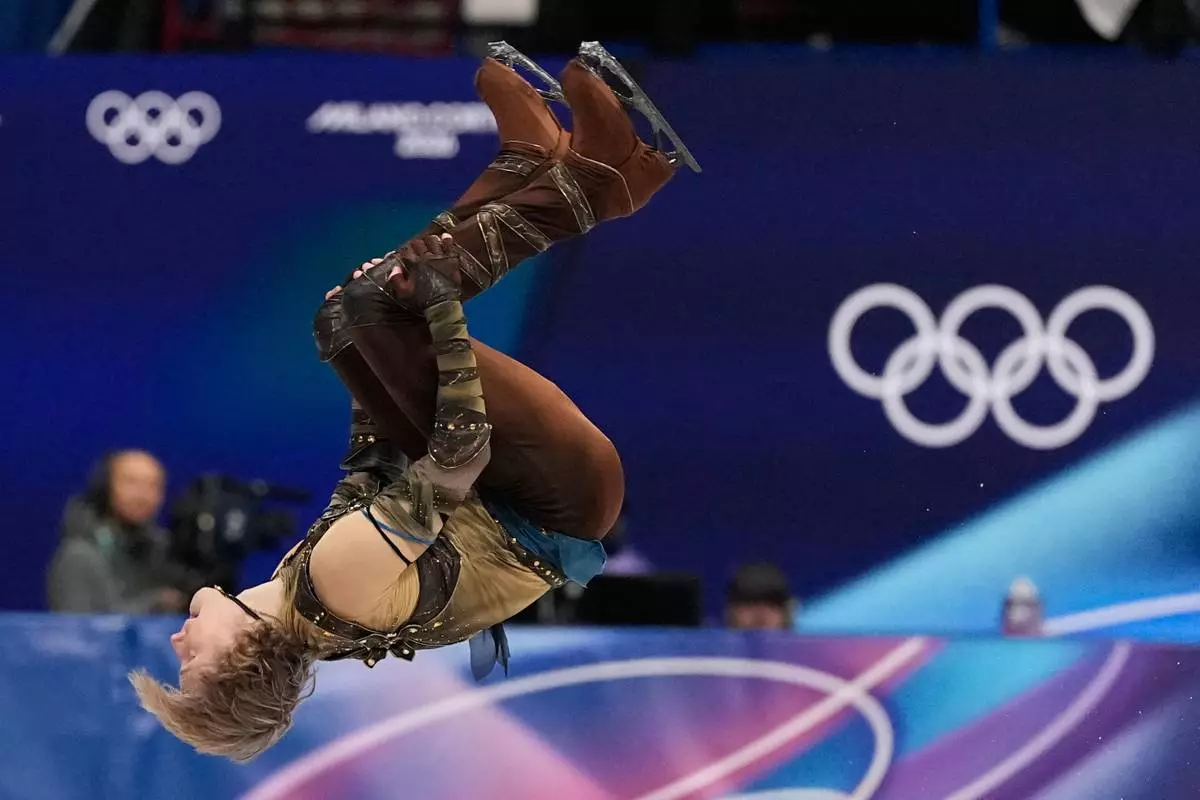
Ilia Malinin of the United States wobbles while competing during the figure skating men's team event at the 2026 Winter Olympics, in Milan, Italy, Sunday, Feb. 8, 2026. (AP Photo/Bernat Armangue)
Ilia Malinin of the United States wobbles while competing during the figure skating men's team event at the 2026 Winter Olympics, in Milan, Italy, Sunday, Feb. 8, 2026. (AP Photo/Bernat Armangue)

Ilia Malinin of the United States does a back flip while competing during the men's figure skating short program at the 2026 Winter Olympics, in Milan, Italy, Tuesday, Feb. 10, 2026. (AP Photo/Ashley Landis)

Ilia Malinin of the United States does a back flip while competing during the men's figure skating short program at the 2026 Winter Olympics, in Milan, Italy, Tuesday, Feb. 10, 2026. (AP Photo/Ashley Landis)

Ilia Malinin of the United States competes during the men's figure skating short program at the 2026 Winter Olympics, in Milan, Italy, Tuesday, Feb. 10, 2026. (AP Photo/Stephanie Scarbrough)

Ilia Malinin of the United States competes during the men's figure skating short program at the 2026 Winter Olympics, in Milan, Italy, Tuesday, Feb. 10, 2026. (AP Photo/Stephanie Scarbrough)

Ilia Malinin of the United States competes during the figure skating men's team event at the 2026 Winter Olympics, in Milan, Italy, Saturday, Feb. 7, 2026. (AP Photo/Francisco Seco)

Ilia Malinin of the United States competes during the figure skating men's team event at the 2026 Winter Olympics, in Milan, Italy, Saturday, Feb. 7, 2026. (AP Photo/Francisco Seco)

Ilia Malinin of the United States competes during the men's figure skating short program at the 2026 Winter Olympics, in Milan, Italy, Tuesday, Feb. 10, 2026. (AP Photo/Ashley Landis)


Ilia Malinin of the United States competes during the men's figure skating short program at the 2026 Winter Olympics, in Milan, Italy, Tuesday, Feb. 10, 2026. (AP Photo/Ashley Landis)

LAS VEGAS (AP) — The Las Vegas Review-Journal announced Friday that it will no longer print its rival the Las Vegas Sun for the first time in decades, amid an ongoing legal dispute over the nation's last joint operating agreement stemming from a 1970 law designed to preserve newspapers.

Readers “will not find a printed Las Vegas Sun insert inside,” the Review-Journal said in an editorial, noting the Sun maintains a website, has a few hundred thousand followers across social media platforms, and is free to produce its own newspaper.

“We encourage them to do so. The Review-Journal competes with countless sources of news and entertainment, but we would welcome one more. We just don’t want to foot the bill. It is time the Sun stood up on its own two feet,” the editorial said, without specifying the cost.

The two publications will be in court Friday and the Sun hopes a judge will order printing to immediately resume, attorney Leif Reid said in an email. It will be the first day in 76 years that the Sun hasn’t been printed, he said.

“This does irreparable harm to our community, as no one benefits when a local newspaper is prevented from being published,” he said.

The now-rare joint operating agreement required the Sun to be printed as a daily insert in the Review-Journal, while both companies remained editorially independent with separate newsrooms and websites.

A lower court had found the agreement was unenforceable because a 2005 update was never signed by the U.S. attorney general, and in February the U.S. Supreme Court declined to hear an appeal by the Sun.

The Review-Journal editorial called the Supreme Court decision a decisive victory, saying that halting publication of the Sun on Friday was “a result of 6½ years of litigation between the newspapers, precipitated by the Sun.”

Such agreements between rival publications have dwindled as part of a "long, slow goodbye of newspapers as we knew them,” said Ken Doctor, a news business analyst. The Detroit Free Press and the Detroit News ended a 40-year agreement last year. USA Today Co., which owns the Detroit Free Press, recently announced its plans to purchase the Detroit News.

In 1950, the Sun was founded in response to the Review-Journal’s refusal to negotiate with typesetters from the International Typographical Union. The union started its own newspaper and reached out to businessman Hank Greenspun for financial backing. The Greenspuns still own the paper.

The Review-Journal has been publishing since 1909, first as the Clark County Review. It is owned by the Adelson family, casino magnates and mega GOP donors, and remains the state’s largest newspaper.

The Review-Journal’s editorials lean more conservative, while the Sun’s lean liberal. The 1970 law signed by then President Richard Nixon, called the Newspaper Preservation Act, was designed to save newspapers costs while maintaining competition and editorial variety in cities as newspapers began to financially struggle.

The papers first entered into a joint operating agreement in 1989 when the Sun was struggling to stay afloat financially. The agreement made the Sun an afternoon newspaper during weekdays and a section within the Review-Journal on weekend mornings, while the Review-Journal handled production, distribution and advertising. The Review-Journal also collected all revenue and was required to pay the Sun monthly to cover the Sun’s news and editorial expenses.

In 2005 the agreement was amended to make the Sun an insert in the Review-Journal every morning.

Review-Journal owners sought to end the agreement in 2019, and in response the Sun’s owners filed a lawsuit alleging that ending the agreement violated anti-trust laws.

The 1970 law allowing such agreements was signed at a time when news options weren't as prevalent and there was more concern over news monopolies.

Las Vegas — and Nevada as a whole — today have more strong, independent news organizations compared to other places, said Stephen Bates, a journalism and media professor at the University of Nevada, Las Vegas.

The Sun also publishes online. But it has argued in court that losing its print product could make it harder to recruit staff, cause a loss in readers, and even force it to close.

Genelle Belmas, a journalism professor at the University of Kansas who specializes in media law, said it would be disappointing if the last joint operating agreement in the country ends. During visits to Vegas, she's enjoyed being able to pick up the Review-Journal and see the Sun folded inside, offering two differing points of view in one place. Online news outlets make it easier for consumers to stay in their echo chambers, she said.

“Every local news outlet we lose — and that includes big towns, small towns, whatever — is a loss of perspective and a loss of a potential alternative view,” Belmas said.

FILE - This Dec. 17, 2015 file photo shows a sign outside the building housing the Las Vegas Review-Journal in Las Vegas. AP Photo/John Locher, File)

FILE - This Dec. 17, 2015 file photo shows a sign outside the building housing the Las Vegas Review-Journal in Las Vegas. AP Photo/John Locher, File)

Recommended Articles