PRISTINA, Kosovo (AP) — Albania introduced what it called the world’s first artificial intelligence minister last year. Turns out she wasn’t entirely artificial — at least not her face and voice. Albanian actor Anila Bisha says those belong to her — and she never imagined the government would use her image so prominently.
Now Bisha, a popular film and theater actor in Albania, is demanding her face and voice be stripped from the so-called virtual minister named Diella.
Citing a violation of her personal data, Bisha filed a formal request through an administrative court in Albania this week demanding the government immediately stop using her voice and image for Diella.
“This is the first legal move to prevent the abuse of Anila’s image,” her lawyer Aranit Roshi said.
The Albanian government did not immediately respond to a request for comment.
Albania drew global attention last year when Prime Minister Edi Rama announced the creation of what he described as the world’s first artificial intelligence minister, aimed at ensuring that all public procurement tenders are handled 100% corruption-free.
Diella is usually depicted in traditional Albanian national dress and is known for her punchy comebacks when prompted by government officials.
Bisha acknowledged she had signed a contract agreeing that her voice and image can be used for the government's online platform e-Albania, which provides a wide range of public services in the country. But she said she was never told of any plans to use them for an AI minister.
“It was surprising when I heard the prime minister declare it. I asked how this could happen without my knowledge, without anyone asking me if I wanted my image to be used or not,” Bisha told The Associated Press on Thursday.
She said she feels her image is now used as a political statement.
It is not the first time that voices used in artificial intelligence platforms have caused a stir.
In 2024, OpenAI pulled one of its ChatGPT voices, Sky, after actor Scarlett Johansson said the voice sounded “eerily similar” to her own. OpenAI said the voice used for Sky was not that of Johansson.
Bisha said she had tried to contact the government multiple times since the AI minister became part of the Albanian Cabinet last September. She said she decided to begin legal proceedings after failing to receive a response requesting a meeting to discuss the issue.
Bisha filed the temporary injunction with the administrative court demanding the government immediately cease using her image for Diella. Her representatives plan to file a formal lawsuit for damages and compensation.
“One cannot take away one’s identity and do with it whatever they want,” she said.

FILE - Albanian experts work at the National Agency for Information Society as an artificial intelligence "minister" Diella, whose name means "Sun" in Albanian, is seen on the screens in Tirana, Albania, Friday, Sept. 12, 2025. (AP Photo/Vlasov Sulaj, File)
WESTMINSTER, Colo.--(BUSINESS WIRE)--Apr 1, 2026--
Vantor, the leading provider of unified spatial intelligence from space to ground, has been awarded its third National Geospatial-Intelligence Agency (NGA) Luno contract to provide NGA and other U.S. Government agencies automated, near real-time orbital intelligence of high-interest objects in space.
This press release features multimedia. View the full release here: https://www.businesswire.com/news/home/20260401774885/en/
Under the $2.3 million contract, Vantor will utilize its high-resolution imagery of space objects, also known as non-Earth Imagery (NEI), to deliver intelligence on priority objects in low Earth orbit, including providing alerts when anomalies are present. The analysis will be largely automated, marking a significant step forward in eliminating manual processing and accelerating timely and actionable insights for Space Domain Awareness.
“In a contested domain like space, awareness is everything,” said Susanne Hake, Executive Vice President & General Manager, U.S. Government at Vantor. “Still, it’s the one domain where exquisite visual intelligence is extremely hard to come by, creating literal and figurative blind spots. Our NEI capabilities are one of the few technologies that can provide high-resolution visual intelligence of objects in space, providing intelligence analysts and decisionmakers with a deeper understanding of the behavior and intent of high-interest space objects—a decisive edge in an increasingly complex environment.”
Vantor’s orbital intelligence capabilities can provide insights into a space object’s features, health, velocity, and movements, including whether an object is changing orbit—a situation that could endanger the safety of U.S. assets in space. Vantor satellites can capture images of other spacecraft at an industry-leading resolution of less than 10 cm from hundreds of kilometers away, making it possible to quickly characterize those space objects and determine their health and status.
This award marks the third win for Vantor under NGA’s Luno program. Vantor previously announced a Luno contract to automatically detect land use land cover change at global scale, enabling NGA to anticipate where maps and their features may require updates. And in June, Vantor was awarded a Luno contract to deliver AI/ML-generated object detection services to identify assets across air, maritime, land, and rail domains; determine counts at specified locations; detect trends and anomalies; and perform advanced spatial and temporal geospatial intelligence analysis.
“These awards reflect the core of Vantor’s mission—to deliver real-time intelligence faster than the speed of threat, from space to ground,” said Hake. “By integrating our persistent monitoring, change detection, and space-domain awareness capabilities, we’re empowering our partners to understand and act on threats across every domain, before they emerge.”
The Luno program—made up of Luno A and Luno B—is part of NGA’s ongoing efforts to execute an agile acquisition strategy that unlocks the capacity and innovation of the commercial geospatial industry.
About Vantor
Vantor is forging the new frontier of spatial intelligence to unlock a more autonomous, interoperable world. We give decision makers and operators the power to build a unified intelligence picture, delivering the clarity they need to navigate what’s happening now and shape what’s coming next. We fuse data from the world’s most capable imaging satellites with real-time sensor feeds from space, air, and ground to create an AI-ready digital twin of Earth. Our spatial intelligence platform automates every part of the cycle—from tasking to collection to production—to update and analyze this foundation at the pace of change. Our products drive deeper mission-critical insights and connect the next generation of autonomous systems across the defense, intelligence, and commercial landscape.
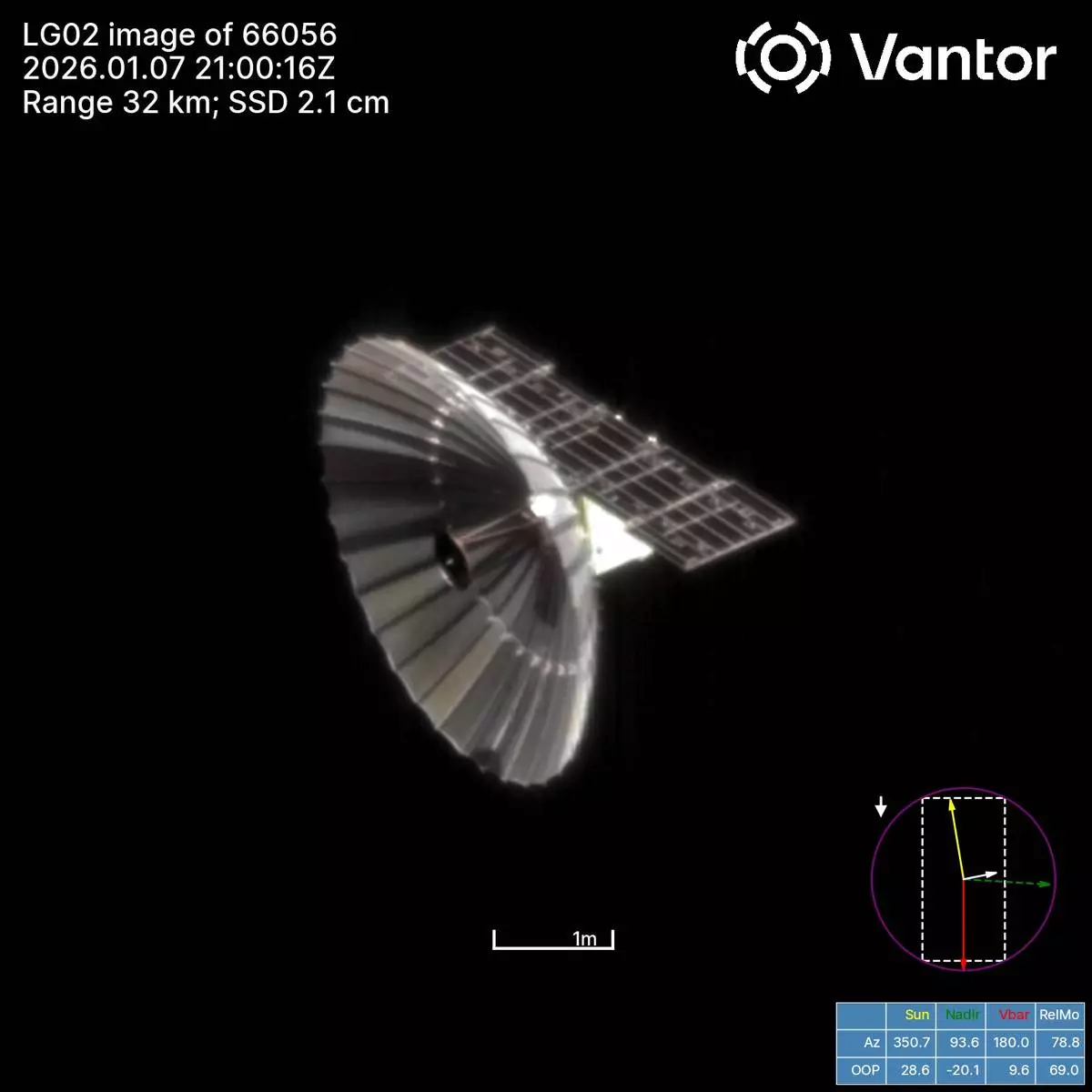
Vantor non-Earth image of a Chinese imaging satellite, collected under the NGA Luno B contract. The synthetic aperture radar (SAR) satellite features a large deployable antenna that enables high-resolution radar imaging from orbit.