In a landmark development for the region's scientific community, Hong Kong has been selected to host the Asia-Pacific Regional IAU Meeting (APRIM) for the first time. Dubbed the "The Olympics of Astrophysics and Space Science," this prestigious event will take place from May 4 to 8, 2026, at the Hong Kong Convention and Exhibition Centre (HKCEC).
Organised by the International Astronomical Union (IAU) and hosted by The University of Hong Kong’s Laboratory for Space Research (LSR), the conference will feature Nobel and Shaw laureates, together with other distinguished scientists from around the world. As a leading astronomical gathering in the Asia-Pacific, the event represents a significant milestone for Hong Kong, underscoring its pivotal role in fundamental research, STEM education, and international collaboration.
APRIM 2026 brings Nobel-level astrophysics and space science summit to Hong Kong for the first time
Professor Quentin Parker, Chair of the APRIM2026 and Director of the HKU Laboratory for Space Research, noted that bringing the "The Olympics of Astrophysics and Space Science" to Hong Kong demonstrates the city's capacity to serve as a global nexus for astrophysics and space science.
"As Chair of this historic meeting, I am honoured to welcome the global Astrophysics and Space Science community to Hong Kong. We aim to use this platform not only to showcase our city’s capabilities in the 'New Space' era but to inspire the next generation of scientists to pursue the unknown," said Prof. Parker.
Professor Xue Suijian, former Deputy Director of the National Astronomical Observatories of the Chinese Academy of Sciences, attributed the IAU's decision to Hong Kong’s highly international environment and academic excellence. He highlighted the city’s growing contributions to deep-space exploration, planetary science, and big data analysis, cementing its role as a bridge for international scientific exchange.
While rooted in academic rigour, APRIM 2026 also addresses the paradigm shift from government-led initiatives to the democratised era of "New Space." The conference offers a platform that links theoretical astrophysics with real-world applications.
Aligning with the global scientific agenda, the conference is expected to bring together nearly 1,000 experts. Discussions will span from the origins of the universe to emerging directions in space exploration, covering key areas such as Planetary Science, Stellar Evolution, and Cosmology. The event will also seek to bridge academia and industry, exploring how frontier technologies can contribute to addressing global challenges.
A defining feature of APRIM2026 is its focus on "Space Sustainability." With the growing density of satellite constellations in low Earth orbit, the scientific community faces urgent challenges, particularly in relation to space debris and light pollution.
Through dedicated sessions and public engagement, the conference will tackle these critical issues, advocating for responsible stewardship of the cosmic environment. By integrating these discussions with outreach sessions including youth-focused workshops, the event aims to cultivate a scientifically literate generation ready to steward the future of space exploration.
Professor Luis C. Ho, Director of the Kavli Institute for Astronomy and Astrophysics at Peking University, described the meeting as a vital platform for strengthening Asia-Pacific research collaboration. He noted that the event marks a shift from pure fundamental research to industrial application, allowing high-tech solutions to serve the public and open the "blue ocean" of the space economy.
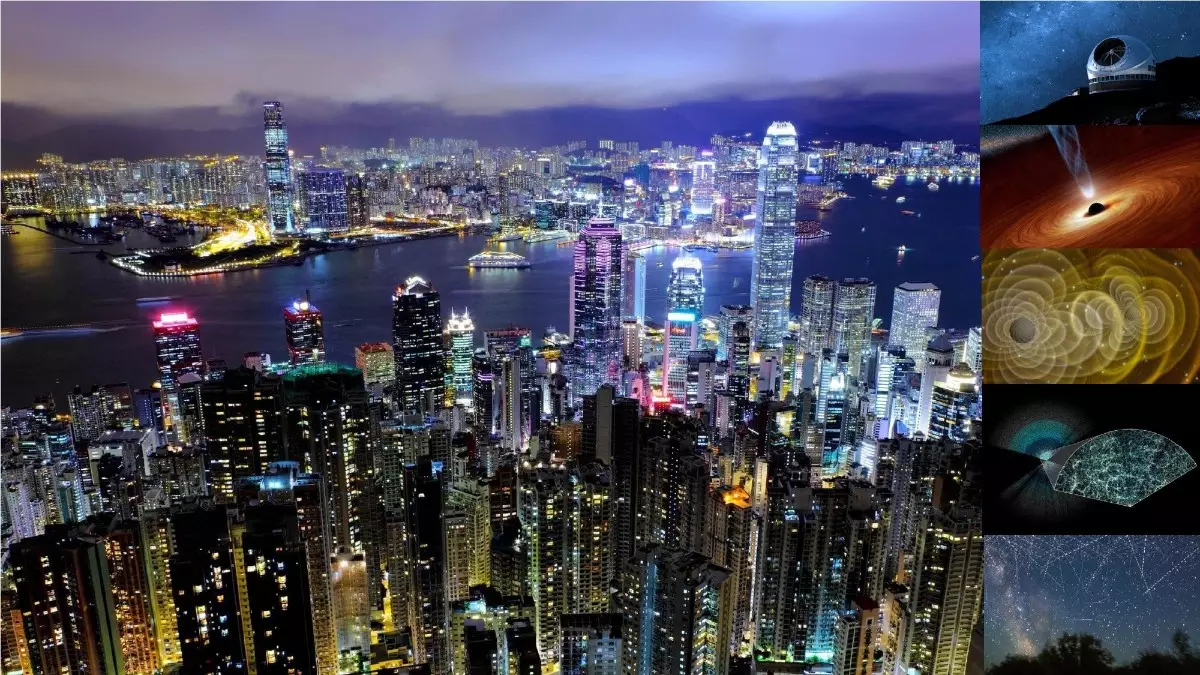
APRIM 2026 brings Nobel-level astrophysics and space science summit to Hong Kong for the first time
Event Details of APRIM2026
Date: May 4 – 8, 2026
Time: 9:00 AM – 6:00 PM
Venue: Hong Kong Convention and Exhibition Centre (HKCEC)
Event Highlights: 1. Nobel-Level Insights: Plenary sessions led by 5 winners of the Nobel Prize, Shaw Prize, and Gruber Prize, analyzing frontiers like black holes and cosmic expansion.
2. Space Sustainability (ESG): A dedicated parallel session addressing space debris and satellite interference.
3. Global Status: Hong Kong's first time hosting this major regional event, collaborating with HKU, HKUST, PolyU etc.
• Prof. Brian Schmidt: 2011 Nobel Laureate; IAU President-elect
• Prof. Victoria Kaspi: 2021 Shaw Prize Laureate; Professor, McGill University
• Prof. Matthew Bailes: 2023 Shaw Prize Laureate; Professor, Swinburne University of Technology
• Prof. Shri Kulkarni: 2024 Shaw Prize Laureate; Professor, Caltech
• Prof. Luis C. Ho, Director of the Kavli Institute for Astronomy and Astrophysics at Peking University
• Prof. Yang Gao: Co-Director of Space Science and Technology Institute, Hong Kong University of Science and Technology
• Dr. Xuejun Zhang, Academician of the Chinese Academy of Engineering; The President of Changchun Institute of Optics Fine Mechanics and Physics (CIOMP), Chinese Academy of Sciences
• Prof. Qiang Wang, Director of Technology and Engineering, Center for Space Utilization, Chinese Academy of Sciences (CSU)