Skip to Content Facebook Feature Image

Asia shares lower after sharp Wall Street losses on AI-related worries

News

Asia shares lower after sharp Wall Street losses on AI-related worries
News

News

Asia shares lower after sharp Wall Street losses on AI-related worries

2026-02-13 15:16 Last Updated At:16:25

HONG KONG (AP) — Asia shares were trading lower Friday, tracking sharp Wall Street losses on a sell-off of technology-related stocks that investors fear could lose out from artificial intelligence disruptions.

U.S. futures edged lower. The future for the S&P 500 fell 0.2%, while that for the Dow Jones Industrial Average was also 0.2% lower.

Tokyo’s Nikkei 225 fell 1.2% to 56,941.97. SoftBank Group, which has a focus on AI, lost 8.9% even after the company reported a $1.6 billion quarterly profit Thursday building on its investments in OpenAI, among other gains.

South Korea’s Kospi was down 0.3% to 5,507.01 despite earlier gains. Samsung Electronics, the country's largest listed company, was up 1.5%.

Hong Kong’s Hang Seng fell 1.7% to 26,575.84. The Shanghai Composite index was down 1% to 4,091.65.

In Australia, the S&P/ASX 200 traded 1.4% lower at 8,917.60.

On Thursday, Wall Street saw sharp losses as AI worries dampened sentiment. The S&P 500 fell for its second-worst day since Thanksgiving, dropping 1.6%, or 108.71, to 6,832.76, but it's still near an all-time high that was set last month. The Dow Jones Industrial Average was down 1.3%, or 669.42, to 49,451.98. The Nasdaq composite lost 2%, or 469.32, to 22,597.15.

American technology giant Cisco Systems sank 12.3% even though it reported better-than-expected quarterly results, as investors were concerned about its ongoing profitability.

Shares of technology company AppLovin plunged 19.7% despite better-than-expected quarterly profits as worries over AI undercutting its business weighed on its stock price.

Fears of AI disruptions across industries in recent days have hit investor confidence in companies, especially in software stocks. Some analysts say uncertainties surrounding the AI disruption risk are likely to go on for a while. Many remained concerned about whether massive AI investments by companies will eventually pay off.

But other analysts are more optimistic. Economists at Capital Economics, for example, argue that they still believe in the AI rally, and that this year will be a “good year” for the S&P 500, building on the technology-led gains.

“Our sense remains that a sustained reversal of tech outperformance would require a big slide in tech itself,” Thomas Mathews, head of markets for Asia Pacific at Capital Economics wrote in a recent note. “We think tech will fare very well.”

For other U.S. stocks, McDonald’s was up 2.7% following stronger-than-expected profits. Walmart gained 3.8%.

Investors and economists are also paying close attention to the U.S. inflation data set to be released Friday, which could impact on the Federal Reserve’s interest rate moves. Some economists expect the likelihood of another rate cut is low for the next few months.

In other dealings early Friday, U.S. benchmark crude oil lost 0.1% to $62.75 a barrel. Brent crude, the international standard, fell less than 0.1% to $67.46 per barrel.

Gold and silver prices gained. The price of gold — which earlier fell back below $5,000 per ounce — was up 0.4% to $4,970.30. The price of silver rose 1% to $76.45 per ounce.

The U.S. dollar rose to 153.38 Japanese yen from 152.72 yen. The euro was trading at $1.1857, down from $1.1871.

James Conti works on the floor at the New York Stock Exchange in New York, Thursday, Feb. 12, 2026. (AP Photo/Seth Wenig)
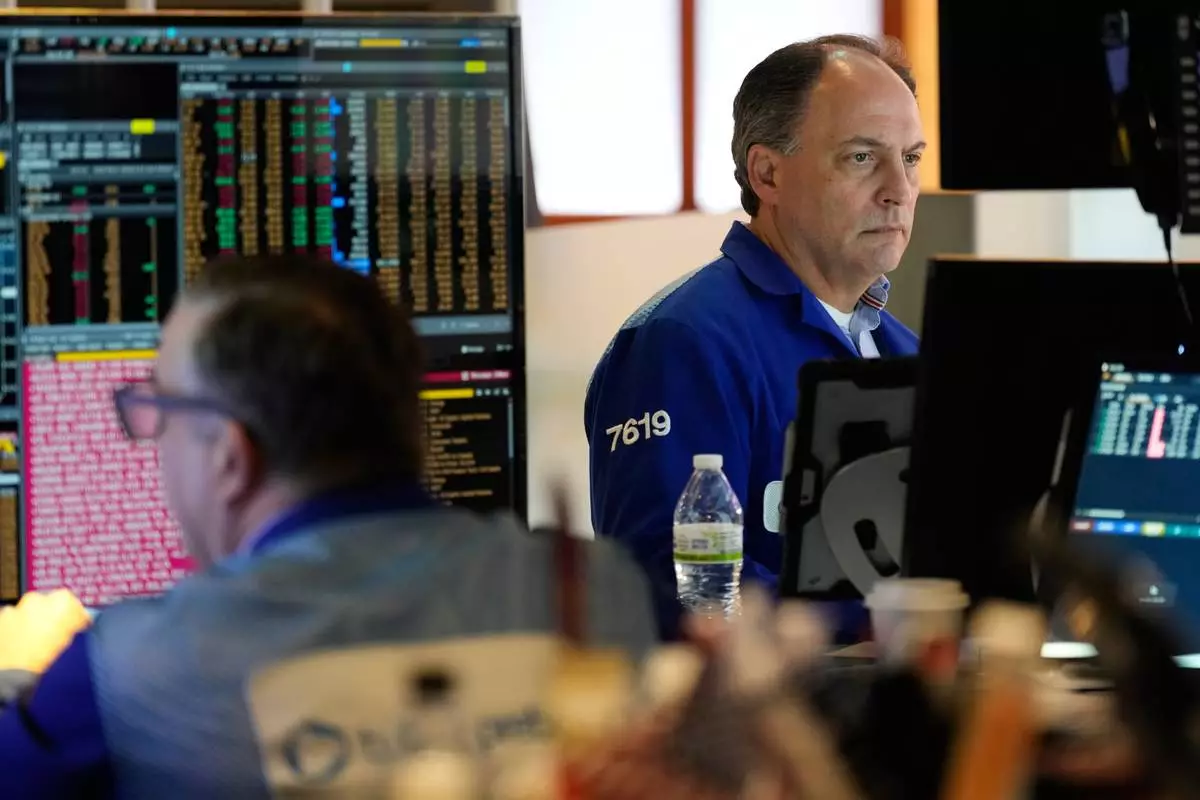
James Conti works on the floor at the New York Stock Exchange in New York, Thursday, Feb. 12, 2026. (AP Photo/Seth Wenig)


DHAKA, Bangladesh (AP) — Tarique Rahman spent 17 years in self-imposed exile. Now, he is poised to become the prime minister of Bangladesh — and follow in the footsteps of his mother.

Thursday’s national election seemed to hand Rahman’s Bangladesh Nationalist Party a majority, according to local media reports, marking a significant political shift in the South Asian nation of more than 170 million people. The BNP has also claimed victory.

For Rahman, the turnaround is dramatic.

The 60-year-old returned from London in December to a country in turmoil. Within days, his mother, former Prime Minister Khaleda Zia, died from long illness. In the election, he faced a rising religious conservative party that had gained momentum after a 2024 student-led uprising toppled Zia's longtime rival, former Prime Minister Sheikh Hasina.

And yet his biggest challenge may still lie ahead.

The path from the 2024 uprising to Thursday’s election has been marked by turmoil. Bangladesh grappled with unrest after a student leader’s death, a resurgence of Islamist groups, the fraying of the rule of law, attacks on Hindu minorities and the press, as well as a struggling economy.

“Rahman has said all the right things, pledging to eliminate corruption and bring the country together. That all sounds well and good. But the BNP has a poor track record from when it was last in power — there was repression and corruption,” said Michael Kugelman, a Senior Fellow for South Asia at the Atlantic Council.

Rahman is a key figure in the Zia political dynasty.

His mother served two five-year terms as prime minister, the last time from 2001 to 2006. His father, Ziaur Rahman, rose from the army to become Bangladesh’s sixth president before his assassination in 1981.

He is married to Zubaida Rahman, a physician and daughter of a former Bangladesh Navy chief.

His BNP, one of the country’s longstanding political forces, alongside Hasina's now-banned Awami League party, has for decades dominated Bangladesh’s political landscape. In recent years, the BNP boycotted several elections, including the 2024 vote, citing widespread fraud.

Rahman’s political career has been controversial.

Targeted by multiple criminal cases under Hasina’s government, he spent 17 years in self-imposed exile in London. In 2018, he was sentenced to life in prison in connection with a 2004 grenade attack on Hasina that killed at least 24 people. Hasina narrowly survived the attack. Rahman denied he was involved in the attack and denounced the verdict, along with his party, terming it politically motivated.

Rahman left Bangladesh in 2008, officially for medical treatment, after enduring torture while in custody during the military-backed administration that governed from 2006 to 2008, following Zia's failure to peacefully hold a new election and hand over power.

Though he never held office in his mother’s governments, Rahman wielded significant influence within the BNP, serving as acting chairman, senior vice chairman, and senior joint secretary.

A leaked set of U.S. diplomatic cables described him as “phenomenally corrupt.”

After the collapse of Hasina’s government, the charges and convictions against Rahman were dropped, clearing the way for his return from exile.

In the run-up to the election, he sought to reshape his image, promising job creation, financial aid for poor families, greater freedom of speech, stronger law enforcement, and an end to corruption. His campaign cast him as a defender of democracy in a country long shaped by entrenched parties, military interventions and allegations of vote rigging.

After Hasina's ouster, the country's interim leader Nobel Peace Prize laureate Muhammad Yunus held a meeting with Rahman in London, an event that apparently led to his return to the country.

However, his rise is expected to rankle many in Bangladesh, particularly those who took part in the uprising and wanted their country free of dynastic politics and the old political guard they blame for the country’s problems.

The Atlantic Council's Kugelman said a key test for Rahman will be how he treats Hasina’s Awami League party, which has been accused of cracking down on the BNP in the past, including arrests of its senior leaders and party workers. Rahman’s mother was arrested and imprisoned during Hasina’s government.

Hasina has been in exile in India since August 2024, and a special tribunal in Dhaka sentenced her to death last year over crimes against humanity related to her crackdown that killed protesters during the uprising that ousted her. She denies all charges. Meanwhile, her party was barred from participating in the election, and thousands of its members remain in hiding due to fears of persecution.

“If Rahman leans on retribution, it shows the old politics haven’t disappeared,” said Kugelman. “But a focus on unity would be an encouraging sign.”

Security personnel guard near the chairman office of the Bangladesh Nationalist Party (BNP) before the national parliamentary election result is announced in Dhaka, Bangladesh, Thursday, Feb. 12, 2026. (AP Photo/Anupam Nath)

Security personnel guard near the chairman office of the Bangladesh Nationalist Party (BNP) before the national parliamentary election result is announced in Dhaka, Bangladesh, Thursday, Feb. 12, 2026. (AP Photo/Anupam Nath)

Bangladesh Nationalist Party Chairperson Tarique Rahman talks to media after casting his vote during the national parliamentary elections in Dhaka, Bangladesh, Thursday, Feb. 12, 2026. (AP Photo/Mahmud Hossain Opu)

Bangladesh Nationalist Party Chairperson Tarique Rahman talks to media after casting his vote during the national parliamentary elections in Dhaka, Bangladesh, Thursday, Feb. 12, 2026. (AP Photo/Mahmud Hossain Opu)

Tarique Rahman, the son of former Prime Minister Khaleda Zia and chairman of the Bangladesh Nationalist Party (BNP), attends an election rally ahead of national election in Dhaka, Bangladesh, on Feb. 8, 2026. (AP Photo/Anupam Nath)

Tarique Rahman, the son of former Prime Minister Khaleda Zia and chairman of the Bangladesh Nationalist Party (BNP), attends an election rally ahead of national election in Dhaka, Bangladesh, on Feb. 8, 2026. (AP Photo/Anupam Nath)

Recommended Articles