Skip to Content Facebook Feature Image

During the Winter Games, some Milan churches are teaching Olympic values to thousands of kids

News

During the Winter Games, some Milan churches are teaching Olympic values to thousands of kids
News

News

During the Winter Games, some Milan churches are teaching Olympic values to thousands of kids

2026-02-13 15:18 Last Updated At:16:25

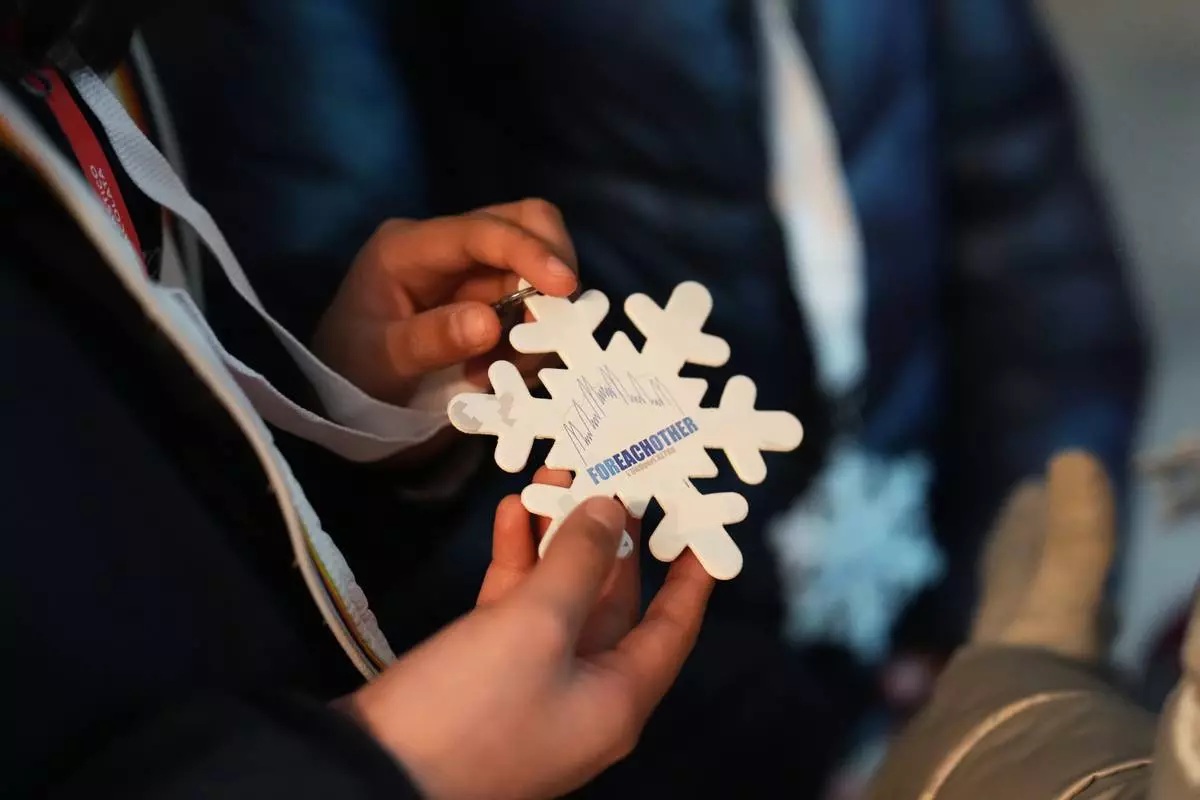
MILAN (AP) — Olympic podiums are where the world’s best athletes win gold. But beyond the spotlight of the 2026 Winter Olympics, dozens of children on Feb. 9 received snowflake-shaped medals of their own in a Milan church — a reminder that they, too, are champions in life.

“This is not about changing lives through elite performance,” said Valentina Piazza, project manager for CSI for the World, which operates outside Italy to provide sports programs to children in developing countries. “It’s about how sport helps young people learn from being together.”

Piazza’s work is part of the Tour of Sports Values, an initiative led by the Catholic Archdiocese of Milan during the Games. With workshops, exhibitions, athlete testimonies and sports activities, the initiative seeks to promote excellence, friendship and respect.

The program is anchored by a series of letters written by Milan’s Archbishop Mario Delpini, who has drawn on those values in recent years as part of preparations for the Games.

It aims to involve about 13,000 young people from schools, parish youth centers and sports clubs across the archdiocese through Feb. 20.

The Tour of Sports Values kicked off on Feb. 9 at the Church of Sant’Antonio, near Milan’s Duomo.

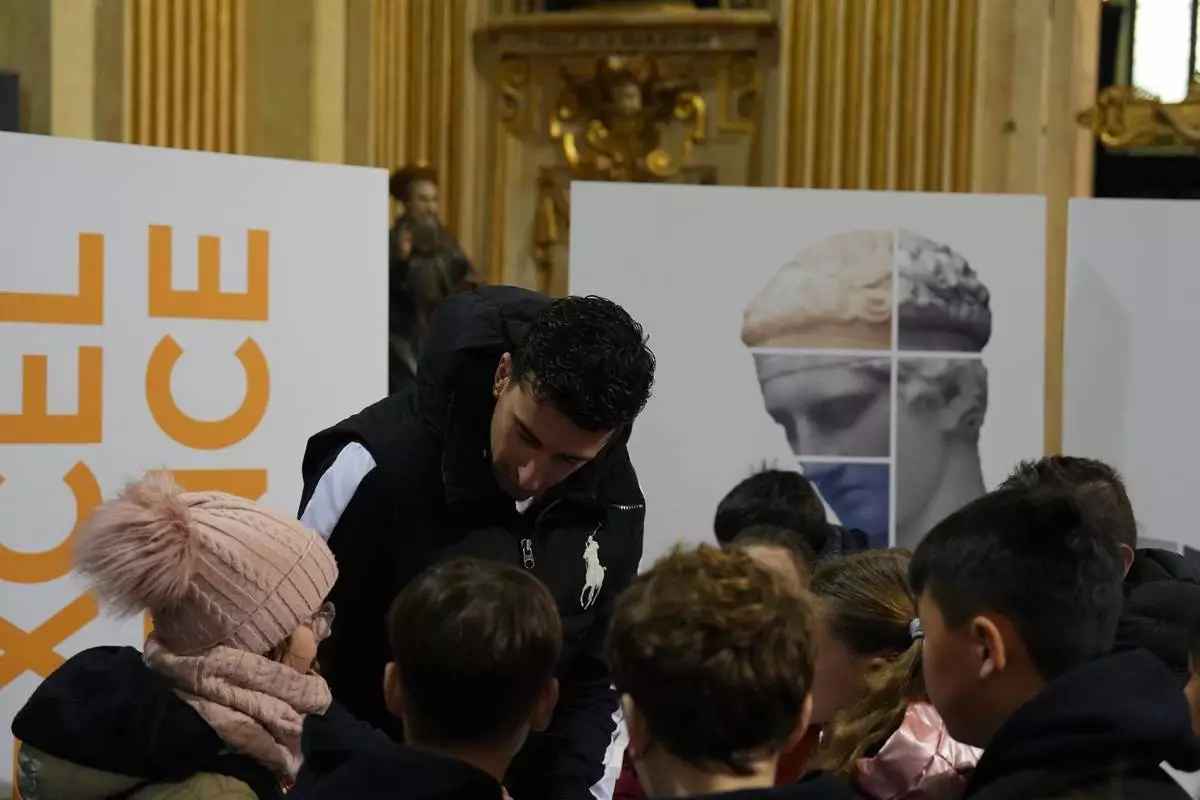
Dozens of children sat quietly on the benches of the Roman Catholic church rebuilt in the late 16th century. After a brief introduction to the program, they met Giordano Bortolani, a basketball player who came up through the youth system of Olimpia Milano, a professional basketball club, and has played in Italy’s top and second divisions.

“Since becoming a professional athlete, I often go around talking to kids,” said Bortolani, who has also engaged in activities organized for people with disabilities within programs of Milan’s Catholic Church.

“With the Winter Olympics happening here in Milan, it’s all about Olympic values,” he added. “The values of sport, and of life as well.”

Behind him hung banners showcasing graphic designs created by students in their final year of high school, highlighting Olympic-inspired principles.

The works interpret those themes by linking past and present, using the Milan Cortina Winter Olympics as a common framework.

“The idea is to rethink sport not only as competition or performance, but also as a vehicle for ethical principles such as cooperation, respect, solidarity and inclusion,” said Matilde Napoli, deputy head of the school.

Initiatives like the Tour of Sports Values unfold largely in oratories, an Italian model of parish spaces where children and teenagers gather after school for sports and recreational activities.

The program is supported by the foundation of Milan’s oratories, known by its Italian initials, FOM, which coordinates these programs across the Milan archdiocese.

During the Winter Olympics, those everyday settings are being used to connect the Olympic spirit with daily life, turning familiar church spaces into classrooms for sport, reflection and community.

“Oratories are places where young people can come together,” said Napoli. “They offer opportunities for social interaction through sports, recreational and leisure activities.”

Aside from teachers, volunteers and athletes, FOM and Catholic leaders rely on organizations like CSI and local sports clubs to bring faith and sports together with youths. According to Massimo Aquino, president of CSI, Milan’s archdiocese oversees almost 1,000 oratories.

“The most beautiful thing is that, for generations, Italians have grown up learning the values of life in oratories, chasing after a ball,” Aquino said. “From this experience of sport born in oratories, many champions have emerged and grown.”

Among them, Aquino added, are Antonio Rossi, one of Italy’s most celebrated canoeists and a five-time Olympic medalist, including three golds, and sprinter Filippo Tortu, who was part of Italy’s gold-winning 4x100-meter relay team at the Tokyo Olympics.

Bortolani himself shares this background. His first encounter with sport, he said, was at age five in an oratory. “Church was part of it,” Bortolani said. “Sometimes, between training sessions, they would take us to pray.”

Later he married, joined Olimpia Milano and became a professional athlete. But oratories have never been far from his heart.

“There is a beauty in sport itself, but sometimes a young person may be interested in hearing the point of view of an athlete,” Bortolani said. “That’s how it was for me when I was younger.”

AP Olympics: https://apnews.com/hub/milan-cortina-2026-winter-olympics

Associated Press religion coverage receives support through the AP’s collaboration with The Conversation US, with funding from Lilly Endowment Inc. The AP is solely responsible for this content.
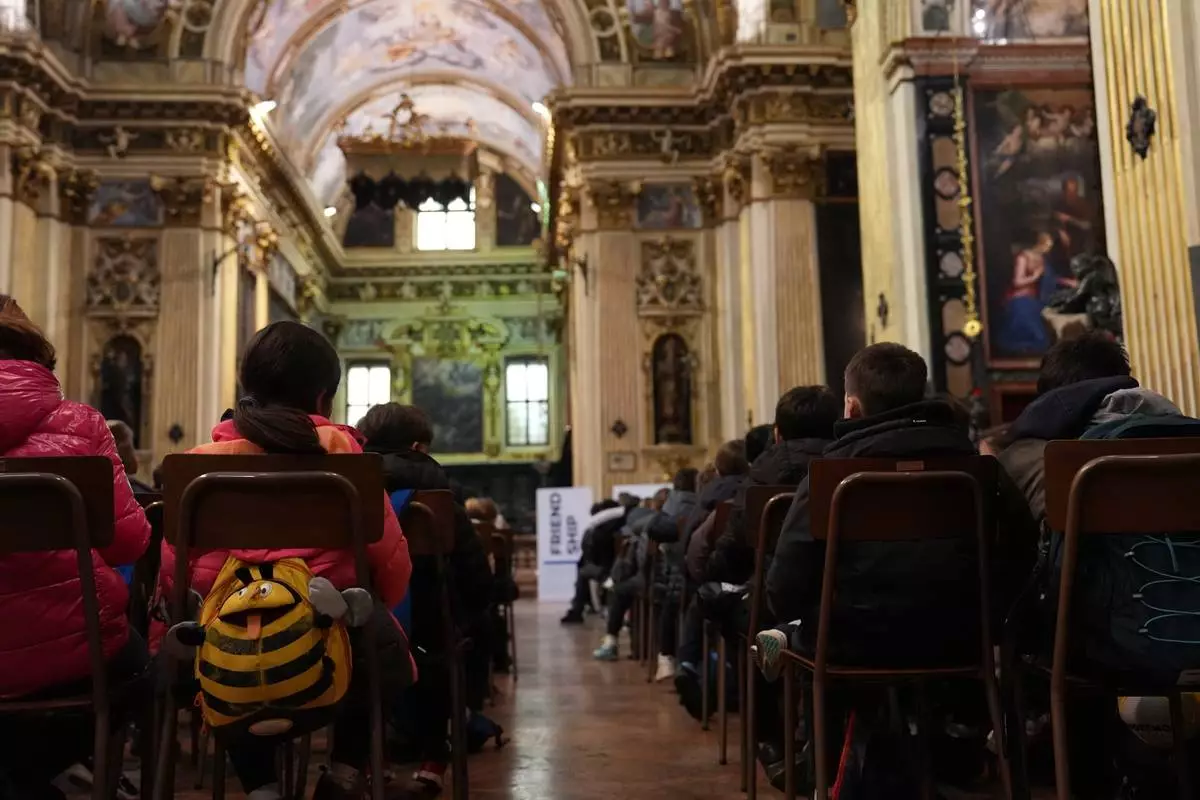
Children sit inside the Church of Sant’Antonio during an activity linked to the “Tour of Sports Values,” an initiative connected to the 2026 Winter Olympics, in Milan, Italy, Monday, Feb. 9, 2026. (AP Photo/María Teresa Hernandez)
Children sit inside the Church of Sant’Antonio during an activity linked to the “Tour of Sports Values,” an initiative connected to the 2026 Winter Olympics, in Milan, Italy, Monday, Feb. 9, 2026. (AP Photo/María Teresa Hernandez)
Basketball player Giordano Bertolani speaks to children during a values-focused activity at the Church of Sant’Antonio, part of a church-led initiative tied to the 2026 Winter Olympics, in Milan, Italy, Monday, Feb. 9, 2026. (AP Photo/María Teresa Hernandez)

Basketball player Giordano Bertolani speaks to children during a values-focused activity at the Church of Sant’Antonio, part of a church-led initiative tied to the 2026 Winter Olympics, in Milan, Italy, Monday, Feb. 9, 2026. (AP Photo/María Teresa Hernandez)

Children receive snowflake-shaped medals inspired by the 2026 Winter Olympics during an activity organized by a parish oratory connected to the Church of Santa Eufemia in Milan, Italy, Monday, Feb. 9, 2026. (AP Photo/María Teresa Hernandez)
Children receive snowflake-shaped medals inspired by the 2026 Winter Olympics during an activity organized by a parish oratory connected to the Church of Santa Eufemia in Milan, Italy, Monday, Feb. 9, 2026. (AP Photo/María Teresa Hernandez)
DHAKA, Bangladesh (AP) — Tarique Rahman spent 17 years in self-imposed exile. Now, he is poised to become the prime minister of Bangladesh — and follow in the footsteps of his mother.

Thursday’s national election seemed to hand Rahman’s Bangladesh Nationalist Party a majority, according to local media reports, marking a significant political shift in the South Asian nation of more than 170 million people. The BNP has also claimed victory.

For Rahman, the turnaround is dramatic.

The 60-year-old returned from London in December to a country in turmoil. Within days, his mother, former Prime Minister Khaleda Zia, died from long illness. In the election, he faced a rising religious conservative party that had gained momentum after a 2024 student-led uprising toppled Zia's longtime rival, former Prime Minister Sheikh Hasina.

And yet his biggest challenge may still lie ahead.

The path from the 2024 uprising to Thursday’s election has been marked by turmoil. Bangladesh grappled with unrest after a student leader’s death, a resurgence of Islamist groups, the fraying of the rule of law, attacks on Hindu minorities and the press, as well as a struggling economy.

“Rahman has said all the right things, pledging to eliminate corruption and bring the country together. That all sounds well and good. But the BNP has a poor track record from when it was last in power — there was repression and corruption,” said Michael Kugelman, a Senior Fellow for South Asia at the Atlantic Council.

Rahman is a key figure in the Zia political dynasty.

His mother served two five-year terms as prime minister, the last time from 2001 to 2006. His father, Ziaur Rahman, rose from the army to become Bangladesh’s sixth president before his assassination in 1981.

He is married to Zubaida Rahman, a physician and daughter of a former Bangladesh Navy chief.

His BNP, one of the country’s longstanding political forces, alongside Hasina's now-banned Awami League party, has for decades dominated Bangladesh’s political landscape. In recent years, the BNP boycotted several elections, including the 2024 vote, citing widespread fraud.

Rahman’s political career has been controversial.

Targeted by multiple criminal cases under Hasina’s government, he spent 17 years in self-imposed exile in London. In 2018, he was sentenced to life in prison in connection with a 2004 grenade attack on Hasina that killed at least 24 people. Hasina narrowly survived the attack. Rahman denied he was involved in the attack and denounced the verdict, along with his party, terming it politically motivated.

Rahman left Bangladesh in 2008, officially for medical treatment, after enduring torture while in custody during the military-backed administration that governed from 2006 to 2008, following Zia's failure to peacefully hold a new election and hand over power.

Though he never held office in his mother’s governments, Rahman wielded significant influence within the BNP, serving as acting chairman, senior vice chairman, and senior joint secretary.

A leaked set of U.S. diplomatic cables described him as “phenomenally corrupt.”

After the collapse of Hasina’s government, the charges and convictions against Rahman were dropped, clearing the way for his return from exile.

In the run-up to the election, he sought to reshape his image, promising job creation, financial aid for poor families, greater freedom of speech, stronger law enforcement, and an end to corruption. His campaign cast him as a defender of democracy in a country long shaped by entrenched parties, military interventions and allegations of vote rigging.

After Hasina's ouster, the country's interim leader Nobel Peace Prize laureate Muhammad Yunus held a meeting with Rahman in London, an event that apparently led to his return to the country.

However, his rise is expected to rankle many in Bangladesh, particularly those who took part in the uprising and wanted their country free of dynastic politics and the old political guard they blame for the country’s problems.

The Atlantic Council's Kugelman said a key test for Rahman will be how he treats Hasina’s Awami League party, which has been accused of cracking down on the BNP in the past, including arrests of its senior leaders and party workers. Rahman’s mother was arrested and imprisoned during Hasina’s government.

Hasina has been in exile in India since August 2024, and a special tribunal in Dhaka sentenced her to death last year over crimes against humanity related to her crackdown that killed protesters during the uprising that ousted her. She denies all charges. Meanwhile, her party was barred from participating in the election, and thousands of its members remain in hiding due to fears of persecution.

“If Rahman leans on retribution, it shows the old politics haven’t disappeared,” said Kugelman. “But a focus on unity would be an encouraging sign.”

Security personnel guard near the chairman office of the Bangladesh Nationalist Party (BNP) before the national parliamentary election result is announced in Dhaka, Bangladesh, Thursday, Feb. 12, 2026. (AP Photo/Anupam Nath)

Security personnel guard near the chairman office of the Bangladesh Nationalist Party (BNP) before the national parliamentary election result is announced in Dhaka, Bangladesh, Thursday, Feb. 12, 2026. (AP Photo/Anupam Nath)

Bangladesh Nationalist Party Chairperson Tarique Rahman talks to media after casting his vote during the national parliamentary elections in Dhaka, Bangladesh, Thursday, Feb. 12, 2026. (AP Photo/Mahmud Hossain Opu)

Bangladesh Nationalist Party Chairperson Tarique Rahman talks to media after casting his vote during the national parliamentary elections in Dhaka, Bangladesh, Thursday, Feb. 12, 2026. (AP Photo/Mahmud Hossain Opu)

Tarique Rahman, the son of former Prime Minister Khaleda Zia and chairman of the Bangladesh Nationalist Party (BNP), attends an election rally ahead of national election in Dhaka, Bangladesh, on Feb. 8, 2026. (AP Photo/Anupam Nath)

Tarique Rahman, the son of former Prime Minister Khaleda Zia and chairman of the Bangladesh Nationalist Party (BNP), attends an election rally ahead of national election in Dhaka, Bangladesh, on Feb. 8, 2026. (AP Photo/Anupam Nath)

Recommended Articles