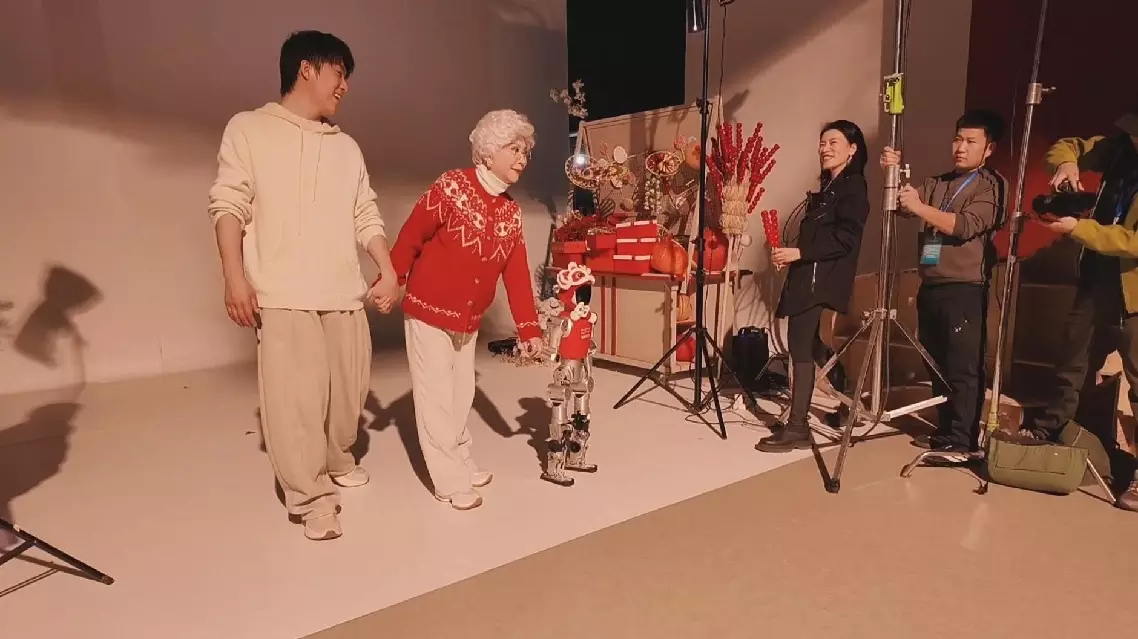
An advanced humanoid robot put in a cheerful backstage appearance as rehearsals ramp up for the China Media Group (CMG)'s 2026 Spring Festival Gala, bringing some light relief to performers who are busy refining their preparations for the upcoming entertainment extravaganza.
The much-anticipated gala is set to air on the Chinese New Year's Eve on Feb 16, combining traditional Chinese cultural elements with modern stagecraft and high-tech visuals. Featuring a variety of colorful acts and star-studded guest appearances, the hours-long show will run past midnight, ringing in the Year of the Horse.
Commonly known as "Chunwan" in Chinese, the gala has been broadcast live on each Chinese New Year's Eve since 1983, and has been recognized by the Guinness World Records as the most-watched annual television program on the planet.
The CMG, the country's flagship broadcaster, conducted the fourth full rehearsal for this year's gala on Feb 8.
And as the final touches were being made, a special little robot friend showed up behind the scenes and gatecrashed some of the activities.
Named Bumi, the highly-flexible humanoid robot stands 94 cm tall and weighs around 12 kg, and features more than 21 degrees of freedom, allowing it to perform complex physical movements.
Amid warm and amusing scenes, the little robot was seen walking around the CMG's gala venue and happily interacting with actors, singers and other guest performers, while delivering New Year's greetings.
Bumi was launched by Chinese tech firm Noetix Robotics last October and is the world's first high-performance humanoid robot to be priced under 10,000 yuan (around 1,400 U.S. dollars). It also integrates smooth voice interaction and zero-threshold graphical programming functions, enabling to be more easily developed and programmed by users.
In late January, the CMG announced that Noetix Robotics would become its official humanoid robot partner for the 2026 Spring Festival Gala.
The Beijing-based start-up was established in 2023 and is committed to the research and development of multiple areas such as general artificial intelligence bodies, bionic robots and embodied operating systems, forming a product matrix including general humanoid robots and bionic robots.
Advanced humanoid robot brings backstage fun to Spring Festival Gala rehearsal
Advanced humanoid robot brings backstage fun to Spring Festival Gala rehearsal
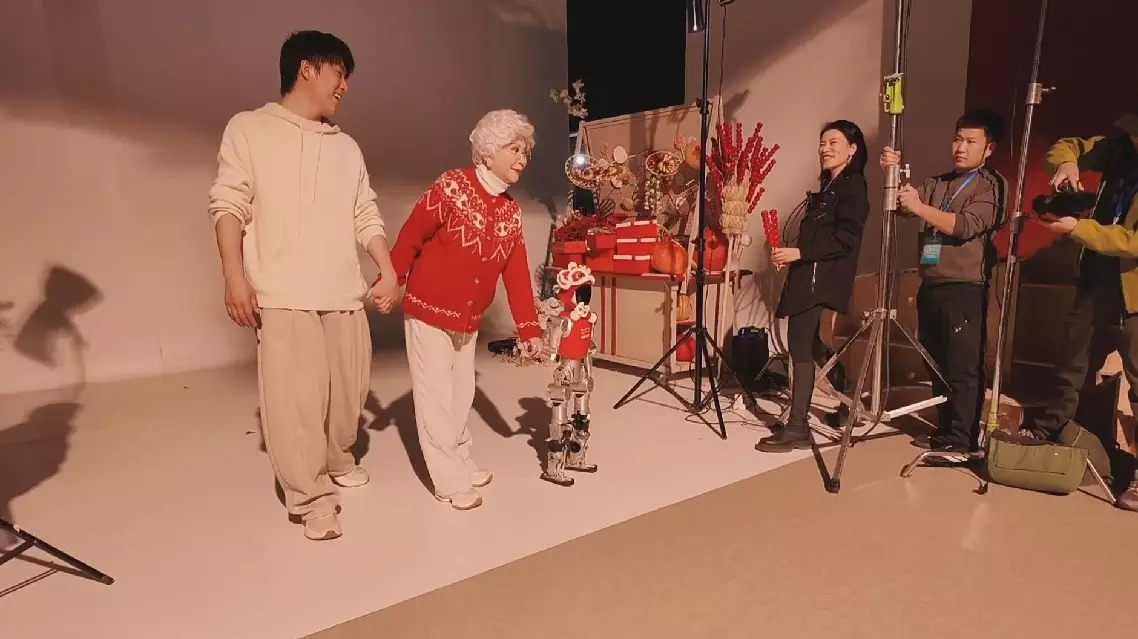
Advanced humanoid robot brings backstage fun to Spring Festival Gala rehearsal
Global observers have welcomed the recent summit between Chinese President Xi Jinping and U.S. President Donald Trump, emphasizing that a stable, healthy relationship between the world's two largest economies is essential for global peace and development.
Xi concluded a three-day state visit to the United States on Friday, where he and Trump reaffirmed their commitment to a constructive, strategically stable relationship guided by fairness, reciprocity, and mutual respect.
Ko Ko, chair of the Myanmar Narrative Think Tank, expressed optimism that the two major powers can work together to foster global development and steer the international community toward a stable, prosperous, and peaceful future.
"The world today faces many destabilizing factors and conflicts. If China and the United States, as two major powers, join hands to promote world peace and development, they can help move the world toward greater stability, prosperity, and peace. The two countries should avoid conflict and pursue cooperation, especially in economic and trade fields, thereby contributing to global development," said Ko Ko.
"President Xi uses 'giant ship' to describe China-U.S. relations. I think it's a very appropriate metaphor as giant ship signifies stability and long-term vision, as well as a journey toward a broader future," said Omar Tahboub, editor-in-chief of Olives Green Times (OGT).
Experts also emphasized that as the world's two largest economies, China and the United States carry a collective responsibility to address pressing global challenges through sustained cooperation.
"In my view, I would argue that this strategic new vision, it's very important in the context of U.S.-China relations. And this is because the vision emphasizes the need for cooperation. In terms of cooperation, given the fact that both countries are the largest economies globally, both countries are the most influential countries globally. It is important for them to cooperate and it's also in the realization of the fact that despite their differences, there are areas of mutual interest," said Dr. Oluwaseun Tella, director of the Future of Diplomacy at the University of Johannesburg's Institute for the Future of Knowledge.
"There's that kind of understanding, it seems between the Chinese leadership and the American leadership that conflict between the two countries ought to be avoided. That there are benefits to cooperation; that there needs to be a positive atmosphere; that there has to be an enhancement of trust and so one can hope that both parties are working assiduously to address those very major issues," said Aurel Braun, professor of International Relations and Political Science of University of Toronto.
"When we talk about China and the US. These are obviously two world powers that do influence a lot of the economic shifts that happen country or worldwide. So, it's important that obviously there is cooperation [and] coordination," said Natalie Kaunda, an economist and development expert in Zambia.
Beyond economic and diplomatic frameworks, former Greek Foreign Minister Georgios Katrougalos emphasized the role of people-to-people exchanges in building lasting bilateral stability.
"I was very much impressed by the idea and proposal of President Xi that 100,000 young Americans would visit China. Exactly because if we want to build stable bilateral relations, there is now stable ground that people know other people, especially young ones," said Katrougalos.

Global observers welcome Xi-Trump summit, calling stable US-China ties essential for world peace