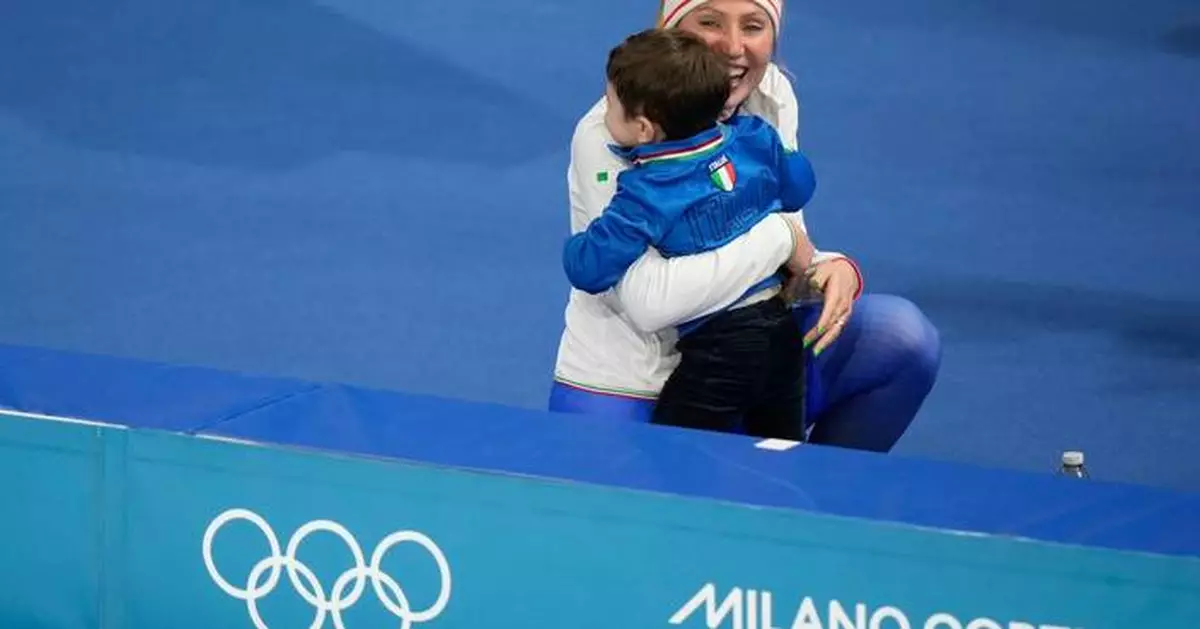
MILAN (AP) — When Francesca Lollobrigida collected Italy's first gold medal of the Milan Cortina Olympics this week, the speedskater immediately looked for her 2-year-old son, Tommaso, so they could celebrate together. She found him but was told he wasn't allowed to go over to where she was after winning the 3,000 meters.
“So I said, ‘Fine. I’ll go to him,’” Lollobrigida said. She sprinted over to Tommaso and enveloped him in a big hug; soon, he was shushing his mother while in her arms during TV interviews.
Click to Gallery
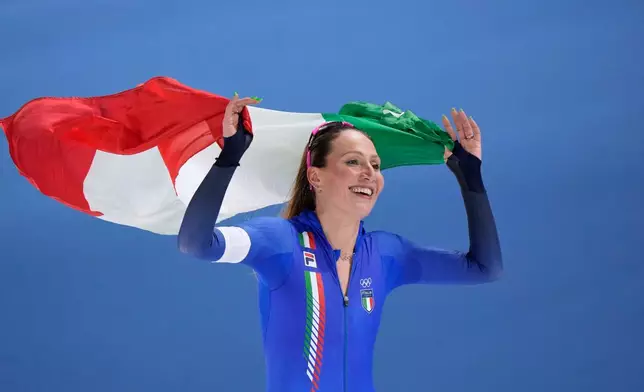
Francesca Lollobrigida of Italy celebrates winning the gold medal in the women's 5,000 meters speedskating race at the 2026 Winter Olympics, in Milan, Italy, Thursday, Feb. 12, 2026. (AP Photo/Luca Bruno)
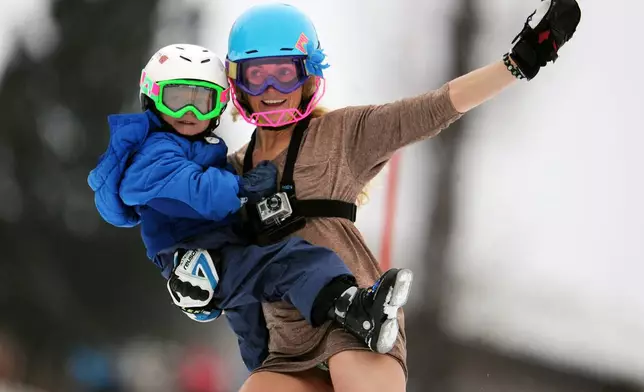
FILE - Sarah Schleper holds her son Lasse as she skies down the course during an alpine ski, women's World Cup slalom, in Lienz, Austria, Thursday, Dec. 29, 2011. (AP Photo/Giovanni Auletta, File)
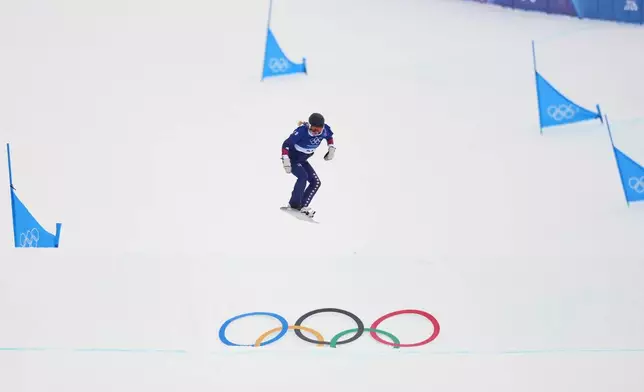
United States' Faye Thelen practices during a snowboard cross training session at the 2026 Winter Olympics, in Livigno, Italy, Friday, Feb. 6, 2026. (AP Photo/Lindsey Wasson)
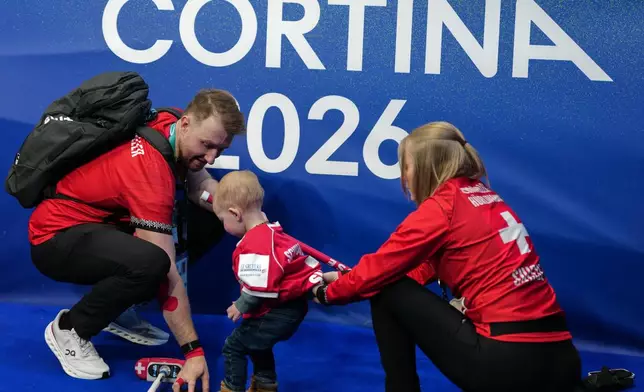
Switzerland's Yannick Schwaller and Briar Schwaller-Huerlimann interact with their child after the mixed doubles round robin phase of the curling competition against Canada, at the 2026 Winter Olympics, in Cortina d'Ampezzo, Italy, Sunday, Feb. 8, 2026. (AP Photo/Misper Apawu)
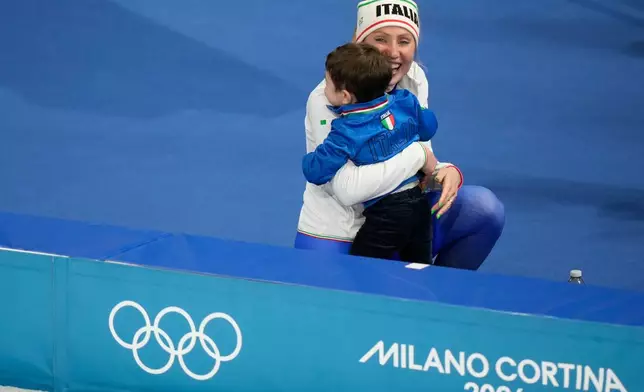
Francesca Lollobrigida of Italy celebrates with her son Tommaso after winning the gold medal in the women's 3,000 meters speedskating race at the 2026 Winter Olympics, in Milan, Italy, Saturday, Feb. 7, 2026. (AP Photo/Luca Bruno)
“Aside from doing this for me, I did it for him, so one day he will be proud of me. Not just for being an Olympic champion, but for all of the journey we’ve lived together," explained Lollobrigida, who added another gold in the 5,000 on Thursday. “The message I wanted to show is that I didn’t choose between being an athlete and being a mom.”
Yes, mothers and fathers are part of the fabric of these Olympics, and so, too, are their children who've tagged along. The 232-athlete U.S. roster, for example, included nine moms — up from just one at the 2018 Pyeongchang Winter Olympics and from four at Beijing in 2022 — and 17 dads.
Some see the trend of more mothers as a reflection of changing attitudes about women balancing parenthood with careers. It's commonplace across society at large over decades in many places but only recently in the sports world.
Amber Donaldson, Vice President of Sports Medicine at the U.S. Olympic and Paralympic Committee, called it a “cultural shift.”
“This isn’t a moment; it’s a movement for female athletes,” she said.
This is the first Winter Olympics since Donaldson, who joined the USOPC from the WTA women's tennis tour, started a women's health task force in 2022.
“Half our population are female athletes at almost every Games. And they get the majority of the medals. They’re more injured. They’re more ill. They have more time-loss injuries,” she said. “But across the board, they’re still performing really well. I said: If we can figure out why, and keep them healthy, then watch out.”
Part of those efforts involve policies to help mothers, or would-be mothers, by providing information about and funding for fertility treatments not covered by insurance, working to make pre-natal vitamins allowed under anti-doping rules, updating lactation spaces or places for athletes' children to hang out at training facilities.
In sum, Donaldson said, “To support our women in not having to make a choice” between sports and raising a family.
In Italy, the USOPC found a company that will rent strollers and car seats to the U.S. team's mothers and fathers.
The International Olympic Committee did not provide nurseries at the spread-out events in Italy for youngsters, the way it did at the Paris Summer Games two years ago, and invariably, some athlete's child is making an appearance at a venue, maybe even stealing the spotlight.
They're as little as 1-year-old River, the son of Swiss curlers Yannick Schwaller and Briar Schwaller-Hürlimann of Switzerland — the kid dubbed the “Curling Baby” for toting a broom twice his size — or as grown as 18-year-old Lasse Gaxiola, 18, who is a competitor himself, scheduled to race Saturday for Mexico in Alpine skiing’s giant slalom. His mother, Sarah Schleper, finished 26th in that sport’s super-G on Thursday.
“It’s kind of like my side gig is the ski racing,” said Schleper, 46, “which I’m so thankful I can still do.”
River is hardly alone at the curling. Canadian couple Jocelyn Peterman and Brett Gallant have their son, Luke, 2, with them. The Peterson sisters from the U.S., Tara (son Eddie, born in September 2024) and Tabitha (daughter Noelle, born two months later) brought their children, too.
“You only have so many hours to dedicate to curling. The rest, I want to be a mother. I also have a day job as well — I’m a dentist — so there’s just a lot of things that we need to balance,” Tara Peterson said. “As for competition, it just makes it that much more sweet when ... you make the big shot, you win the big game, you look over, and there’s a little baby screaming, ‘Mama! Mama!’"
Nick Baumgartner, a U.S. snowboardcross rider who won a gold in Beijing, is at his fifth Olympics, and second with his son, Michigan State student Landon, on-site.
“I just race different when my son’s at the bottom of the course,” Baumgartner said. “Look out! Dad’s coming down!”
Faye Thelen, who was scheduled to compete in snowboard cross Friday, is at her fifth Games, and first as a mother of two, who are with her.
“I wasn’t going to leave them back in Utah with my husband or any other childcare,” Thelen said. “I have this image in my head that they're going to be down there and I'm going to win gold and I'm going to cry.”
She was fully prepared for the reality to not match the dream.
“My daughter is 7 months old and she doesn’t even know that she exists at this point,” Thelen said with a laugh. “I guarantee my son’s going to have his head in the snow. … It probably won't look that magical, but to me, it will be."
There are, to be sure, plenty of challenges for parents of little ones. U.S. bobsledder Elana Meyers Taylor travels the World Cup circuit with her two sons — one is 5, the other 3 — and brought them to Italy. Both children are deaf; one has Down syndrome.
“I thought doing this with one kid was crazy. Doing it with two is just — I think I’m just a glutton for punishment, because this is just insane,” Meyers Taylor said. “It’s just chaos all the time. Like, getting to the starting line most weeks is a huge accomplishment.”
The IOC doesn't track data about how many parents are at an Olympics.
According to the Italian National Olympic Committee, the only mother on its squad is Lollobrigida, a 2022 silver medalist who initially figured she wouldn't return to speedskating after giving birth in May 2023. Upon her return, she recalled, Italy's speedskating coach, Maurizio Marchetto, told Lollobrigida: “OK, I never had to train a mom, but we can do it together.”
And they did — with help, of course. Lollobrigida spoke about needing a support team, including her husband and sister, especially while she spends more than 250 days a year on the road.
“It’s not easy. It’s not, ‘Wow!’ like this," she said, and snapped her fingers. “There are more low moments than high ones.”
Still, Lollobrigida pointed out that the best results of her career — the pair of Olympic golds in Milan and a world title last year — arrived after she became a parent.
“You can be a mom,” she said, “and come back to be much stronger.”
AP National Writer Eddie Pells in Livigno; Associated Press writer Julia Frankel and AP Sports Writers Andrew Dampf, Steve Douglas and Tim Reynolds in Cortina d’Ampezzo; AP Sports Writer Pat Graham in Bormio; and AP Sports Writers Graham Dunbar and John Wawrow in Milan contributed.
AP Olympics: https://apnews.com/hub/milan-cortina-2026-winter-olympics
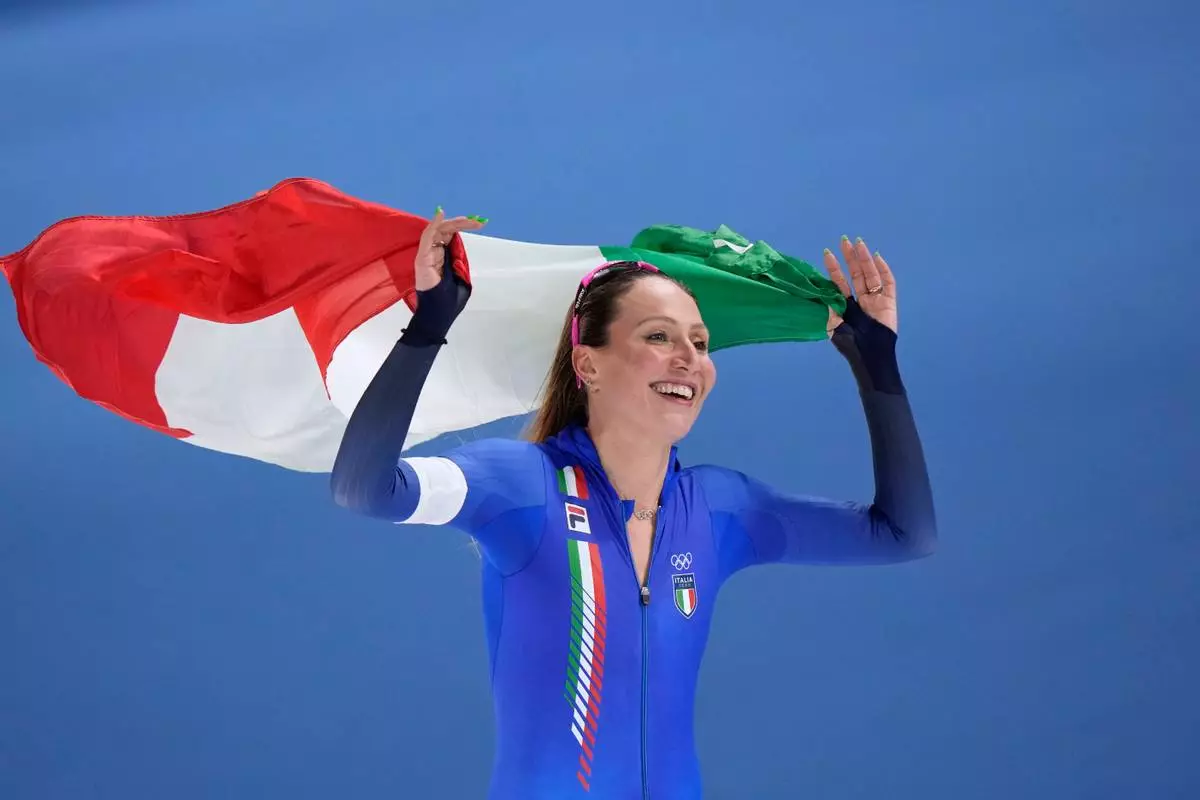
Francesca Lollobrigida of Italy celebrates winning the gold medal in the women's 5,000 meters speedskating race at the 2026 Winter Olympics, in Milan, Italy, Thursday, Feb. 12, 2026. (AP Photo/Luca Bruno)
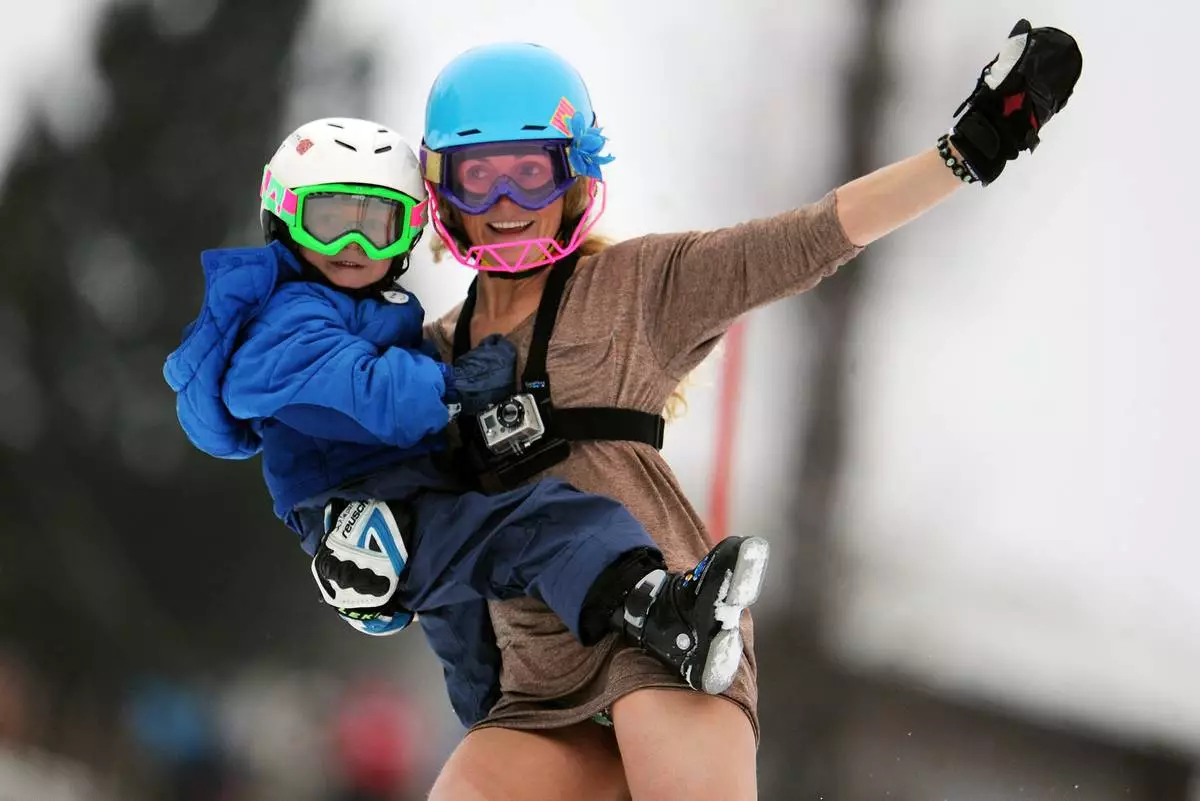
FILE - Sarah Schleper holds her son Lasse as she skies down the course during an alpine ski, women's World Cup slalom, in Lienz, Austria, Thursday, Dec. 29, 2011. (AP Photo/Giovanni Auletta, File)
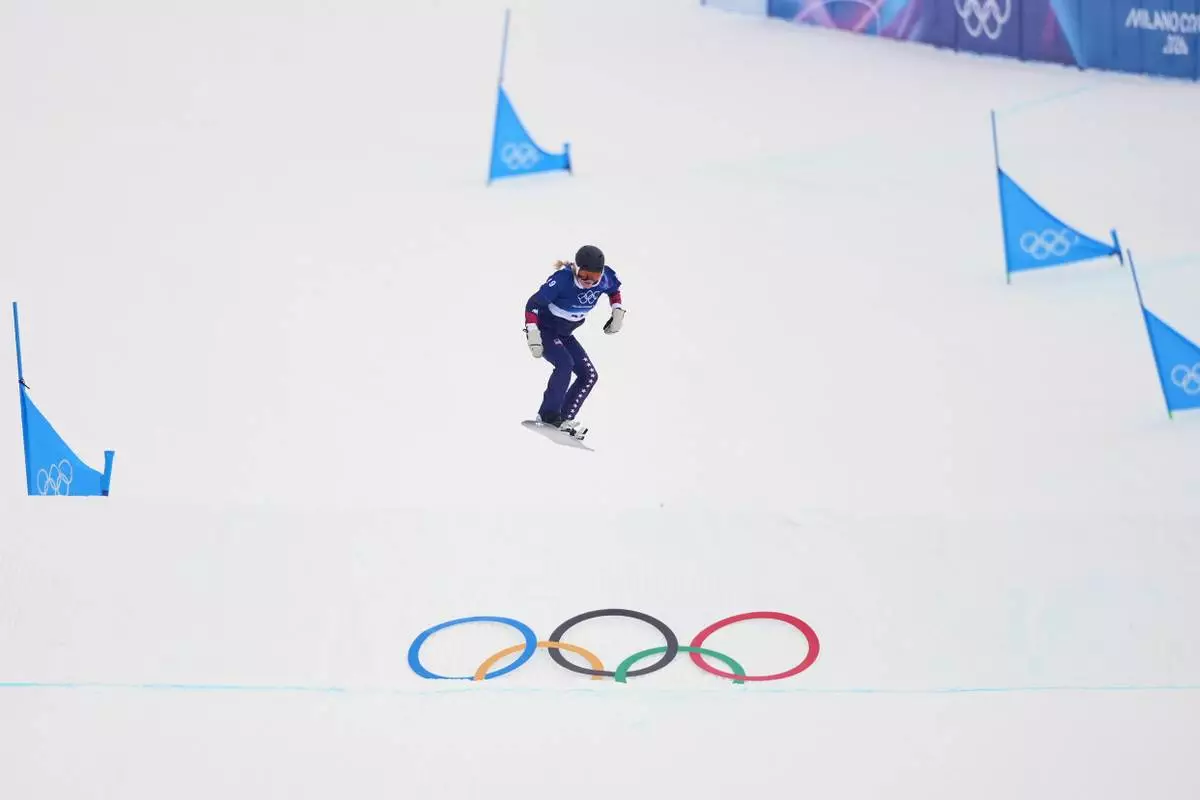
United States' Faye Thelen practices during a snowboard cross training session at the 2026 Winter Olympics, in Livigno, Italy, Friday, Feb. 6, 2026. (AP Photo/Lindsey Wasson)
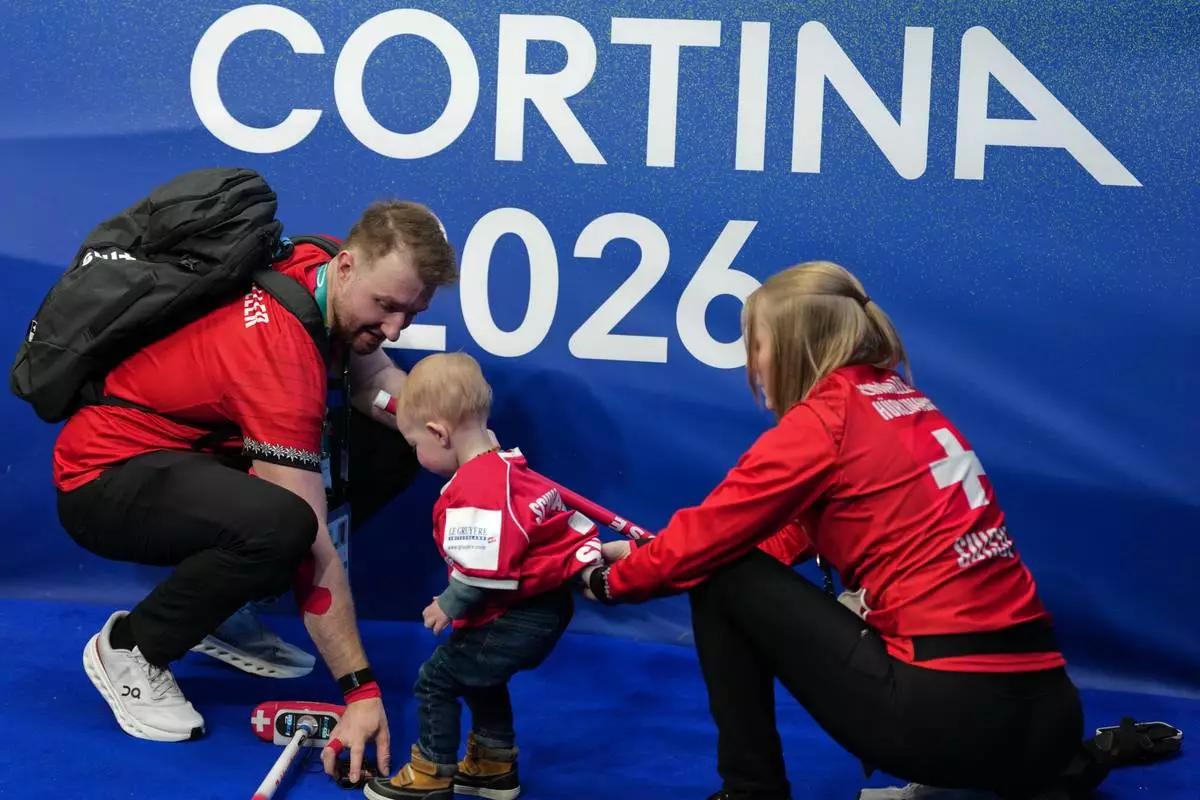
Switzerland's Yannick Schwaller and Briar Schwaller-Huerlimann interact with their child after the mixed doubles round robin phase of the curling competition against Canada, at the 2026 Winter Olympics, in Cortina d'Ampezzo, Italy, Sunday, Feb. 8, 2026. (AP Photo/Misper Apawu)
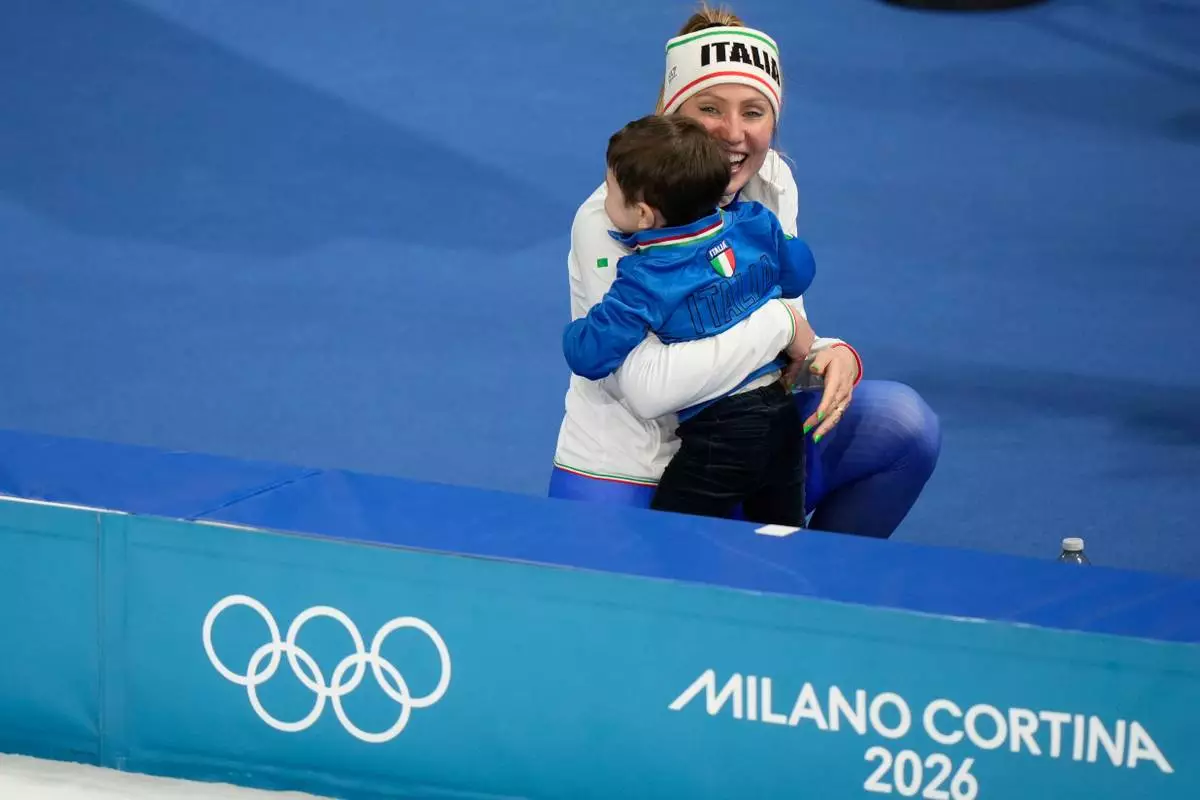
Francesca Lollobrigida of Italy celebrates with her son Tommaso after winning the gold medal in the women's 3,000 meters speedskating race at the 2026 Winter Olympics, in Milan, Italy, Saturday, Feb. 7, 2026. (AP Photo/Luca Bruno)