Former Slovenian President Danilo Turk said on Sunday that strategic autonomy may become a requirement for the European Union (EU) in the future and that the bloc needs to recalibrate its relations with both China and the United States.
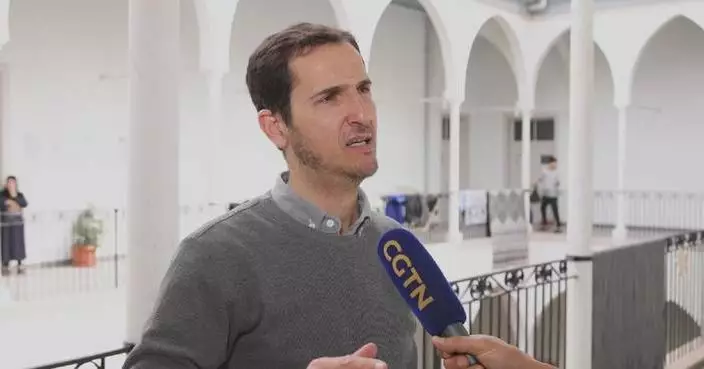
Turk was speaking about the increasing need for the EU to assume greater responsibility for its own well-being and security amid fraying relations with the United States, in an interview with the China Media Group on the sidelines of the 62nd Munich Security Conference in Germany.
He believes that Europe needs to move toward closer ties with China in the years to come.
"Strategic autonomy may become a requirement for European Union in the future. There is going to be a redefinition of relations between European Union and the United States of America. And I think that in the context of strategic autonomy, there will be a very intense need for European Union to look into its relations with China from a new perspective. And I believe that that is going to happen in the coming years. This is not something that can happen tomorrow, but let's say in the next year and the years later, it may be a major theme for both sides to discuss," Turk said.
This year's MSC ran from Friday to Sunday amid intense trade frictions, shifting security commitments, and diminished trust between the EU and the U.S.
European leaders present at the gathering on Saturday called for greater strategic autonomy, reflecting their growing anxieties over a fractured international order and a widening rift in transatlantic relations.
The Munich Security Report 2026 describes the current era as one of the "wrecking-ball politics", saying political forces favoring destruction over reform are gaining momentum across many Western societies, driven by disenchantment with the performance of democratic institutions and a loss of trust in political course correction.

Strategic autonomy required for EU's future: former Slovenian president

Strategic autonomy required for EU's future: former Slovenian president
The Shenzhou-21 crew aboard China's orbiting Tiangong space station completed their mission's third series of extravehicular activities (EVAs) on Friday, according to the China Manned Space Agency (CMSA).
The astronaut trio -- Zhang Lu, Wu Fei and Zhang Hongzhang -- worked for roughly five and a half hours and completed their EVAs at 01:36 (Beijing Time), assisted by the space station's robotic arm and a team on Earth.
The trio completed the installation of a space debris protection device for the space station, and extravehicular equipment and facility inspections, among other tasks. Zhang Lu, the commander of the Shenzhou-21 mission, and Wu Fei conducted the spacewalk and returned to the Wentian lab module safely, according to the CMSA.
Zhang Lu has so far carried out seven EVAs, making him one of the Chinese astronauts with the most spacewalks to date.
Since completing their second series of EVAs on March 16, the Shenzhou-21 astronauts have steadily advanced experiments in areas such as space life sciences, human research, and microgravity physical science. They have carries out in-orbit environmental monitoring, equipment inspection and maintenance, and supply management. The crew has also completed a full-system pressure emergency drill, emergency life-support training, and preparations for extravehicular activities.
The three astronauts have been in orbit for more than five months and remain in good working and living condition.
To further validate technologies related to long-term human habitation in orbit and to maximize the comprehensive benefits of using the Shenzhou-22 spacecraft as an emergency launch vehicle to resupply the space station, it has been decided, after careful evaluation and assessment, that the crew's stay in orbit will be extended by approximately one month.
During the upcoming phase of their space journey, the crew will continue to conduct scientific experiments and technical tests, and will also celebrate the Space Day of China, which is marked annually on April 24, and the International Workers' Day on May 1 while in orbit.
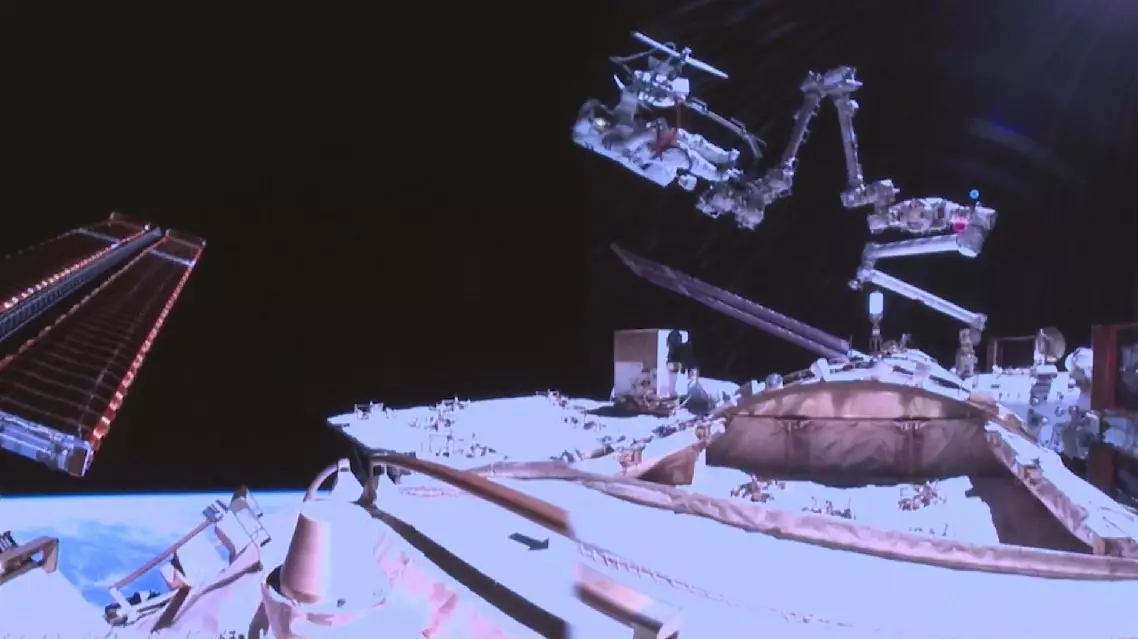
Shenzhou-21 astronauts complete 3rd series of extravehicular activities