Global media professionals urged Europe to strengthen cooperation with China in interviews with China Media Group (CMG) at the Munich Security Conference (MSC).
Amid profound and complex changes in the international landscape, both Europe and China have sent positive signals on enhancing communication and expanding cooperation at the conference. Several foreign journalists told CMG that Europe is actively advancing its relations with China and that the two sides enjoy broad prospects for cooperation across multiple fields, making closer collaboration both necessary and beneficial.
"As far as I'm concerned, China can be a friend to the world. It doesn't have to be a threat. We can all work together to our mutual benefit. Let's work to save the planet we have and stop fighting each other when we can just have so much benefit by working together," said Nick Holdsworth, a British journalist.
"I think it (the cooperation between China and Europe) is important also. It makes it more important, the fact that we see the Trump administration advertising for unilateralism. And on the other side, we see that China is coming here to an international conference to say that we need to respect multilateralism, and this is the way forward in the world. And this is where I think it's the most important," said Raghida Bahnam, a German journalist.

Global media professionals call for stronger Europe-China cooperation at MSC
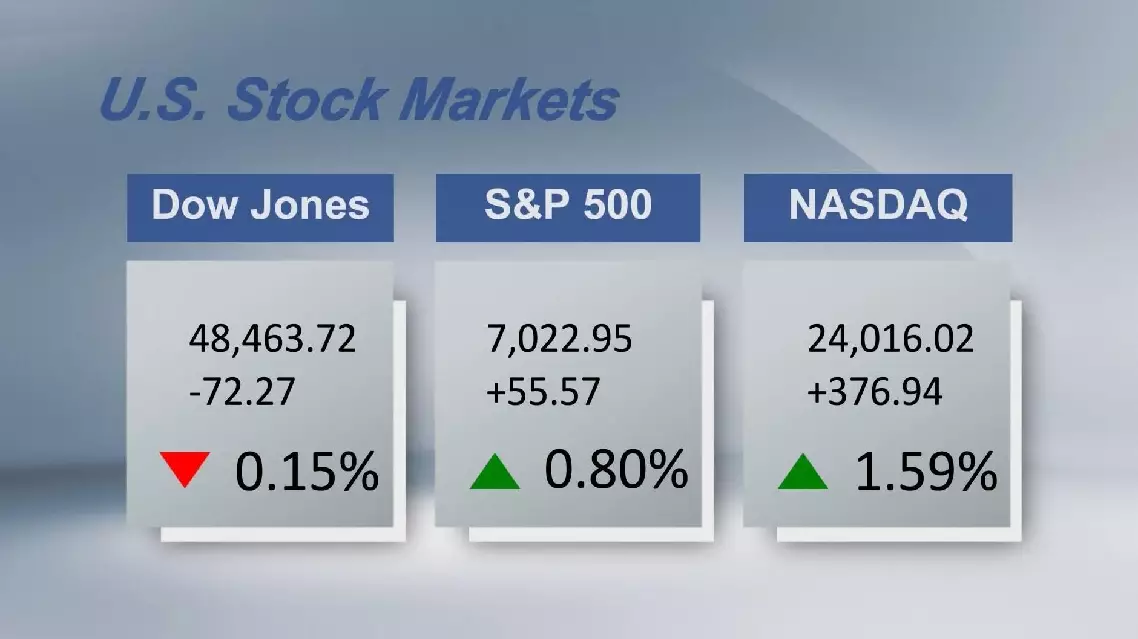
U.S. stocks ended mixed on Wednesday, with the S and P 500 and Nasdaq Composite rising to fresh all-time highs, as investors remained hopeful about progress toward a U.S.-Iran peace deal.
The Dow Jones Industrial Average fell 0.15 percent to 48,463.72. The S and P 500 added 0.8 percent to a new record close of 7,022.95. The Nasdaq Composite Index rose 1.59 percent to 24,016.02, extending its winning streak to 11 consecutive sessions.
Seven of the 11 primary S and P 500 sectors closed lower, with materials and industrials leading the laggards at declines of 1.3 percent and 1.24 percent, respectively. Technology and consumer discretionary were the top performers, rising 2.08 percent and 1.37 percent.
Stocks have rallied strongly this week on hopes that a deal between the United States and Iran may materialize. U.S. President Donald Trump offered further encouragement, telling Fox Business in an interview on Wednesday that the Iran war is "very close to being over."
Broadcom was among the session's standout performers, rising 4.19 percent after Meta Platforms announced an extension of their partnership to deploy custom chips based on Broadcom's technology.
Meanwhile, the U.S. economy grew at a "slight to modest pace" over the past six weeks, even as consumers faced higher prices and increasing demand for assistance, according to the Federal Reserve's Beige Book released Wednesday. The report, covering the 12 Fed districts, described the Iran war as "a major source of uncertainty" for businesses. Price growth was characterized as "moderate," despite a sharp rise in energy and fuel costs.
"Many Districts continued to report signs of consumer financial strain, increased price sensitivity, and rising demand at food banks and other social service organizations, while spending among higher-income consumers was resilient," the Beige Book stated.
Shares of all the "Magnificent Seven" technology giants ended higher except for Amazon, led by a 7.62 percent surge in Tesla.
Bank of America rose nearly 2 percent and Morgan Stanley advanced 4.52 percent after reporting better-than-expected quarterly results. Goldman Sachs kicked off bank earnings season on Monday, followed by Wells Fargo, JPMorgan Chase and Citigroup on Tuesday.
Snap Inc. surged nearly 8 percent after the company announced it would lay off approximately 16 percent of its global workforce, with its CEO Evan Spiegel citing "rapid advancements in artificial intelligence" as a key factor.
U.S. stocks close mixed with S and P 500, Nasdaq hitting record highs