SEATTLE--(BUSINESS WIRE)--Feb 16, 2026--
Chronus, a next-level mentoring and connection platform for the future of work, today announced the launch of its Change Adoption solution which is designed to help organizations move beyond change announcements and training to the moment that matters most: employees actually adopting new behaviors in the flow of work.
This press release features multimedia. View the full release here: https://www.businesswire.com/news/home/20260216370926/en/
From AI enablement and operating model shifts to culture changes and cross-functional collaboration, organizations are navigating constant transformation. Yet many change initiatives stall after rollout because employees don’t have enough space to process what the change means, learn from one another, and translate new expectations into real actions. Traditional approaches often rely on one-way communication or manager-led reinforcement, while day-to-day adoption happens peer-to-peer through questions, shared problem-solving, and accountability inside teams.
The new Chronus Change Adoption solution helps organizations scale those moments of peer enablement by pairing employees for intentional peer conversations that create understanding, alignment, and follow-through. With guided conversation experiences and progress visibility, organizations can run change programs that help employees make sense of new priorities, build confidence, and commit to specific actions, without adding heavy process or administrative burden.
“As leaders, we are navigating unprecedented change and continually trying to make the best decisions to drive performance and growth while resource constrained,” said Courtney Deimel, Vice President of Product & Innovation at Chronus. “The bets we make need their best chance of succeeding, and it requires our people to stay agile. Our new Change Adoption solution is designed to provide the space and structure employees need to reflect on the changes you’re making at an organizational level and truly adopt it as their new normal. That requires clarity, support, and accountability. We can now help organizations do that at scale.”
A Practical, Scalable Approach to Change Adoption
At the center of the Chronus Change Adoption solution is a structured peer experience that helps employees move from awareness to action. Rather than positioning peers as mentors or coaches, participants engage as equal thinking partners who learn together through guided, reflective dialogue, supporting faster buy-in and stronger accountability during change.
Organizations can deploy Change Adoption programs for a range of transformation priorities, including:
Chronus Change Adoption Programs Include:
With this launch, Chronus expands beyond mentoring to help organizations operationalize change adoption through scalable, human-centered conversations so that transformation translates into sustained behavior change across the enterprise.
About Chronus
Chronus is a next-level mentoring and connection platform for the future of work that transforms how enterprise organizations shape and leverage their internal talent networks, empowering leaders to accelerate business performance through their people. Chronus provides guidance in the flow of conversation that helps people align, share knowledge, navigate change, and grow faster together. Chronus partners with many of the world’s most respected enterprise organizations to ensure the right conversations happen at the right time—turning relationships into a measurable driver of performance. Chronus has delivered remarkable results for companies like Amazon, AMN Healthcare, Daikin, Electronic Arts, HCLTech, Mediaocean, Memorial Sloan Kettering Cancer Center, PNC, T-Mobile, USI, Zendesk, and more. For more information, please visit chronus.com.
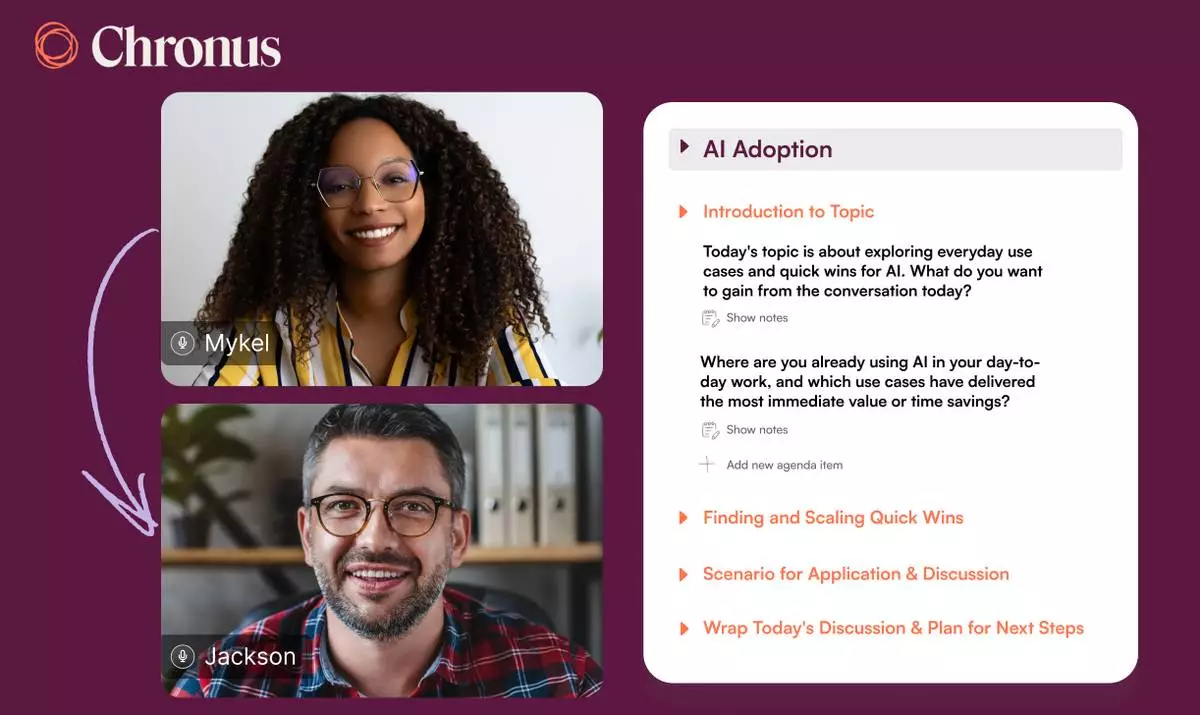
Chronus connects peers for guided conversations around Change Adoption including AI Adoption.
KYIV, Ukraine (AP) — A Ukrainian delegation was heading to Geneva on Monday for another round of U.S.-brokered talks with Russian officials, ahead of next week’s fourth anniversary of Russia’s full-scale invasion of its neighbor.
There was no anticipation of any significant progress on ending the war at the Tuesday-Wednesday meeting in Switzerland as both sides appear to be sticking to their negotiating positions on key issues, despite the United States setting a June deadline to reach a settlement. The future of Ukrainian land that Russia occupies or still covets is a central issue.
Ukrainian defenders remain locked in a war of attrition with Russia’s bigger army along the roughly 1,250-kilometer (750-mile) front line. Ukrainian civilians endure Russian aerial barrages that repeatedly knock out power and smash homes, while Ukraine has developed drones that can fly deep into Russian territory and strike oil refineries and arms depots.
The governor of western Russia’s Bryansk region said Monday that air defenses had shot down 229 Ukrainian drones in the previous 24 hours. No other Russian region has come under as many simultaneous drone attacks in a single day, Gov. Alexander Bogomaz said.
Ukraine’s Air Force, meanwhile, said Russia launched 62 long-range strike drones and six missiles of various types at Ukraine overnight.
Kremlin spokesman Dmitry Peskov said Monday that the talks in Geneva will deal with a “broader range of issues related to the territories and other issues connected to the demands that we have.” He didn’t elaborate on the issues.
A year of peace efforts by U.S. President Donald Trump’s administration has failed to stop the fighting. Western officials and analysts say Russian President Vladimir Putin believes that time is on his side, that Western support for Ukraine will peter out and that Ukraine’s resistance will eventually collapse under pressure.
Gen. Kyrylo Budanov, Ukrainian President Volodymyr Zelenskyy’s chief of staff, posted a photograph on Telegram showing himself standing next to a train with other members of the negotiating team, which is due to be led in Geneva by Rustem Umerov, Ukraine’s National Security and Defense Council chief.
Entering or leaving Ukraine entails a long overland journey, even for VIPs, as the country’s airspace is closed because of the war.
Putin’s adviser Vladimir Medinsky, who headed Moscow’s team of negotiators in the first direct peace talks with Ukraine in Istanbul in March 2022 and who has forcefully pushed Putin’s war goals, is returning to lead Moscow’s delegation. Medinsky has written several history books that focus on exposing purported Western plots against Russia and denigrate Ukraine.
Igor Kostyukov, the head of Russian military intelligence, and Deputy Foreign Minister Mikhail Galuzin, along with other officials, will also be in the delegation, Kremlin spokesman Peskov said.
Putin’s envoy Kirill Dmitriev will also travel to Geneva for separate talks with the U.S. on economic cooperation, according to Peskov. Moscow and Kyiv are keen to offer future business opportunities to Washington.
It was not clear which American officials would be in Geneva. At recent talks in Abu Dhabi, the capital of the United Arab Emirates, the Trump administration was represented by envoys Steve Witkoff and Jared Kushner.
The Russian and Ukrainian delegations were to report back to their leaders before any possible compromises discussed in Geneva could be accepted.
Follow AP’s coverage of the war in Ukraine at https://apnews.com/hub/russia-ukraine
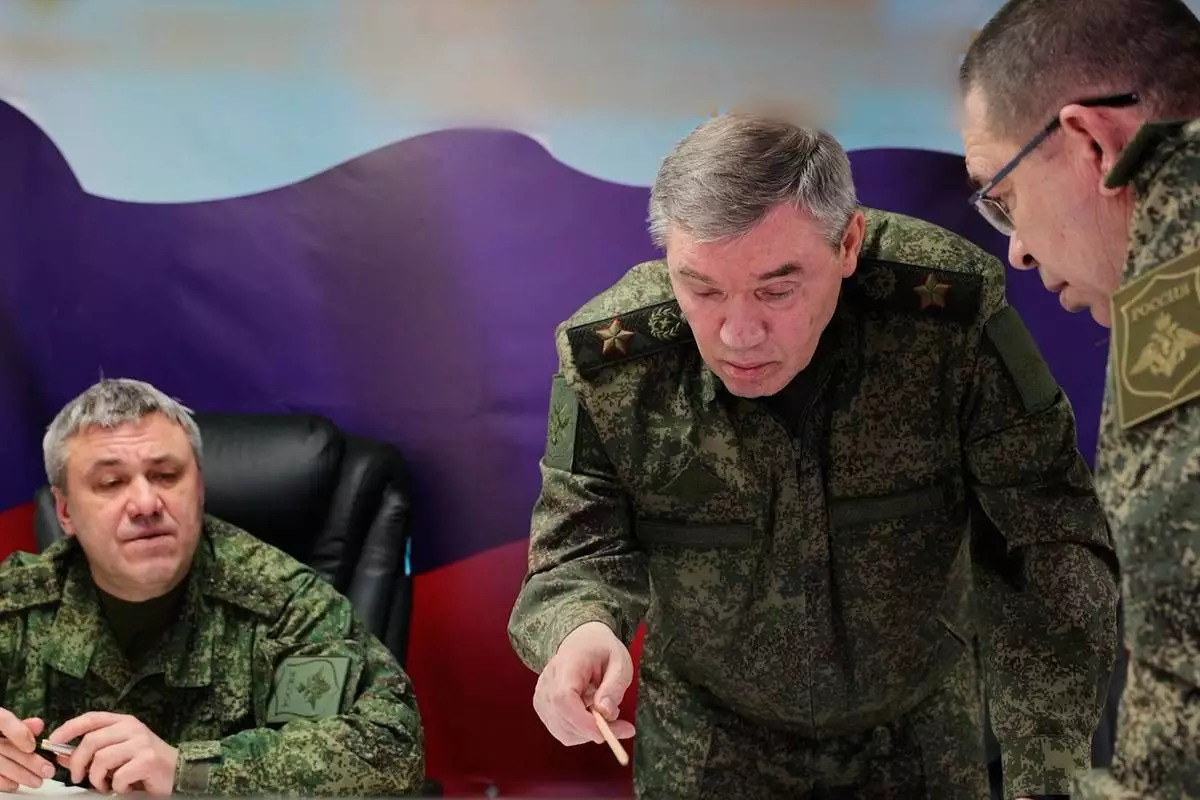
In this image made from video provided by Russian Defense Ministry Press Service on Saturday, Feb. 14, 2026, Russian Chief of General Staff Gen. Valery Gerasimov, second right, speaks while inspecting the troops involved in the fighting in Ukraine. (Russian Defense Ministry Press Service via AP)
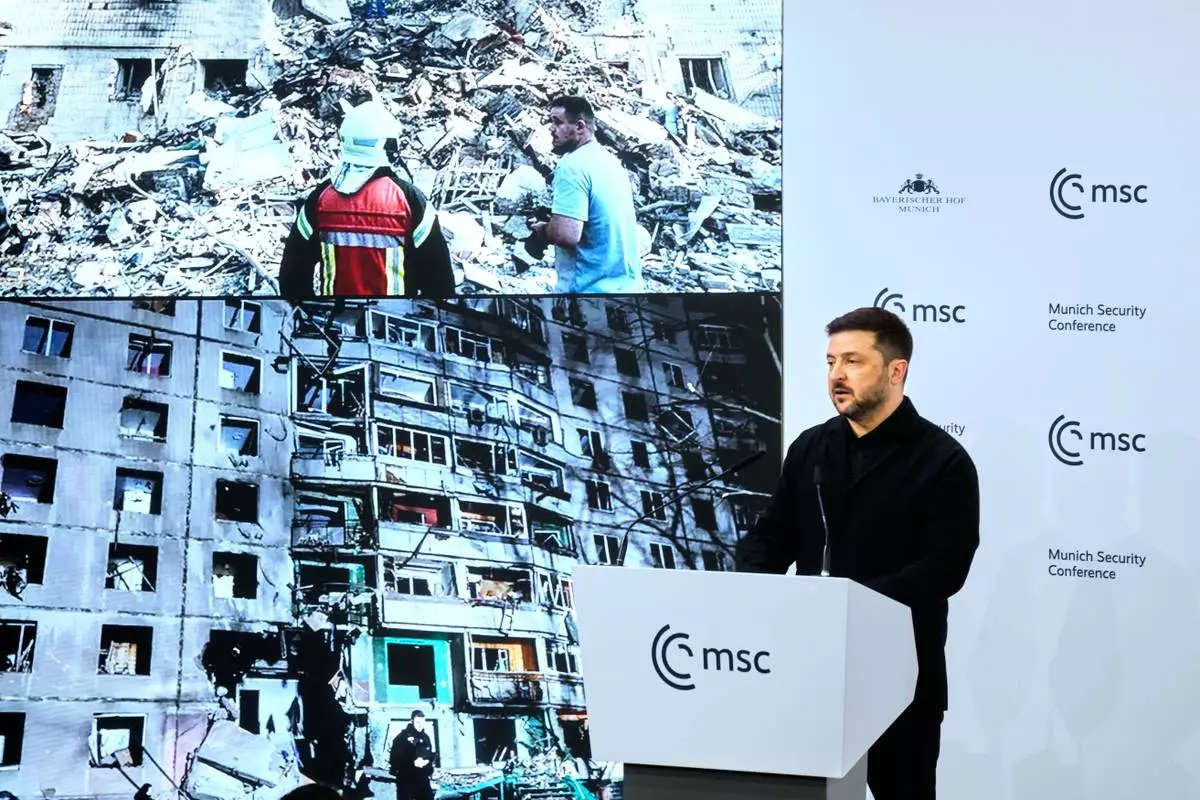
Ukraine's President Volodymyr Zelenskyy addresses the audience during a session at the Munich Security Conference in Munich, Germany, Saturday, Feb. 14, 2026. (AP Photo/Michael Probst)