BORMIO, Italy (AP) — Lucas Pinheiro Braathen wouldn't change the way he was flying through the course in Monday's Olympic slalom.
Sure, he fell in the first run. Sure, it ended any hopes of another medal.
But that charge, that no-holding-back approach from the Brazilian ski racer also led him to a gold two days before in the giant slalom at the Milan Cortina Games. It was a gold that gave South America its first medal at a Winter Games.
A gold that had Brazilians celebrating back home and everyone from the nation’s president to Brazilian soccer great Ronaldinho sending praise his way.
It's a fine line in ski racing, between pushing too much and holding back just enough, and he experienced both spectrums.
“You’ve got to ski with your heart and you’ve got to give it everything you’ve got, and that’s what I did," Pinheiro Braathen said. “But the sport of Alpine skiing, what makes it the art that it is, is a fine balance between strategy, technique and intensity.”
It was a simple mistake, he acknowledged. One moment, Pinheiro Braathen was in a rhythm, his time fast and his skis singing. The next, his ski was sliding out from under him and he was tumbling to the snow, sliding down the course.
With that, the Brazilian ski racer's Olympics were over. A "DNF” — did not finish.
“Of course I’m conflicted. Oh man, this sport,” Pinheiro Braathen said. “It brings you up to the sky and it just slams you back into reality equally as fast.
“I take with me a lot of growth, from both beautiful and amazing experiences, and I take with me what happened today. That gold was a product of all the highs and the lows equally as much.”
The 25-year-old Pinheiro Braathen comes from a family where his mother is Brazilian and his father is Norwegian. He started racing for Norway until abruptly retiring before the 2023 season, only to return a year later representing Brazil. His country celebrated his gold medal, which just so happened to coincide with Carnival.
Nothing could take away that feeling — not even a wipeout.
“This means the world to me, it means everything,” Pinheiro Braathen said. “Every time I step on that start gate, that’s all that matters to me. Yeah, a complicated sensation as we stand here right now. Of course, it goes without saying that I’m so beyond proud. I still have this sun inside of me that’s just blossoming, and I’m just so happy.”
It was tricky conditions for the racers, with the snow heavily falling and the fog making visibility difficult.
“This is a course you have to absolutely get after,” he said. “You have to push. You have to create everything yourself. I did so, but you have to do it with composure.”
It has been an emotional few days for Pinheiro Braathen, with so many reaching out. He's trying to soak it all in — even the lows from a fall.
“I’ve come to the stage in my career where I’ve learned to embrace all of the failures as well with gratitude because I know what that results in,” he said. “Growth is the answer.
“What I’ve been able to prove myself to the greatest extent, perhaps, is that daring to be who I am is my source of happiness, and happiness for me is my definition of success.”
AP Winter Olympics: https://apnews.com/hub/milan-cortina-2026-winter-olympics

Brazil's Lucas Pinheiro Braathen reacts at the finish area of an alpine ski, men's slalom race, at the 2026 Winter Olympics, in Bormio, Italy, Monday, Feb. 16, 2026. (AP Photo/Rebecca Blackwell)

Brazil's Lucas Pinheiro Braathen speeds down the course, during an alpine ski, men's slalom race, at the 2026 Winter Olympics, in Bormio, Italy, Monday, Feb. 16, 2026. (AP Photo/John Locher)

Brazil's Lucas Pinheiro Braathen skis down after crashing during an alpine ski, men's slalom race, at the 2026 Winter Olympics, in Bormio, Italy, Monday, Feb. 16, 2026. (AP Photo/Julia Demaree Nikhinson)
MIAMI (AP) — A photo of Vinícius Júnior celebrating a goal with one fist in the air was mounted near the entrance of the art exhibition, right next to an acrylic piece of a woman’s dreadlocks suspended in air as she heads a soccer ball.
A replica of the FIFA World Cup trophy was encased in glass nearby, surrounded by images, paintings and flags that document generations of African soccer dreams and stories. All of it is part of an exhibition celebrating Africa’s deep connection to soccer during the World Cup.
“This is what art is about," said Alfonso D. Brooks, founder of AfriKin, a foundation showcasing African and diaspora art. “Art has always been a platform to foster peace and understanding and give voice to those that can’t speak for themselves. “This is the necessary part we feel the need to do with AfriKin.”
Brooks — a longtime sound engineer turned art curator — spent about six months putting together the exhibition, titled “Art and the Beautiful Game: Africa on the World Stage,” which opened in Miami ahead of the start of the World Cup. The collection by more than 50 artists from 25 nations traces soccer's role in the continent's history, while celebrating some of the game's most influential figures from the late Pelé to French star Kylian Mbappé.
All 10 African nations competing in the World Cup are represented and celebrated, with special tributes to Cape Verde. The small nation off the western coast of Africa pulled off one of the most stunning upsets of the tournament with a draw against Spain in its World Cup debut. AfriKin plans to hold a ceremony honoring Cape Verde on Saturday night before it faces Uruguay in a group stage match in Miami on Sunday.
With the World Cup bringing tens of thousands of fans to Miami, Brooks and participating artists wanted to carve out a space for the African community to gather and celebrate its culture throughout the tournament.
“Miami is a huge melting pot,” said Tasanee Durrett, a 31-year-old Orlando-based artist. “We have the Latin (residents), we have Haitian and the Caribbean, we have so many different influences. And so now that we have this voice, we have this platform, why not speak to it?”
Brooks was born in the Dutch Caribbean territory of St. Maarten and moved to Miami in 2008. His love for the game stems from its humble roots in Africa, where he remembers young children kicking around soccer balls — or any circular objects they could find — in school corridors, living rooms or concrete streets.
"This is where you get the term ‘the beautiful game,’” he said, “because it required nothing but a beautiful spirit.”
The exhibition reflects that simplicity with windows into the intimacy of those neighborhood pitches, as well as nods to the global scale of the sport, which unites people of different backgrounds, races and languages.
Bamazi Talle, a Columbus-based artist from the West African nation Togo, tells that story through paintings of the calabash, a large, woody gourd that holds deep cultural significance in Africa. The fruit is used in meals or hardened to make bowls and vessels for carrying water and food, but it is also a cultural symbol of community and hospitality.
Talle paints the gourds floating against the flags of nations competing in the World Cup. For him, the history of the fruit coincides with the unifying spirit of the tournament.
“Calabash became one (thing) that united all of us,” Talle said. “And this cup, this World Cup is, I think, this celebration of all of us coming together.”
Durrett, another artist who is also a licensed architect, honors Black women in soccer with a pair of acrylic pieces, including one titled “A Beautiful Game” of the woman head butting the ball.
She began drawing people years ago as a therapeutic outlet and is passionate about highlighting underrepresented communities.
“I hope that they see the stories that are being told through the artists,” said Durrett, who does mostly canvas pieces in one single line. “And I hope they see themselves in these stories.”
Other nations like France, Belgium and England are also included in the exhibition in what Brooks calls “Hidden Africa.” He came up with the term to describe teams that include players of African heritage who were born or developed in European countries.
He hopes to show the African diaspora's links throughout tournament field, while also sparking conversations of identity, immigration and the many factors that can affect a player's choice in what country they represent.
“I’m not just showing a football and putting up some pretty pictures or goals,” Brooks said. “No, we want to have a story that people can actually come in, read and say, ‘Wow, I didn’t know this.’ People must learn from the exhibition.”
AP World Cup coverage: https://apnews.com/hub/fifa-world-cup
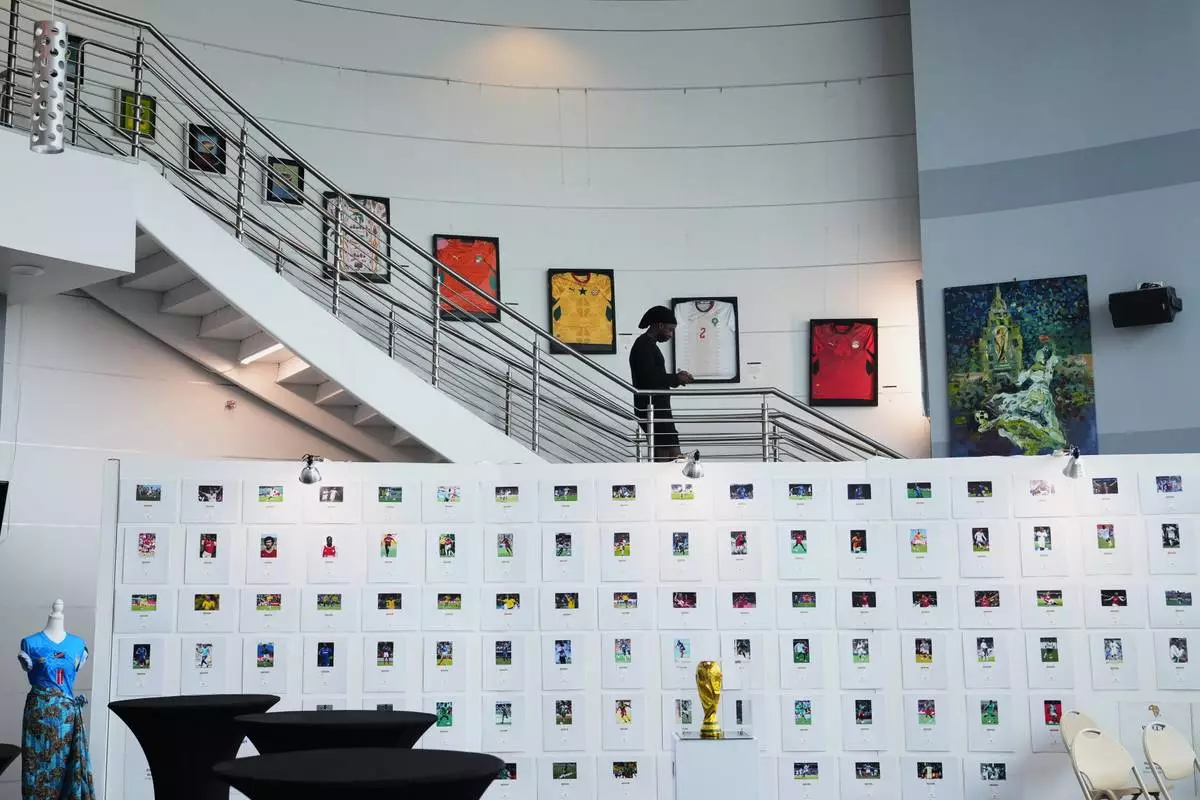
A person walks among artwork displayed at an exhibition, "Art and the Beautiful Game: Africa on the World Stage," on June 1, 2026, in North Miami, Fla. (AP Photo/Lynne Sladky)
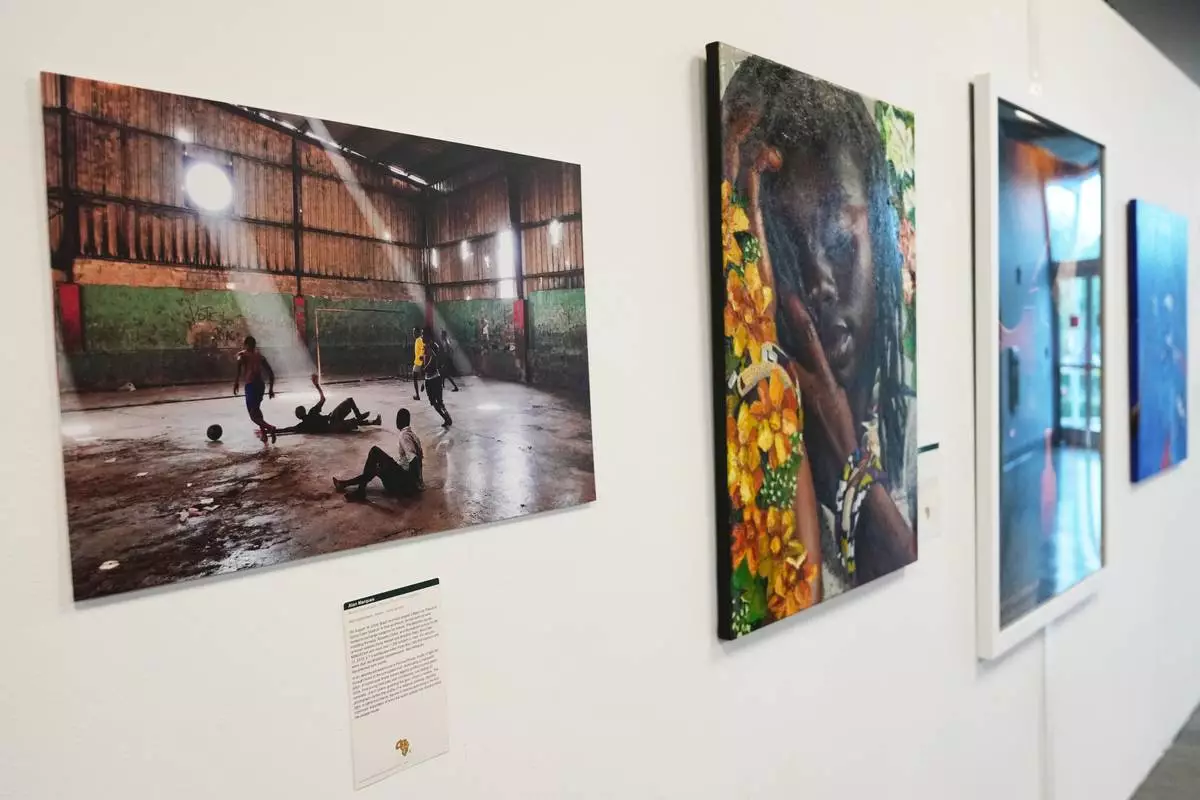
A photograph titled, "Boulos Warehouse," by photographer Alan Marques showing soccer players playing in a warehouse in Haiti is displayed in an exhibition, "Art and the Beautiful Game: Africa on the World Stage," on May 30, 2026, in North Miami, Fla. (AP Photo/Lynne Sladky)
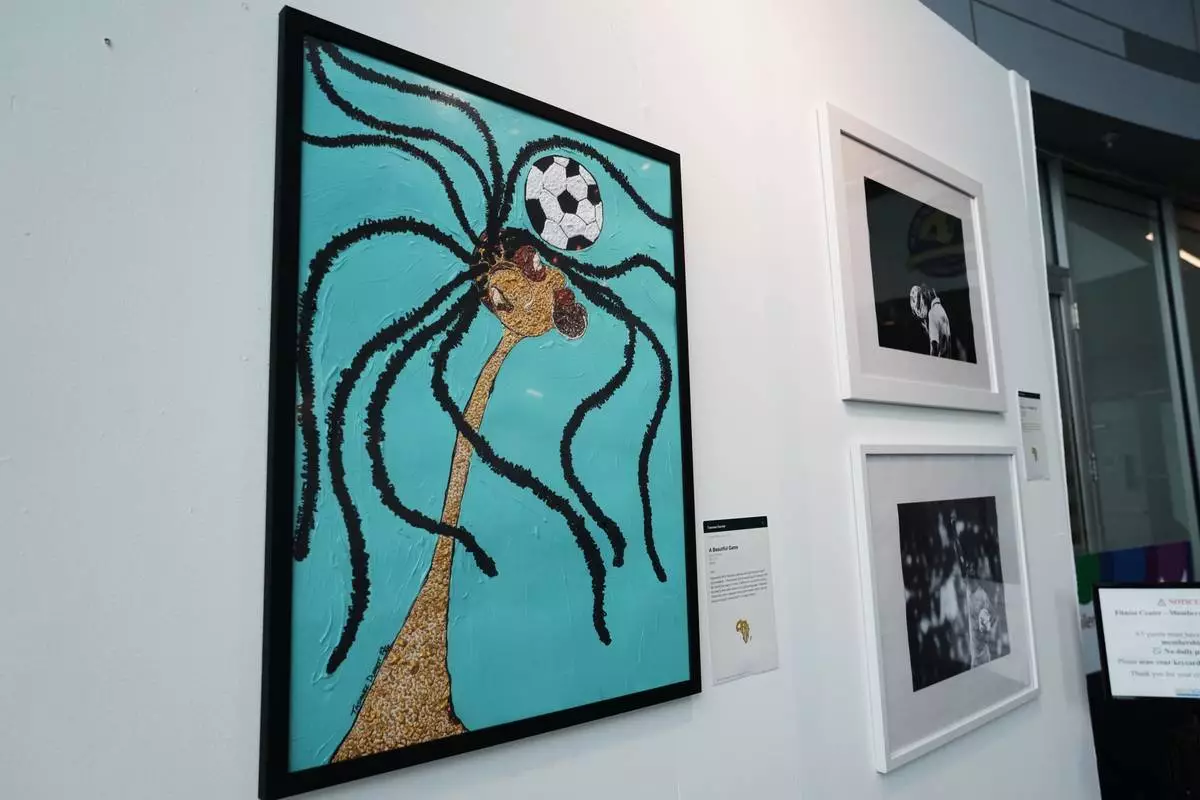
A painting of a woman heading a soccer ball titled, "A Beautiful Game," by artist Tasanee Durrett is displayed at an exhibition, "Art and the Beautiful Game: Africa on the World Stage," on June 1, 2026, in North Miami, Fla. (AP Photo/Lynne Sladky)
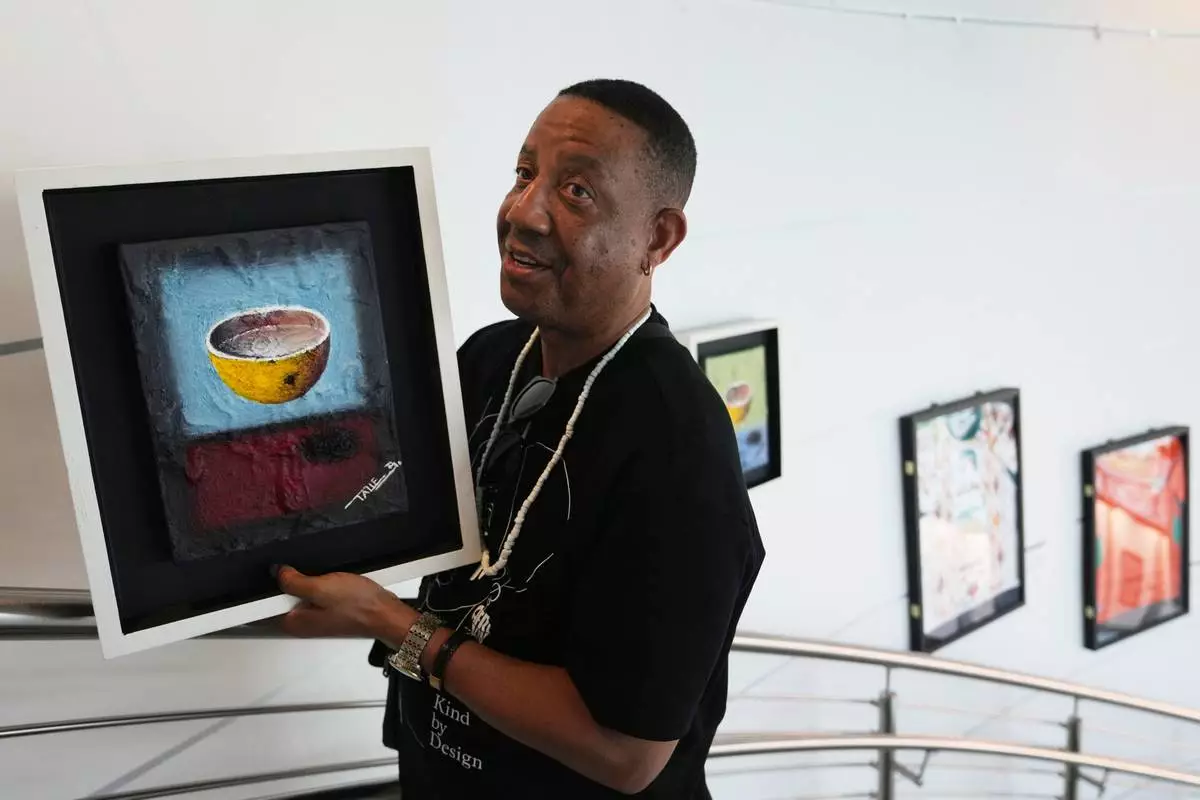
Alfonso D. Brooks, founder of AfriKin, holds a painting of a calabash by artist Bamazi Talle at an exhibition, "Art and the Beautiful Game: Africa on the World Stage," on May 30, 2026, in North Miami, Fla. (AP Photo/Lynne Sladky)
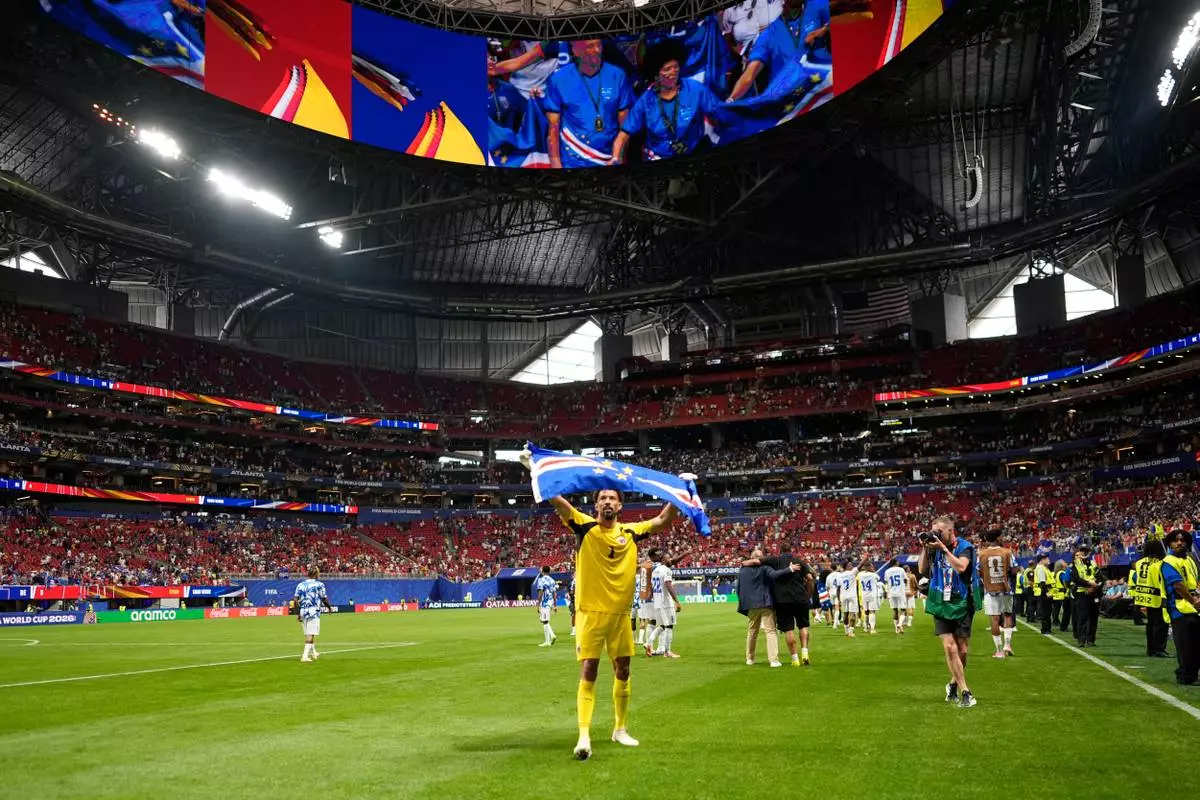
Cape Verde goalkeeper Vozinha celebrates as holds the flag of his country during the World Cup Group H soccer match between Spain and Cape Verde in Atlanta, Monday, June 15, 2026. (AP Photo/Mike Stewart)