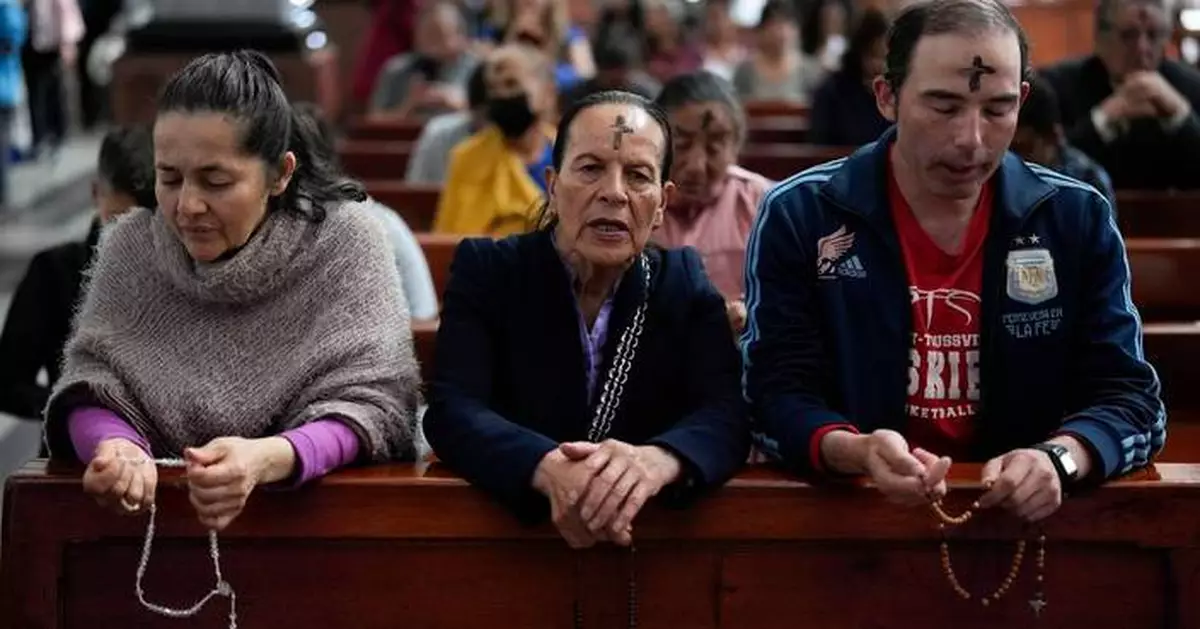
This is the week of Ash Wednesday, a solemn day of fasting and reflection that signals the start of Lent, the most penitential season of the church calendar for Catholics and many other Christians.
On Ash Wednesday, many Christians go to church for a service that emphasizes the start of a season of reflection, self-denial and repentance from sin.
Worshippers receive ashes, commonly imposed in the shape of a cross on the forehead. The officiant typically says, “Remember that you are dust, and to dust you shall return,” a stark reminder that death is part of life and that one should focus on things of the spirit. Or the officiant says, “Repent and believe in the Gospel.”
Ash Wednesday is considered an obligatory fast day for Roman Catholics between 18 and 59 — meaning limiting food to one full meal and two smaller-than-normal meals.
Many Protestants — particularly those in Episcopal, Lutheran and other historic churches — also mark Ash Wednesday with similar liturgies.
In recent years, many Episcopal and other churches in the United States have begun offering “Ashes to Go” in parking lots, commuter-rail stations and elsewhere. Clergy offer to impose ashes on busy workers and others who want to participate in the ritual but may lack the time to get to church.
Chaplains of various denominations offer ashes at airport chapels and other sites.
Among other Protestants, such as Baptists and other evangelical groups, traditions vary. Some observe Ash Wednesday and Lent, others don't. But they often have their own penitential and ascetic traditions. Many Pentecostals, for example, fast for a period in January to consecrate the year ahead.
Members of another of the world’s largest religions are also about to embark on their season of prayer and fasting. The start of Ramadan and the start of Lent may fall on the same date — for sure within the same week — this year.
Ash Wednesday marks the beginning of the season of Lent, leading up to observances of Jesus' death on Good Friday and resurrection on Easter.
Ash Wednesday is designated by counting backward 40 days from Easter, minus the Sundays.
Different churches have found various ways of calculating the traditional 40 days of Lent, but the number itself is important. It connects to the biblical symbolism of the number 40, typically used for times of testing, judgment, purification or renewal. Most directly, it alludes to the 40 days that Jesus fasted in the wilderness after his baptism, in preparation for his public ministry.
During Lent, the faithful devote themselves to prayer and other devotions, as well as charitable deeds, fasting and other forms of self-discipline. People speak of giving up something for Lent — stereotypically chocolate, but really anything that one finds difficult to do without. These days, that might mean reducing screen time.
Many churches also have extra times of devotions and other activities. Catholics often have group meditations on the Stations of the Cross, marking different events surrounding the crucifixion of Jesus.
Observant Catholics also abstain from meat on Fridays — though not fish.
To that point, Lent is not all solemnity. For many Catholic parishes in the U.S., the Friday fish fry has become a tradition combining food, fundraising and community bonding.
Ash Wednesday is not a fixed date. Its timing is tied to Easter Sunday. For most Christians, Easter will fall on April 5 this year.
Easter moves annually, swinging between March 22 and April 25, following an ancient formula in which Easter falls on the first Sunday after the first full moon in spring.
Eastern Orthodox Christians calculate the beginning and end of their “Great Lent” differently. They begin their observances on a Monday — this year on Feb. 23 — which they call “Clean Monday” or “Pure Monday.” While they don't use ashes, they do start a period of penance and fasting. The Great Lent continues through the Friday before Holy Week, including Sundays.
The dates for Great Lent are also determined in tandem with Orthodox calculations of Easter (Pascha), which differ from those of Western churches. Orthodox Easter is April 12 this year — as in most years, falling later than Catholic and Protestant observances.
Associated Press religion coverage receives support through the AP’s collaboration with The Conversation US, with funding from Lilly Endowment Inc. The AP is solely responsible for this content.
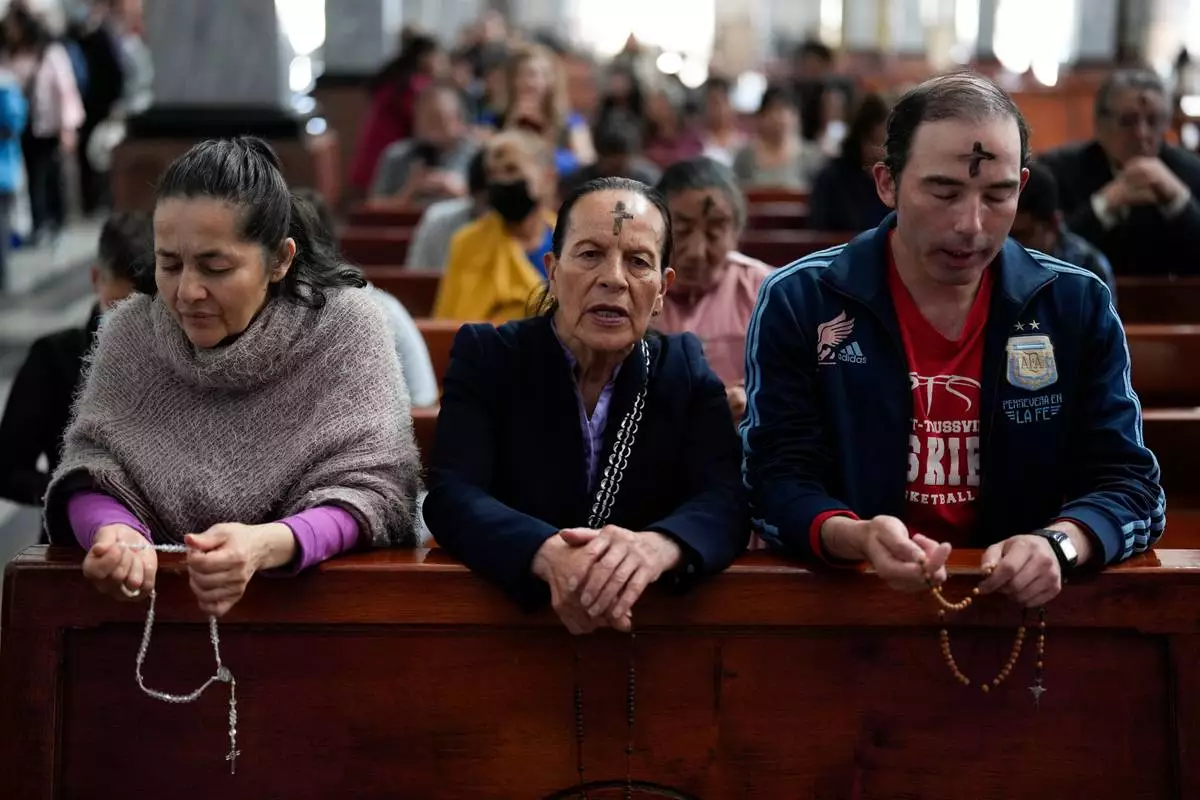
FILE - Catholics pray the rosary while a priest marks people's foreheads with ashes during Ash Wednesday Mass at the Church of the Divine Child in Bogota, Colombia, Wednesday, Feb. 14, 2024. (AP Photo/Fernando Vergara, File)
CORTINA D'AMPEZZO, Italy (AP) — The two-man bobsled competition at the Milan Cortina Olympics is four runs over two days, the same format the event has used for nearly a century.
Germany's Johannes Lochner might have ended this year's event in exactly 54.68 seconds.
That was Lochner's time in the first run Monday, giving him a lead that only got bigger — much bigger — as the day went along. Lochner and brakeman Georg Fleischhauer finished their two runs in 1 minute, 49.90 seconds, and nothing short of a disaster on their end should keep them from winning gold in the final two runs on Tuesday night.
“Such a big lead,” Flesichhauer said. “We didn't really expect that.”
Their margin at the midway point is 0.80 seconds. Here's some historical perspective of how absolutely one-sided that is: If you add up the halftime leads in the last nine Olympic two-man races, combined, it comes out to 0.58 seconds. And the average halftime lead since 1964 — just 0.25 seconds.
This is a bobsled blowout.
“He might be perfect,” U.S. pilot and medal contender Frank Del Duca said.
It's Germany-Germany-Germany in the top three spots, though Del Duca is right there, just one-tenth of a second from the bronze medal position.
Reigning world and Olympic two-man champion Francesco Friedrich, who has been looking up at Lochner all season in the World Cup rankings, finished two runs in 1:50.70 seconds. He's the only one within a second of Lochner; Germany's Adam Ammour is third in 1:51.14, with Del Duca and Josh Williamson fourth in 1:51.24.
Friedrich is at the Milan Cortina Games trying to become the first five-time gold medalist in Olympic bobsled history, after sweeping the two- and four-man races at the 2018 Pyeongchang Games and the 2022 Beijing Games.
“We have to give all what we can do," said Friedrich, widely considered the best bobsledder ever. "We want to make the best push times, the best drives tomorrow. ... The race is over when four runs are in the finish.”
Technically, that's true.
In reality, though, it might be over. The race might really be for third between Ammour and Del Duca.
“Frankie Del Duca is right behind us," Ammour said. "So, yeah, there’s no room for error tomorrow.”
Del Duca is bidding to be the first U.S. medalist in two-man since Steven Holcomb and Steven Langton grabbed silver at the 2014 Sochi Games.
“I left quite a bit of time out there," Del Duca said. "I mean, as drivers, we always do. I don’t know if someone can really walk away and say it was a perfect run. I haven’t seen Lochner’s runs. ... But for us to be this close, it's really just a testament to our whole system, our people behind us, how hard everybody’s been working.”
Del Duca, one of the two U.S. flagbearers entering the Olympics, is driving the only two-man sled the Americans have in the competition, after officials would not let pilot Kris Horn compete because he finished four — one shy of the minimum — out of seven World Cup races this winter.
Horn will race in the four-man event later this week.
Lochner is in what he says is his final season and won the World Cup two- and four-man overall titles this winter. He won medals in all 14 World Cup races — nine gold and five silver, never finishing worse than second. And in two-man, he was especially dominant with six wins in seven races.
He will not reconsider retirement, he said.
“I have a wife and child waiting for me at home,” Lochner said.
A trip to the top of the Olympic medal podium seems to be waiting for him as well.
AP Olympics: https://apnews.com/hub/milan-cortina-2026-winter-olympics
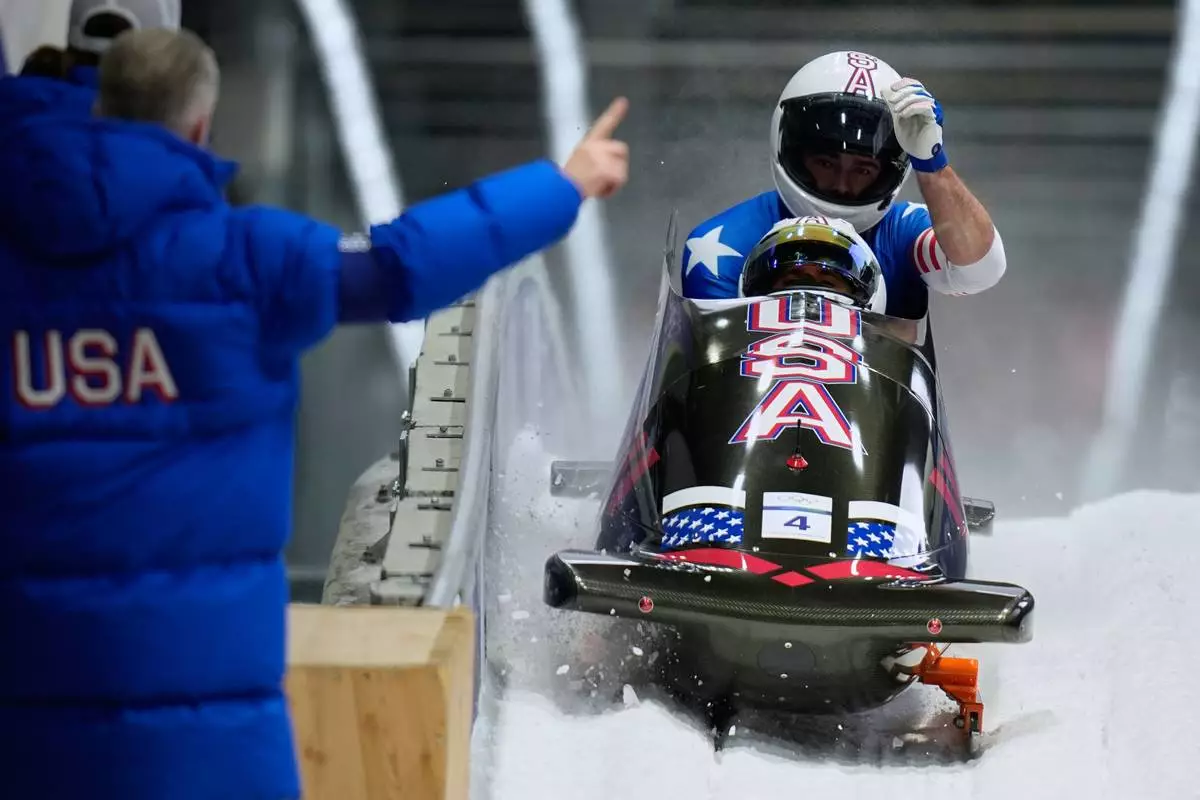
United States' Frankie del Duca, front, and Joshua Williamson arrive at the finish during a two man bobsled run at the 2026 Winter Olympics, in Cortina d'Ampezzo, Italy, Monday, Feb. 16, 2026. (AP Photo/Aijaz Rahi)
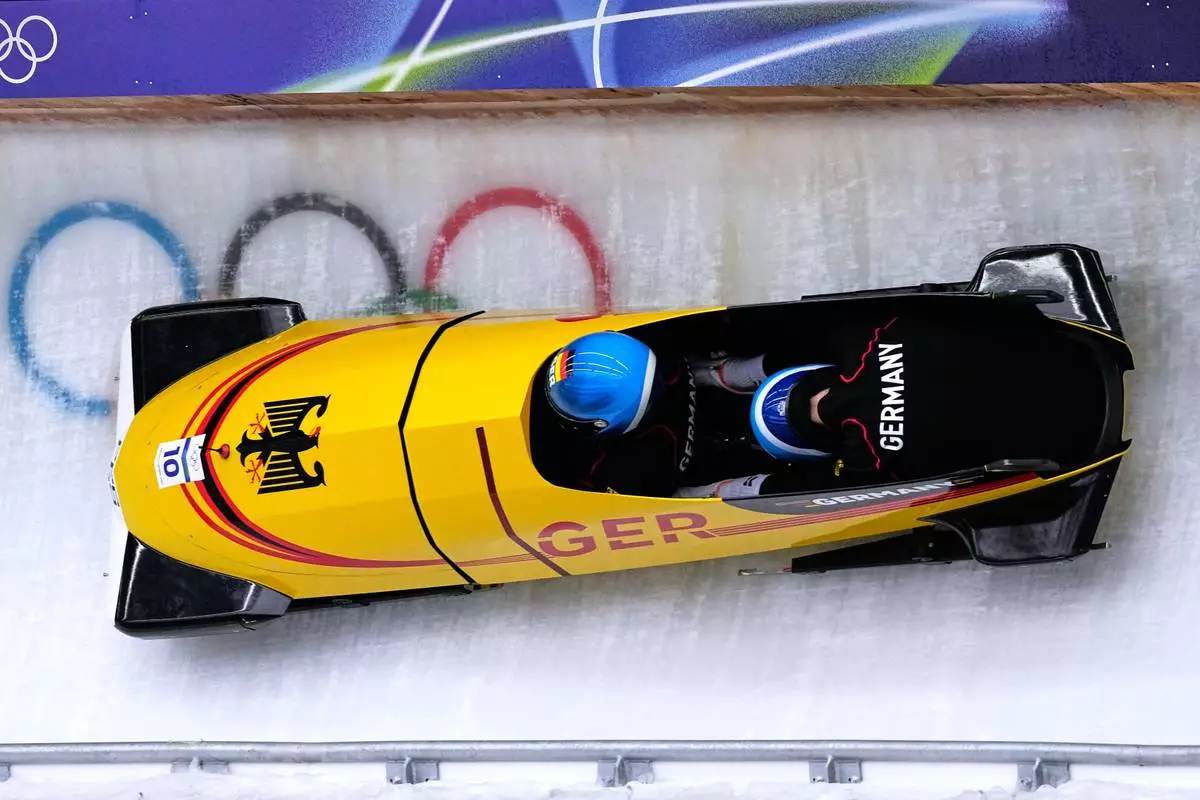
Germany's Francesco Friedrich, left, slides down the track during a two man bobsled training session at the 2026 Winter Olympics, in Cortina d'Ampezzo, Italy, Saturday, Feb. 14, 2026. (AP Photo/Aijaz Rahi)
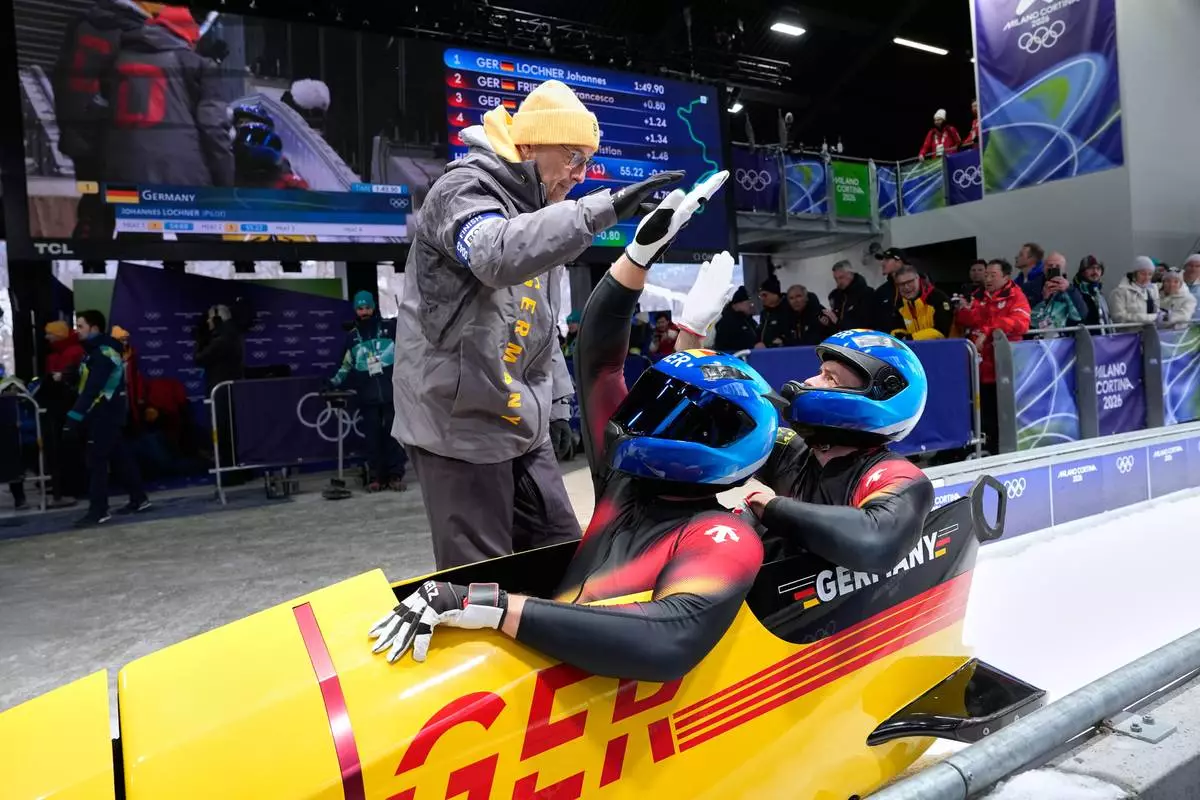
Germany's Johannes Lochner, front, and Georg Fleischhauer, rear, arrive at the finish during a two man bobsled run at the 2026 Winter Olympics, in Cortina d'Ampezzo, Italy, Monday, Feb. 16, 2026. (AP Photo/Alessandra Tarantino)
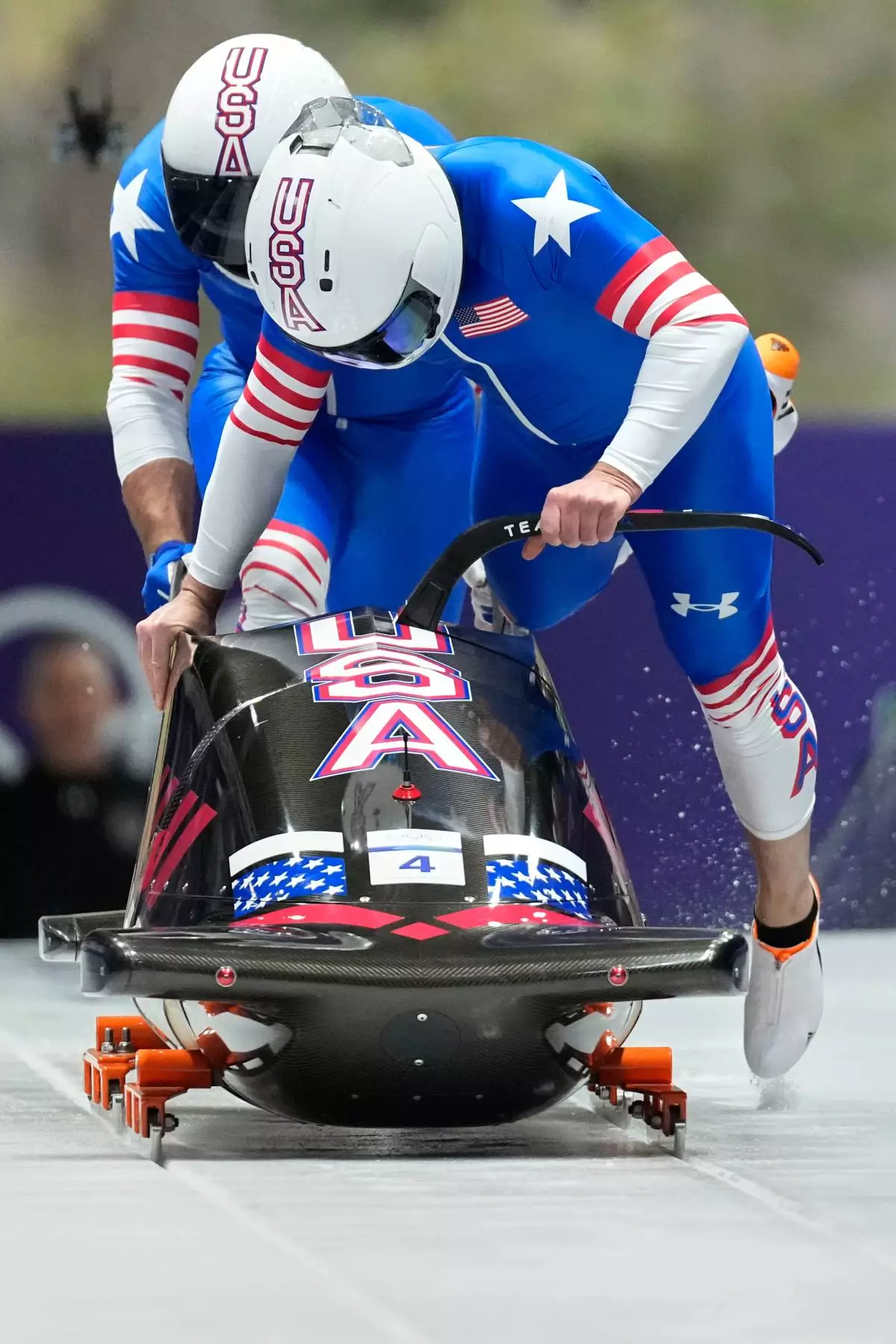
United States' Frankie del Duca, right, and Joshua Williamson start for a two man bobsled run at the 2026 Winter Olympics, in Cortina d'Ampezzo, Italy, Monday, Feb. 16, 2026. (AP Photo/Alessandra Tarantino)
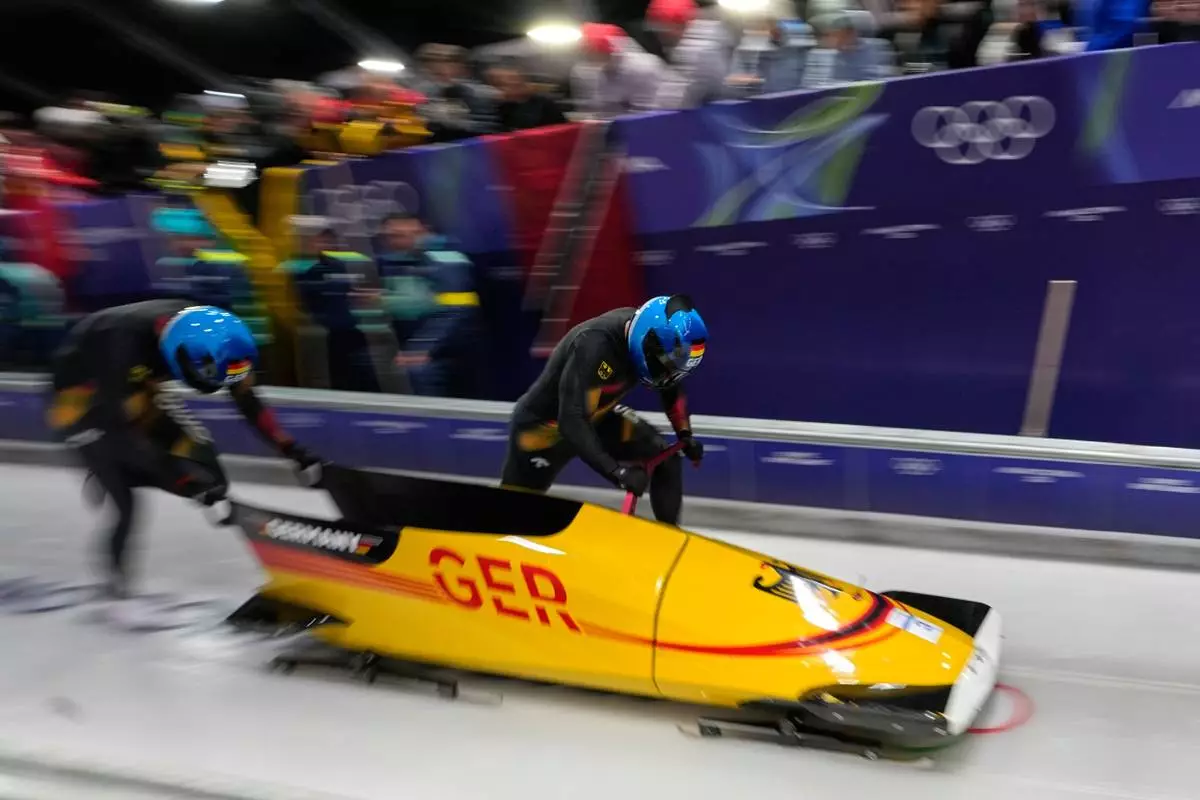
Germany's Adam Ammour, right, and Alexander Schaller start for a two man bobsled run at the 2026 Winter Olympics, in Cortina d'Ampezzo, Italy, Monday, Feb. 16, 2026. (AP Photo/Aijaz Rahi)
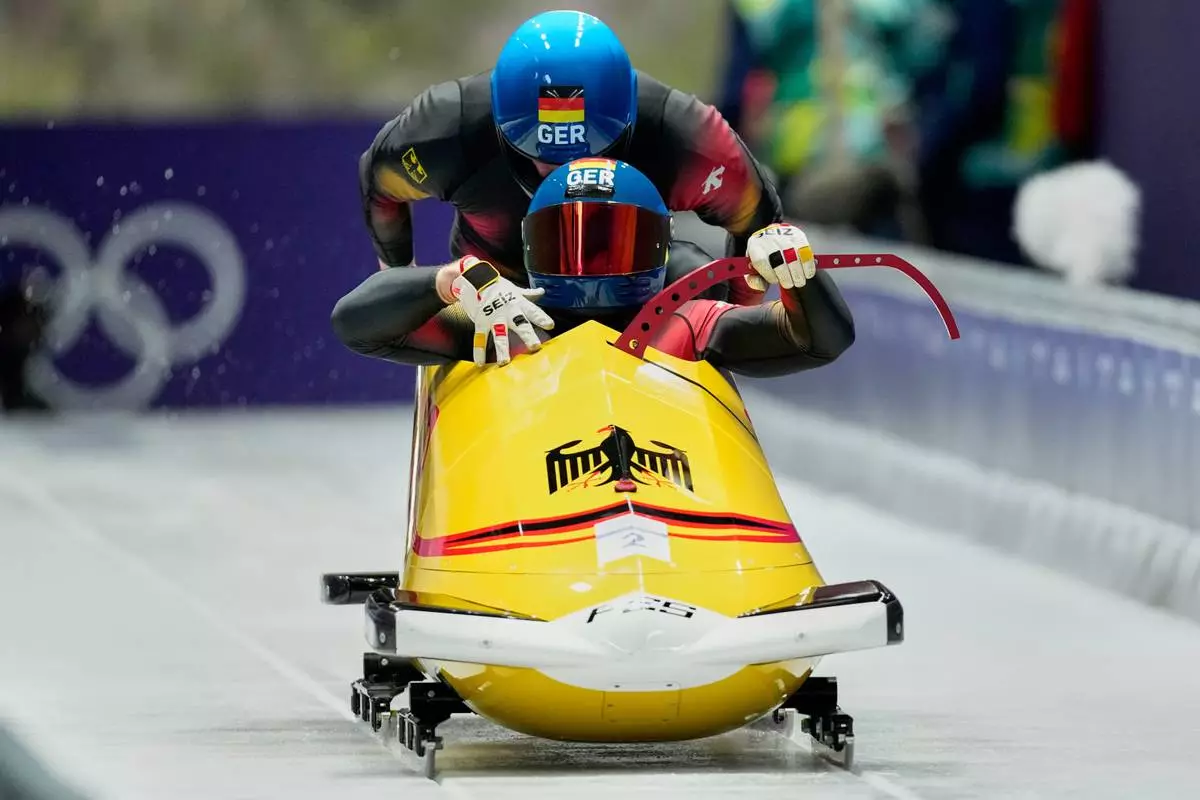
Germany's Francesco Friedrich, right, and Alexander Schuller start for a two man bobsled run at the 2026 Winter Olympics, in Cortina d'Ampezzo, Italy, Monday, Feb. 16, 2026. (AP Photo/Alessandra Tarantino)
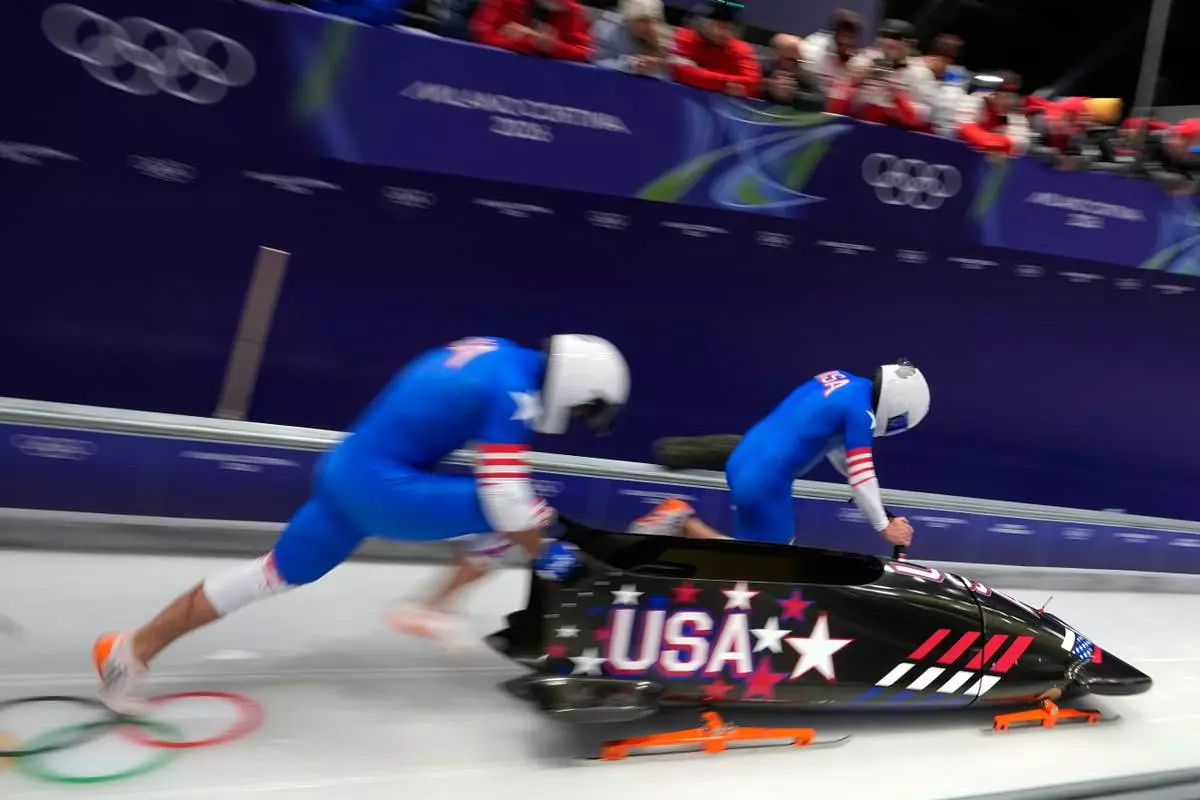
United States' Frankie del Duca, right, and Joshua Williamson start for a two man bobsled run at the 2026 Winter Olympics, in Cortina d'Ampezzo, Italy, Monday, Feb. 16, 2026. (AP Photo/Aijaz Rahi)
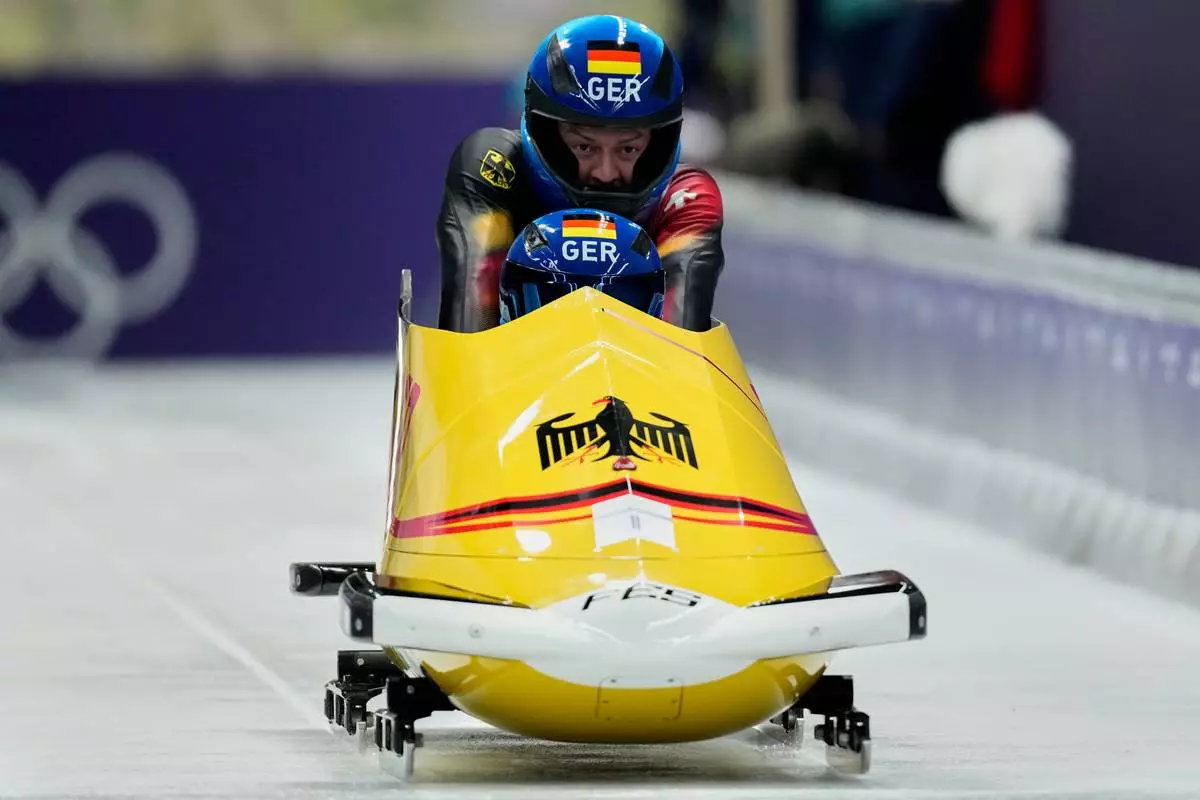
Germany's Johannes Lochner, right, and Georg Fleischhauer start for a two man bobsled run at the 2026 Winter Olympics, in Cortina d'Ampezzo, Italy, Monday, Feb. 16, 2026. (AP Photo/Alessandra Tarantino)