Dozens of humanoid robots teamed up with young Kung Fu artists to deliver a knockout martial arts performance during the China Media Group (CMG)'s 2026 Spring Festival Gala on Monday. What supports the dazzling show performed by AI-embodied robots is China's cutting-edge technologies in the industry.
The highly-energetic display saw the versatile robots and young human Kung Fu masters perform a series of impressive choreographed stunts and synchronized moves in a breathtaking stage segment.
The robots also used traditional Kung Fu weapons such as swords and nunchuks, demonstrating impressive speed, balance, coordination and precision as they executed the pulsating performance in style.
The robot's performance is controlled by a newly-developed cluster automatic control system that is specially tailored for the gala, and operated with a single button.
"Over the past year, the embodied robot industry across China has indeed been very active. Taking advantage of the current trend, we hope that this year's Spring Festival Gala can mark the beginning of a new era of scientific innovation in the Spring Festival Gala, or the beginning of the era of digital intelligence," said Yu Lei, chief director of CMG's 2026 Spring Festival Gala.
Wang Xingxing, founder and CEO of Unitree Robotics, said "many technologies used in the program design did not exist before the Spring Festival Gala. All of these are newly developed technologies".
The ability to control dozens of humanoid robots with a single button is made possible by the joint support of multiple innovative technologies. More than a month before the first rehearsal, the technical team conducted comprehensive data collection and 3D modeling of the 600-square-meter stage, allowing the robots to get familiar with every part of the site in advance.
"The most challenging part is to enable the robot to move quickly while maintaining extremely high precision, which is a significant technological upgrade this year. This is a navigation interface. By using such a laser radar, we scan the surrounding space, and the robot then knows its position within this space. This provides a reference for it when making overall scheduling and movement plans. The space you saw on the laptop was scanned by it. If there are too many electronic devices on site, they will interfere with our robot's signals. We have also conducted a large number of tests on this," said Wang Qixin, chief marketing officer of Unitree Robotics.
The most fascinating aspect of the show lies in the seamless cooperation between the young martial arts performers and the robots, which is the result of repeated training.
"Music must be integrated with movements to achieve an excellent stage effect. Every movement is timed to the hundredth of a second to control the stage effect. This is very similar to human performers dancing or performing martial arts to the rhythm. This time, we can have the humanoid robots run onto the stage, perform fight sequences, and then quickly move to their next position. Their speed has been greatly improved, roughly five to 10 times faster than last year," said Wang Xingxing.
To present a wonderful performance, the technical team made upgrades to the hardware, increasing the power of the core joint motors, strengthening the limb structure, and upgrading the dexterous hands. At the same time, soft padding and other buffering components were added to the robot's limbs, which not only reduced the impact on the stage but also provided safety guarantees for the children performing on the same stage.
"First, I watched it perform martial arts [from a distance]. For the second time, I stood a little away from it, and performed in pace with it. Later, I gradually moved closer to it [and performed together with it]," said Fu Liyuan, a young Kung Fu artist who performed with robots.
Many martial arts movements that are easy for human performers are quite challenging for humanoid robots. The young martial artists helped the robots learn and optimize, eventually making the robots' martial arts moves more precise and smooth.
"Don't be fooled by the seemingly simple action during the performance, where the left hand holds the stick steady while the dexterous right hand grasps it. Within that single second, the robot has to complete three steps: grabbing, straightening, and gripping the stick. This is achieved through highly rapid movements, which are extremely difficult and very challenging. This is also a technological breakthrough for us," said Wan Shanlin from the marketing department of Unitree Robotics.
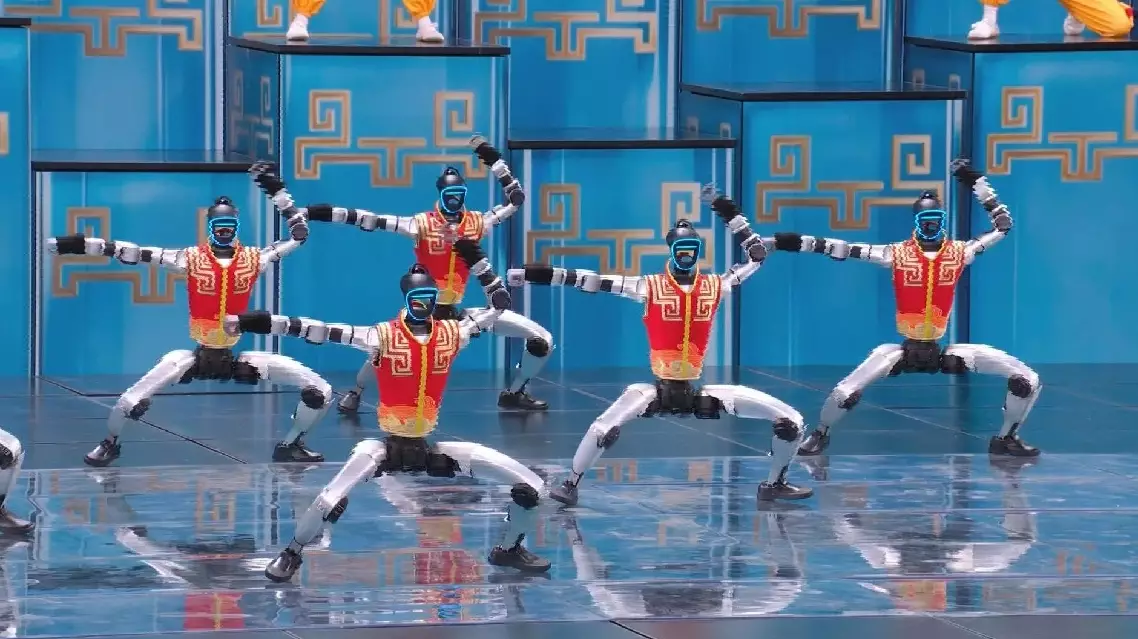
Martial arts show at CMG Gala showcases China's cutting-edge robotic technologies