Cities across China staged a variety of vibrant festive activities on Chinese New Year's Eve and the first day of the Year of the Horse to celebrate the grand festival and wish for a good start to a brand-new year.
On Chinese New Year’s Eve, festive lights across cities illuminated the night sky, creating a vivid atmosphere of celebration.
In Chengdu, southwest China's Sichuan Province, the Tianfu Twin Towers lit up with a New Year-themed light show blending traditional customs, intangible cultural heritage and modern technology.
In Weixian County in north China's Hebei Province, streets were adorned with red lanterns and colorful lights, showcasing a mix of folk traditions and contemporary activities.
Residents of Lijiang Old Town in southwest China's Yunnan Province dressed in festive costumes and gathered around bonfires, singing and dancing to usher in the new year.
In Mudanjiang City, northeast China's Heilongjiang Province, the snowy landscape complemented the bright red lanterns, while jubilant performances of yangko dance -- a traditional folk dance of the ethnic Han people, commonly performed in northern China -- filled the streets with joy.
In neighboring Jilin Province, fireworks lit up the night sky over Changchun City, heralding the new year with hopes for prosperity and happiness.
In Zhangzhou, Fujian Province, the newly adorned Nanjing tulou complex was filled with a strong New Year atmosphere. Visitors from far and wide toasted alongside local residents, keeping the New Year's Eve vigil around warm stoves and sharing hopes for the year ahead.
Fujian Tulou, which dates back to the Song and Yuan dynasties, is a type of traditional Chinese rural dwelling built by the Hakka people in the mountainous areas of Fujian Province. The layout of Fujian Tulou follows the traditional Chinese concept of "closed on the outside, open on the inside," featuring an enclosing outer wall with living quarters arranged around the perimeter and a common courtyard at the center. In 2008, Fujian Tulou was added to the UNESCO World Heritage List as a cultural site.
The Zhaoxing Dong Village in Liping County of Qiandongnan Miao and Dong Autonomous Prefecture, southwest China's Guizhou Province, was bustling with holiday celebrations. Round tables were set up for visitors to share a communal feast. In 2025, the village received about 1.51 million tourists, helping its collective income surpass 3 million yuan (about 420,000 U.S. dollars).
"Over the past year, more villagers opened homestays, restaurants and photography studios. With the start of the Year of the Horse, I hope that our village will gallop forward like a spirited horse, and that the lives of the villagers will become increasingly prosperous," said local villager Lu Yongmei.
Zhaoxing Dong Village is home to over 1,000 households of the Dong ethnic group. The traditional architectural style and rich cultural heritage of the Dong ethnic group are well preserved.
In recent years, while preserving the village's historical character and cultural traditions, the local community has established Dong Grand Song and Dong opera performance groups, turning traditional festivals into tourism highlights.
On the first day of the Chinese New Year, festivities continued with lively temple fairs and diverse folk customs.
In Zhengzhou City, in central China's Henan Province, a market showcasing intangible cultural heritage drew crowds, while a grand float parade added to the merriment.
In Shenzhen, a city in southern China's Guangdong Province, traditional visits to flower markets were in full swing, with flower exhibitions and fairs offering shopping, sightseeing, and entertainment.
Folk performances took the center stage in some other cities.
Dragon and lion dances mesmerized audiences in Yancheng City, east China's Jiangsu Province, while performers engaged the crowd in lively festivities.
Performances featuring intangible cultural heritage skills, such as Yingshang Flower Drum Lantern dances and Yingshang, enthralled spectators along the parade routes of two teams in Yingshang County, east China's Anhui Province.
In Liangping District of Chongqing Municipality, a folk parade of vibrant dragon and lion performances dazzled spectators.
In Tai'an City, east China's Shandong Province, many tourists ascended Mount Tai to witness the first sunrise of the Year of the Horse and experience the breathtaking beauty of dawn.
In Henyang City, central China's Hunan Province, tourists gathered on the highest peak of Mount Heng to wish for abundant blessings in the new year.
"I wish my family peace and safety, and I hope our motherland continues to grow even stronger and more prosperous," said Liu Sina, a tourist.
On the first day of the Chinese New Year, lion dance performances filled venues across the Hong Kong Special Administrative Region with festive cheer as locals and tourists celebrated together.
Meanwhile, authorities in the Macao Special Administrative Region organized community roadshows featuring dragon and lion dances at the Ruins of St. Paul's and Senado Square, creating memorable moments for locals and tourists alike.
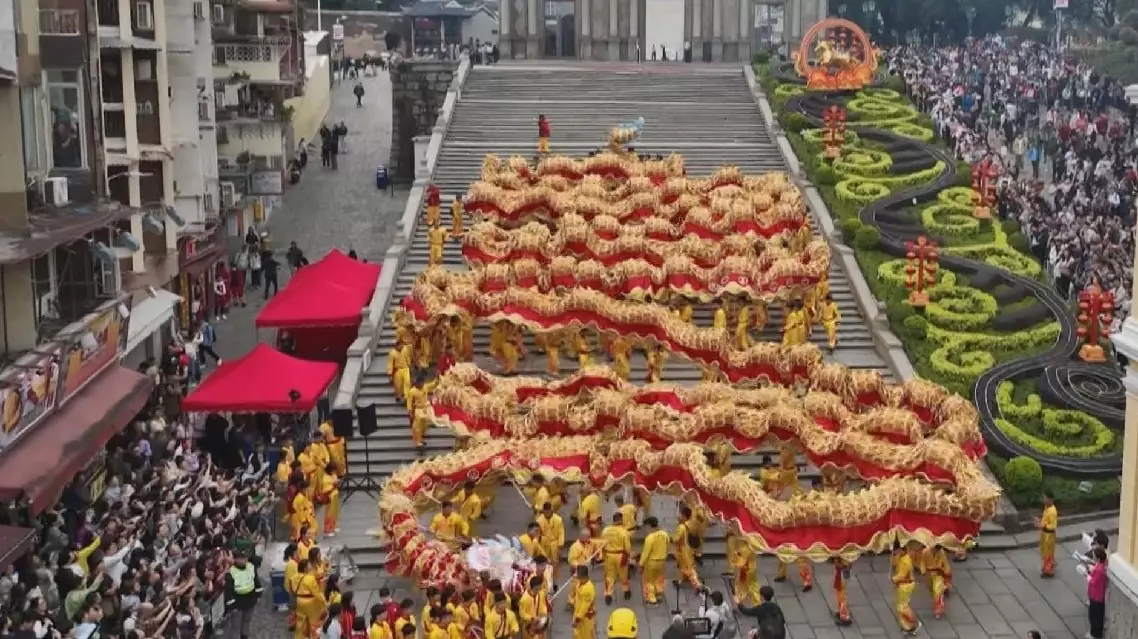
Chinese cities hold vibrant celebrations to welcome new year