A long-running food redistribution system in Shenzhen City of south China's Guangdong Province is playing a key role in recycling safe ingredients and offering them to people most in need at the community level, redirecting surplus food that might otherwise go to waste and making it available most via a number of accessible vending machine-style food stations.
The so-called "food bank" network has been in operation in the city for more than 1,300 days -- over three and a half years -- and enables eligible recipients to collect the safely packaged food items from the various pick up points.
Shaped like vending machines, these food distribution stations can be found on many streets across Shenzhen's Futian District, offering an added layer of support for vulnerable members of the community.
After simply booking in advance and scanning a QR code on the machine, a package of free food is ready for collection for those who have pre-registered and been approved.
"All the food comes from surplus donations by caring businesses. We distribute it to sanitation workers, cleaners, elderly people living alone and persons with disabilities — those registered on the community 'whitelist.' They can scan the QR code and collect the food free of charge," said Liu Bingjun, a volunteer involved in the project.
Liu, a retired serviceman, and his wife Xu Zhihong are among the reliable team of volunteers who keep the initiative running smoothly. Every morning at 06:30, they set out from home and split up to collect donations from partner companies, carefully undertaking the process of receiving, inspecting, and packaging the food.
Once this is complete, the food is stocked on schedule into the various stations by 09:00. Liu often stays on duty to assist residents with reservations and helps personally deliver food to those with limited mobility.
Even during the current Spring Festival period, China's most important family holiday which celebrates the Chinese New Year, volunteers are diligently standing by and continue to keep the service running.
"Except for a few who really need to return home, most of us stay in Shenzhen and work as usual. Whenever companies post donation notices, we pick up the food and restock it, because people in need are still waiting," said Xu.
The couple's commitment to volunteering comes from their own past experience. In years gone by, when Liu was unemployed, the daily vegetables or staple foods they received from the program provided much needed relief. With support from the community, Liu later secured a flexible job and they decided to pass on the kindness they had received in return.
Behind the seemingly simple setup is a well-coordinated operating system. Local subdistrict offices compile lists of residents on subsistence allowances, people with disabilities, and underprivileged workers such as deliverymen. The Futian District Civil Affairs Bureau uploads the information into an online booking system. Social organizations liaise with donor companies and recruit and train volunteers, who inspect and distribute the food. After 20:00 each night, any remaining items are made available for all residents to reserve free of charge.
Over the last three years, nearly 100 companies have joined the initiative, while the 22 food bank stations across 10 sub-districts have provided assistance to a total of 500,000 residents during this time, saving about 202 tons of food and cutting over 404 tons of carbon emissions.
"What we truly see is the circulation of goodwill and warmth, both between individuals and across society. That sense of kindness may well be a city's most defining character," said Zeng Jiawen, a representative from the Futian District Civil Affairs Bureau who heads up the food bank project.
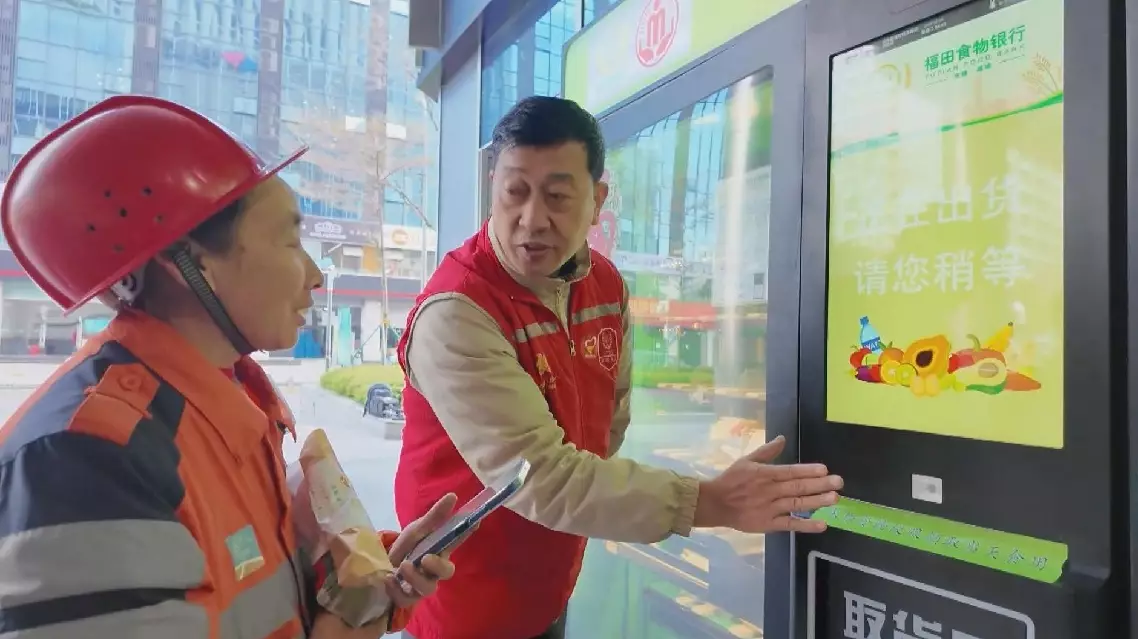
Community-level food redistribution program offers fresh ingredients to those in need