LONDON--(BUSINESS WIRE)--Feb 19, 2026--
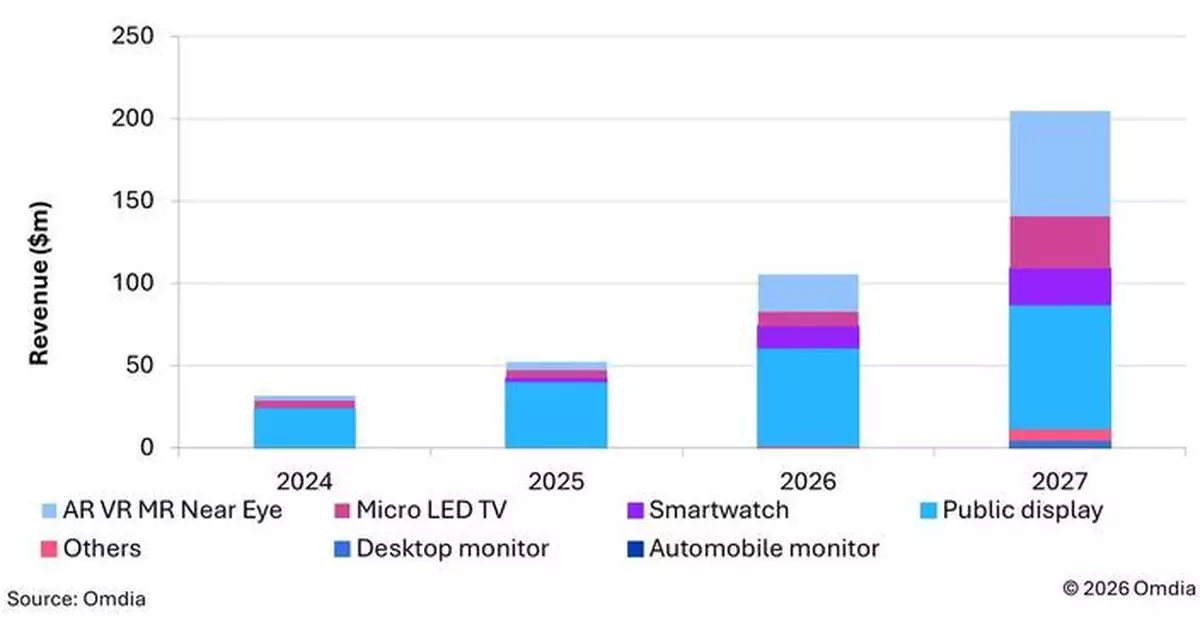
Micro LED display revenue is projected to grow 100% year-over-year (YoY), increasing from $52.4 million in 2025 to $105.4 million in 2026, according to the Omdia Micro LED Display Market Tracker. While Micro LED displays for public display, ultra-large TVs, smart watches, and smart glasses remain limited, rapidly maturing manufacturing capabilities and new product adoption are expected to drive significant shipment and revenue growth in the near term.
This press release features multimedia. View the full release here: https://www.businesswire.com/news/home/20260219980076/en/
Until recently, large-scale commercialization faced significant hurdles, including variability in electro-optical characteristics, limitations in mass transfer technologies, backplane yield challenges and, most crucially, high manufacturing cost. By addressing these challenges, display manufacturers have now begun mass production for Micro LED TVs, public displays and smart watches.
The rapid growth of LEDoS (Micro LED on Silicon), a field previously difficult for existing display manufacturers to enter, is particularly noteworthy. LEDoS enables ultra-small displays by electrically integrating micro LED chips, each just a few nanometers wide, onto a semiconductor substrate. As a result, LEDoS manufacturing is often more closely aligned with semiconductor processes than conventional panel manufacturers.
A typical LEDoS display may feature a diagonal length of 0.1 to 0.2 inches and a resolution in the range of 4000 to 6000 pixels per inch (PPI), making it well suited to AR, VR, MR, and near-eye display applications. More global brands are expanding AI services through smart glasses and plan to adopt LEDoS as their wearable display solution, as it offers greater brightness and higher resolution than LCoS or OLEDoS.
Jerry Kang, Practice Leader, OLED, Flexible, Micro LED and Emerging Technology, at Omdia, said: “The method of mass-transferring tens or even millions of Micro LED chips, depending on size and resolution, differs significantly from the methods used by existing panel manufacturers to inject liquid crystals or pattern OLEDs. Furthermore, designing, procuring, transferring, and modularizing micro LED chips of varying specifications based on the final product specifications requires significant resources.
From Omdia’s perspectives, micro LED display are best positioned to grow first in specialized application markets where competing technologies cannot meet performance requirements. These include ultra-large displays with low PPI (high transfer frequency but relatively low precision), ultra-small displays with high PPI (high precision but relatively low transfer frequency), automotive displays requiring exceptionally high brightness (for improved outdoor visibility versus LCD/OLED), transparent displays that require both high brightness and a high aperture ratio, and stretchable displays that conform to uneven surfaces. We expect these innovative applications to be the key drivers of micro LED display adoption going forward.”
Looking ahead, Omdia projects micro LED display revenue will grow roughly twofold from $52.4 million in 2025 to $105.4 million in 2026, and reach approximately $6.8 billion by 2032, representing around 4.4% of the total flat panel display market.
ABOUT OMDIA
Omdia, part of TechTarget, Inc. d/b/a Informa TechTarget (Nasdaq: TTGT), is a technology research and advisory group. Our deep knowledge of tech markets grounded in real conversations with industry leaders and hundreds of thousands of data points, make our market intelligence our clients’ strategic advantage. From R&D to ROI, we identify the greatest opportunities and move the industry forward.
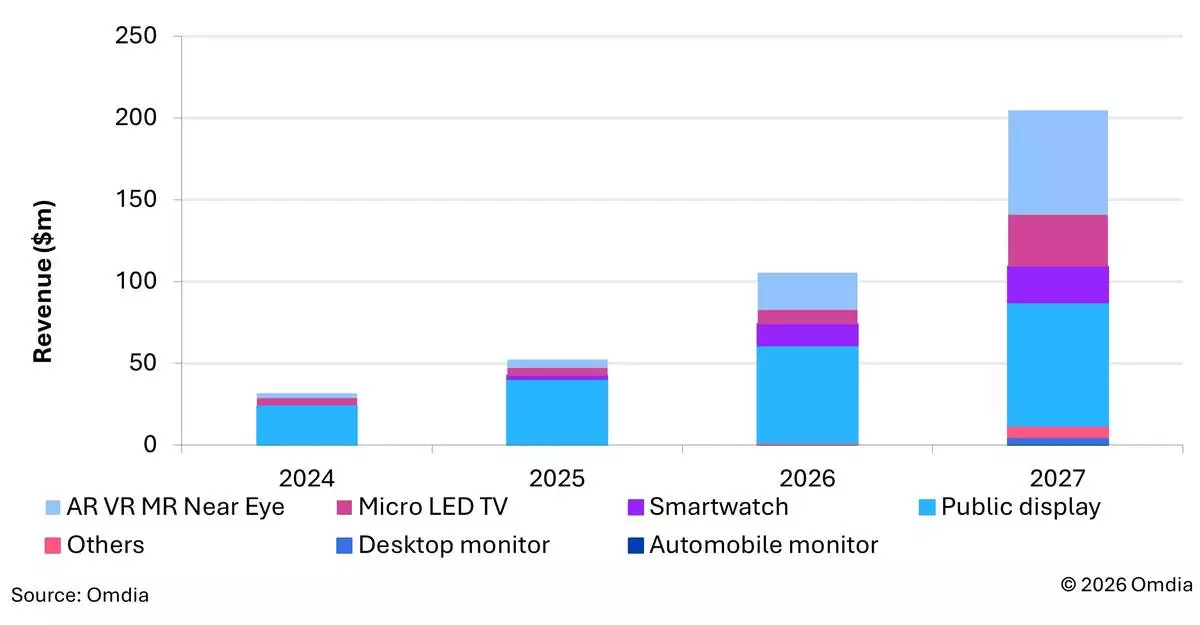
Figure 1: Micro LED display revenue forecast by applications
SURPRISE, Ariz. (AP) — Bruce Meyer was promoted to interim executive director of the baseball players’ association on Wednesday, a day after Tony Clark’s forced resignation.
It was a move for continuity ahead of the likely start in April of what figures to be contentious collective bargaining with team owners.
Matt Nussbaum was promoted to interim deputy executive director from general counsel.
The decisions were made by the Major League Baseball Players Association executive board during an online meeting. Both votes were unanimous.
“Bruce and Matt are talented and experienced and respected by players,” said Scott Boras, an agent for many top stars. “Players trust their leadership to continue to advance to advance the longstanding positions of the MLBPA.”
A 64-year-old veteran labor lawyer, Meyer joined the union staff in 2018 and led negotiations through a 99-day lockout that led to a five-year agreement in March 2022. The deal barely avoided what would have been the first loss of regular-season games since 1995. He was promoted to deputy executive director in July 2022.
Meyer spent 30 years at Weil, Gotshal & Manges before joining the NHL Players Association in 2016 as senior director of collective bargaining, policy and legal.
Three members of the union’s eight-man executive subcommittee, Jack Flaherty, Lucas Giolito and Ian Happ, were among the players who in March 2024 advocated for the ouster of Meyer in an effort led by former union lawyer Harry Marino. Clark backed Meyer, the effort failed and those three players were dropped off the subcommittee that December.
The subcommittee voted 8-0 against approving the 2022 labor contract and Meyer had advocated pushing management for a deal more favorable to the union. Team player representatives, the overall group supervising negotiations, voted 26-4 in favor, leaving the overall ballot at 26-12 for ratification.
The current subcommittee includes Chris Bassitt, Jake Cronenworth, Pete Fairbanks, Cedric Mullins, Marcus Semien, Paul Skenes, Tarik Skubal and Brent Suter.
A former All-Star first baseman who headed the union since 2013, Clark resigned Tuesday just months ahead of the expected start of bargaining for a labor contract to replace the deal that expires Dec. 1.
He was asked to resign by the union’s eight-man executive subcommittee after an investigation by the union’s outside counsel discovered evidence Clark had an inappropriate relationship with his sister-in-law, a union employee since 2023, a person familiar with the union’s deliberations told The Associated Press. The person spoke on condition of anonymity because that detail was not announced.
“The information that really led to this came out within the last ... 72 hours or so,” Meyer said earlier Wednesday. “So this is not something that has been kind of sat on. When the information came out, the players on the subcommittee made their feelings known. And Tony, to his credit, he’s always been about the players first and Tony decided to take the action he did in the interest of the players.”
Clark did not respond to a text message seeking comment.
The start of the annual tour of spring training camps by union officials was pushed back a day and began Wednesday with the Kansas City Royals.
“Just on a personal level I think we’re all fairly devastated by things that have happened in the last 48, 72 hours,” Meyer said. “I’m not going to go beyond that in terms of personal feelings, but it’s fair to say that we were all personally upset, concerned about Tony. But I think this was something that the players determined had to happen at this particular point in time.”
Meyer, hired by Clark in 2018, headed the 2021-22 negotiations that led to an agreement on March 10 that ended a 99-day lockout. Meyer was promoted to deputy executive director in July 2022.
“I don’t anticipate that anybody’s going to be leading negotiations other than me,” Meyer said.
Clark’s departure took place during a probe by the U.S. Attorney in Brooklyn, New York, into the union's relationship with OneTeam Partners, a licensing company founded by the union, the NFL Players Association and RedBird Capital Partners in 2019.
“There have been some issues hanging over, as you know, and in some respects it’s good to get them out of the way sooner rather than later,” Meyer said.
“OneTeam and its employees are not, and have never been, targets of the Eastern District of New York’s investigation and have been fully cooperative,” the company said in a statement. “Any reporting that characterizes the EDNY investigation as targeting OneTeam is inaccurate.”
Meyer said the union’s entire executive board of 72 players was eligible to vote for executive director: the executive subcommittee, 30 major league team player representatives and 34 minor leaguers, who have been represented by the union since 2022.
MLB appears on track to propose a salary cap, which possibly could lead to a work stoppage that causes regular-season games to be canceled for the first time since 1995.
“We don’t expect anything to change in terms of bargaining,” Meyer said. “We’ve been preparing for bargaining for years. Players have been preparing. Players know what’s coming. At the end of the day leadership is important and leadership comes and goes, but what remains is the players. At the end of the day, it’s the players who determine the direction of the union. At the end of the day, it’s the players who determine our priorities and bargaining. Those priorities obviously have not changed and will not change.”
The union said it will resist a salary cap.
“Our position and the historic position of this union for decades on a salary cap is well known,” Meyer said. “It’s the ultimate restriction. It’s something that owners in all the sports have wanted more than anything and in baseball in particular there’s a reason for that, because it’s good for them and not good for players.”
Meyer spent 30 years at Weil, Gotshal & Manges before joining the NHL Players Association in 2016 as senior director of collective bargaining, policy and legal.
He wouldn’t directly address whether the union intends to restrict the hiring of family members.
“I think it’s fair to say there are issues that will be addressed,” Meyer said. “There are various issues that will be evaluated, re-evaluated with the advice of counsel and, as always, at the direction of players.”
Nussbaum, 47, succeeded Ian Penny as general counsel in July 2022. He was hired by the union in 2011 as staff counsel.
Blum reported from New York.
AP MLB: https://apnews.com/hub/mlb
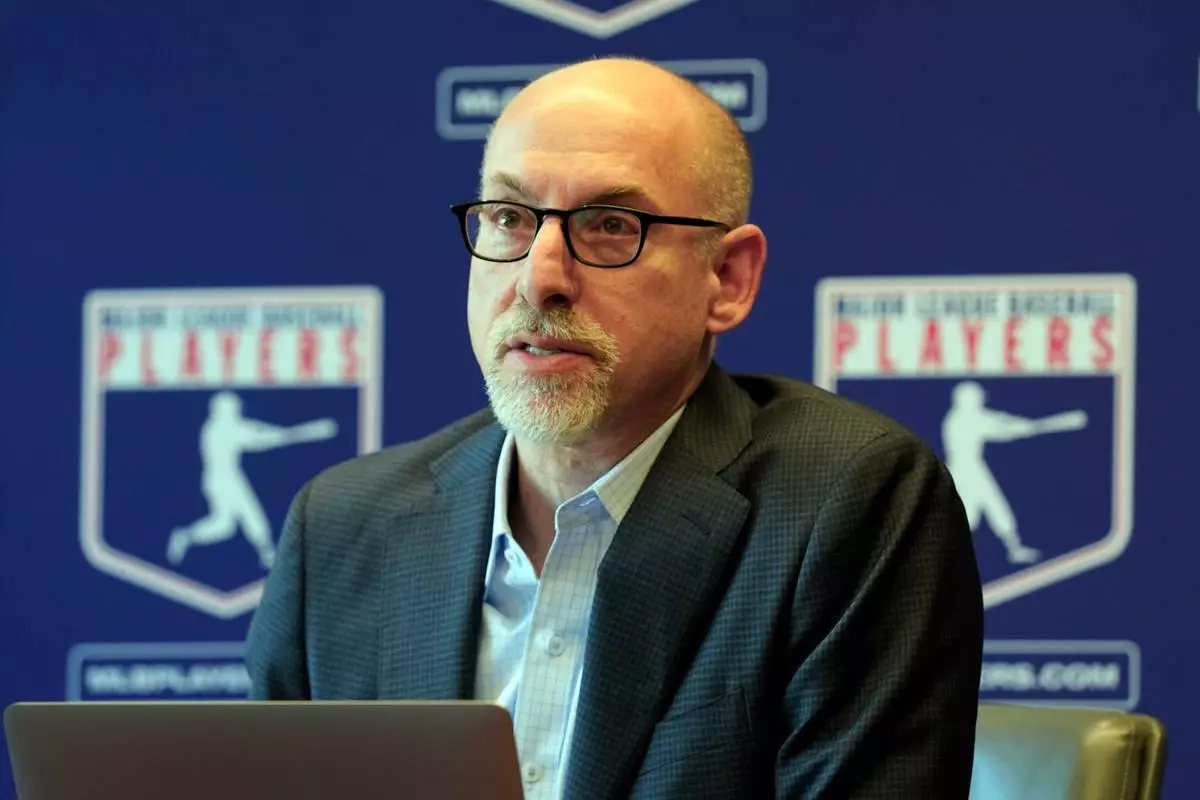
FILE - Major League Baseball Players Association Senior Director, Collective Bargaining & Legal, Bruce Meyer answers a question at a news conference in their offices in New York, March 11, 2022. (AP Photo/Richard Drew, File)
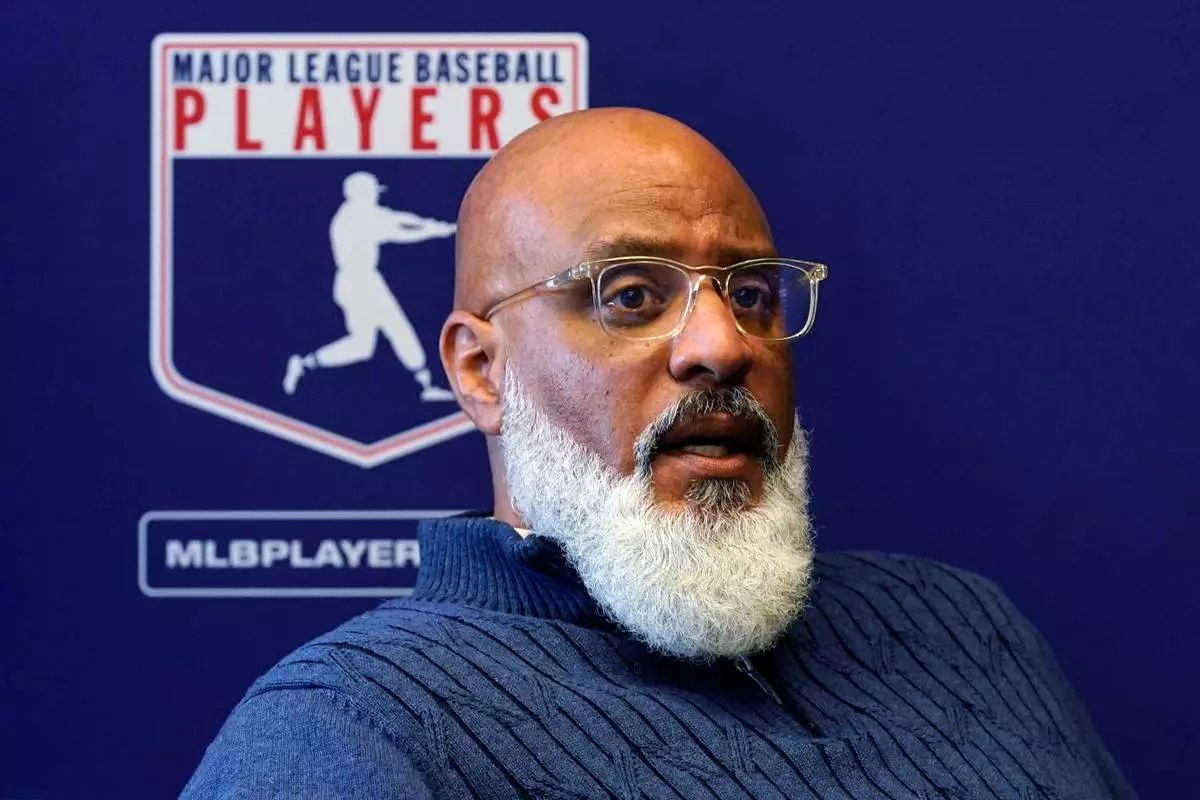
FILE - Major League Baseball Players Association Executive Director Tony Clark answers a question during a news conference in New York on March 11, 2022. (AP Photo/Richard Drew, File)