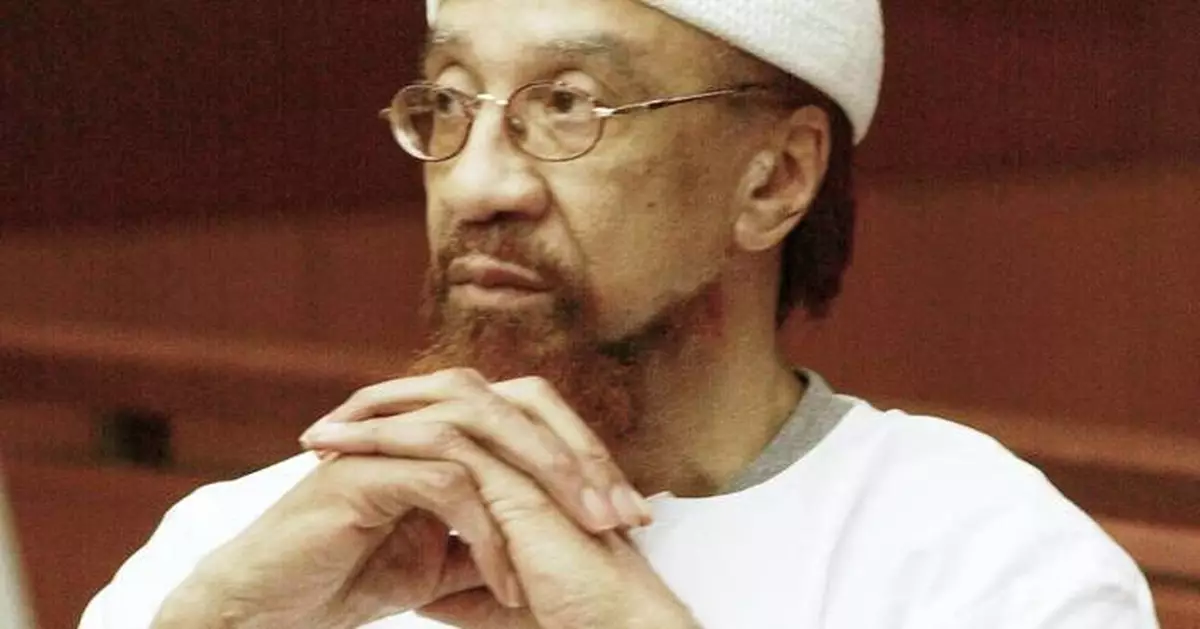
ATLANTA (AP) — Georgia prosecutors defending the 2002 murder conviction of a onetime Black Panther leader known as H. Rap Brown say new DNA evidence still points strongly to his guilt in the shooting of two sheriff’s deputies. However, they also accuse the case’s original lead prosecutor, now a Fulton County judge who has handled several high-profile political cases, of “grave and clear” misconduct.
The striking Wednesday filing by Fulton County District Attorney Fani Willis’ office acknowledges serious wrongdoing by the former prosecutor and an FBI agent involved in the original investigation. But it argues that modern DNA testing, combined with ballistic evidence and trial testimony, leaves little doubt that Brown — by then known as Jamil Abdullah Al-Amin — was responsible for the attack that killed one deputy and wounded another outside of Al-Amin's Atlanta home.
The former prosecutor, Robert McBurney, is a superior court judge and has been involved in some of the most politically charged cases in the country. Prosecutors described his conduct in Al-Amin's trial as “the most egregious” issue in the case.
Despite standing by the conviction, Willis’ office said it does “not object to a hearing to evaluate the case in its entirety,” potentially keeping alive a public reexamination of a prosecution that has long divided civil rights advocates and law enforcement.
Al-Amin died in prison in November, but his family wants a hearing to clear his name, their attorney Mawuli Davis said, adding, “His legacy is still at the center of this.”
McBurney oversaw the special grand jury Willis used in her investigation that eventually resulted in the indictment of Trump and others over allegations that they illegally tried to overturn the president's narrow 2020 election loss in Georgia. Notably, though, McBurney barred Willis from seeking charges against then-state Sen. Burt Jones because she had hosted a fundraiser for his Democratic opponent in the lieutenant governor’s race, which McBurney ruled created an “actual and untenable” conflict of interest.
McBurney also declared Georgia’s restrictive abortion law unconstitutional — a finding the state Supreme Court has vacated in a case that is ongoing.
“This case had a trifecta of issues which undermined the process and the public’s confidence in justice,” the filing says.
During closing arguments at trial, McBurney displayed a chart titled “Questions for the defendant” and asked questions meant to focus the jury’s attention on the fact that Al-Amin didn’t testify. Al-Amin also had court permission to remain seated during the trial for religious reasons, including not standing when the jury entered. McBurney implored the jury, “Don’t stand for him.”
Federal courts have ruled that McBurney violated Al-Amin's constitutional rights, but that it's unlikely his actions substantially affected the verdict.
This week's filing says McBurney “crossed the line from aggressive advocacy into misconduct that undermined the core principles of justice,” accusing him of misrepresenting evidence and withholding critical information from the defense, among other things.
“These were not minor oversights; they reflected a troubling pattern of behavior that prioritized winning over truth, and conviction over justice,” the filing says.
McBurney did not immediately respond to an email Thursday seeking comment.
FBI Special Agent James Campbell approached Al-Amin while he was on the ground in handcuffs, kicked and spit on him, and said, “This is what we do to cop killers,” the filing says. A reprimand of Campbell “did not clear SA Campbell's stain on the investigation,” it says.
Lawyers for Al-Amin have also maintained that Campbell planted the guns used to shoot the deputies at the site where Al-Amin was arrested.
The Associated Press was unable to find contact information for Campbell to seek comment.
Campbell had been transferred to Atlanta after shooting an unarmed Muslim man in the back of the head, the filing says. That man's supporters accused Campbell of planting a gun found at the scene.
The judge did not allow the jury to hear about the prior shooting after the defense presented newspaper articles about it, wanting to use that shooting to demonstrate bias and motive to plant guns. If defense attorneys had presented recently interviewed witnesses rather than relying on articles, the judge likely would have allowed the jury to consider that information, the new filing argues.
Al-Amin's lawyers argued that nothing connected Al-Amin to the guns used to shoot the deputies. Willis' office used DNA testing that wasn't available at the time of the trial to test the guns and related items.
The tests excluded Al-Amin from the DNA found on both guns. But Al-Amin's DNA was identified on a leather belt wrapped around one of the guns, the filing says. That evidence is a strong indication of his guilt, especially when paired with prior ballistics evidence and testimony, the filing says.
As a radical activist in the 1960s, Al-Amin once said violence was “as American as cherry pie” and that Black people would use violence, if needed, to fight oppression.
He converted to Islam during a prison stint and moved to Atlanta in the 1970s, becoming the leader of one of the nation’s largest Black Muslim groups, the National Ummah.
On March 16, 2000, Fulton County sheriff’s deputies Ricky Kinchen and Aldranon English went to Atlanta’s West End neighborhood, where Al-Amin lived, was an imam and owned a grocery store, to serve a warrant for failure to appear in court on charges of driving a stolen car and impersonating a police officer during a traffic stop the previous year.
English testified at trial that Al-Amin fired a high-powered assault rifle when the deputies tried to arrest him. Then, prosecutors said, he used a handgun to fire three shots into Kinchen’s groin as the wounded officer lay in the street.
He was arrested four days later in White Hall, Alabama, a small town where he had helped develop a Muslim community.
This story was first published on Feb. 19, 2026. It was updated on Feb. 23, 2026, to correct that the date of the murder conviction was in 2002, not 2000.
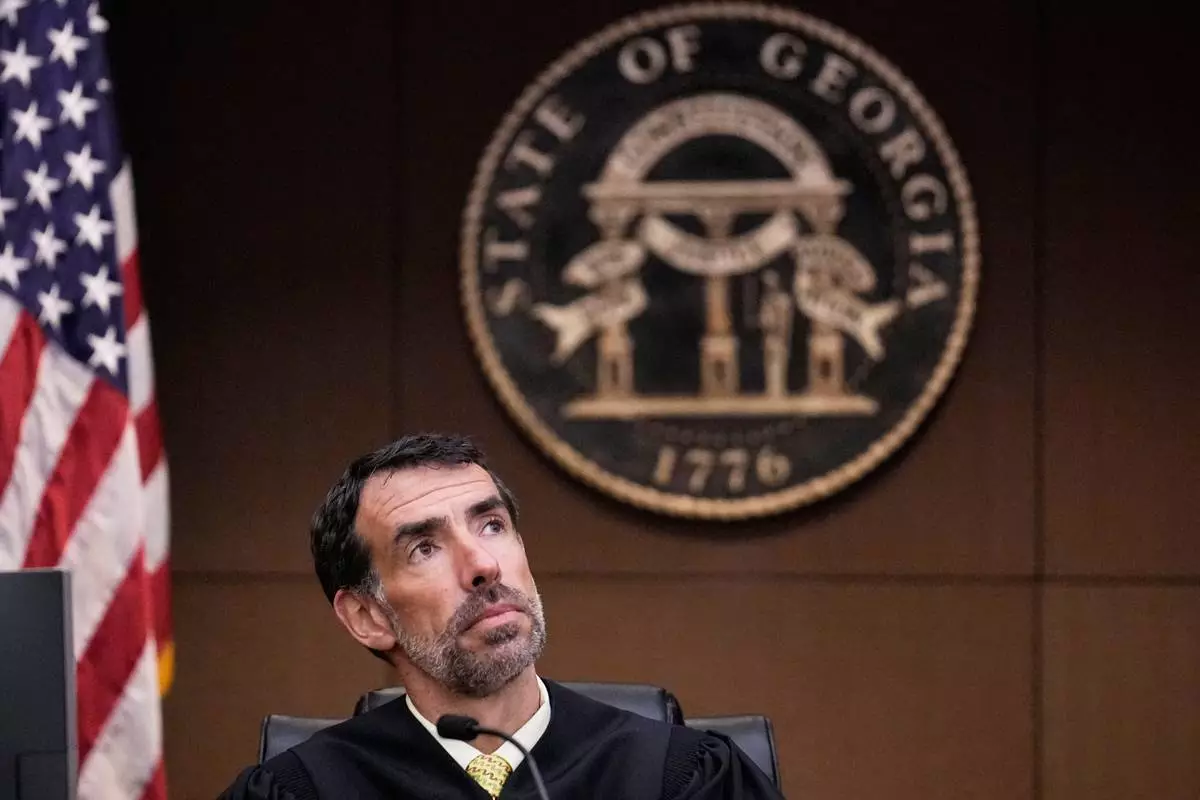
FILE - Chief Judge Robert McBurney, of the Superior Court of Fulton County, sits in his courtroom, Aug. 14, 2023, in Atlanta. (AP Photo/Brynn Anderson, File)
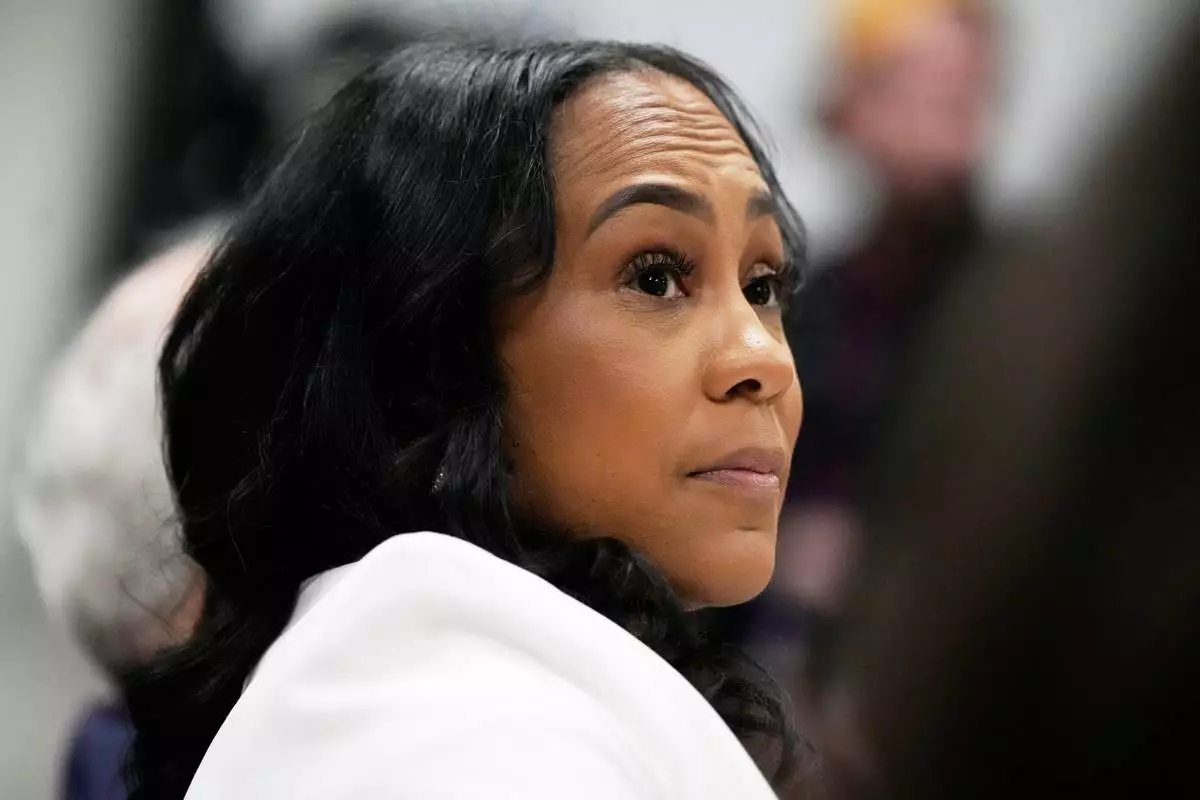
FILE - Fulton County District Attorney Fani Willis is seen at the Georgia State Capitol on Dec. 17, 2025, in Atlanta. (AP Photo/Brynn Anderson, File)
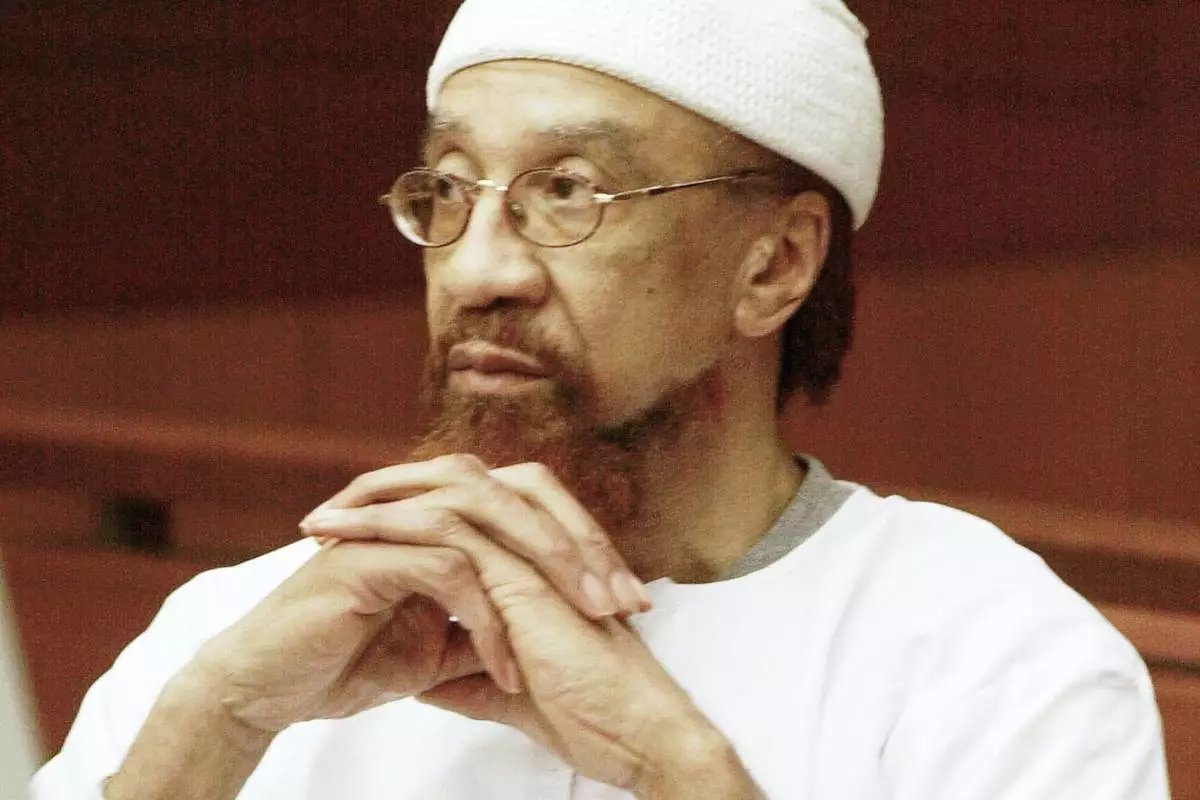
FILE - Jamil Abdullah Al-Amin is seen during the sentencing portion of his trial in Atlanta on March 11, 2002. (AP Photo/Ric Feld, File)
GUADALAJARA, Mexico (AP) — Mexico Security Secretary Omar García Harfuch said Monday 25 members of the National Guard were left dead in Jalisco in six separate attacks after the killing of Jalisco New Generation Cartel leader Nemesio Oseguera Cervantes.
Oseguera Cervantes, known as “El Mencho” was the boss of one of the fastest-growing criminal networks in Mexico, notorious for trafficking fentanyl, methamphetamine and cocaine to the United States and staging brazen attacks against government officials who challenged it.
He was killed during a shoot-out in his home state of Jalisco as the Mexican military attempted to capture him. Cartel members responded with violence across the country, blocking roads and setting fire to vehicles.
Also killed were a prison guard, an agent from the state prosecutor’s office and a woman whom García Harfuch did not identify. He also said some 30 criminal suspects were killed in Jalisco and four others were killed in Michoacan.
Several Mexican states canceled school on Monday, with local and foreign governments warning their citizens to stay inside after widespread violence erupted.
President Claudia Sheinbaum urged calm Monday and authorities said all of the more than 250 cartel roadblocks across 20 states had been cleared. The president was expected to address the situation at her daily news briefing Monday morning.
The White House confirmed that the U.S. provided intelligence support to the operation to capture the cartel leader and applauded Mexico's army for taking down a man who was one of the most wanted criminals in both countries.
Mexico hoped the death of the world's biggest fentanyl traffickers would ease Trump administration pressure to do more against the cartels, but many remained hunkered down and on edge as they waited to see the powerful cartel's reaction.
The U.S. Embassy said via X that its personnel in eight cities and the state of Michoacan would shelter in place and work remotely Monday and it warned U.S. citizens in many parts of Mexico to do the same.
Cars began circulating in Guadalajara before sunrise Monday with the start of the work week, a notable change from Sunday when Jalisco's state capital and Mexico's second-largest city was almost completely shut down as fearful residents stayed home.
More than 1,000 people were stuck in Guadalajara’s zoo overnight, sleeping in buses. On Monday morning. mothers wrapped up in blankets carried their toddlers out of the buses for a much-needed bathroom break as police trucks guarded the area.
Luis Soto Rendón, the zoo’s director, said many had been trapped there since 9 a.m. the day before, when violence broke out in Jalisco and the surrounding states. Families were left stranded, trying to distract their children, as they decided they couldn't return home in nearby states like Zacatecas and Michoacan.
“We decided to let people stay inside the zoo for their safety,” Soto said. “There are small children and senior citizens.”
Irma Hernández, a 43-year-old hotel security guard in Guadalajara, arrived at work early Monday morning.
She normally takes public transportation to work, but buses were not running and she had no way to cross the city. Her bosses organized a private car to pick her up. Her family, she said, was staying at home, too scared to leave.
“I am worried because I don't know how to get home if something happens,” she said.
Passengers arriving at the city's international airport Sunday night were told it was operating with limited personnel because of the burst of violence.
Authorities in Jalisco, Michoacan and Guanajuato reported at least 14 other people killed Sunday, including seven National Guard troops.
Videos circulating on social media Sunday showed tourists in Puerto Vallarta walking on the beach with smoke rising in the distance.
David Mora, Mexico analyst for International Crisis Group, said the capture and outburst of violence marks a point of inflection in Sheinbaum’s push to crack down on cartels and relieve U.S. pressures.
U.S. President Donald Trump has demanded Mexico do more to fight the smuggling of the often-deadly drug fentanyl, threatening to impose more tariffs or take unilateral military action if the country does not show results.
There were early signs that Mexico’s efforts were well received by the United States.
U.S. Ambassador Ron Johnson recognized the success of the Mexican armed forces and their sacrifice in a statement late Sunday. He added that “under the leadership of President Trump and President Sheinbaum, bilateral cooperation has reached unprecedented levels.”
But it may also pave the way for more violence as rival criminal groups take advantage of the blow dealt to the CJNG, Mora said.
“This might be a moment in which those other groups see that the cartel is weakened and want to seize the opportunity for them to expand control and to gain control over Cartel Jalisco in those states,” he said.
“Ever since President Sheinbaum has been in power, the army has been way more confrontational, combative against criminal groups in Mexico,” Mora said. “This is signaling to the U.S. that if we keep cooperating, sharing intelligence, Mexico can do it. We don’t need U.S. troops on Mexican soil."
Oseguera Cervantes, who was wounded in the operation to capture him Sunday in Tapalpa, Jalisco, about a two-hour drive southwest of Guadalajara, died while being flown to Mexico City, the Defense Department said in a statement.
During the operation, troops came under fire and killed four people at the location. Three more people, including Oseguera Cervantes, were wounded and later died, the statement said.
White House press secretary Karoline Leavitt said via X that the U.S. government provided intelligence support for the operation. “‘El Mencho’ was a top target for the Mexican and United States government as one of the top traffickers of fentanyl into our homeland,” she wrote. She commended Mexico’s military for its work.
The U.S. State Department had offered a reward of up to $15 million for information leading to the arrest of El Mencho. The Jalisco New Generation Cartel is one of the most powerful and fastest-growing criminal organizations in Mexico and began operating around 2009.
In February 2025, the Trump administration designated the cartel as a foreign terrorist organization.
Sheinbaum has criticized the “kingpin” strategy of previous administrations that took out cartel leaders, only to trigger explosions of violence as cartels fractured. While she has remained popular in Mexico, security is a persistent concern and since U.S. President Donald Trump took office a year ago, she has been under tremendous pressure to show results against drug trafficking.
The Jalisco cartel has been one of the most aggressive cartels in its attacks on the military — including on helicopters — and is a pioneer in launching explosives from drones and installing mines. In 2020, it carried out a spectacular assassination attempt with grenades and high-powered rifles in the heart of Mexico City against the then head of the capital’s police force and now federal security secretary.
Sánchez reported from Mexico City. Associated Press writer María Verza in Mexico City contributed to this report.
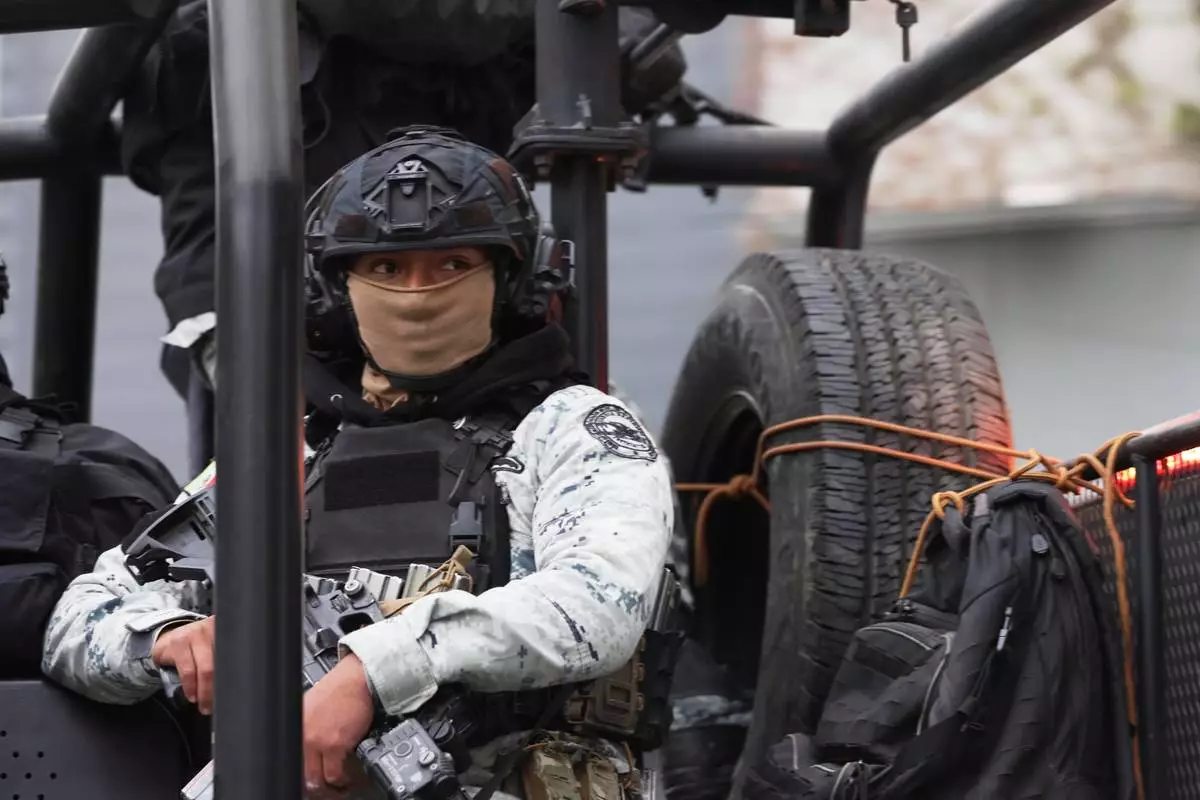
A National Guard patrols the area outside of the General Prosecutor's headquarters in Mexico City, Sunday, Feb. 22, 2026, after authorities reported that the Mexican Army killed Jalisco New Generation Cartel leader Nemesio Oseguera, known as "El Mencho." (AP Photo/Ginette Riquelme)
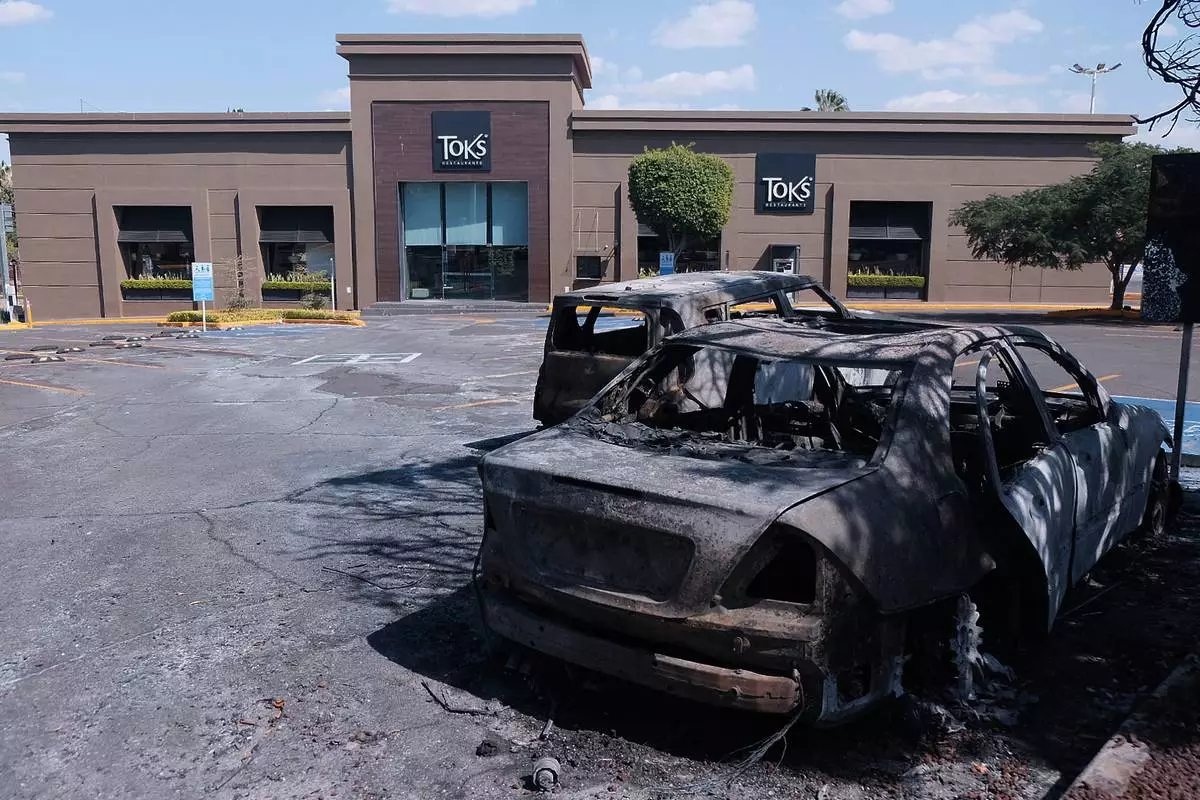
Charred vehicles sit in a parking lot sit outside a shopping mall in Guadalajara, Jalisco state, Mexico, Sunday, Feb. 22, 2026, as authorities reported that the Mexican Army killed Jalisco New Generation Cartel leader Nemesio Oseguera, known as "El Mencho." (AP Photo/Alejandra Leyva)
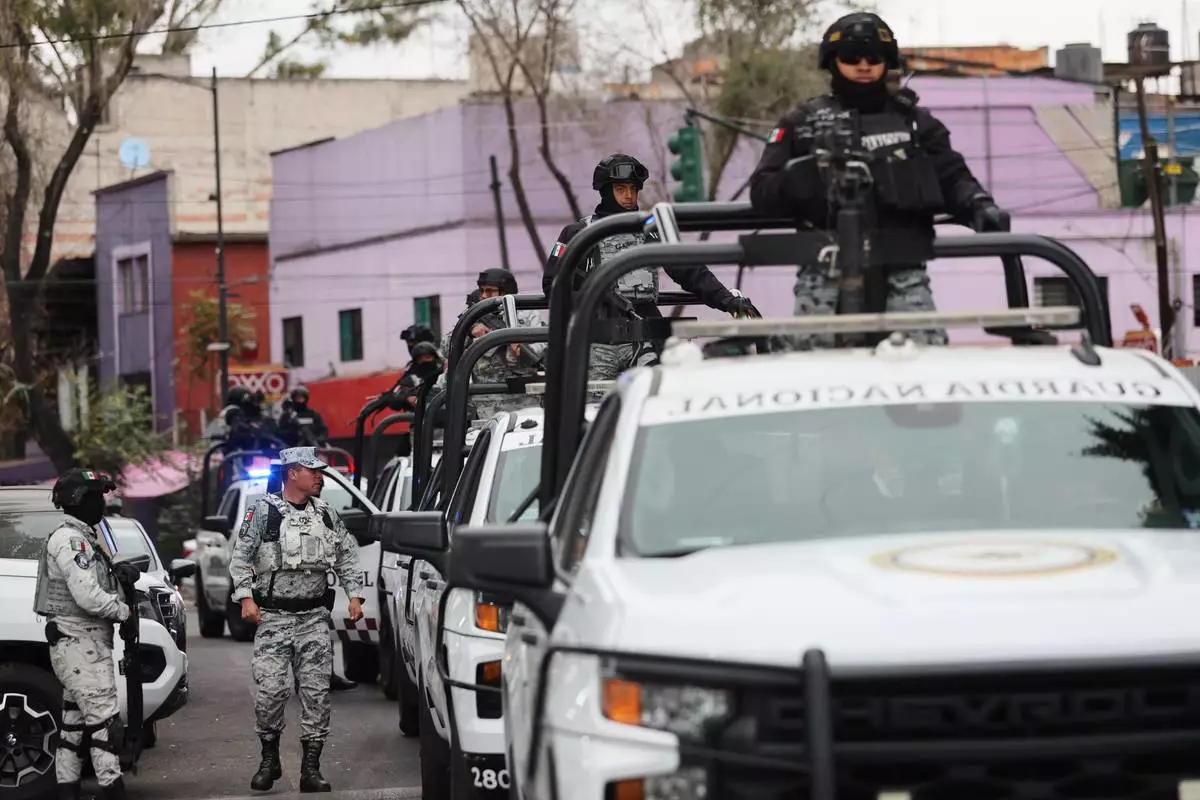
National Guards patrol the area outside of the General Prosecutor's headquarters in Mexico City, Sunday, Feb. 22, 2026, after authorities reported that the Mexican Army killed Jalisco New Generation Cartel leader Nemesio Oseguera, known as "El Mencho." (AP Photo/Ginette Riquelme)
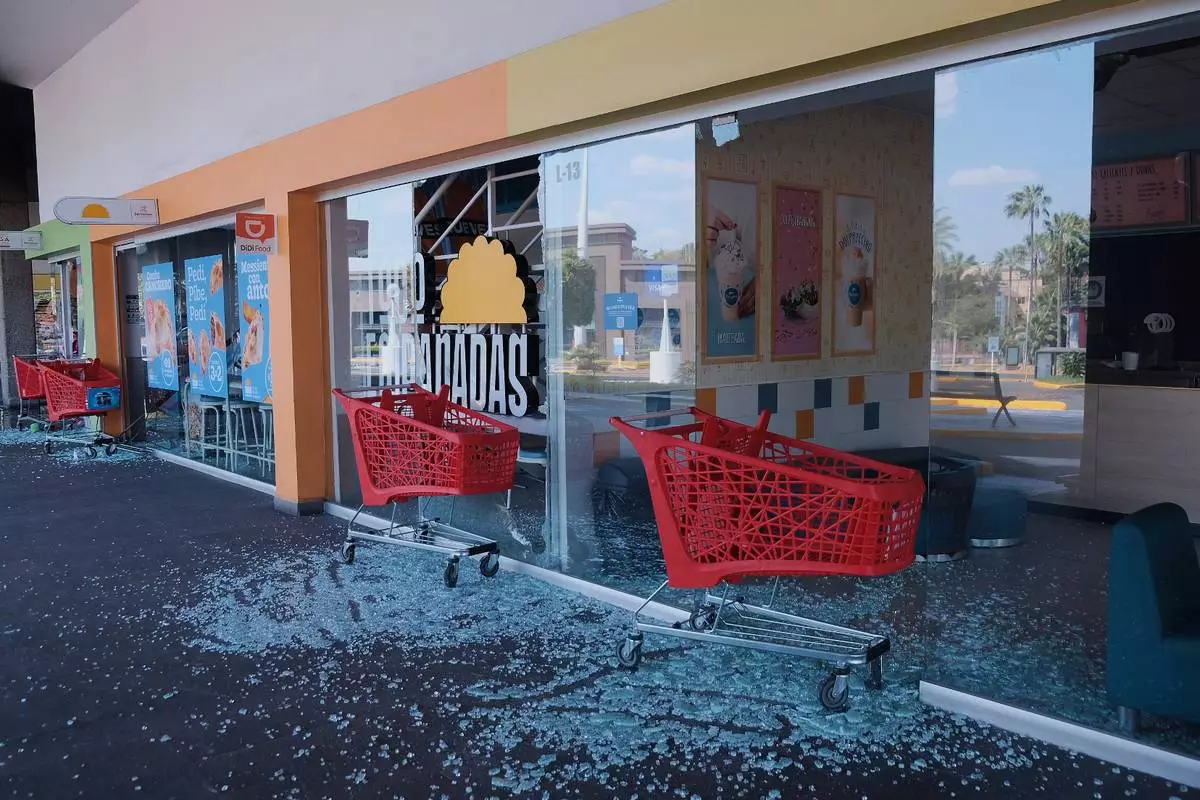
Carts stand outside of a vandalized supermarket in Guadalajara, Jalisco state, Mexico, Sunday, Feb. 22, 2026, after the death of the leader of the Jalisco New Generation Cartel, Nemesio Rubén Oseguera Cervantes, known as "El Mencho." (AP Photo/Alejandra Leyva)
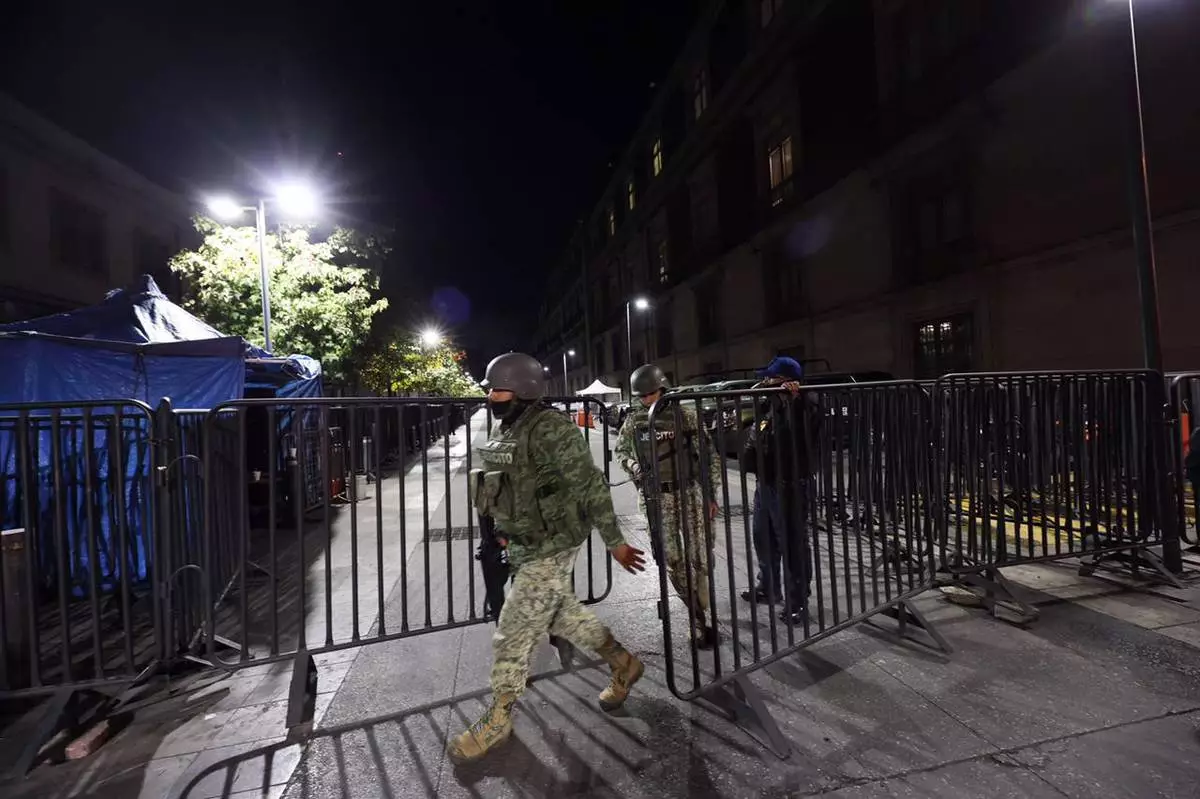
Army soldiers patrol outside the National Palace ahead of the daily, morning news conference by Mexican President Claudia Sheinbaum in Mexico City, Monday, Feb. 23, 2026. (AP Photo/Ginnette Riquelme)
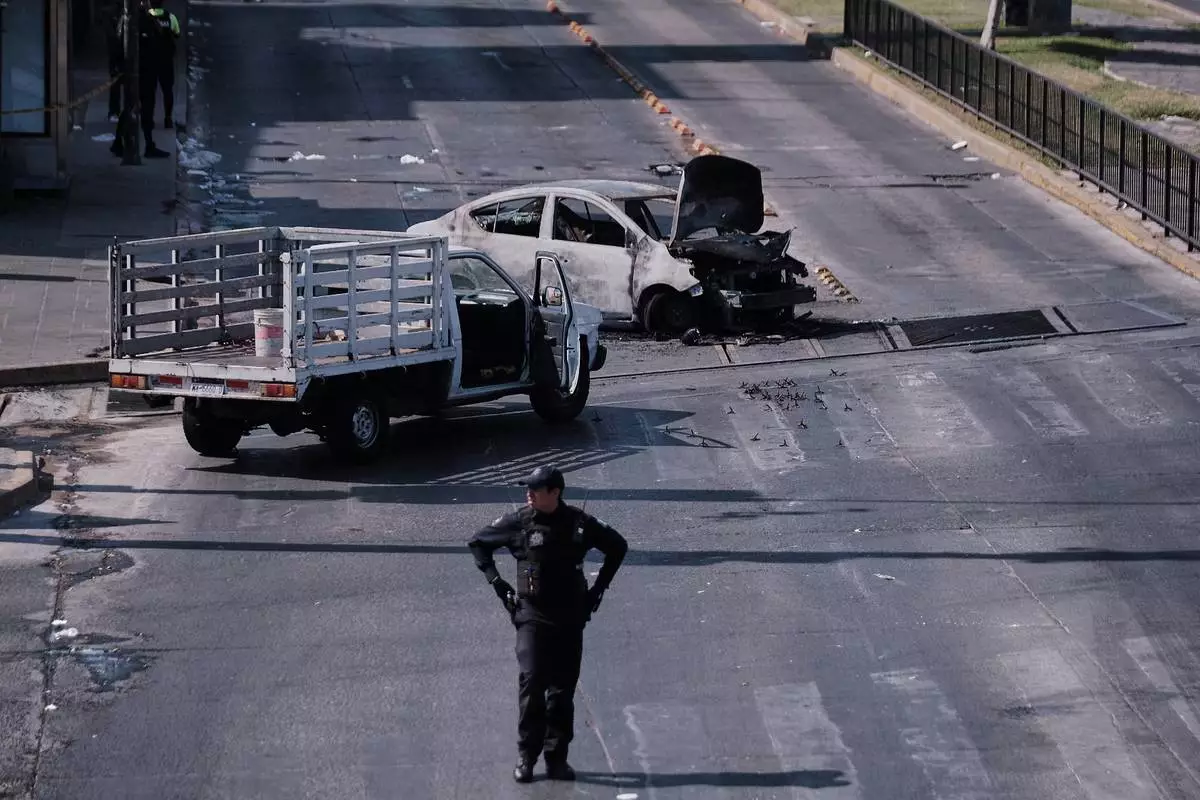
A police officer stands guard by a charred vehicle after it was set on fire, on a road in Guadalajara, Jalisco state, Mexico, Sunday, Feb. 22, 2026, after the death of the leader of the Jalisco New Generation Cartel, Nemesio Rubén Oseguera Cervantes, known as "El Mencho." (AP Photo/Alejandra Leyva)
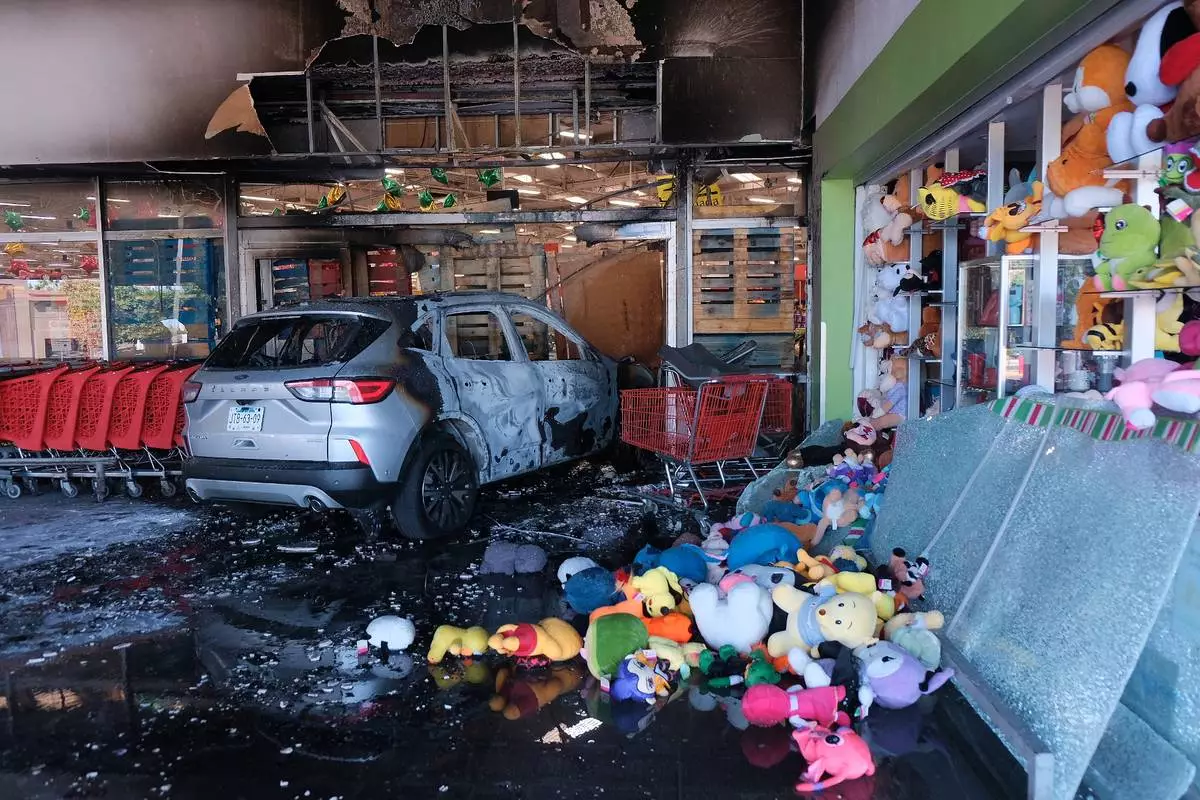
A charred vehicle sits at a damaged supermarket in Guadalajara, Jalisco state, Mexico, Sunday, Feb. 22, 2026, after the death of the leader of the Jalisco New Generation Cartel, Nemesio Rubén Oseguera Cervantes, known as "El Mencho." (AP Photo/Alejandra Leyva)
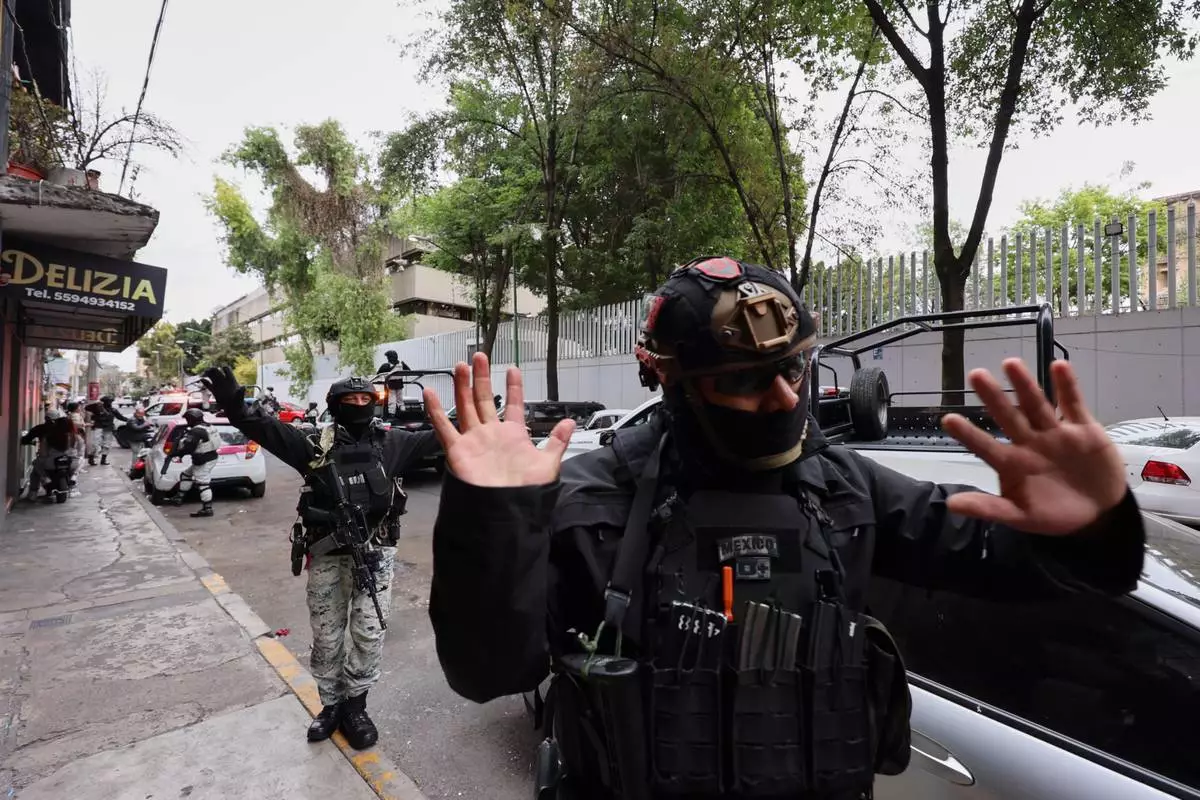
National Guards remove pedestrians by the General Prosecutor's headquarters in Mexico City, Sunday, Feb. 22, 2026, after the death of the leader of the Jalisco New Generation Cartel, Nemesio Rubén Oseguera Cervantes, known as "El Mencho." (AP Photo/Ginette Riquelme)
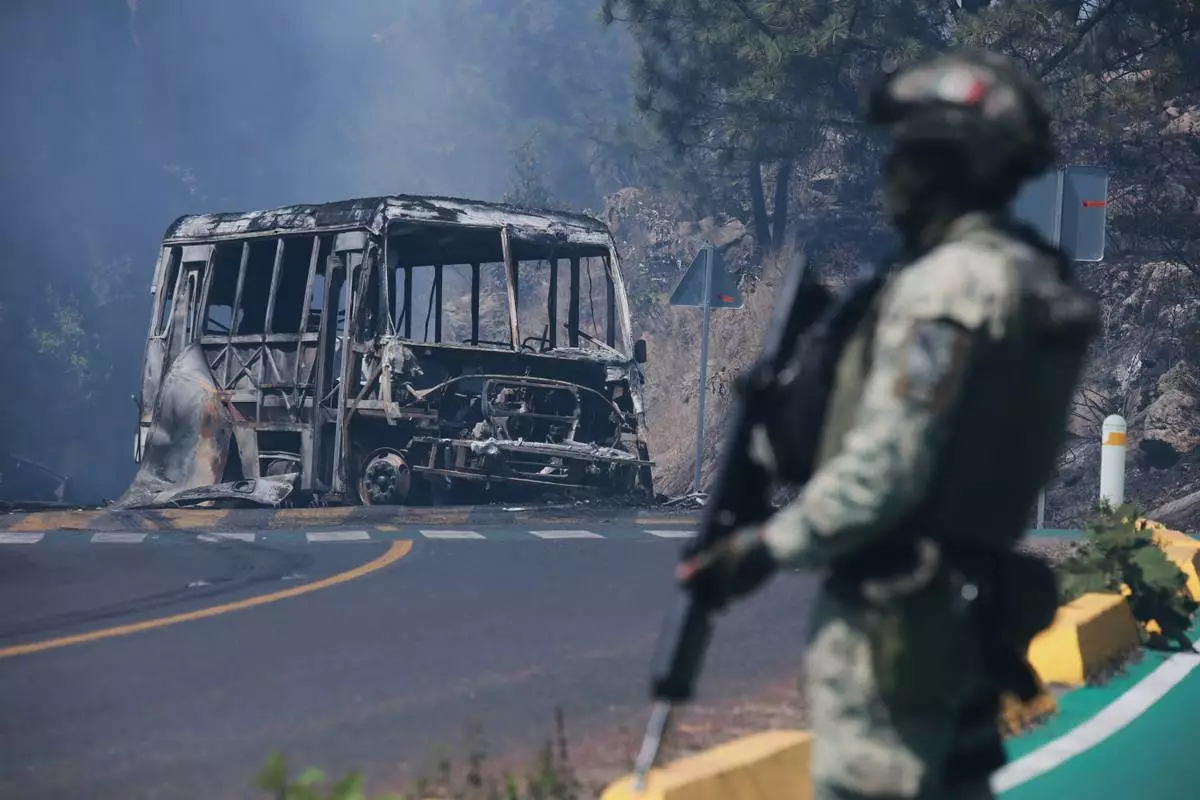
A soldier stands guard by a charred vehicle after it was set on fire, in Cointzio, Michoacán state, Mexico, Sunday, Feb. 22, 2026, following the death of the leader of the Jalisco New Generation Cartel, Nemesio Oseguera, known as "El Mencho." (AP Photo/Armando Solis)
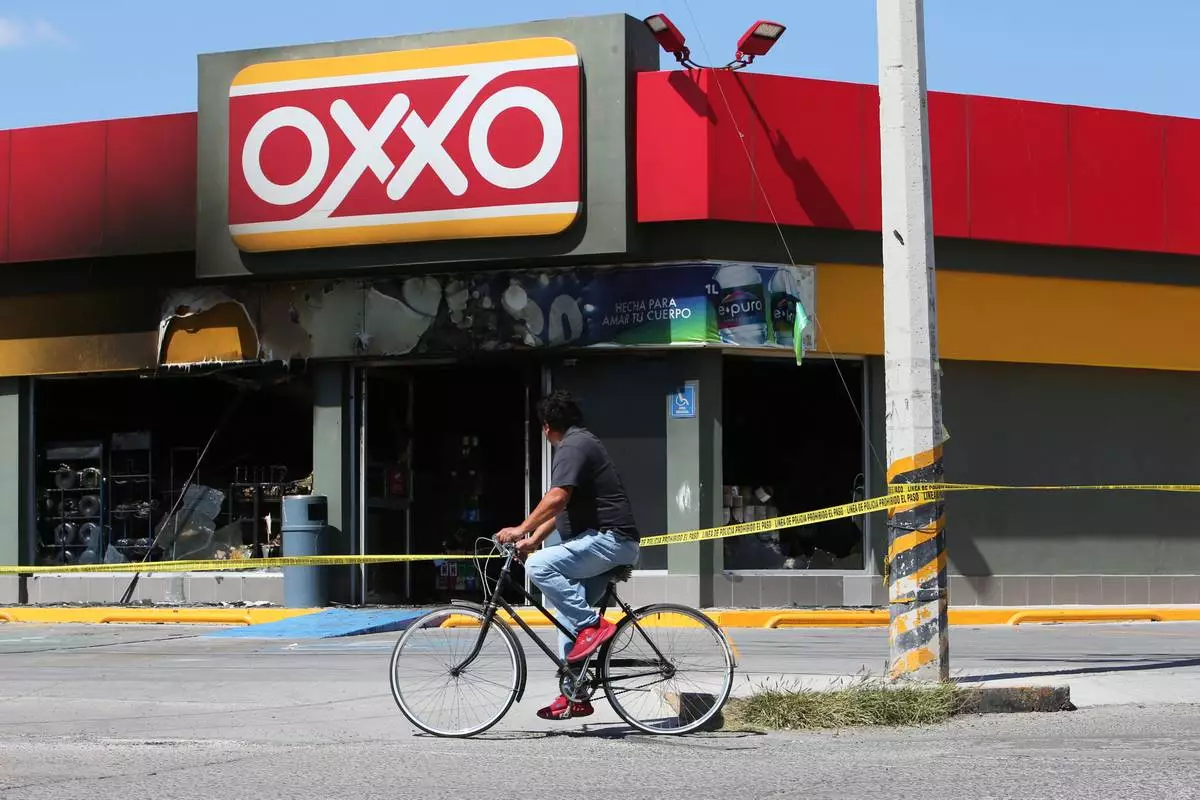
A man rides a bike next to a convenience store that was set on fire, in San Francisco del Ricon, Guanajuato state, Mexico, Sunday, Feb. 22, 2026, after the death of the leader of the Jalisco New Generation Cartel, Nemesio Ruben Oseguera Cervantes, known as "El Mencho." (AP Photo/Alfredo Valadez)