A team of Chinese ocean engineers has been tracking data on natural resources in relevant areas of the South China Sea throughout the year to support work including ecological early warning, marine observation and forecasting, and disaster prevention and mitigation.
The engineers at the Sansha Marine Center under the Ministry of Natural Resources said they had observed various shades of blue in the South China Sea, which reveal rich information about weather, marine life, and seabed topography.
While enjoying the vitality and diversity deep under the waves, they also perceived the sensitivity and vulnerability of the ecosystems.
Bai Chenghua, one of the team members, participated in coral reef investigations at Xianbin Jiao, Ren'ai Jiao, and Tiexian Jiao in the South China Sea, and documented different situations of the coral reef ecosystems under China's protection and amid destruction by the foreign side.
"I carry out my daily work with a sense of patriotism. Each time we conduct an investigation here, it is a declaration of China's sovereignty over this sea area. Combining my work experience and knowledge, I feel quite proud to be able to make a contribution to upholding China's territorial sovereignty and maritime rights and interests," said Bai.
"By obtaining natural resources data with the highest possible precision, we have been safeguarding China's territory in our own way," said Liu Taorong, another engineer of the team.
The team has collected samples of over 400 fish species and 300 shellfish species from the South China Sea and compiled the findings into books.

Chinese ocean engineers track data on natural resources in South China Sea
Venezuela is working to stabilize consumers prices and ensure domestic supply in response to U.S. sanctions by further improving domestic productivity.
Long-standing sanctions on Venezuela's oil industry have hindered the country's ability to generate adequate foreign currency, leading to heightened inflation and significant shortages of essential imported goods.
In shifting its focus towards increasing domestic production rather than depending on exports, Venezuela has managed to stabilize prices for some goods, said Juan Carlos Valdes, an economist.
"Although the blockade has severely damaged the Venezuelan economy, it has also forced us to manufacture our own goods. Because we cannot buy from abroad, we have to focus on local production, and this shift has stabilized prices in various sectors," he said.
Valdes said that investment in domestic manufacturing is contributing to reducing inflation.
"There is no doubt that local production is helping to slow inflation. We hope that ultimately it will not only curb inflation but also achieve complete price stabilization in Venezuela," he said.
Angel Arteaga, the manager of an 80-year-old state-run edible oil factory, said that the production in the factory has continued uninterrupted despite U.S. attacks earlier this year.
"Our production remains steady and has not been impacted by the U.S. military actions. We refuse to raise product prices or costs just because of unforeseen factors or variables," he said.
Data from the Venezuelan Ministry of Food indicates that by the end of 2025, the country had achieved 97 percent food self-sufficiency through domestic production.
In an earlier speech, Venezuela's acting President Delcy Rodriguez said that overall consumption in the county in January increased by 32 percent compared to the same period last year.
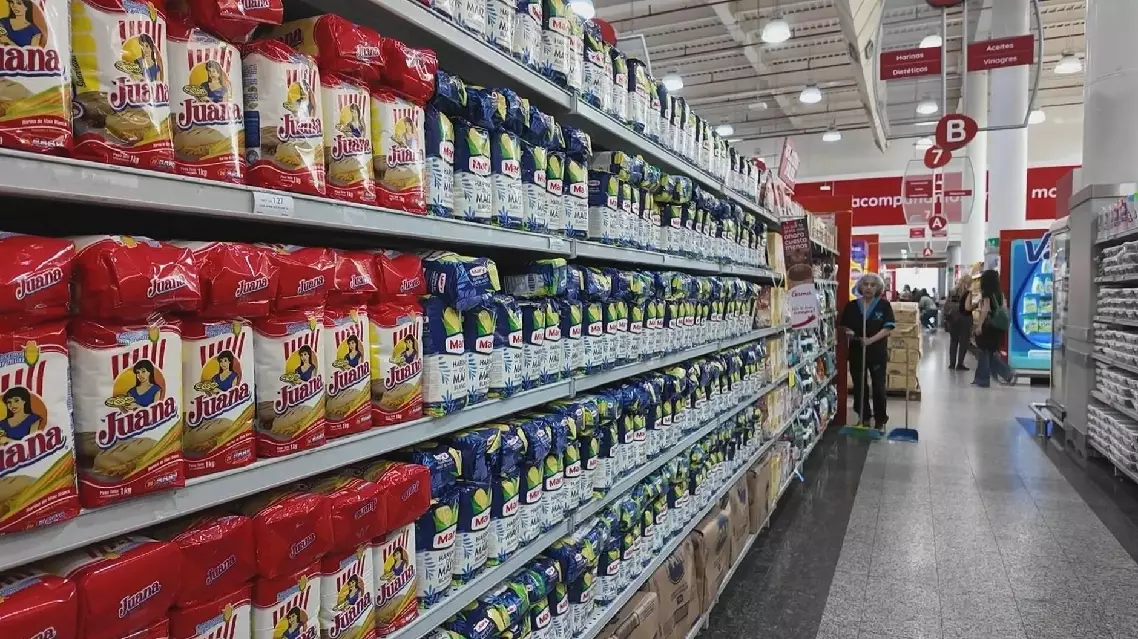
Consumer prices stable in Venezuela as focus turns to enhancing domestic productivity