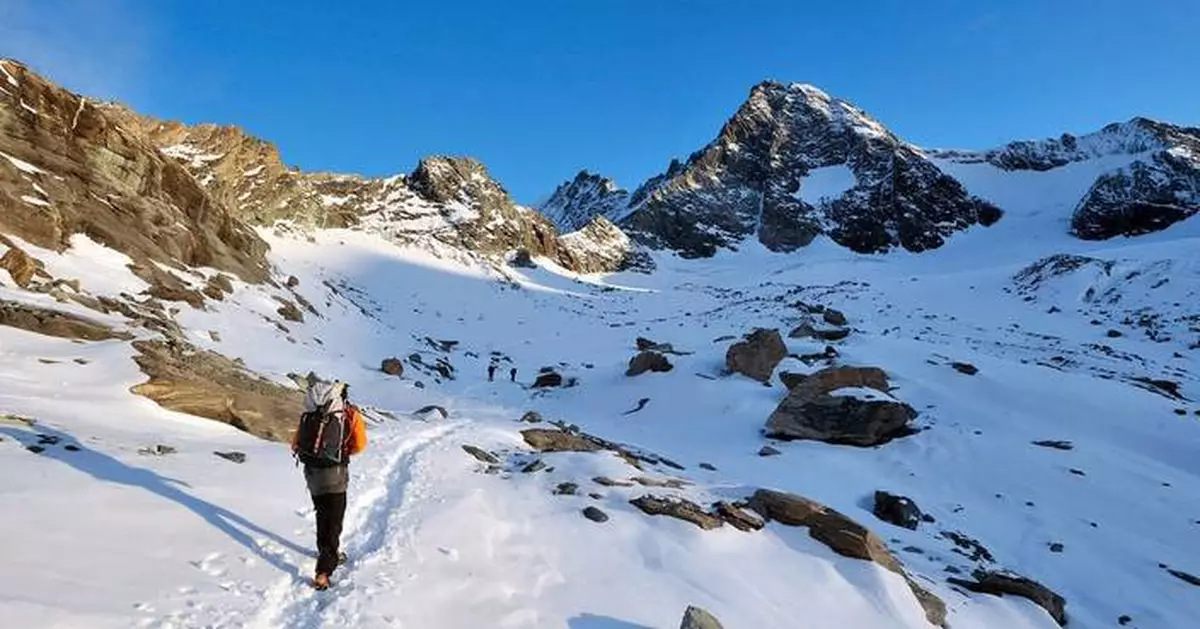
VIENNA (AP) — An Austrian court has convicted a man of manslaughter caused by gross negligence after his girlfriend froze to death as the couple attempted to climb the country's highest peak last year.
The 37-year-old defendant was given a five-month suspended sentence and a 9,600-euro ($11,300) fine in a verdict handed down by the Innsbruck state court Thursday night after a one-day trial, the Austria Press Agency reported. The court did not identify him, in keeping with local privacy rules.
The man and his 33-year-old girlfriend set out to climb the Grossglockner in western Austria in January 2025. Prosecutors said that she died about 50 meters (164 feet) below the 3,798-meter (12,460-foot) peak after he left her behind. The defendant pleaded not guilty to the charges.
Judge Norbert Hofer said that the defendant had misjudged the situation on the mountain but had not wilfully left behind his girlfriend — whose knowledge of mountaineering, he said, was “galaxies” short of the man's own. The sentence was well short of the maximum three years in prison.
“I don't see you as a murderer, I don't see you as a cold-hearted man,” he said, alluding to social media posts about the case. “I see you as the one who ultimately tried to call help and stand by his girlfriend.”
However, the judge said that the defendant had failed to take his “leadership responsibility.” He said the woman would almost certainly have survived “if the appropriate measures had been taken,” for example making an emergency call earlier or turning back.
The defendant told the court he was “endlessly sorry," APA reported. He said that the couple had made all their decisions together and planned their climbs together, including the Grossglockner climb.
He argued that he himself had no formal Alpine training and that his girlfriend's knowledge wasn't far short of his own. He said she had been in good condition when a police helicopter flew over the couple earlier in the climb and he couldn't explain her rapid deterioration. He said he had descended to seek help after consulting with her.
The verdict can be appealed.
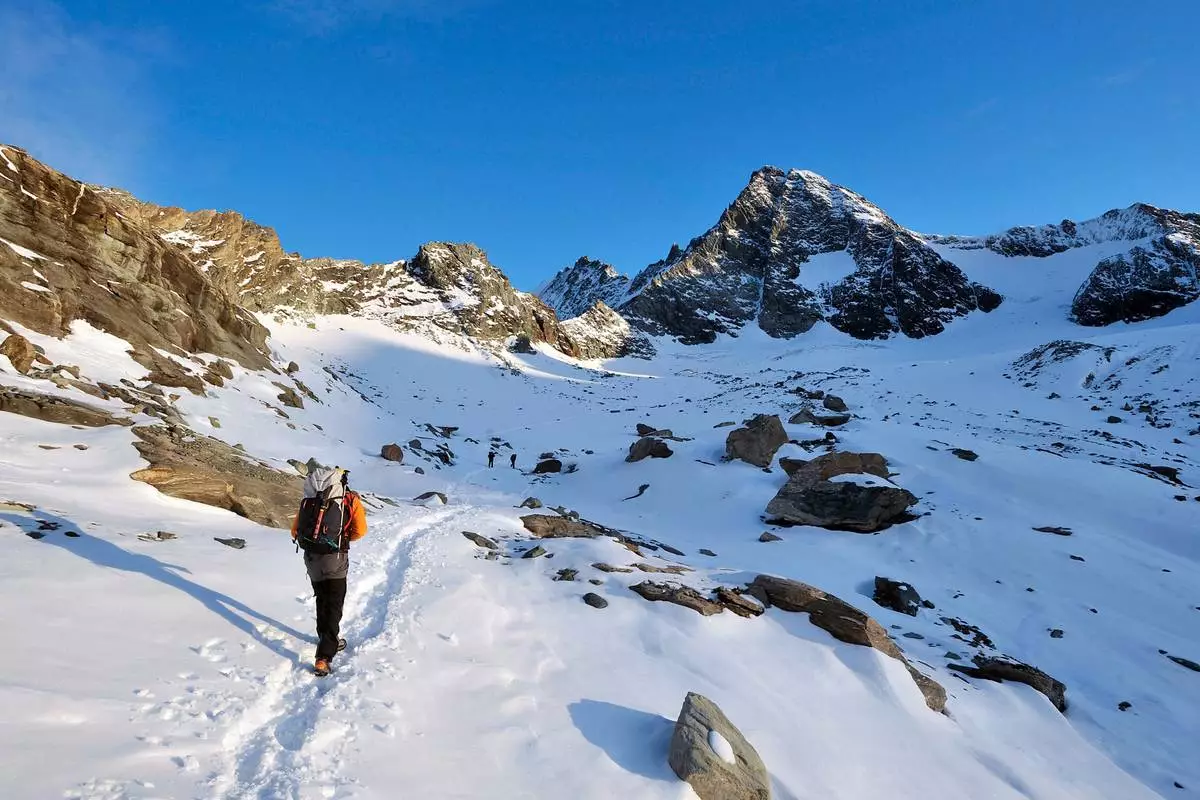
FILE - An alpinist is seen on his way to the cross on the summit of the 'Gross Glockner' mountain, right, on Austrian province of Easttyrol, on Wednesday, Oct. 8, 2008. (AP Photo/Kerstin Joensson, File)
WARSAW, Poland (AP) — Poland will use antipersonnel as well as anti-tank land mines to defend its eastern border against the growing threat from Russia, Poland's deputy defense minister told The Associated Press on Friday, as the country officially left an international convention banning the use of the controversial weapons.
The 1997 Anti-Personnel Mine Ban Treaty, also known as the Ottawa Convention, prohibits signatories from keeping or using antipersonnel mines, which can last for years and are known for having caused large-scale suffering among civilians in former conflict zones in countries including Cambodia, Angola and Bosnia-Herzegovina.
Poland, which ratified the document in 2012 and completed the destruction of its domestic anti-personnel mine stockpile in 2016, withdrew from the treaty on Friday and says it plans to renew manufacturing weapons.
“These mines are one of the most important elements of the defense structure we are constructing on the eastern flank of NATO, in Poland, on the border with Russia in the north and with Belarus in the east,” Paweł Zalewski, Poland's deputy defense minister, said.
He said Poland needed to defend itself against Russia, a country which “has very aggressive intentions vis a vis its neighbors” and which itself never committed to the international land mine ban treaty.
Since Russia's full-scale invasion of Ukraine, nearby countries have been reassessing their participation in the international treaty. Last year, Warsaw joined Finland, the three Baltic states of Estonia, Latvia and Lithuania, and Ukraine to announce it would leave the treaty.
Russia is one of nearly three dozen countries that have never acceded to the Ottawa treaty, alongside the United States.
Zalewski said that Poland will begin domestic production of both antipersonnel and anti-tank land mines, adding that the government would cooperate with Polish producers. He said Poland was aiming for self-sufficiency.
Land mines are an explosive weapon that's placed on or just under the ground and blows up when a person or a vehicle crosses over them. Anti-tank mines, which are designed not to be triggered by a person's weight, are not forbidden by the Ottawa Convention.
Speaking on Thursday after attending a demonstration of Bluszcz, an unmanned vehicle designed to distribute anti-tank mines produced by Polish company Belma S.A. and a military research institute, Polish Prime Minister Donald Tusk said Poland would “soon” have the ability to mine its eastern borders within 48 hours in case of a threat.
Given the length of the country's eastern borders, Zalewski said, “a lot” of land mines will be needed.
Poland plans to prepare mine stockpiles as part of the so-called Eastern Shield, a system of enhanced fortifications Poland has been building on its borders with Belarus and Russia since 2024, Zalewski said.
But he said that Poland would only deploy the mines along its borders “when there is a realistic threat of Russian aggression.”
“We very much respect our territory and we don’t want to exclude it from day to day use for the Polish citizens,” Zalewski said.
Human rights groups have condemned moves to withdraw from the Ottawa Convention, arguing that anti-personnel mines are too dangerous to civilians.
But Zalewski responded that the country is striking a balance by keeping the mines in reserve unless the country faces attack.
“We are not an aggressive country,” he said, “but we have to use all means to deter Russia.”
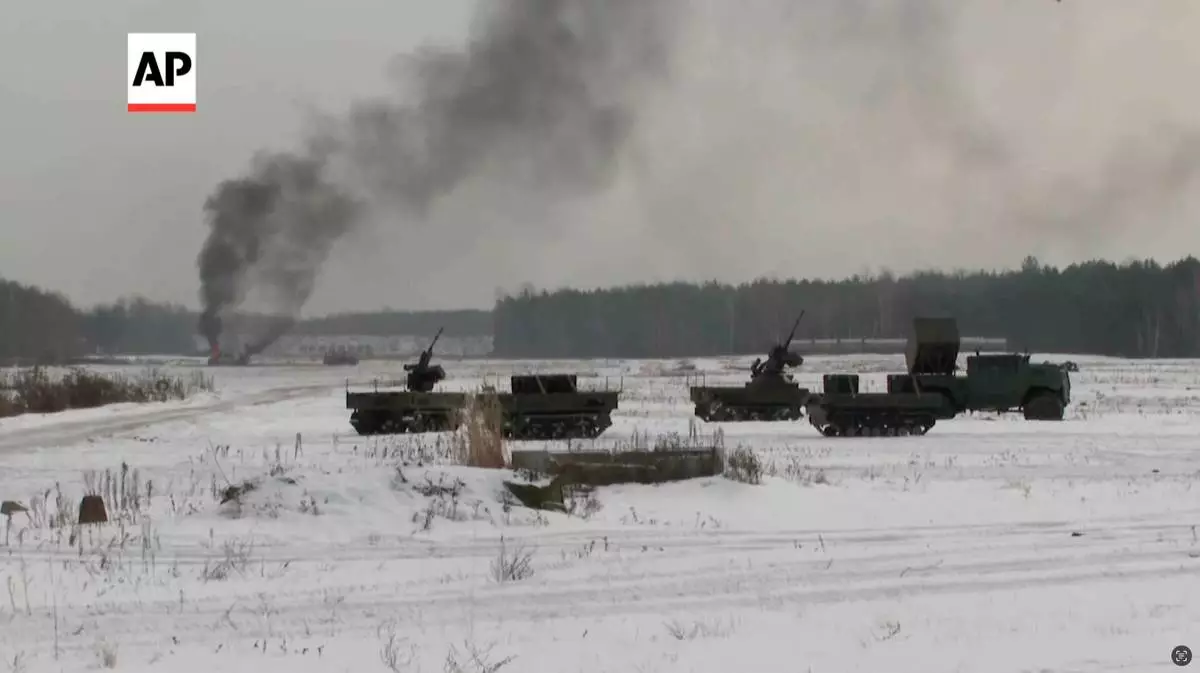
This image obtained from video shows military vehicles, including the hybrid mine layer called Bluszcz or Ivy, in Zielonka, Poland, Thursday Feb. 19, 2026. (AP Photo)

FILE - Poland's Prime Minister Donald Tusk looks on in the Serbia Palace in Belgrade, Serbia, Thursday, Oct. 24, 2024. (AP Photo/Darko Vojinovic, File)
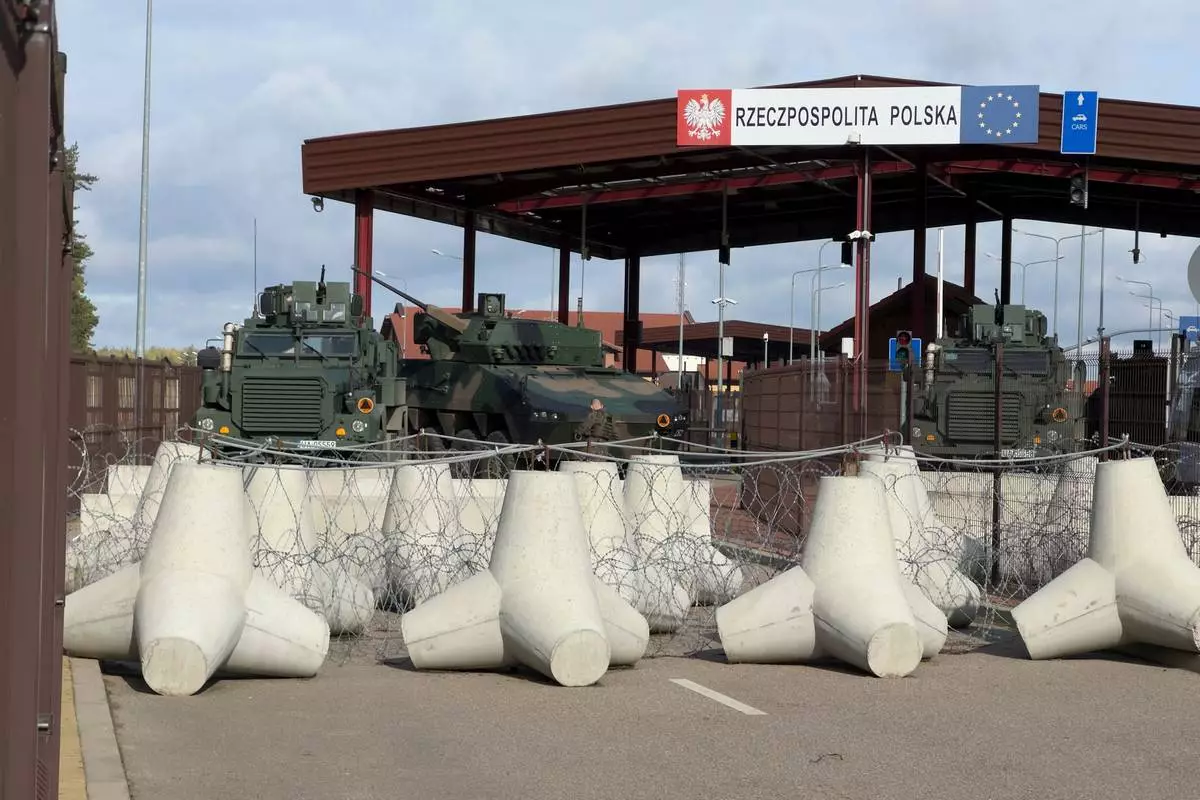
FILE - Armoured vehicles are parked at a section of Poland - Belarus border near the Polowce-Pieszczatka, Poland, Wednesday, Oct. 15, 2025. (AP Photo/Rafal Niedzielski, File)