Skip to Content Facebook Feature Image

You can give old batteries a new life by safely recycling them

ENT

You can give old batteries a new life by safely recycling them
ENT

ENT

You can give old batteries a new life by safely recycling them

2026-02-20 22:49 Last Updated At:23:01

NEW YORK (AP) — When household batteries die, it's hard to know what to do with them. So they get shoved into a junk drawer or sheepishly thrown into the trash.

But dead batteries aren't quite finished. They can leak heavy metals like cadmium and nickel into soil and water once they reach the landfill. Some of them can also overheat and cause fires in garbage trucks and recycling centers.

The good news is, safely disposing of your batteries takes just a few steps. They'll get shipped to recycling centers that break down their contents to make new things.

Battery recycling processes could use some fine-tuning, but it's still a simple and responsible way to get rid of them.

Recycling old batteries “keeps you safe, keeps the waste industry safe, keeps the first responders safe and responsibly sees that battery reach a proper end of life,” said Michael Hoffman, president of the National Waste and Recycling Association.

Batteries keep things running in our homes, powering everything from alarm clocks and TV remotes to gaming controllers. Millions are bought and used every year in the U.S., according to the Environmental Protection Agency.

They leave their stamp on the environment at nearly every stage of their life span.

Many of the materials used to make batteries — elements like lithium and nickel — are mined. Over half the world’s cobalt reserves are in Congo.

Once mined, those materials are shipped around to be refined, fashioned into a battery and packaged for sale. All the ships, trucks and planes moving them add to batteries' carbon footprint. Making the batteries can release carbon emissions and pollution into the air and atmosphere, too.

Though household batteries are far smaller than the big ones that power EVs and electric bicycles, there are a lot more of them and it’s worth figuring out how to get rid of them.

“One person’s single battery is not necessarily a lot,” said environmental scientist Jennifer Sun with Harvard University. “But everyone uses many batteries."

To begin, wrangle your old batteries and figure out what kind they are. Batteries “come in all shapes and sizes, but what’s inside differs,” said materials scientist Matthew Bergschneider of the University of Texas at Dallas.

Alkaline and zinc-carbon batteries are generally single-use and come in AA, AAA and more. These can be safely thrown in the household trash in most places, but the EPA still recommends recycling them so that their materials can be made into something new.

Lithium-ion batteries — commonly found in things like power tools and cordless vacuums — are a risk to cause fires and leak toxic gases in garbage trucks and landfills. A lot of rechargeable batteries are lithium-ion, but more single-use batteries are being made this way too.

Be sure to look up battery disposal laws for your area: Places like New York, Vermont and Washington, D.C. have special rules about throwing away household or rechargeable batteries.

Once you've corralled your batteries, tape their ends or put them in plastic bags to avoid the possibility of sparking. Then, take them to a drop-off location. How easy or hard this is depends on where you live.

Many hardware and office supplies stores accept old batteries. Look into city and state drop-off programs or search by ZIP code using The Battery Network, a nonprofit geared toward safe battery recycling.

Have a location in your home to collect the batteries over time and then “at some point, hopefully among all the other things that we all have in our lives, you can find a convenient drop-off location,” said Todd Ellis of The Battery Network.

If your batteries look swollen, cracked or are leaking, don't drop them off. You'll need to get in touch with your local hazardous waste removal agency to figure out how to turn them in.

Once batteries are dropped off at a collection site, they're sorted by type and taken to a recycling facility where they're broken down into their essential components — like cobalt, nickel or aluminum. Some bits can be used to make new batteries or other things. Nickel, for example, can be used to make stainless steel products and alkaline batteries can be turned into sunscreen.

Safely recycling a battery doesn't cancel out the environmental cost of making it. But it does give the battery's components their best chance at becoming something new.

“You continue to recycle and you don’t have to go back to the Earth to mine,” said public health expert Oladele Ogunseitan, who studies electronic waste at the University of California, Irvine.

Good battery habits are also good for us. It protects against old or damaged batteries leaking toxic compounds into our cabinets and junk drawers.

“I think it’s one of the simplest and most controllable actions that we can take to reduce our impact,” said Sun, the Harvard scientist.

The Associated Press Health and Science Department receives support from the Howard Hughes Medical Institute’s Department of Science Education and the Robert Wood Johnson Foundation. The AP is solely responsible for all content.
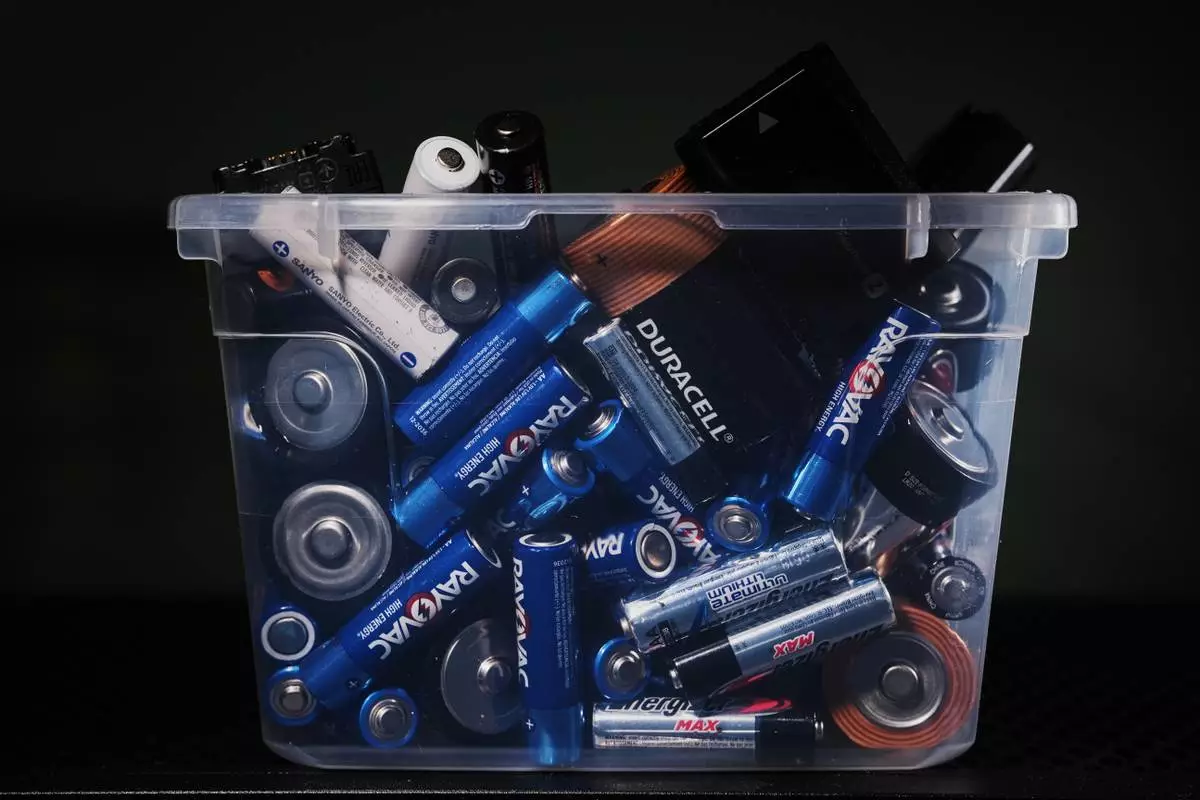
Batteries are displayed in a box Wednesday, Feb. 11, 2026, in Cincinnati. (AP Photo/Joshua A. Bickel)

Batteries are displayed in a box Wednesday, Feb. 11, 2026, in Cincinnati. (AP Photo/Joshua A. Bickel)
NEW YORK (AP) — U.S. stocks are drifting on Friday after discouraging reports showing a combination of slowing growth for the economy and faster inflation created relatively few ripples in the market.

The S&P 500 fell 0.2% and is close to dropping to a third straight losing week. The Dow Jones Industrial Average was down 175 points, or 0.4%, as of 9:35 a.m. Eastern time, and the Nasdaq composite was 0.1% lower.

Treasury yields also did not move much in the bond market following the economic reports. While they were disappointing and underscored the tricky situation the Federal Reserve may be facing as it sets interest rates, the reports did not change traders’ expectations much for what the Fed will ultimately do.

One report said that the U.S. economy’s growth slowed to a 1.4% annual rate during the end of 2025. That’s down from a 4.4% burst during the summer and “a bummer of a number,” according to Brian Jacobsen, chief economic strategist at Annex Wealth Management.

A second report said the measure of inflation that the Fed likes to use accelerated to 2.9% in December from 2.8% in November. An underlying measure that economists consider a better predictor of where inflation may be heading quickened to 3% from 2.8%.

The Fed could lower rates to give the economy a boost, as it did last year and as President Donald Trump has been demanding, but that would risk worsening inflation. Fed officials said at their last meeting that they want to see inflation fall further before they would support cutting rates further.

Following the reports, traders are still mostly betting that the Fed will lower rates at least twice by the end of this year, according to data from CME Group. But some shifted the timing for when the cuts could begin to slightly later in the summer.

The yield on the 10-year Treasury edged down to 4.07% from 4.08% late Thursday. The two-year yield, which more closely tracks expectations for Fed action, held at 3.47%.

On Wall Street, Akamai Technologies helped lead the market lower after falling 10.1%. The cybersecurity and cloud computing company reported stronger results for the end of 2025 than analysts expected, but it gave a profit forecast for the upcoming year that fell short of estimates.

Akamai plans to spend a bigger percentage of its revenue this upcoming year on equipment and other investments. It’s the latest potential indicator of how higher prices for computer memory amid shortages created by the AI boom is affecting customers throughout the economy.

That helped offset a 5.6% gain for Comfort Systems after the provider of heating, ventilation air conditioning and electrical services reported a stronger profit for the latest quarter than analysts expected. CEO Brian Lane said his company is seeing “unprecedented demand.”

In stock markets abroad, indexes rose modestly in Europe following a more mixed finish in Asia.

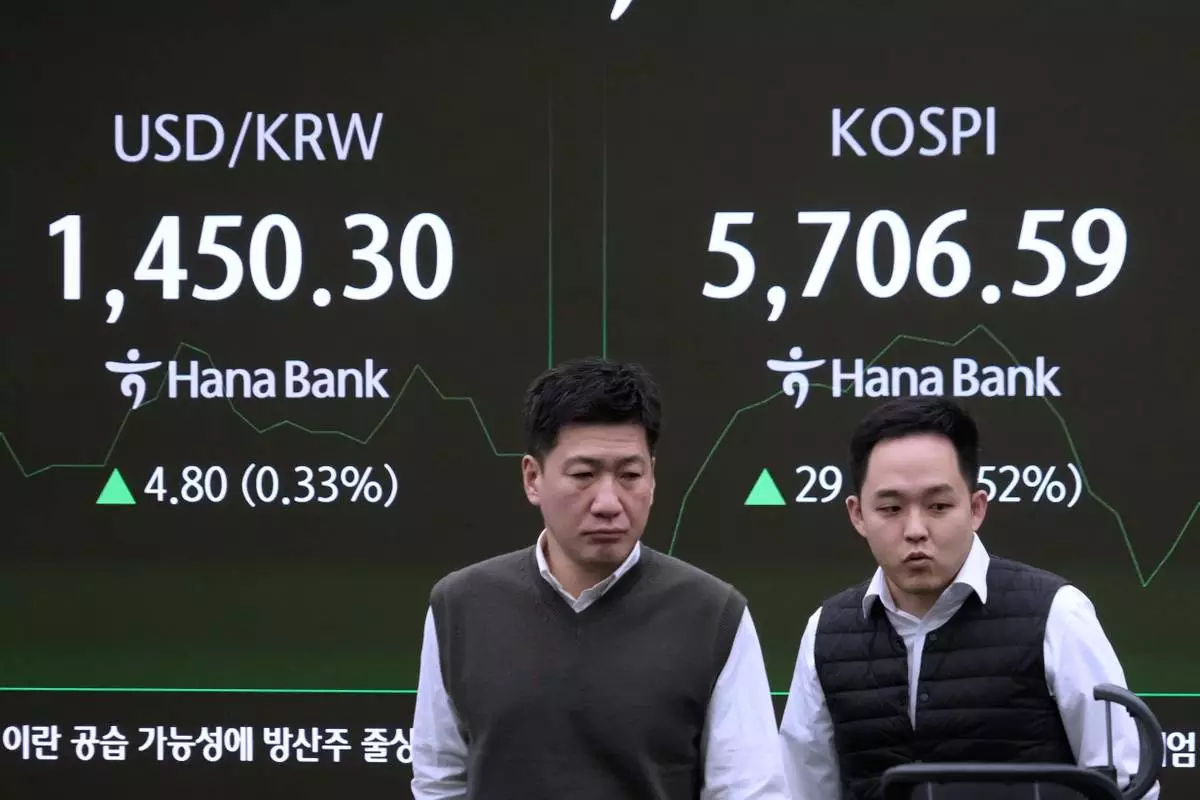
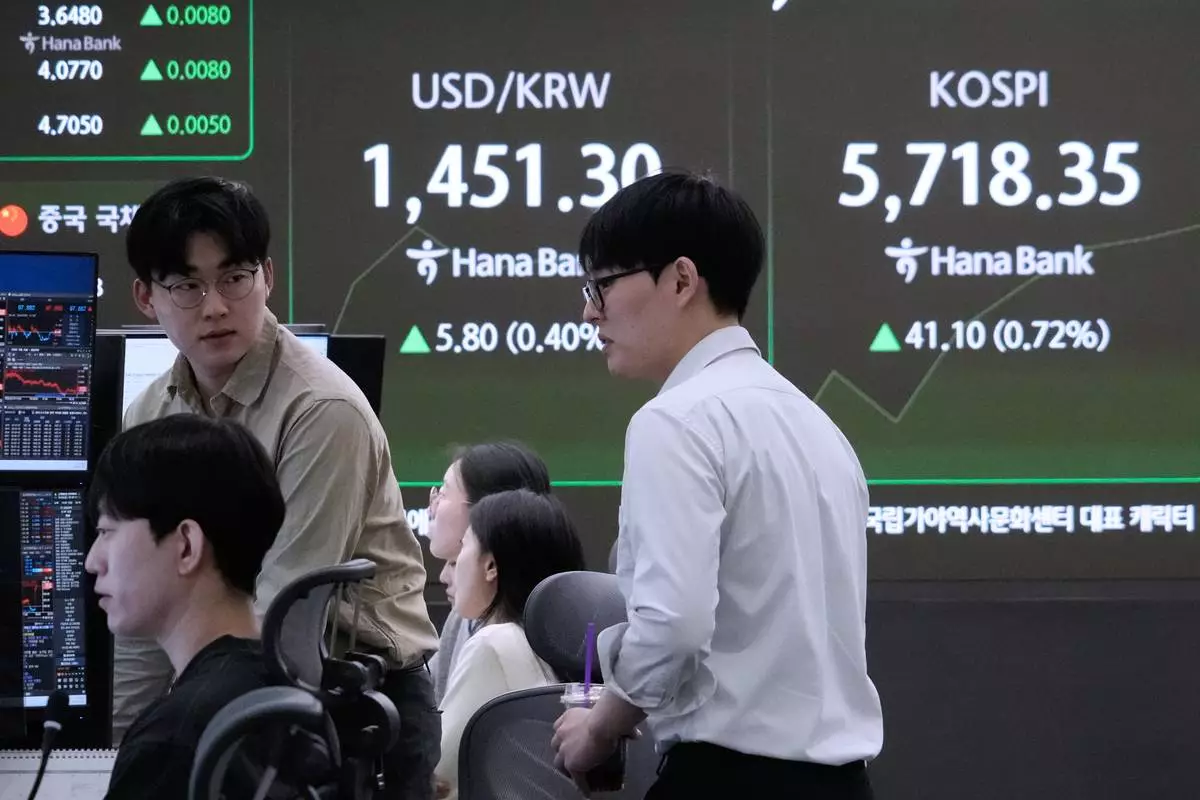
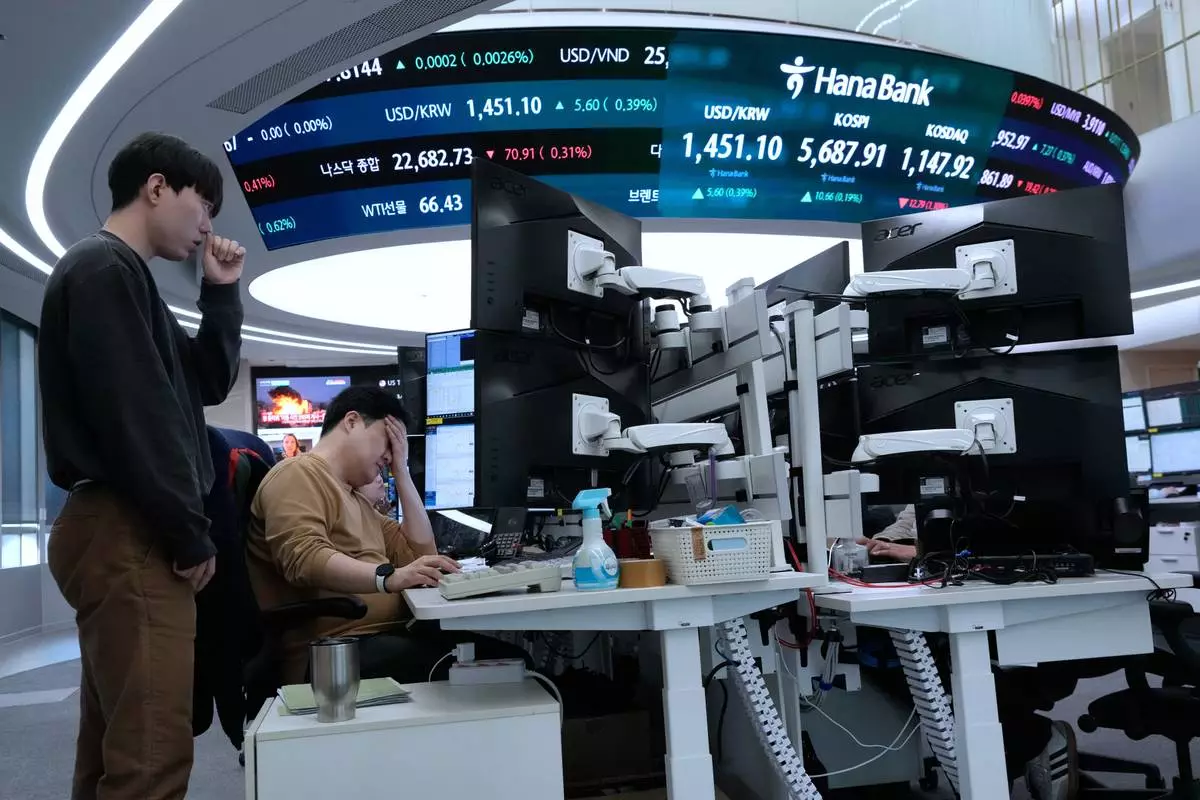
The Hang Seng fell 1.1% after Hong Kong’s market reopened following Lunar New Year holidays, but South Korea’s Kospi jumped 2.3% to a record, led by major defense contractors like Hanwha Aerospace, whose shares soared 8.1%. The company is one of many benefiting from a ramp up in military spending in many countries.

AP Business Writers Matt Ott and Elaine Kurtenbach contributed.

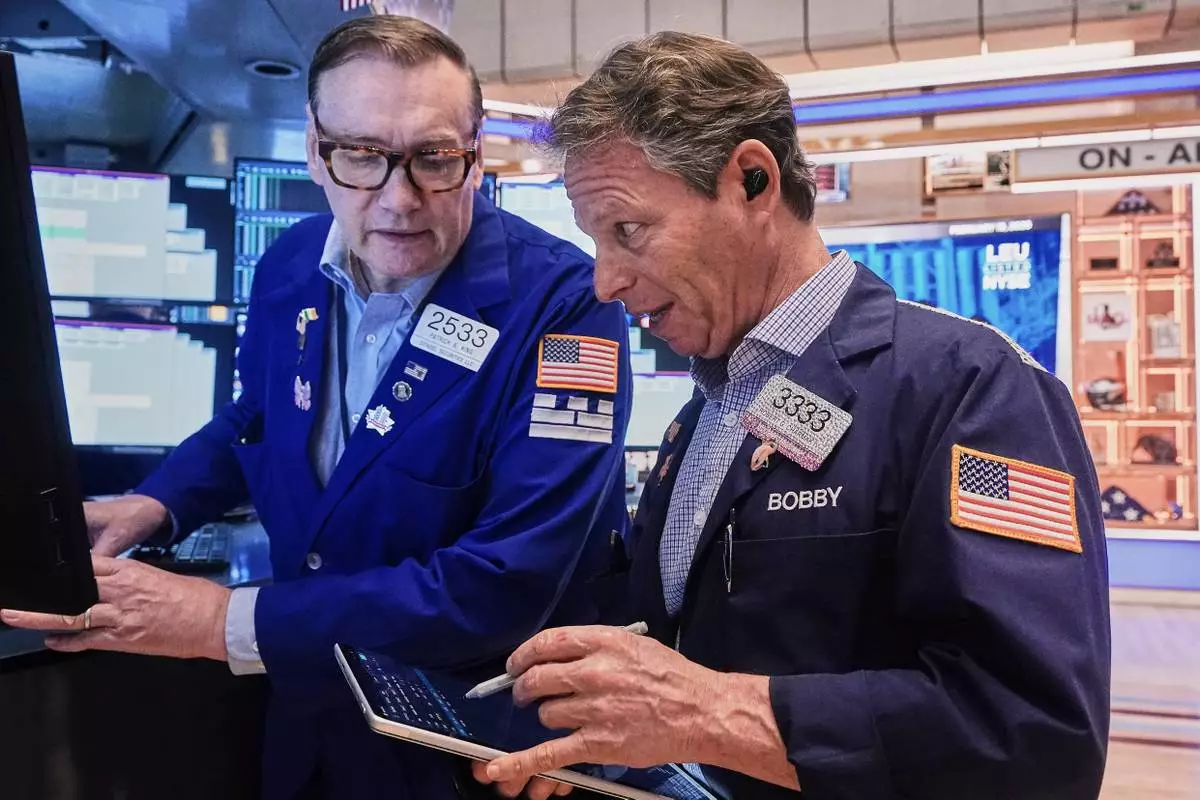
Specialist Patrick King, left, and trader Robert Charmak work on the floor of the New York Stock Exchange, Thursday, Feb. 19, 2026. (AP Photo/Richard Drew)

Specialist Patrick King, left, and trader Robert Charmak work on the floor of the New York Stock Exchange, Thursday, Feb. 19, 2026. (AP Photo/Richard Drew)

Options trader Anthony Spina works on the floor of the New York Stock Exchange, Friday, Feb. 13, 2026, in New York. (AP Photo/Richard Drew)

Options trader Anthony Spina works on the floor of the New York Stock Exchange, Friday, Feb. 13, 2026, in New York. (AP Photo/Richard Drew)

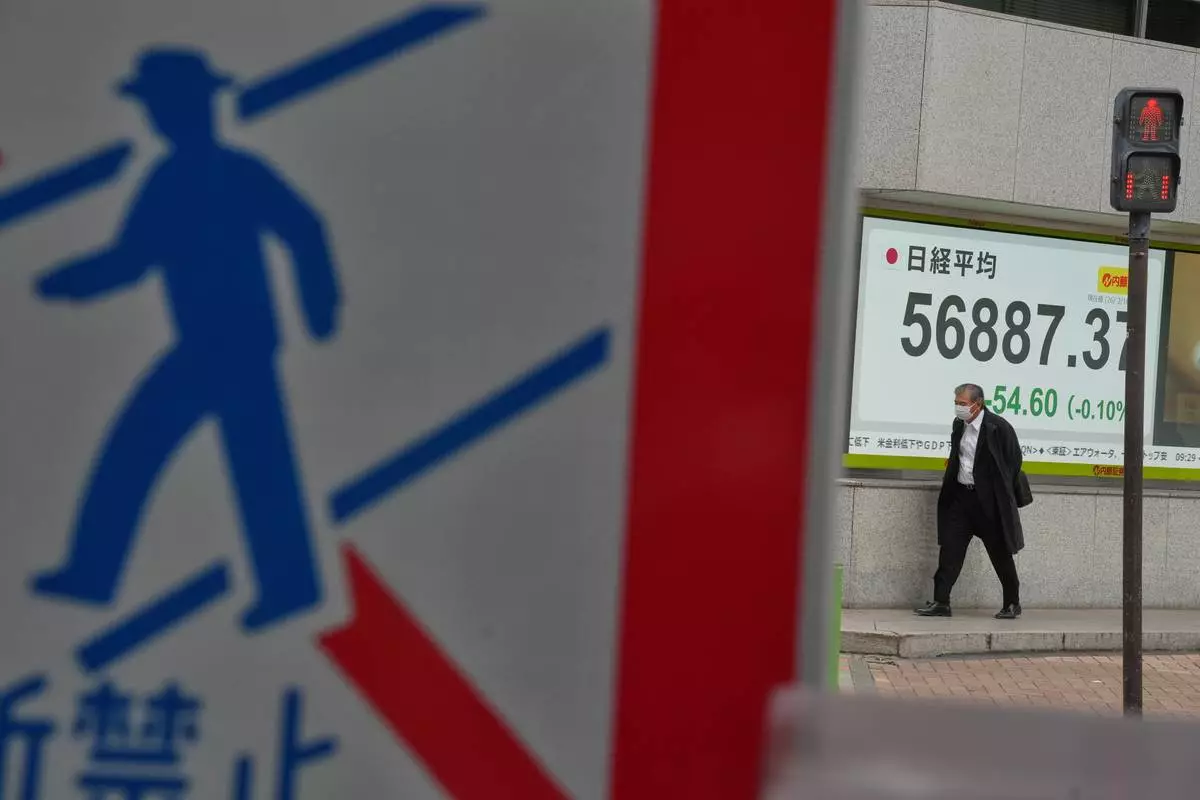
A person walks in front of an electronic stock board showing Japan's Nikkei index at a securities firm Monday, Feb. 16, 2026, in Tokyo. (AP Photo/Eugene Hoshiko)

A person walks in front of an electronic stock board showing Japan's Nikkei index at a securities firm Monday, Feb. 16, 2026, in Tokyo. (AP Photo/Eugene Hoshiko)

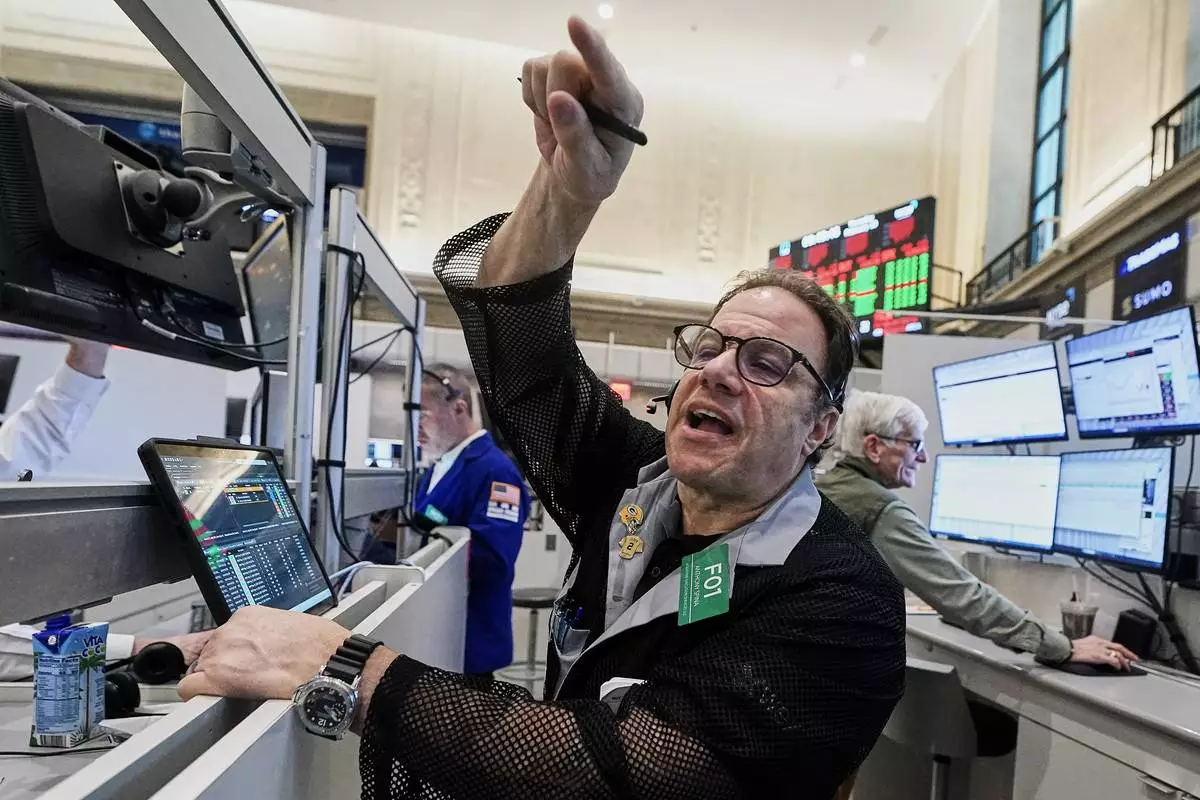
Options trader Anthony Spina works on the floor of the New York Stock Exchange, Thursday, Feb. 19, 2026. (AP Photo/Richard Drew)

Options trader Anthony Spina works on the floor of the New York Stock Exchange, Thursday, Feb. 19, 2026. (AP Photo/Richard Drew)

Currency traders pass by a screen showing the Korea Composite Stock Price Index (KOSPI), right, and the foreign exchange rate between U.S. dollar and South Korean won at the foreign exchange dealing room of the Hana Bank headquarters in Seoul, South Korea, Friday, Feb. 20, 2026. (AP Photo/Ahn Young-joon)

Currency traders pass by a screen showing the Korea Composite Stock Price Index (KOSPI), right, and the foreign exchange rate between U.S. dollar and South Korean won at the foreign exchange dealing room of the Hana Bank headquarters in Seoul, South Korea, Friday, Feb. 20, 2026. (AP Photo/Ahn Young-joon)

Currency traders work near a screen showing the Korea Composite Stock Price Index (KOSPI), right, and the foreign exchange rate between U.S. dollar and South Korean won at the foreign exchange dealing room of the Hana Bank headquarters in Seoul, South Korea, Friday, Feb. 20, 2026. (AP Photo/Ahn Young-joon)

Currency traders work near a screen showing the Korea Composite Stock Price Index (KOSPI), right, and the foreign exchange rate between U.S. dollar and South Korean won at the foreign exchange dealing room of the Hana Bank headquarters in Seoul, South Korea, Friday, Feb. 20, 2026. (AP Photo/Ahn Young-joon)

Currency traders work near a screen showing the Korea Composite Stock Price Index (KOSPI), top center, and the foreign exchange rate between U.S. dollar and South Korean won, top center left, at the foreign exchange dealing room of the Hana Bank headquarters in Seoul, South Korea, Friday, Feb. 20, 2026. (AP Photo/Ahn Young-joon)

Currency traders work near a screen showing the Korea Composite Stock Price Index (KOSPI), top center, and the foreign exchange rate between U.S. dollar and South Korean won, top center left, at the foreign exchange dealing room of the Hana Bank headquarters in Seoul, South Korea, Friday, Feb. 20, 2026. (AP Photo/Ahn Young-joon)

Recommended Articles