The U.S. Supreme Court's tariff ruling will restrain the authority of the U.S. president, but the impact on the global economy still warrants close observation, said a Chinese scholar of international politics on Friday.
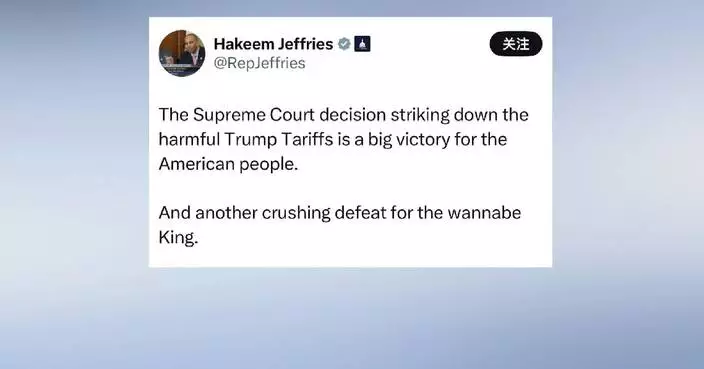
The U.S. Supreme Court ruled on Friday that U.S. President Donald Trump's sweeping tariffs under a law meant for use in national emergencies are illegal. In a 6-3 ruling, the court said that the tariff policies under the International Emergency Economic Powers Act (IEEPA) are unconstitutional, officially striking down the tariffs Trump has introduced since April.
The justices ruled that the president did not have the authority under the IEEPA to impose import tariffs on goods from nearly all U.S. trading partners and the voting upheld that it is the right of Congress to impose taxes, not the president.
"This outcome reflects the reality: the United States' extreme tariff policy harms others as well as itself. It has sparked widespread controversy domestically and further intensified (political) divisions," said Su Xiaohui, an associate research fellow at China Institute of International Studies.
"The deepening polarization once again highlights that this ruling will inevitably have an impact on the U.S. government's tariff war. Many Western media outlets have already described the decision as a heavy blow to Trump's tariff policy. At the same time, it places certain limits on the authority of the U.S. president," she said.
However, the scholar warned that the U.S. government is unlikely to give up easily and may seek alternative means to continue the tariff confrontation.
"Even if it does not rely on domestic laws to impose so-called 'reciprocal tariffs' or other extreme measures, the U.S. government can still use mechanisms such as Section 301 investigations or Section 232 investigations to justify additional tariffs. Therefore, although this ruling clearly opposes the administration's tariff approach and seeks to restrain the president's use of power, significant negative factors remain within the U.S. trade policy. The impact on the global economy still warrants close observation," Su said.

Impact on global economy warrants close observation after US Supreme Court ruling: expert

Impact on global economy warrants close observation after US Supreme Court ruling: expert