MILAN (AP) — Jorrit Bergsma spread his arms wide down the backstretch of speedskating's mass start event at the Milan Cortina Games. He blew kisses to the loud Dutch fans shouting in their orange outfits and wearing their mullet wigs to match his hairstyle. He even applauded right back at them.
Bergsma was so far ahead of everyone else Saturday that he was able to really enjoy and celebrate becoming, at 40, by far the oldest long track speedskating gold medalist in Olympic history.
Click to Gallery
Gold medallist Metodej Jilek of Czechia, center, celebrates on the podium with Vladimir Semirunniy of Poland, left and silver medal, and Jorrit Bergsma of the Netherlands, right and bronze medal, after the men's 10,000 meters speedskating race at the 2026 Winter Olympics, in Milan, Italy, Friday, Feb. 13, 2026. (AP Photo/Luca Bruno)
Gold medallist Jorrit Bergsma of the Netherlands celebrates winning the men's mass start final speedskating race at the 2026 Winter Olympics, in Milan, Italy, Saturday, Feb. 21, 2026. (AP Photo/Ben Curtis)
Dutch coach Jillert Anema wears a mullet honouring the bronze medal of Jorrit Bergsma of the Netherlands after the men's 10,000 meters speedskating race at the 2026 Winter Olympics, in Milan, Italy, Friday, Feb. 13, 2026. (AP Photo/Ben Curtis)
Gold medallist Metodej Jilek of Czechia, center, celebrates on the podium with Vladimir Semirunniy of Poland, left and silver medal, and Jorrit Bergsma of the Netherlands, right and bronze medal, after the men's 10,000 meters speedskating race at the 2026 Winter Olympics, in Milan, Italy, Friday, Feb. 13, 2026. (AP Photo/Luca Bruno)
Jorrit Bergsma of the Netherlands celebrates winning the bronze medal in the men's 10,000 meters speedskating race at the 2026 Winter Olympics, in Milan, Italy, Friday, Feb. 13, 2026. (AP Photo/Ben Curtis)
“Unbelievable. Unbelievable,” Bergsma said later, his medal hanging from his neck. “I’m a 40-year-old guy. ... It is crazy. This one was really unexpected.”
The oldest previous Olympic champion in long track was Ireen Wust, who was 35 when she won the 1,500 meters for Netherlands at the 2022 Beijing Games. The record for oldest man had stood for nearly a century: It belonged to Clas Thunberg, who was 34 when he won the 1,500 for Finland at the 1928 St. Moritz Olympics.
“It's super incredible,” said Jordan Stolz, the 21-year-old American who is about half of Bergsma's age and finished fourth Saturday after collecting two golds and a silver earlier in Milan. "He’s super nice, super relaxed."
Stolz's coach, Bob Corby, called Bergsma's performance “pretty phenomenal.”
Stolz was surprised none of the other racers back in the main pack during the 16-lap race wanted to try to chase down Bergsma, who took a big early lead with eventual silver medalist Viktor Hald Thorup of Denmark.
Bergsma was pretty stunned, too.
After that duo had pulled away, Bergsma easily skated away from Thorup.
“I knew ... this final is going to be a tough one. It’s going to be a tough cookie. Nobody wanted to do the first move, so I did it,” said Bergsma, this season's World Cup champion in the mass start. “I didn’t expect it. Nobody responded. Nobody wanted to close the gap for each other. I’m still mind blown that I won the gold medal here today.”
This title comes a dozen years after he won the gold in the 10,000 meters and a bronze in the 5,000 at the 2014 Sochi Olympics. His career haul also includes a silver in the 10,000 in 2018, and a bronze at that distance this time.
Other racers were impressed to see him get this medal at this age.
Mia Manganello, the 36-year-old American who took bronze in the women's mass start behind Marijke Goenewoud of the Netherlands, joked after what she had said would be the final race of her career that she didn't want anyone to mention to her coach that Bergsma just showed what can be done at 40.
“So well-deserved. He's a great racer, a great competitor,” Manganello said. “It shows this sport has a lot of maturity and the longevity of it.”
AP Sports Writer Daniella Matar contributed to this report.
AP Winter Olympics: https://apnews.com/hub/milan-cortina-2026-winter-olympics

Gold medallist Jorrit Bergsma of the Netherlands celebrates winning the men's mass start final speedskating race at the 2026 Winter Olympics, in Milan, Italy, Saturday, Feb. 21, 2026. (AP Photo/Ben Curtis)

Dutch coach Jillert Anema wears a mullet honouring the bronze medal of Jorrit Bergsma of the Netherlands after the men's 10,000 meters speedskating race at the 2026 Winter Olympics, in Milan, Italy, Friday, Feb. 13, 2026. (AP Photo/Ben Curtis)

Gold medallist Metodej Jilek of Czechia, center, celebrates on the podium with Vladimir Semirunniy of Poland, left and silver medal, and Jorrit Bergsma of the Netherlands, right and bronze medal, after the men's 10,000 meters speedskating race at the 2026 Winter Olympics, in Milan, Italy, Friday, Feb. 13, 2026. (AP Photo/Luca Bruno)

Jorrit Bergsma of the Netherlands celebrates winning the bronze medal in the men's 10,000 meters speedskating race at the 2026 Winter Olympics, in Milan, Italy, Friday, Feb. 13, 2026. (AP Photo/Ben Curtis)
The Virginia Supreme Court on Friday struck down a voter-approved Democratic congressional redistricting plan, delivering another major setback to the party in a nationwide battle against Republicans for an edge in this year's midterm elections.
The court ruled 4-3 that the state's Democratic-led legislature violated procedural requirements when it placed the constitutional amendment on the ballot to authorize the mid-decade redistricting. Voters narrowly approved the amendment April 21, but the court's ruling renders the results of that vote meaningless.
Writing for the majority, Justice D. Arthur Kelsey wrote that the legislature submitted the proposed constitutional amendment to voters “in an unprecedented manner.”
“This violation irreparably undermines the integrity of the resulting referendum vote and renders it null and void," he wrote.
Democrats had hoped to win as many as four additional U.S. House seats under Virginia's redrawn U.S. House map as part of an attempt to offset Republican redistricting done elsewhere at the urging of President Donald Trump. That ruling, combined with a recent U.S. Supreme Court decision severely weakening the Voting Rights Act, has supercharged the Republicans' congressional gerrymandering advantage heading into this year's midterm elections.
Richard Hudson, chairman of the National Republican Congressional Committee said the ruling was another sign of GOP momentum heading into the midterms.
"We’re on offense, and we’re going to win,” he said in a statement.
Don Scott, the Democratic speaker of the Virginia House of Delegates, said Democrats respect the court’s opinion but lamented that it overturned the will of the voters: “They voted YES because they wanted to fight back against the Trump power grab.”
Suzan DelBene, chairwoman of the Democratic Congressional Campaign Committee, criticized the court majority for what she said was a decision that “cast aside the will of the voters,” but she said the people will have the final say.
“In November, they will, and they’ll power Democrats to the House majority,” she said in a statement.
Legislative voting districts typically are redrawn once a decade after each census to account for population changes. But Trump started an unusual flurry of mid-decade redistricting last year when he encouraged Republican officials in Texas to redraw districts in a bid to win several additional U.S. House seats and hold on to their party's narrow majority in the midterm elections.
California responded with new voter-approved districts drawn to Democrats' advantage, and Utah's top court imposed a new congressional map that also helps Democrats. Meanwhile, Republicans stand to gain from new House districts passed in Florida, Missouri, North Carolina, Ohio and Tennessee. They could add even more after the U.S. Supreme Court's ruling in the Voting Rights Act case, which has prompted some other Republican states to consider redrawing their maps in time for this year’s elections.
Virginia currently is represented in the U.S. House by six Democrats and five Republicans who were elected from districts imposed by a court after a bipartisan redistricting commission failed to agree on a map after the 2020 census. The new districts could have given Democrats an improved chance to win all but one of the state's 11 congressional seats.
The Supreme Court's majority was critical of the state’s redrawing of the congressional maps to benefit one political party. Those justices noted that 47% of the state’s voters supported GOP congressional candidates in 2024 but the new map could result in Democrats making up 91% of the state’s House delegation.
Under the Democratic-drawn map, five districts would have been anchored in the Democratic stronghold of northern Virginia, including one stretching out like a lobster to consume Republican-leaning rural areas. Revisions to four other districts across Richmond, southern Virginia and Hampton Roads would have diluted the voting power of conservative blocs in those areas. And a reshaped district in parts of western Virginia would have lumped together three Democratic-leaning college towns to offset other Republican voters.
The state Supreme Court’s seven justices are appointed by the state legislature, which has toggled back and forth between Democratic, Republican and split control over recent years. Legal experts say the body doesn’t have a set ideological profile
The case before the court focused not on the shape of the new districts but rather on the process the General Assembly used to authorize them.
Because the state’s redistricting commission was established by a voter-approved constitutional amendment, lawmakers had to propose an amendment to redraw the districts. That required approval of a resolution in two separate legislative sessions, with a state election sandwiched in between, to place the amendment on the ballot.
The legislature’s initial approval of the amendment occurred last October — while early voting was underway but before it concluded on the day of the general election. The legislature’s second vote on the amendment occurred after a new legislative session began in January. Lawmakers also approved a separate bill in February laying out the new districts, subject to voter approval of the constitutional amendment.
Judicial arguments focused on whether the legislature’s initial approval of the amendment came too late, because early voting already had begun for the 2025 general election.
Attorney Matthew Seligman, who defended the legislature, argued that the “election” should be defined narrowly to mean the Tuesday of the general election. In that case, the legislature’s first vote on the redistricting amendment occurred before the election and was constitutional, he told judges.
But, the Supreme Court said in its ruling, “this view appears to be wholly unprecedented in Virginia’s history.”
An attorney for the plaintiffs, Thomas McCarthy, argued that an “election” should be interpreted to cover the entire period during which people can cast ballots, which lasts several weeks in Virginia. If that’s the case, he told justices, then the legislature’s initial endorsement of the redistricting amendment came too late to comply with the state constitution.
The Supreme Court agreed with that argument, writing: “The General Assembly passed the proposed constitutional amendment for the first time well after voters had begun casting ballots during the 2025 general election.”
By the time lawmakers initially endorsed the constitutional amendment, statewide voters already had cast more than 1.3 million ballots in the general election, about 40% of the total votes ultimately cast, the court said.
The Supreme Court’s ruling affirms a decision by a judge in rural Tazewell County, in southwestern Virginia. The court had placed a hold on that ruling and allowed the redistricting vote to proceed before hearing arguments on the case.
In the dissent to Friday's ruling, Chief Justice Cleo Powell said the election for the purpose of considering the amendment does not include the early voting period.
“The majority’s definition creates an infinite voting loop that appears to have no established beginning,” she wrote, “only a definitive end: Election Day.”
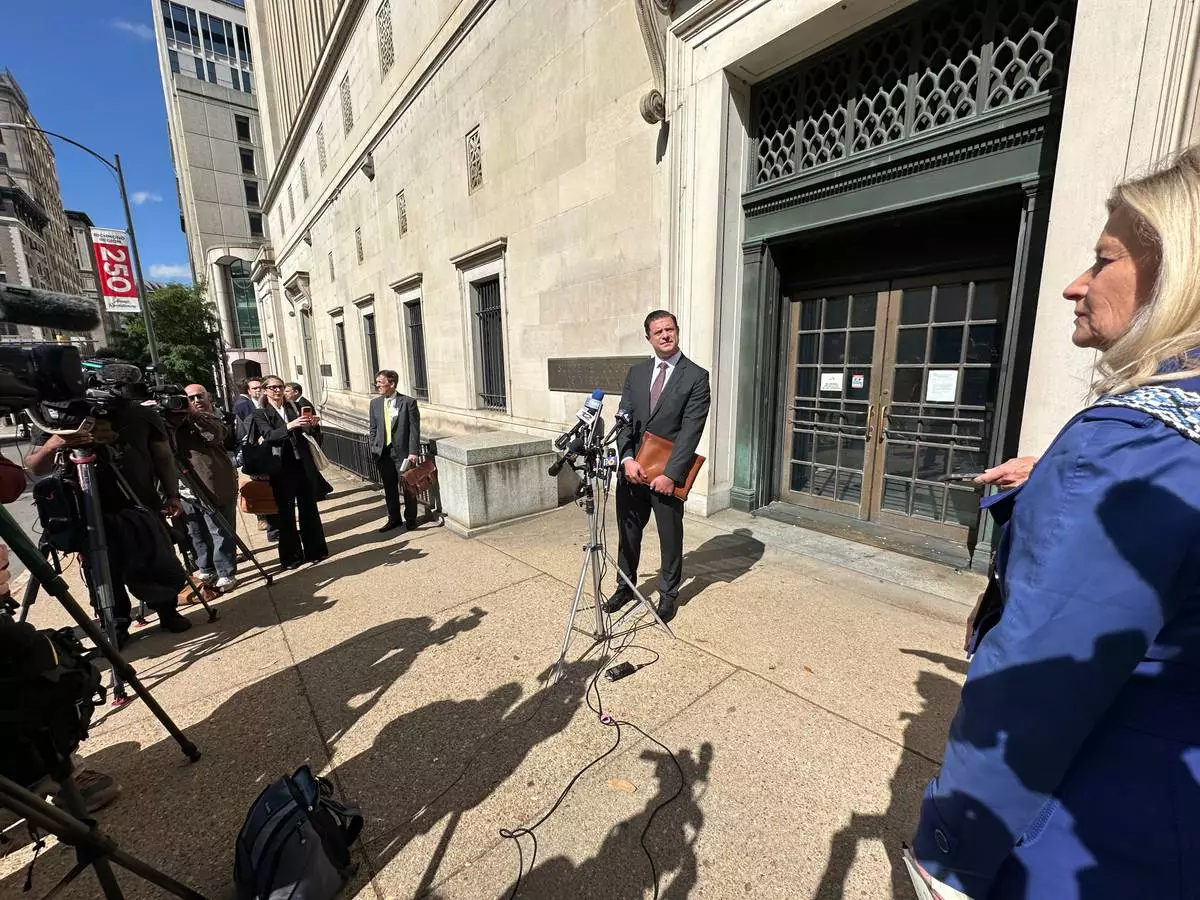
Attorney Matthew Seligman, representing Democratic state legislators, speaks with the media following a hearing on new congressional maps before the state Supreme Court in Richmond, Va., on Monday, April 27, 2026. (AP Photo/Allen G. Breed)
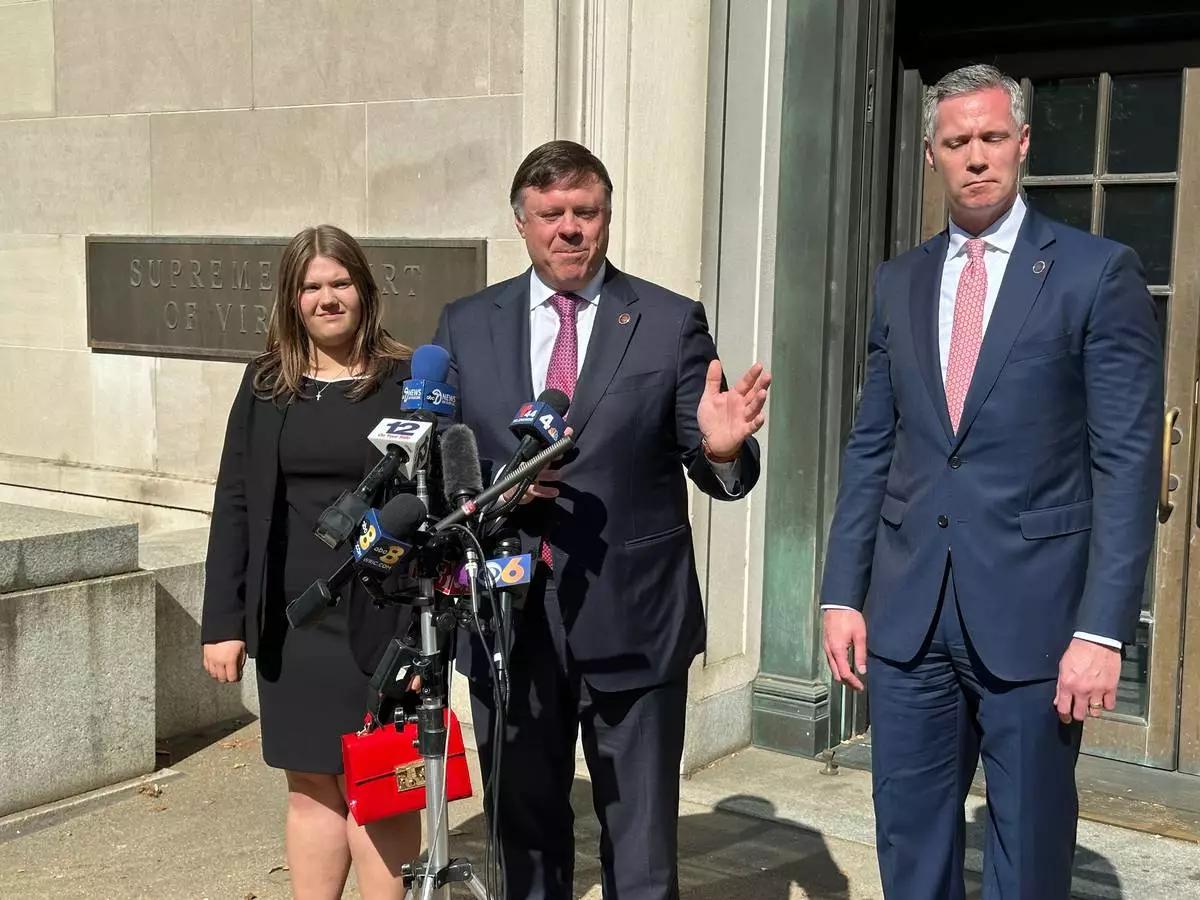
State Senate Minority Leader Ryan McDougle, center, speaks outside the Supreme Court of Virginia after arguments were heard in a redistricting-related case at the court in Richmond, Va., on Monday, April 27, 2026. (AP Photo/Allen G. Breed)