HOUSTON--(BUSINESS WIRE)--Feb 23, 2026--
Starlab Space LLC, developer of a next-generation commercial space station, has successfully completed its Commercial Critical Design Review (CCDR) with NASA in attendance, marking a decisive transition from design to manufacturing and systems integration. The CCDR data supports the 28th milestone on the NASA Commercial LEO Destinations Space Act Agreement.
This press release features multimedia. View the full release here: https://www.businesswire.com/news/home/20260223423078/en/
The milestone confirms that Starlab’s architecture, safety approach and performance requirements are technically mature, integrated and executable, allowing the program to move beyond design validation and fully into fabrication, testing and assembly.
In parallel with the technical review, Starlab completed a review of the business plan and business model, validating the commercial intent underpinning the Commercial LEO Destinations (CLD) program. The business plan substantiates a sustainable, robust revenue model, demonstrates ISS-equivalent payload and crew capabilities, and confirms Starlab is being developed as a market-driven platform rather than a government-dependent asset.
“Completing CCDR is a critical step in delivering continuous access to low Earth orbit, with no gap in capability to science, industry or national interests,” said Marshall Smith, CEO of Starlab. “This confirms Starlab is executable at scale and that our timeline aligns with ISS transition requirements. Equally important, our CCDR business plan review demonstrates that Starlab is being built around a real, diversified commercial market – one that supports sustained human presence and research in low Earth orbit.”
This achievement reflects years of disciplined engineering, close coordination with NASA, ESA, and JAXA, and strong collaboration across a global team, including Voyager Technologies, Airbus, Mitsubishi Corporation, MDA Space, Palantir Technologies, and Space Applications Services. It validates both Starlab’s technical maturity and the credibility of the underlying business case.
About Starlab
Starlab Space is a U.S.-led, global joint venture among Voyager Technologies (NYSE: VOYG), Airbus, Mitsubishi Corporation, MDA Space, Palantir Technologies, and Space Applications Services, with strategic partners including Hilton, Journey, Northrop Grumman, and The Ohio State University. Starlab is developing a next-generation, AI-enabled commercial space station, aiming to ensure continued human presence in low-Earth orbit and a seamless transition of microgravity science and research alongside the retirement of the International Space Station. Starlab's advanced, user-driven design and robust capabilities make it a premier platform for scientific discovery and technological advancement in space. For more information, visit starlab-space.com.

Starlab Space, developer of a next-generation commercial space station, has successfully completed its Commercial Critical Design Review, allowing the program to move beyond design validation and fully into fabrication, testing and assembly. The milestone further positions Starlab to maintain continuity of human presence and research in low Earth orbit.
DURBAN, South Africa (AP) — The Proteas would of course love Kagiso Rabada to be slinging thunderbolts at Kingsmead on Friday, the first day of Australia’s first test cricket series in South Africa since the “ Sandpapergate ” scandal in 2018.
Because of a hamstring injury, South Africa's premier fast bowler hasn't played since May. Rabada has been in the nets lately but the Proteas are leaving it as late as possible to green-light him.
They also say they won't push him. Not with eight home tests between now and January and 10 left in this World Test Championship cycle for the defending champion.
And if there's one thing about South Africa's national cricket team, it's the trust in its entire squad to cope with setbacks and excel. Selections from out of the blue have constantly risen to the occasion.
Medium-pacer Dane Paterson, out of the test side for four years, helped them qualify for the 2025 WTC final. Lungi Ngidi, out of red-ball cricket for 10 months, then helped them win that final against 2023 champion Australia at Lord's.
Inspired by the victory, offspinner Simon Harmer made himself available at the age of 37, and took 30 wickets late last year to help South Africa win in Pakistan for the first time in 18 years and win a series in India for the first time in 25 years.
“It feels like every time we win it's somebody else putting up their hand,” Harmer said on Wednesday. “There's not this reliance on certain individuals.”
For their first test series of the year, and their first at home in nearly two years, the Proteas have summoned pacers Anrich Nortje and Gerald Coetzee, who haven't played a test since 2023 and 2024 respectively.
They have a decent chance of making the XI with Rabada doubtful and Ngidi, Kwena Maphaka and Ottneil Baartman out of the series injured. Another bad hamstring ruled out Tony de Zorzi from the first test, giving hope of a debut at his home ground for Marques Ackerman, who will vie for the No. 3 batting spot with Tristan Stubbs, Wiaan Mulder and David Bedingham.
There's talk the pitch — which offered lots of spin in the ODI two weeks ago — may persuade South Africa to play two spinners, Harmer with Keshav Maharaj.
A turning pitch would help the prospects of a stunning Australia comeback for batter Nic Maddinson, who played three tests in 2016 then was dropped. He resurrected himself in a risky move to another state in domestic cricket and overcame testicular cancer that spread to his abdomen and lung in 2025. He hasn't played a first-class game since March 2025 but was sensationally added to the test squad last week.
Unlike 10 years ago, though, Maddinson isn't daunted or feeling out of place.
However, Australia great Matthew Hayden this week blasted the selectors for “disrespecting first-class cricket” by picking the 34-year-old Maddinson.
On Wednesday, vice-captain Travis Head, without referencing players or comments, took issue with commentary by former players, accusing them of being unfair in “putting a bullet through” current players. Head said the game has changed significantly since they played.
Another certainty is allrounder Cameron Green won't play in the first test, ruled out by an abdominal strain during the third ODI a week ago. If he were to return for the other two tests, he won't bowl, coach Andrew McDonald has said.
But it's Green's batting that will likely be missed more. He was the leading run-scorer in the drawn series with Bangladesh in August.
Australia won the first of an acrimonious four-test series here in 2018, and South Africa won the second. The third test will long be rememebred for what became known as the “Sandpapergate” fiasco that rocked Australian cricket and set South Africa on course for a 3-1 series win.
Steve Smith and David Warner — then the captain and vice-captain — were each suspended for a year by Cricket Australia and opener Cameron Bancroft was banned for nine months after South African broadcasters caught an attempt at ball tampering in the Cape Town match. Bancroft was caught trying to scratch the surface of the ball to make it more favorable for Australia’s bowlers. Smith and Warner returned to re-establish their test careers. Smith is still in the test lineup.
After Durban, the other tests are in Gqeberha from Oct. 18-22 and in Cape Town from Oct. 27-31.
See AP’s full cricket coverage here
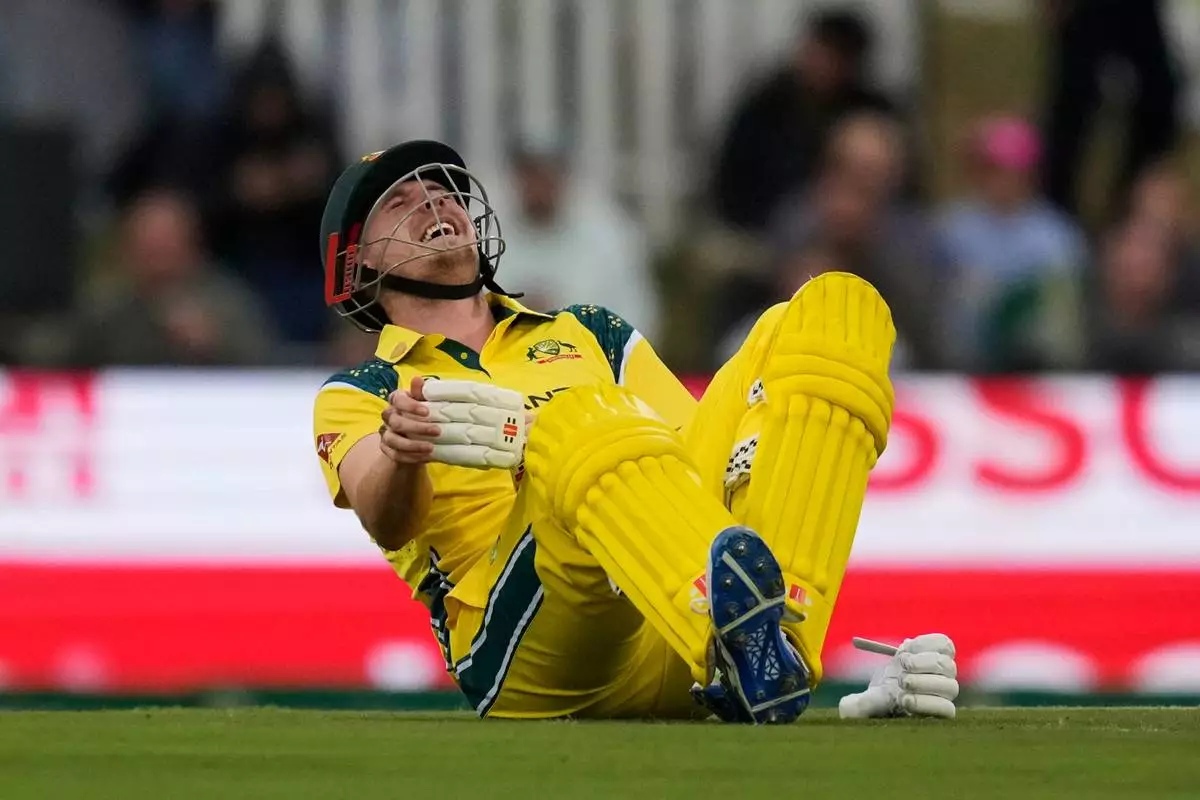
Australia's Cameron Green reacts after being hit by a ball during the third one day international cricket match between South Africa and Australia, in Potchefstroom, South Africa, Wednesday, Sept. 30, 2026. (AP Photo/Themba Hadebe)

South Africa's bowler Gerald Coetzee celebrates after dismissing Australia's batsman Matt Renshaw during the first one day international cricket match between South Africa and Australia, in Durban, South Africa, Thursday, Sept. 24, 2026. (AP Photo/Themba Hadebe)