WASHINGTON (AP) — A federal judge on Monday permanently barred the release of a report by special counsel Jack Smith on his investigation into President Donald Trump’s hoarding of classified documents, a prosecution that was once seen as the most perilous of the four criminal cases the Republican faced.
U.S. District Judge Aileen Cannon, who was nominated to the bench by Trump, granted a request from the president to keep under wraps the report on an investigation alleging that Trump stored sensitive documents at his Mar-a-Lago estate after he left the White House following his first term and that he obstructed government efforts to get them back.
Smith and his team produced a two-volume report on the classified documents investigation and a separate probe into Trump’s efforts to overturn the 2020 presidential election after he lost to Democrat Joe Biden. Both investigations produced indictments that were abandoned by Smith’s team after Trump’s November 2024 election win in light of longstanding Justice Department legal opinions that say sitting presidents cannot face federal prosecution.
Attorney General Pam Bondi had already determined that the report was “an internal deliberative communication that is privileged and confidential and should not be released” outside the Justice Department, according to court papers. The Trump administration has characterized Smith's investigation as politically motivated and said in recent court papers that the report belongs in the “dustbin of history."
Cannon's order blocking the release also applies to Bondi's successors at the Justice Department. Cannon, who in 2024 dismissed the case after concluding that Smith was unlawfully appointed after multiple other favorable rulings for Trump, said the release of the report would present a “manifest injustice” to the president and his two co-defendants.
“Special Counsel Smith, acting without lawful authority, obtained an indictment in this action and initiated proceedings that resulted in a final order of dismissal of all charges,” she wrote. “As a result, the former defendants in this case, like any other defendant in this situation, still enjoy the presumption of innocence held sacrosanct in our constitutional order.”
A First Amendment group and a watchdog organization have been pressing for the report's release.
Chioma Chukwu, executive director of American Oversight, said it "will continue using every tool available to force this information into the open and to defend the public’s right to the truth through the release of this report.”
Scott Wilkens, senior counsel at The Knight First Amendment Institute at Columbia University — another group pushing for the report's public release — said “there is no legitimate basis for its continued suppression.”
“Judge Cannon’s decision to permanently block the release of this extraordinarily significant report is impossible to square with the First Amendment and the common law,” Wilkens said in an emailed statement.
A lawyer for Trump, Kendra Wharton, praised Cannon's ruling, saying in a statement that Smith was unconstitutionally appointed and that his report “should never see the light of day.”
Cannon wrote that though it is true that special counsels have historically released reports at the conclusion of their work, they have done so either after electing not to bring charges in a particular case or “after adjudications of guilt by plea or trial." Though Cannon suggested that an adjudication of guilt typically precedes the release of a special counsel report, there have been instances in which defendants charged by a special counsel have been acquitted at trial and the allegations against them have nonetheless been subsequently rehashed in a publicly released report.
The classified documents case was once considered the most serious of the four criminal cases against him. It accused Trump of repeatedly enlisting aides and lawyers to help him hide records demanded by investigators and cavalierly showing off a Pentagon “plan of attack” and classified map.
The first volume of Smith’s report on Trump’s 2020 election interference case was released last year shortly before Trump returned to the White House. Smith has defended his decision to bring those charges, saying he believes they would have resulted in a conviction had voters not elected Trump in 2024.
Cannon last year granted a defense request to at least temporarily halt the release of the report dealing with the classified documents case. That edict meant that Smith could not discuss the substance of that investigation when he testified last month before the House Judiciary Committee.
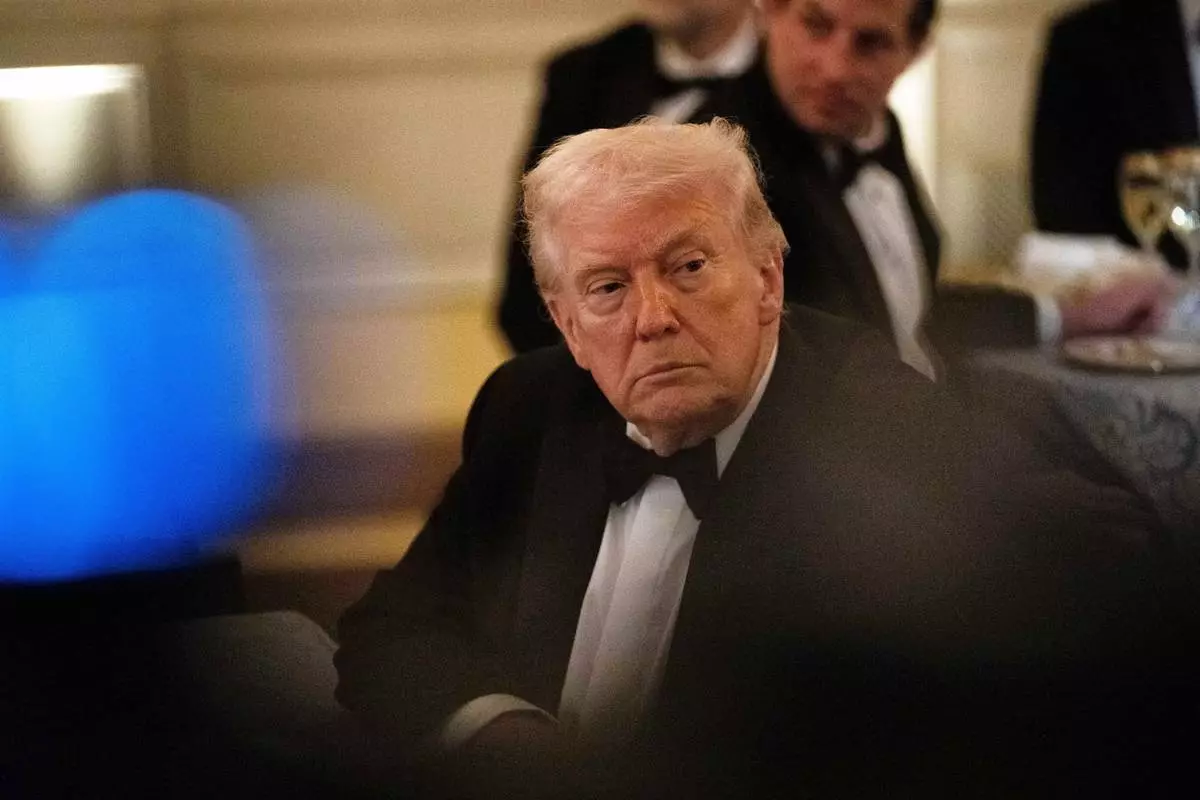
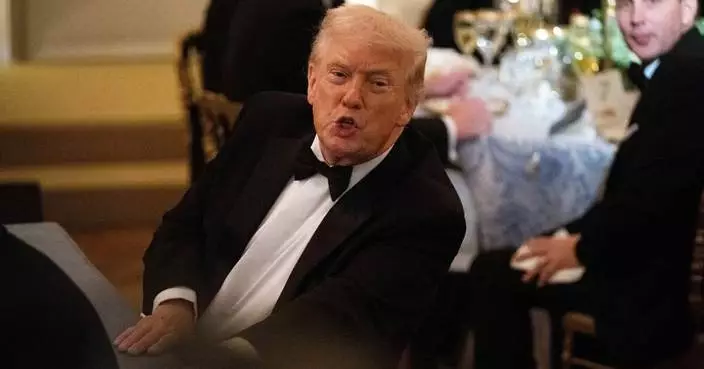
President Donald Trump attends the National Governors Association dinner at the White House, Saturday, Feb. 21, 2026, in Washington. (AP Photo/Allison Robbert)
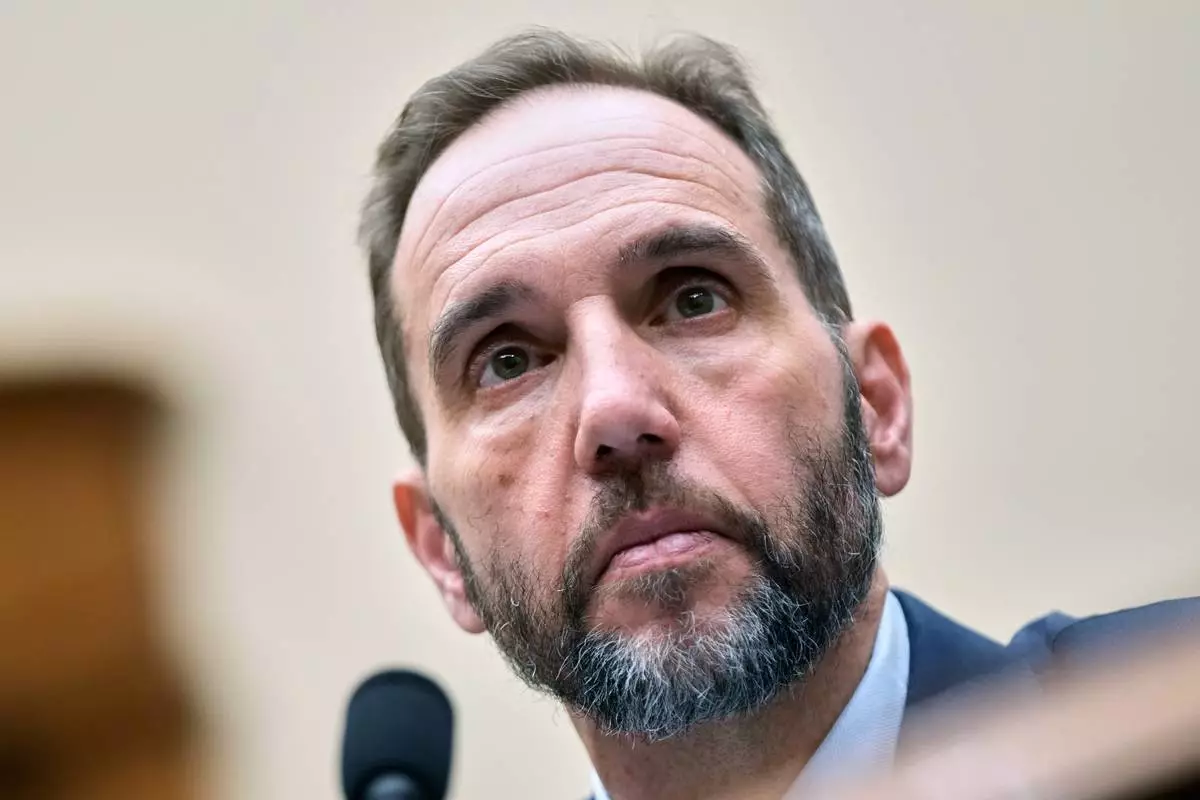
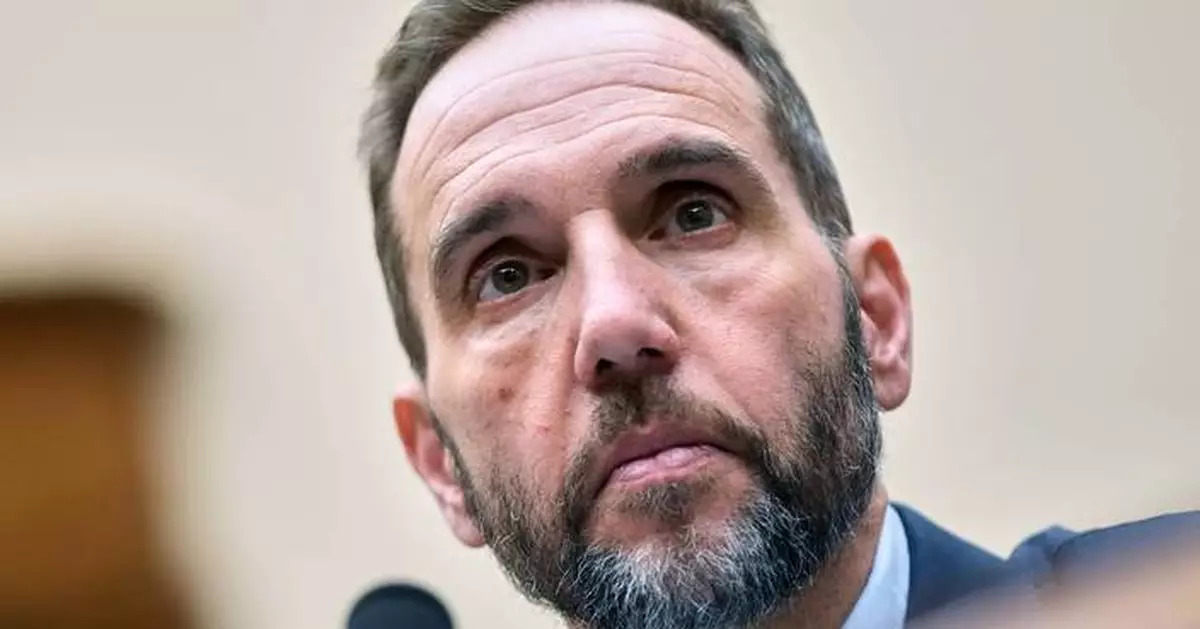
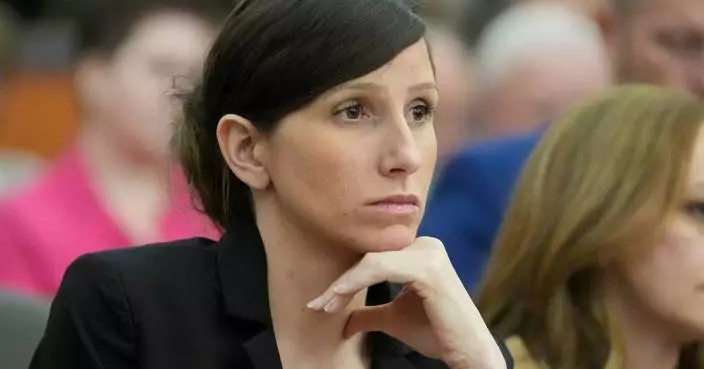
FILE - Former Justice Department special counsel Jack Smith testifies before the House Judiciary Committee at the Capitol in Washington, Jan. 22, 2026. (AP Photo/Mark Schiefelbein, File)
GENEVA (AP) — A U.S. official focusing on arms control on Monday provided what he called new, declassified details of a Chinese underground nuclear test nearly six years ago and urged countries to press China and Russia to do more on nuclear disarmament.
Christopher Yeaw, assistant secretary of state for the bureau of arms control and nonproliferation, spoke to a U.N.-backed body after the last nuclear arms pact between the United States and Russia expired this month. That has ended limits on the arsenals of the world’s biggest nuclear powers and raised concerns about a possible new arms race.
Yeaw called for greater transparency from China and pointed to some shortcomings of the New START treaty, such as that it didn't address Russia's large arsenal of nonstrategic nuclear weapons — which counts up to 2,000 warheads.
“But perhaps its greatest flaw was that New START did not account for the unprecedented, deliberate, rapid and opaque nuclear weapons buildup by China,” he told the U.N.-backed Conference on Disarmament.
Yeaw said Beijing “has deliberately, and without constraint, massively expanded its nuclear arsenal” despite its assurances to the contrary. He lamented a lack of transparency about China's “endpoint” or goals.
“We believe China may achieve parity within the next four or five years,” he said.
Beijing has balked at any restrictions on its smaller but growing nuclear arsenal and denies carrying out such a nuclear test.
Yeaw met Monday with a Russian delegation and was to meet with Chinese and other delegations Tuesday in Geneva. U.S. officials have already held repeated meetings with partners, including nuclear-armed France and Britain.
In his speech, Yeaw cited an explosion detected at the Lop Nur underground site in western China as a magnitude 2.75 seismic event on June 22, 2020, based on information collected from an international monitoring system station in neighboring Kazakhstan.
“It was a probable explosion based upon comparisons between historic explosions and earthquakes,” he said. “The seismic signals were indicative of a single fire explosion, not typical of mining explosions.”
Yeaw said China has made it “difficult” for the international community to monitor its testing activities and that during talks, it rejected allowing seismic testing stations to be put at a comparable distance to Lop Nur that the U.S. allows near its test site in Nevada.
China's ambassador to the conference said Monday that Beijing “resolutely rejects the unfounded accusations” by the U.S. and lashed out at “continued distortion and smearing of China’s nuclear policy by certain countries.”
“The U.S. accusation that China conducted a nuclear explosion test is completely unfounded and is merely a pretext for resuming its own nuclear testing,” Ambassador Jian Shen said. “The U.S.’s practice of smearing other countries to evade international arms control obligations seriously damages its own international standing.”
President Donald Trump in October pointed to U.S. intentions to resume nuclear tests for the first time since 1992, but Energy Secretary Chris Wright later said such tests would not include nuclear explosions.
In his first term, Trump tried and failed to push for a three-way nuclear pact involving China.
Just after the New START pact expired, Secretary of State Marco Rubio said the U.S. was “pursuing all avenues” to fulfill Trump’s “desire for a world with fewer of these awful weapons,” but insisted Washington would not stand still while Russia and China expand their nuclear forces.
“Since 2020, China has increased its nuclear weapons stockpile from the low 200s to more than 600 and is on pace to have more than 1,000 warheads by 2030,” Rubio wrote on Substack this month.
The U.S. has expressed a willingness to pursue multiple diplomatic avenues over the issue — whether bilateral, in a small group of countries or in broader multilateral talks.
“We are looking to all of you to help encourage nuclear-weapon states like China and Russia to engage meaningfully in a multilateral process,” Yeam told the conference, which brings together some 65 countries on issues like nuclear, biological and chemical weapons.
Shen said China has consistently supported the goals of the Comprehensive Nuclear Test Ban Treaty, “always adhered” to the commitments of the five nuclear weapons states to suspend nuclear testing and “never” engaged in activities that violate the treaty.
He also suggested Beijing, which has been on a vigorous military buildup in recent years, still has fewer nuclear weapons than the U.S. or Russia and said it was “unfair, unreasonable and unfeasible” to demand China engage in three-way nuclear arms control talks.
“China’s nuclear arsenal is not on the same scale as the country with the largest nuclear arsenal, and the strategic security environment faced by China’s nuclear policy is completely different from that of the U.S.,” Shen said.
Associated Press writer Didi Tang in Washington contributed to this report.
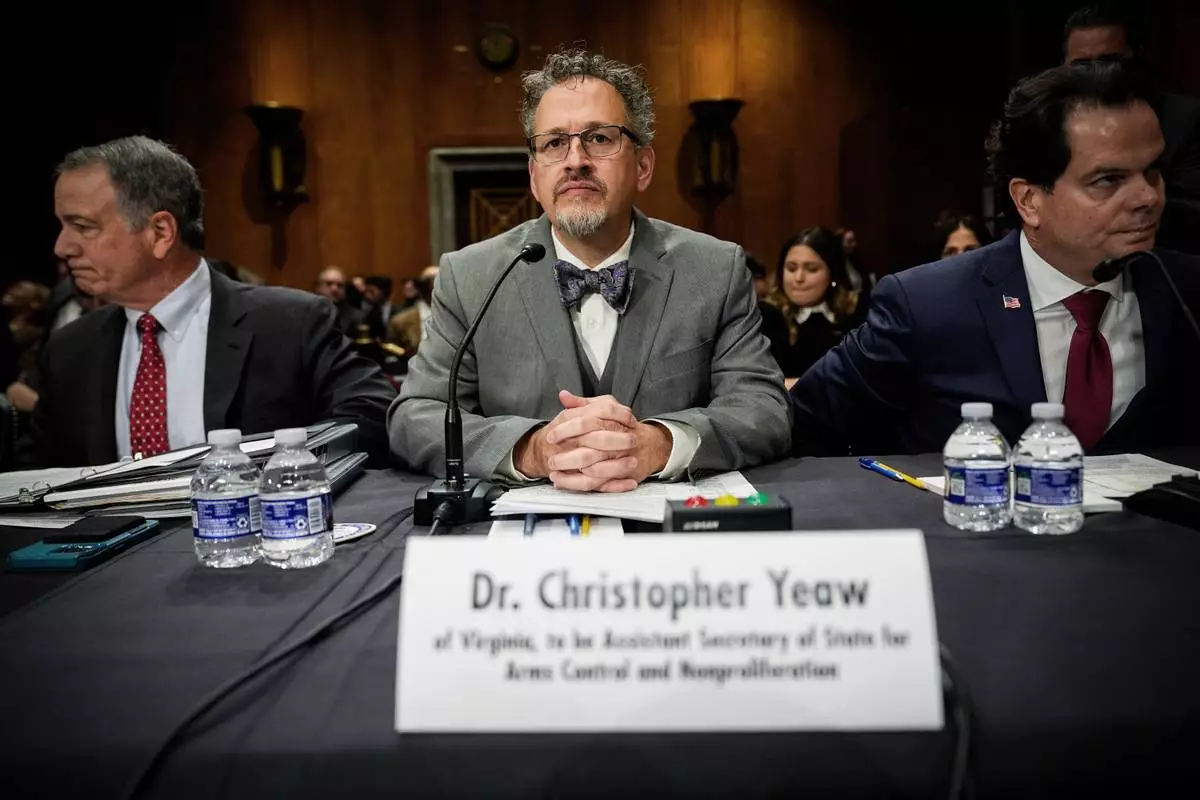
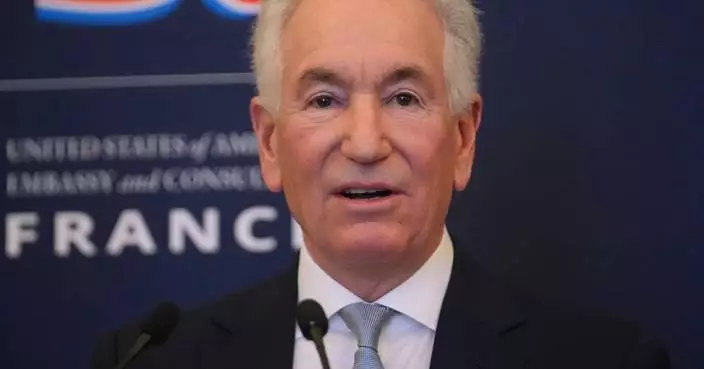
FILE - Christopher Yeaw, center, arrives to a Senate Foreign Relations Committee confirmation hearing on his nomination to be an assistant Secretary of State, Nov. 19, 2025, on Capitol Hill in Washington. (AP Photo/Julia Demaree Nikhinson, File)