VAIL, Colo. (AP) — American skier Lindsey Vonn says she nearly lost her left leg following a frightening crash in the women’s downhill at the Milan Cortina Olympics.
Vonn shared in an Instagram post on Monday that her injuries went far beyond the complex tibia fracture in the leg she initially revealed after clipping a gate and sailing off course just 13 seconds into her run on Feb. 8.
The 41-year-old Vonn said the trauma from the crash led to compartment syndrome in the leg. Compartment syndrome involves excessive pressure building up inside a muscle, either from bleeding or swelling. High pressure restricts blood flow and can lead to permanent injury if not treated quickly.
“When you have so much trauma to one area of your body so that there’s too much blood and it gets stuck and it basically crushes everything,” Vonn said.
Vonn credited Dr. Tom Hackett, an orthopedic surgeon who works for Vonn and Team USA, for conducting a fasciotomy to salvage her leg.
“He filleted it open (and) let it breathe, and he saved me,” she said.
Vonn noted that Hackett was only in Cortina because she was competing after tearing the ACL in her left knee shortly before the Olympics.
“If I hadn’t had done that, Tom wouldn’t have been there (and he) wouldn’t have been able to save my leg,” she said.
Vonn, who said she has been discharged from the hospital, also broke her right ankle in the crash.
“It has been quite the journey and by far the most extreme and painful and challenging injury I’ve ever faced in my entire life times 100,” she said.
Vonn underwent multiple surgeries during a week-long stay at a hospital in Treviso, Italy, following the accident. She credited both Hackett and Italian doctors for their efforts to repair her leg, which she said was “in pieces" following the accident.
She says she struggled with pain and blood loss in the immediate aftermath and had to receive a transfusion to help raise her hemoglobin levels.
Vonn, who said she is “very much immobile," is confined to a wheelchair at the moment, but has turned her attention to her rehab and is working her way toward being able to use crutches. She estimated it will take about a year for the bones in her left leg to heal. Only after that will doctors be able to go in and repair the torn ACL, which played no role in the crash.
“It's going to be a long road,” she said. “I always fight and we keep going.”
Vonn stressed she had “no regrets” about her comeback following a six-year retirement or her decision to ski at the Olympics despite the knee injury.
“I wish it had ended differently, but I’d rather go down swinging than not try at all,” said Vonn, who was atop the World Cup series rankings in the downhill when she arrived in Cortina. “I think what I was able to achieve was more than anyone expected to begin with. ... This year was incredible and so worth everything.”
She likened her injuries to “one blip on the radar." She did not go into any sort of detail about her competitive career, though her father, Alan Kildow, told The Associated Press shortly after the accident he would like her to retire.
“Life is life and we have to take the punches that come,” Vonn said. “Going to do the best I can with this one. It really knocked me down. But I’m like Rocky. I’ll just keep getting back up.”
AP Winter Olympics: https://apnews.com/hub/milan-cortina-2026-winter-olympics

United States' Lindsey Vonn crashes into a gate during an alpine ski women's downhill race, at the 2026 Winter Olympics, in Cortina d'Ampezzo, Italy, Feb. 8, 2026. (AP Photo/Jacquelyn Martin, File)
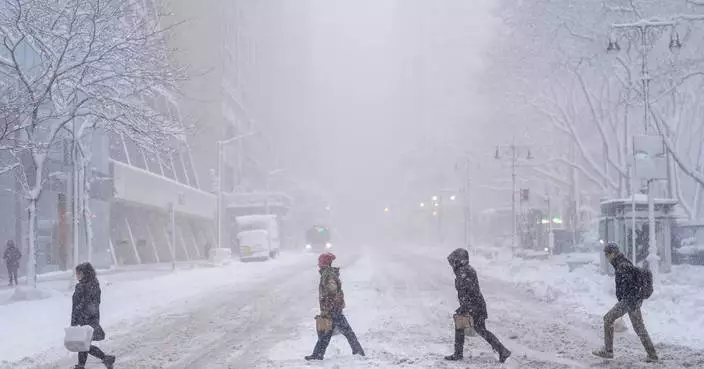
Millions of people in New York City and a large swath of the northeastern U.S. are stuck at home under road travel bans and blizzard warnings Monday as heavy snow and strong winds intensified, creating whiteout conditions in the densely populated region.
Snow fell at a rate of 2 to 3 inches (5 to 7.6 centimeters) an hour early Monday from New York through Massachusetts. Some areas have gotten well over a foot (30 centimeters) of snow since Sunday, along with wind gusts of over 30 mph (48 kph) and low visibility.
More than 5,000 flights in and out of the U.S. were canceled for Monday, according to the flight tracking website FlightAware. Most were canceled in New York, New Jersey and Boston.
Here's the latest:
Speed limits on New Jersey interstates and state highways have been lowered temporarily to 35 mph (56.3 kph) under an emergency traffic regulation order.
The order started Sunday afternoon and includes the New Jersey Turnpike, Garden State Parkway and Atlantic City Expressway.
The Metropolitan Transportation Authority in New York City says some express trains are running local on Monday and riders should expect delays. Some delays could be severe, especially on lines running above ground.
Bus riders also should expect longer waits as articulated buses have been removed from service during the storm.
Meanwhile, Long Island Rail Road service has been fully suspended until further notice, while the Metro-North Railroad is operating on a reduced schedule in some areas.
▶ Read more
The weather service referred to the storm as a “classic bomb cyclone/nor’easter off the Northeast coast.” But what does that mean?
According to the U.S. National Oceanic and Atmospheric Administration, certain storms undergo bombogenesis, which happens when a storm’s central pressure drops at least 24 millibars in 24 hours. These storms are sometimes called bomb cyclones. Storm intensity is measured by central pressure, so the lower the pressure, the stronger the storm.
Such rapidly strengthening storms can produce heavy rain, blizzard conditions and intense winds that can lead to downed trees and power outages.
Bomb cyclones can occur in any season, but primarily develop during fall and winter when frigid air from the Arctic can creep south and clash with warmer air masses.
▶ Read more
More than 5,000 flights in and out of the United States were canceled for Monday, according to the flight tracking website FlightAware. Most were canceled in New York, New Jersey and Boston.
Public transit also was suspended in some areas. And DoorDash announced it was suspending deliveries in New York City overnight.
“The combination of heavy snowfall and strong winds will continue to produce blizzard conditions along the Northeastern Seaboard,” the weather service said Monday. “Sharply reduced visibility will make travel extremely treacherous across these areas.”
Heavy snow and strong winds have intensified, creating whiteout conditions in a large swath of the northeastern U.S.
The National Weather Service called travel conditions “nearly impossible.”
Blizzard warnings stretched from Maryland to Maine. Cellphones across New York City received wailing push alerts Sunday night announcing a ban on non-emergency travel on all streets through noon Monday because of “dangerous blizzard conditions.” Rhode Island and New Jersey implemented similar restrictions.
22.5 inches (57 centimeters) at New York, Long Island MacArthur Airport
About 15 inches (38 centimeters) fell in New York City’s Central Park
About 18 inches (46 centimeters) in Newark, New Jersey
17 inches (43 centimeters) in New London, Connecticut
17 inches (43 centimeters) in North Kingstown, Rhode Island
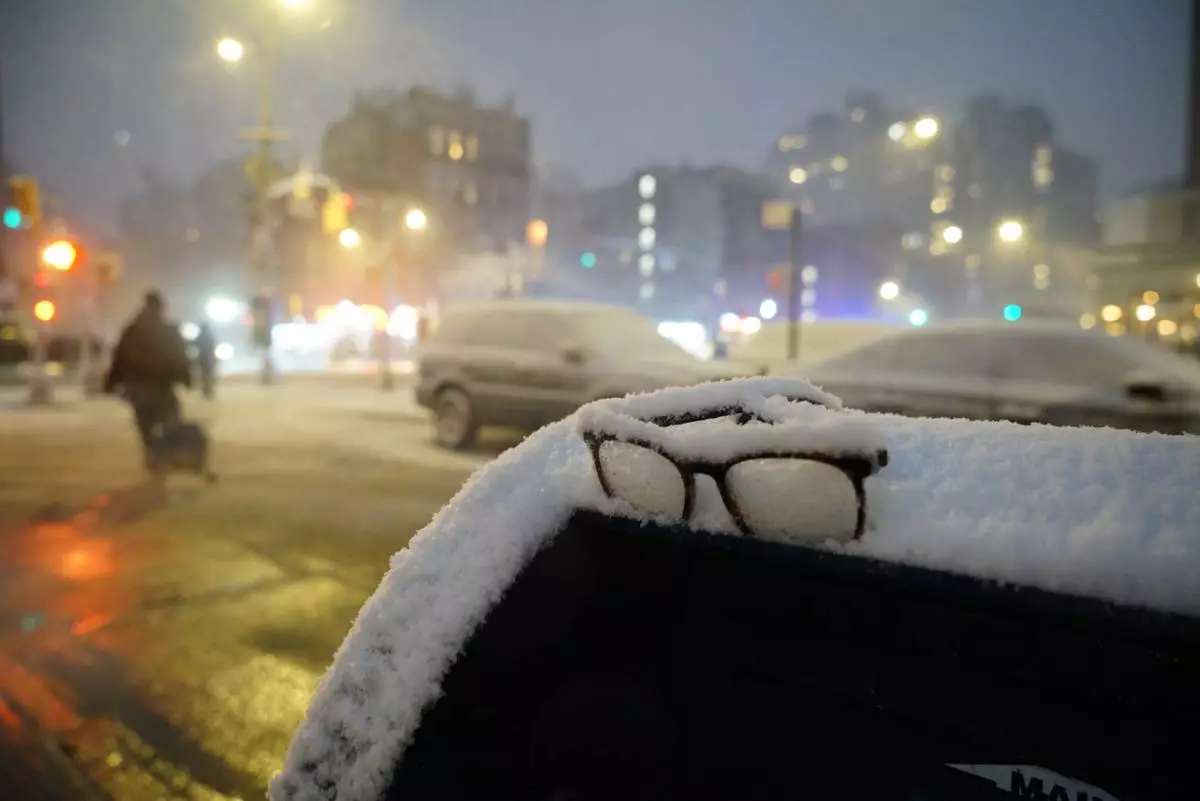
A pair of missing glasses sits in accumulated snow on top of a mailbox during a snowstorm, Sunday, Feb. 22, 2026, in New York. (AP Photo/Pamela Hassell)
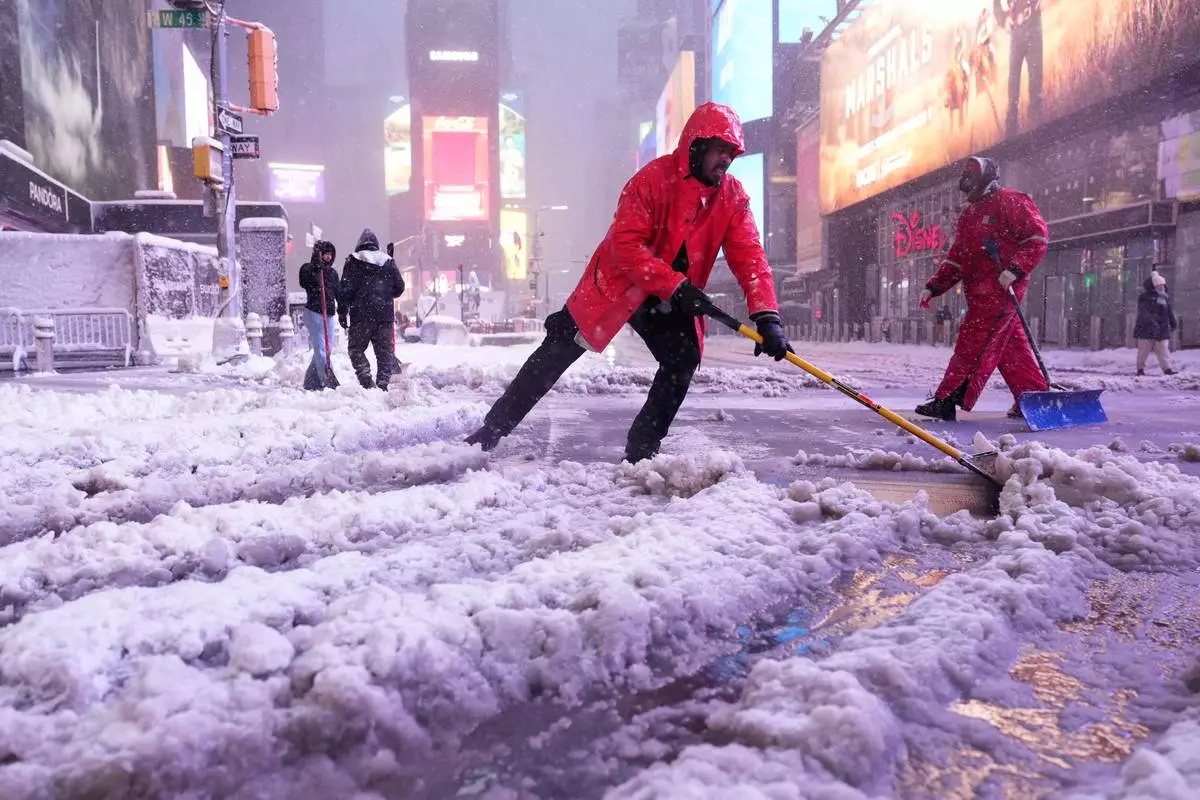
A worker with the Times Square Alliance sanitation crew shovels snow in Times Square, Monday, Feb. 23, 2026, in New York. (AP Photo/Seth Wenig)
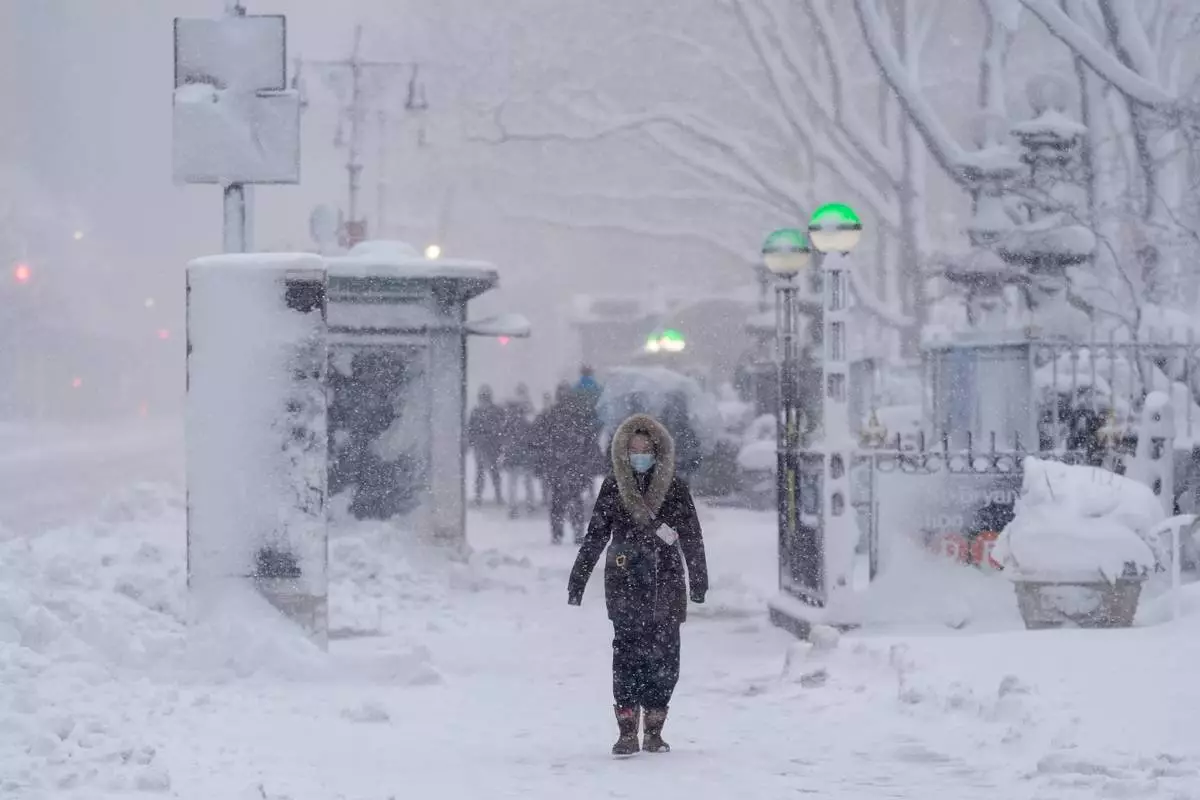
A pedestrian walks along 42nd Street near Bryant Park during a snow storm, Monday, Feb. 23, 2026, in New York. (AP Photo/Seth Wenig)