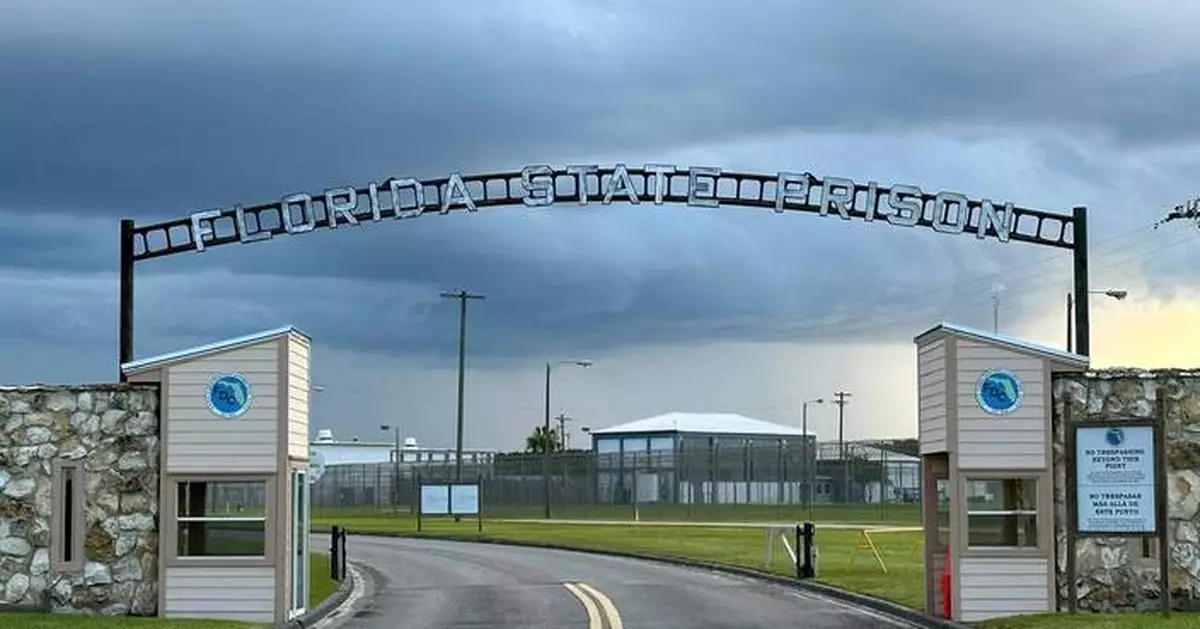
STARKE, Fla. (AP) — A man convicted of killing a grocery store owner during a robbery is set Tuesday evening to become the second person executed in Florida this year.
Melvin Trotter, 65, is scheduled to receive a three-drug injection starting at 6 p.m. at Florida State Prison near Starke. Trotter was initially convicted of first-degree murder and sentenced to death in 1987. However, the Florida Supreme Court found the trial court had erred in handling aggravating factors in Trotter's case and ordered a new sentencing, and Trotter again drew the death penalty in 1993.
Tuesday's planned execution and another earlier this month in Florida follow a record 19 executions in the state last year. In 2025, Gov. Ron DeSantis oversaw more executions in a single year than any other Florida governor since the death penalty was reinstated in the U.S. in 1976. The previous Florida record was eight executions in 2014.
According to court records, Trotter strangled and stabbed Virgie Langford at her store in Palmetto in 1986. A truck driver found Langford alive after the attack, and she was able to describe her attacker before eventually dying at a hospital.
Besides recalling Trotter's physical appearance, Langford said her attacker had a Tropicana employee badge with the name “Melvin” on it. According to court records, police later found a T-shirt with Langford's blood type at Trotter's home and the man's handprint on a meat cooler at the grocery store.
Last week, the Florida Supreme Court denied appeals filed by Trotter. His attorneys had argued that Florida corrections officials had mismanaged its own death penalty protocols. Attorneys also argued that Trotter's advanced age of 65 should exempt him from execution.
Trotter's final appeals were still pending Tuesday before the U.S. Supreme Court.
A total of 47 people were executed in the U.S. in 2025. Florida led the way with a flurry of death warrants signed by DeSantis. Alabama, South Carolina and Texas tied for second with five executions each last year.
So far this year, Texas, Oklahoma and Florida have carried out one execution each.
On Feb. 10, a man convicted of killing a traveling salesperson who he and his brother had met at a bar become the first person executed in Florida this year. Ronald Palmer Heath, 64, was convicted of first-degree murder and other charges in the 1989 killing of Michael Sheridan.
Two more Florida executions have already been scheduled for next month: Billy Leon Kearse, 53, is scheduled to receive a lethal injection on March 3, and Michael Lee King, 54, on March 17.
All Florida executions are carried out by injecting a sedative, a paralytic and a drug that stops the heart, according to the Department of Corrections.
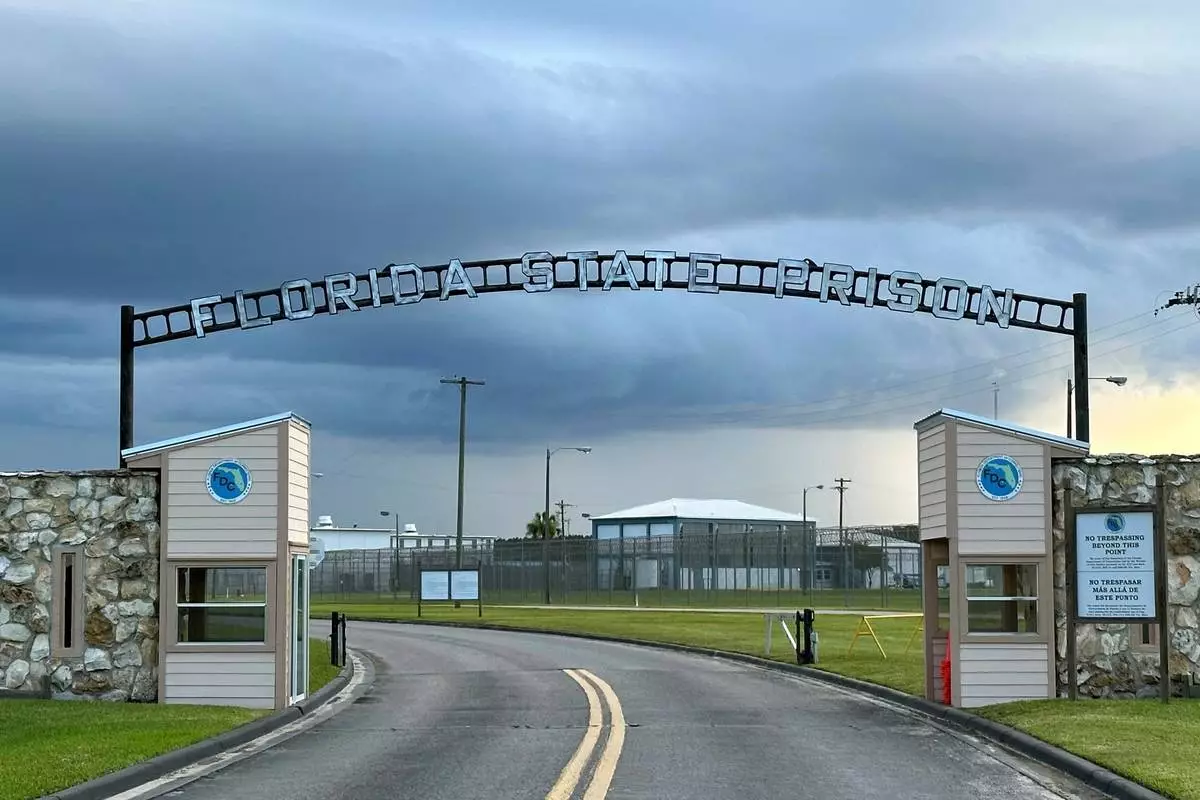
FILE - Clouds hover over the entrance of the Florida State Prison in Starke, Fla., Aug. 3, 2023. (AP Photo/Curt Anderson, File)
NEW YORK (AP) — Horses whinny to find new friends, greet old ones and celebrate happy moments like feeding time.
How exactly horses produce that distinctive sound — also called a neigh — has long eluded scientists.
The whinny is an unusual combination of both high and low pitched sounds, like a cross between a grunt and a squeal — that come out at the same time.
The low-pitched part wasn't much of a mystery. It comes from air passing over bands of tissue in the voice box that make noise when they vibrate. It's a technique similar to how humans speak and sing.
But the high-pitched piece is more puzzling. With some exceptions, larger animals have larger vocal systems and typically make lower sounds. So how do horses do it?
According to a new study, they whistle.
Researchers slid a small camera through horses' noses to film what happened inside while they whinnied and made another common horse sound, the softer, subtler nicker. They also conducted detailed scans and blew air through the isolated voice boxes of dead horses.
The whinny's mysterious high-pitched tones, they discovered, are a kind of whistling that starts in the horse's voice box. Air vibrates the tissues in the voice box while an area just above contracts, leaving a small opening for the whistle to escape.
That's different from human whistling, which we do with our mouths.
“I'd never imagined that there was a whistling component. It's really interesting, and I can hear that now,” said Jenifer Nadeau, who studies horses at the University of Connecticut. Nadeau was not involved with the study, which was published Monday in the journal Current Biology.
A few small rodents like rats and mice whistle like this, but horses are the first known large mammal to have a knack for it. They're also the only animals known to be able to whistle through their voice boxes while they sing.
“Knowing that a ‘whinny’ is not just a ‘whinny’ but that it is actually composed of two different fundamental frequencies that are created by two different mechanisms is exciting,” said Alisa Herbst with Rutgers University's Equine Science Center, of the study in an email.
A big lingering question is how horses' two-toned calls came to be. Wild Przewalski’s horses can do something similar, as can elks. But more distant horse relatives like donkeys and zebras can't make the high-pitched sounds.
The two-toned whinnies could help horses convey multiple messages at the same time. The differently pitched neighs may help them express a more complex range of feelings when socializing, said study author Elodie Mandel-Briefer with the University of Copenhagen.
“They can express emotions in these two dimensions,” Mandel-Briefer said.
Associated Press video journalist James Brooks contributed to this report.
The Associated Press Health and Science Department receives support from the Howard Hughes Medical Institute’s Department of Science Education and the Robert Wood Johnson Foundation. The AP is solely responsible for all content.
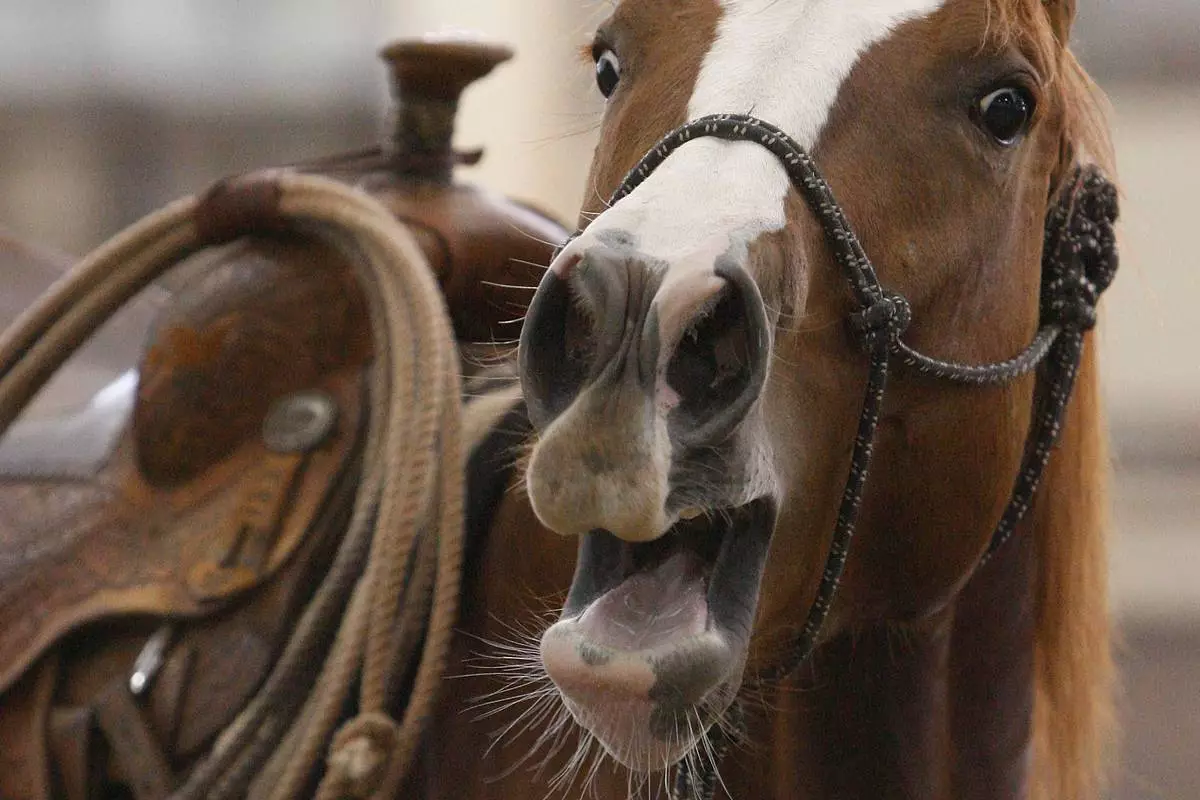
FILE - A horse whinnies in a barn at the Oklahoma State Fairgrounds in Oklahoma City, during a cutting horse competition, Monday, June 20, 2011. (AP Photo/Sue Ogrocki, File)