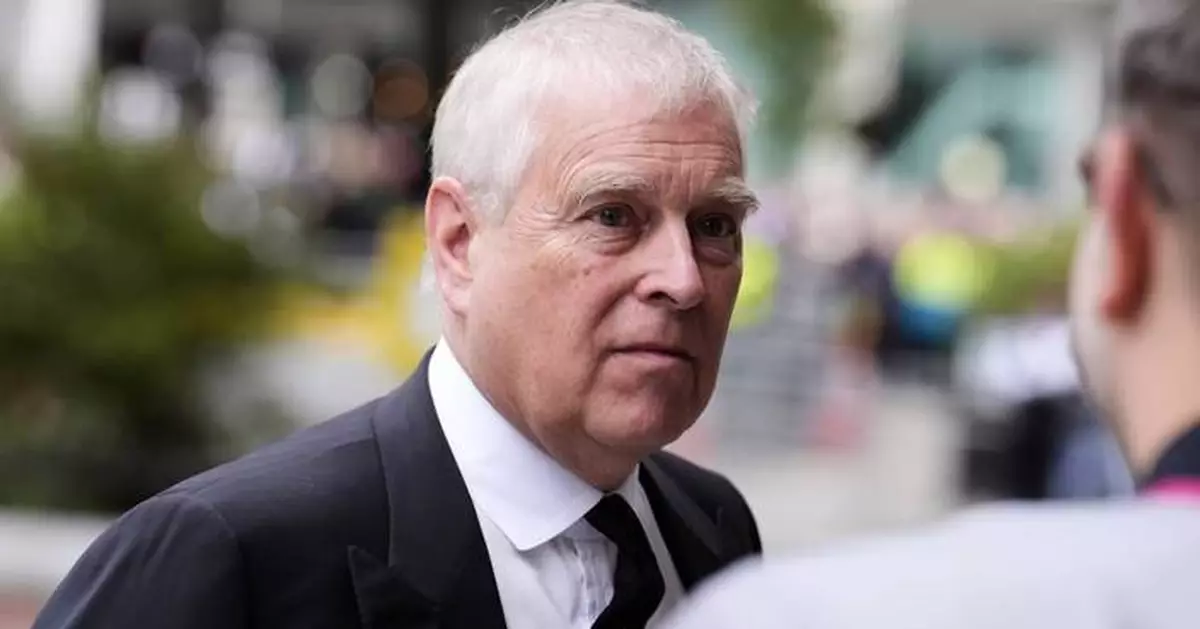
LONDON (AP) — The British government will release confidential papers related to the former Prince Andrew’s appointment as trade envoy after a scathing parliamentary debate in which lawmakers called for greater accountability from the royal family and said the king’s brother had put his friendship with Jeffrey Epstein ahead of his duty to the country.
Lawmakers approved a motion Tuesday demanding publication of the documents, after the one-time prince and Duke of York, now known simply as Andrew Windsor-Mountbatten, was arrested on charges related to allegations that he shared government reports with Epstein while he was trade envoy. Prime Minister Keir Starmer’s government backed the motion, assuring its passage.
“Frankly, it is the least we owe the victims of the horrific abuse that was perpetrated by Jeffrey Epstein and others, the abuse that was enabled, aided and abetted by a very extensive group of arrogant, entitled and often wealthy individuals in this country and elsewhere,” Trade Minister Chris Bryant said for the government.
He described Mountbatten-Windsor as being engaged in a constant "self-enriching hustle'' — a "rude, arrogant and entitled man who could not distinguish between the public interest, which he said he served, and his own private interest.''
While the government agreed to release the files, Bryant said the publication of some documents may be delayed until police finish their investigation.
The move co mes as the U.S. Justice Department’s release of millions of pages of documents related to Epstein exposes how the wealthy financier used an international web of rich, powerful friends to gain influence and sexually exploit young women. Nowhere has the fallout been felt more strongly than in the U.K., where the scandal has raised questions about the way power is wielded by the aristocracy, senior politicians and influential businessmen, known collectively as “the Establishment.”
Mountbatten-Windsor was arrested on Thursday at his home on the private estate of his brother King Charles III. He was released later that day pending further investigation.
Then on Monday p olice arrested Peter Mandelson, a one-time government minister who later served as ambassador to the United States, on suspicion of misconduct in public office related to allegations that he, too, shared confidential information with Epstein. Mandelson was released early Tuesday morning. That investigation is also continuing.
While they haven’t spoken publicly since their arrests, both Mountbatten-Windsor and Mandelson have previously denied any wrongdoing. Epstein died in custody in 2019 while awaiting trial on sex trafficking charges.
Ed Davey, the leader of the opposition Liberal Democrats, said he introduced the motion to shed light on why Mountbatten-Windsor was named trade envoy in 2001 amid reports that Mandelson pushed for the appointment. The episode appears to be a case of one friend of Epstein lobbying for a job for another friend of Epstein, he said.
“Can there be many people more symbolic of the rot that eats away at the British establishment than the former Duke of York and special trade envoy, and the former business secretary, first secretary of state and ambassador to the United States?” Davey asked.
“Their association with Epstein and their actions on his behalf, while trusted with the privilege of public office, are a stain on our country,” he added.
During the debate, lawmakers called for greater accountability from the monarchy and a change in the rules and traditions of the House of Commons, which have historically barred members of Parliament from criticizing members of the royal family.
Davey said such changes would help shield the monarchy from the kind of fallout it has suffered because of Mountbatten-Windsor.
“The changes that we think are necessary would indeed protect the royal family, strengthen the monarchy, which in some places is being criticized,” Davey said. “And that’s why we need these reforms.”
For the House of Windsor, Tuesday’s debate was a reflection of a crisis that shows no sign of abating.
Buckingham Palace has tried to insulate the monarchy from the scandal by drawing a clear bold line between Mountbatten-Windsor and the rest of the royal family. In addition to removing his royal titles, Charles forced his brother to move out of the 30- room estate near Windsor Castle where he had lived rent free for more than 20 years.
But that may not be enough to quell the voices demanding change. The loudest of those comes from the campaign group Republic, which has long called for the monarchy to be replaced by an elected head of state.
While the U.K.’s constitutional monarchy no longer wields political power, it remains hugely influential at the apex of British society. The king is a symbol of continuity who serves as head of state for Britain and 14 other independent countries with ties to the former British Empire. Working members of the royal family support him by making hundreds of public appearances each year, visiting charities, military bases and community groups that still clamor for their attention.
Commentators have compared the pressures facing the House of Windsor to 1936, when King Edward VIII abdicated the thrown to marry the American divorcee Wallis Simpson.
“Unlike the last significant family crisis of the modern monarchy, the abdication of 1936, this is not an immediate matter of constitutional crisis, yet its implications may well prove more significant for the monarchy, and so they should,’’ royal historian Anna Whitelock wrote this week in the Sunday Times newspaper. “It is the last of our public institutions to face the full glare of public scrutiny, with questions raised about its role, purpose, governance, financing and accountability.’’
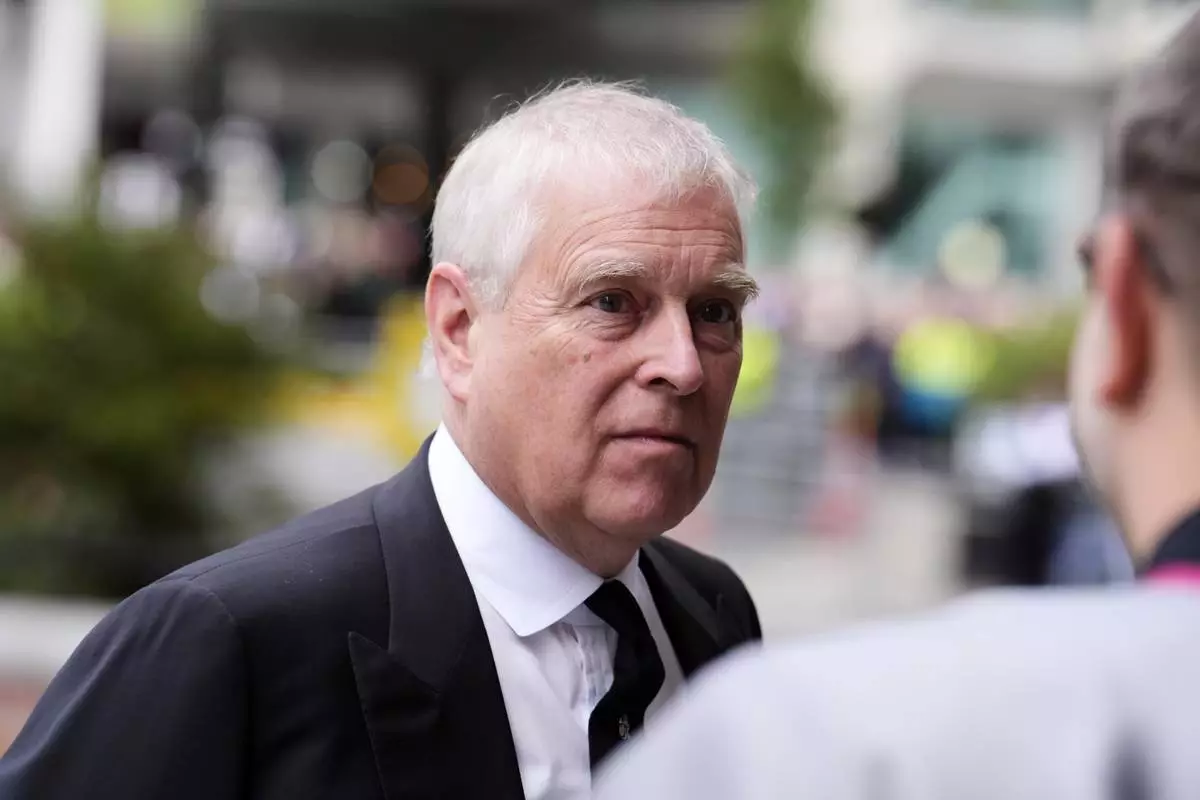
FILE - Then-Prince Andrew arrives for the funeral of the Duchess of Kent at Westminster Cathedral in London, Tuesday, Sept. 16, 2025. (Jordan Pettitt/Pool Photo via AP, file)
TAPALPA, Mexico (AP) — Maria Dolores Aguirre’s corner store has lived off the tourism that flows into her cobblestoned town of Tapalpa, tucked away in the mountains of Mexico's state of Jalisco.
Then gunshots erupted and helicopters flew overhead as the Mexican army killed the country’s most powerful drug lord Sunday just a few kilometers (miles) from her home. The killing sparked a surge in violence and put the country on edge.
Now the 50-year-old Aguirre worries that the bloodshed will deal a blow to her livelihood and change towns like hers. Many others in Jalisco are grappling with the same concerns, from the Pacific Ocean beaches to the capital of Guadalajara, which will host matches in June for the 2026 FIFA World Cup.
“It’s going to affect us. It’s collateral damage,” Aguirre said. “The government is going to have to have a lot of security. … The entire world just saw what happened and, of course, people are going to think twice about coming.”
President Claudia Sheinbaum was asked Tuesday at her daily news briefing what guarantees there are that World Cup matches will be held in Jalisco. “Every guarantee," she said, adding that there was “no risk” for fans coming to the tournament.
Fighting between the Jalisco New Generation Cartel and Mexican security forces raged on in a number of states Monday, fueling fears that more violence is to come.
More than 70 people died in the attempt to capture Nemesio Oseguera Cervantes and its aftermath, authorities said Monday. Known as “El Mencho,” he was the notorious leader of the Jalisco New Generation Cartel, one of the fastest-growing criminal networks in Mexico, known for trafficking fentanyl, methamphetamine and cocaine to the United States and staging brazen attacks against Mexican government officials.
The White House confirmed that the U.S. provided intelligence support to the operation to capture the cartel leader and applauded Mexico’s army for taking down a man who was one of the most wanted criminals in both countries. The U.S. State Department had offered a reward of up to $15 million for information leading to his arrest.
The death of Oseguera Cervantes came as Mexico's government has stepped up its offensive against cartels in an effort to meet demands by U.S. President Donald Trump to crack down on criminal groups. He has threatened to impose more tariffs or take unilateral military action if the country does not show results.
Mexico hoped the death of one of the world’s biggest fentanyl traffickers would ease that pressure, but many people were anxious as they waited to see the powerful cartel’s reaction.
Oseguera Cervantes died after a shootout Sunday with the Mexican military. Mexican Defense Secretary Gen. Ricardo Trevilla said Monday that authorities had tracked one of his romantic partners to his hideout in Tapalpa. The cartel leader and two bodyguards fled into a wooded area where they were seriously wounded in a firefight. They were taken into custody and died on the way to Mexico City, Trevilla said.
In the aftermath, a sense of unease simmered in tourist towns.
The Pacific Ocean resort city of Puerto Vallarta also was hard hit by cartel reprisals, frightening tourists.
Steve Perkins, 57, was visiting Puerto Vallarta with his wife, Gayle, and some friends. They were on their hotel room's terrace when explosions and black smoke started appearing around the city Sunday morning.
Their return to Broken Arrow, Oklahoma, was delayed when their flight was canceled Monday, and they were rebooked for March 1.
Perkins and his wife have been taking annual trips to Puerto Vallarta since 2012 and have always felt safe, until now. He said they don’t plan on returning to Mexico.
“There’s a lot of Americans trapped here,” Perkins said.
Aguirre worked next to her son in the small neighborhood shop her family has owned for 50 years. The 15-year-old's classes were canceled due to the violence.
Aguirre said it was unclear whether the military or the cartel was in control of the area surrounding her. The other question on her mind was if this was a one-off event, or if more violence was in store.
“We don't know if these people (cartel leaders) are permanently here or not,” she said. “If they really did kill this leader, it could be that they fight between each other to win control or see who will lead it.”
__
Associated Press writer Juan Lozano in Houston contributed to this report.
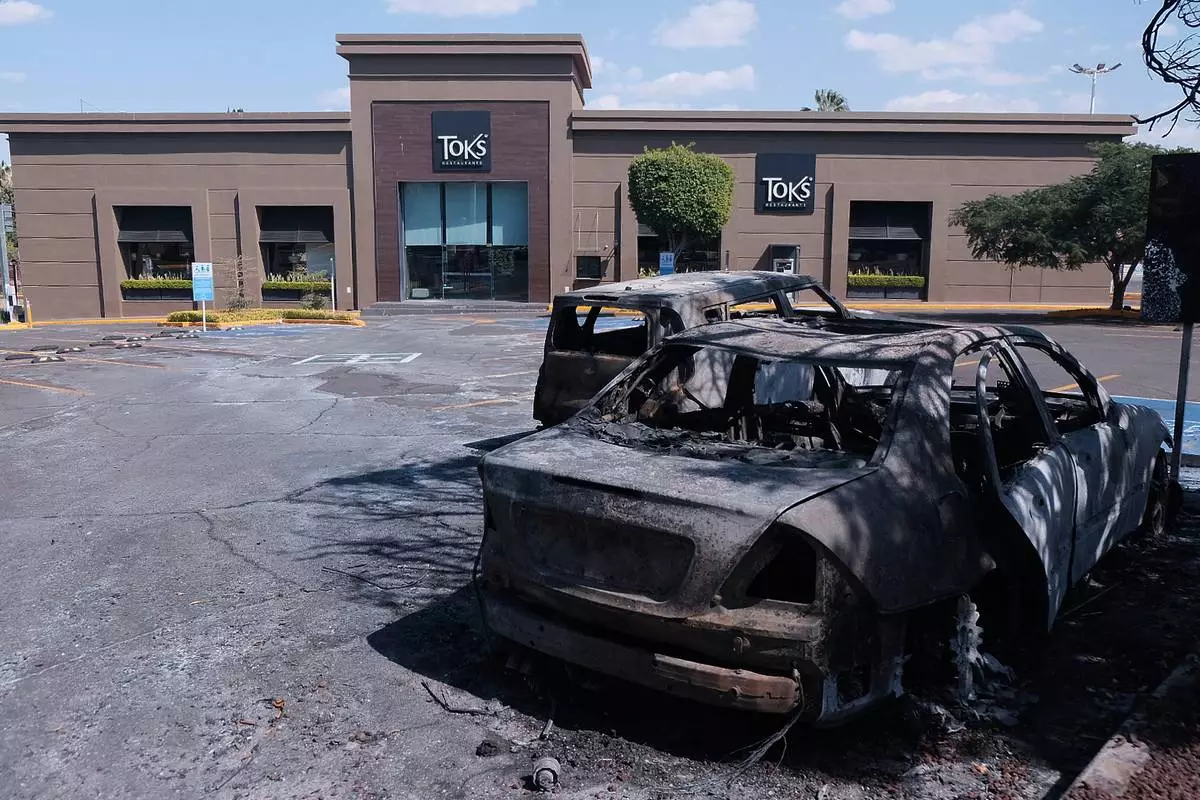
Charred vehicles sit in a parking lot outside a shopping mall in Guadalajara, Jalisco state, Mexico, Sunday, Feb. 22, 2026, as authorities reported that the Mexican Army killed Jalisco New Generation Cartel leader Nemesio Oseguera Cervantes, known as "El Mencho." (AP Photo/Alejandra Leyva)
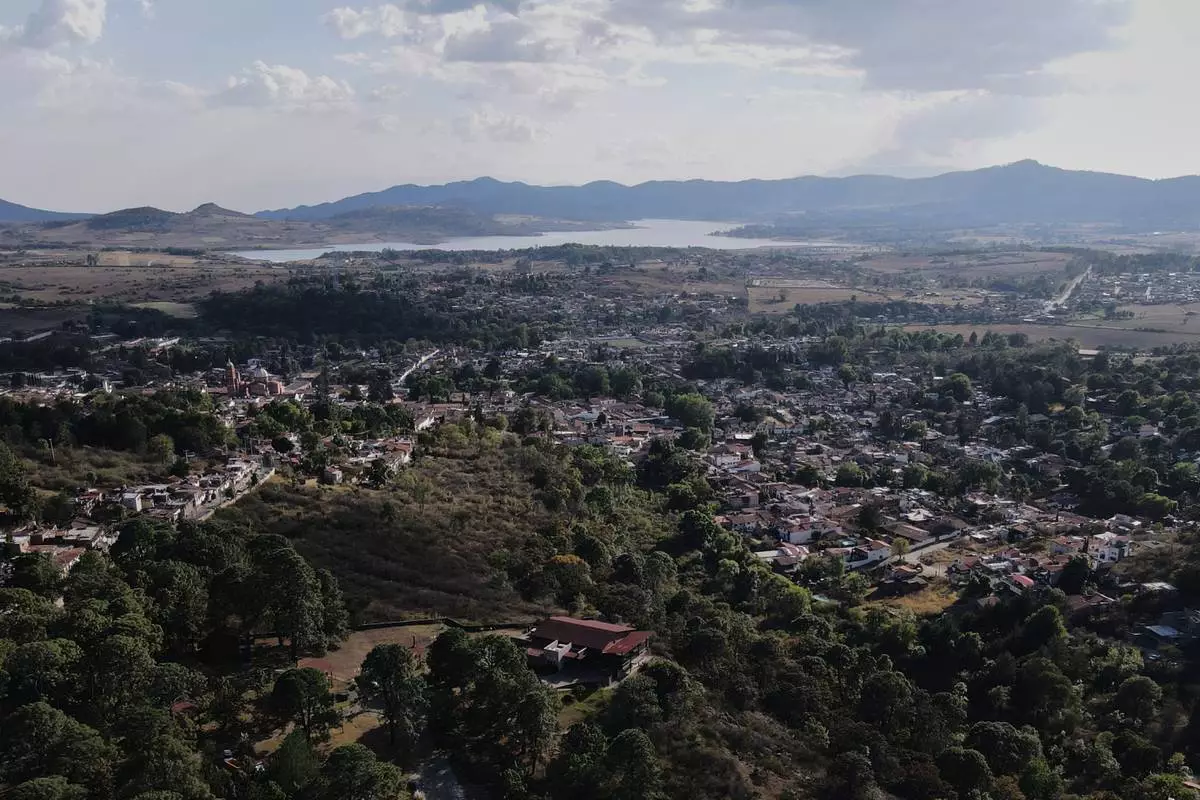
Trees and buildings dot Tapalpa, Mexico, Monday, Feb. 23, 2026, a day after the Mexican army killed Jalisco New Generation Cartel leader Nemesio Oseguera Cervantes, known as "El Mencho." (AP Photo/Marco Ugarte)
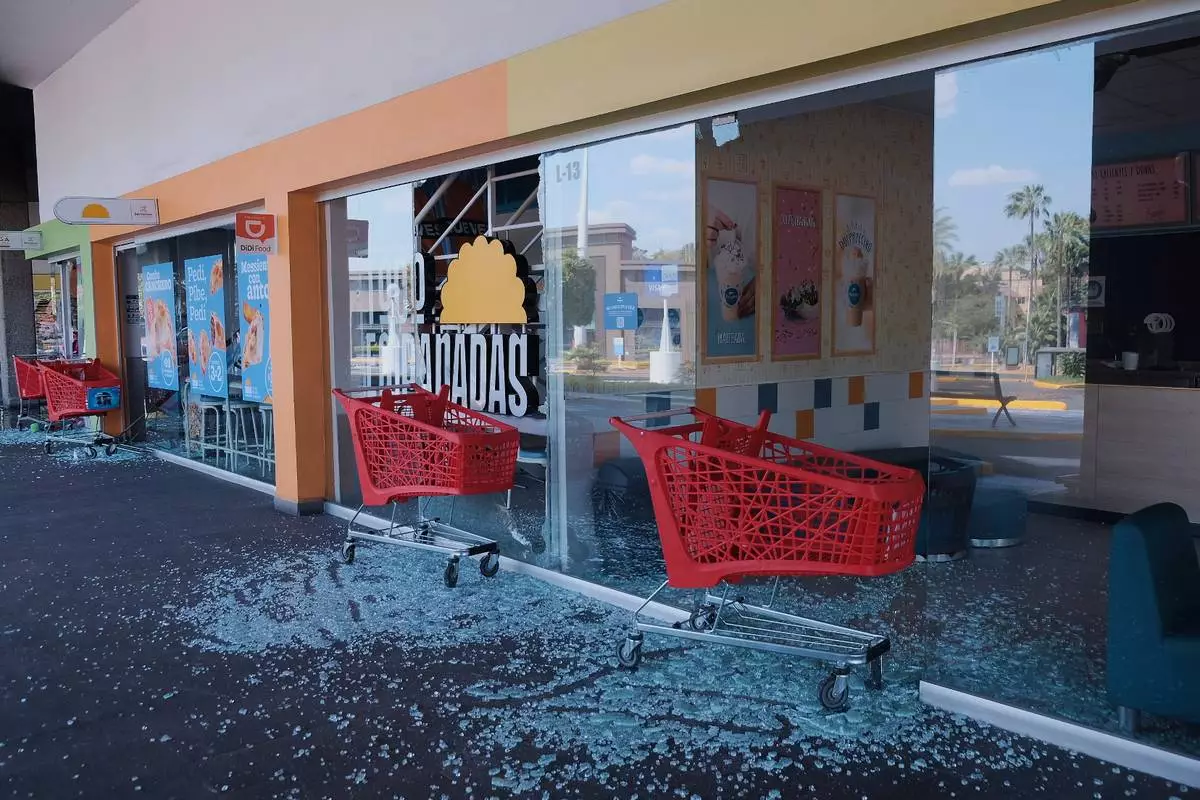
Carts stand outside of a vandalized supermarket in Guadalajara, Jalisco state, Mexico, Sunday, Feb. 22, 2026, after the death of the leader of the Jalisco New Generation Cartel, Nemesio Rubén Oseguera Cervantes, known as "El Mencho." (AP Photo/Alejandra Leyva)
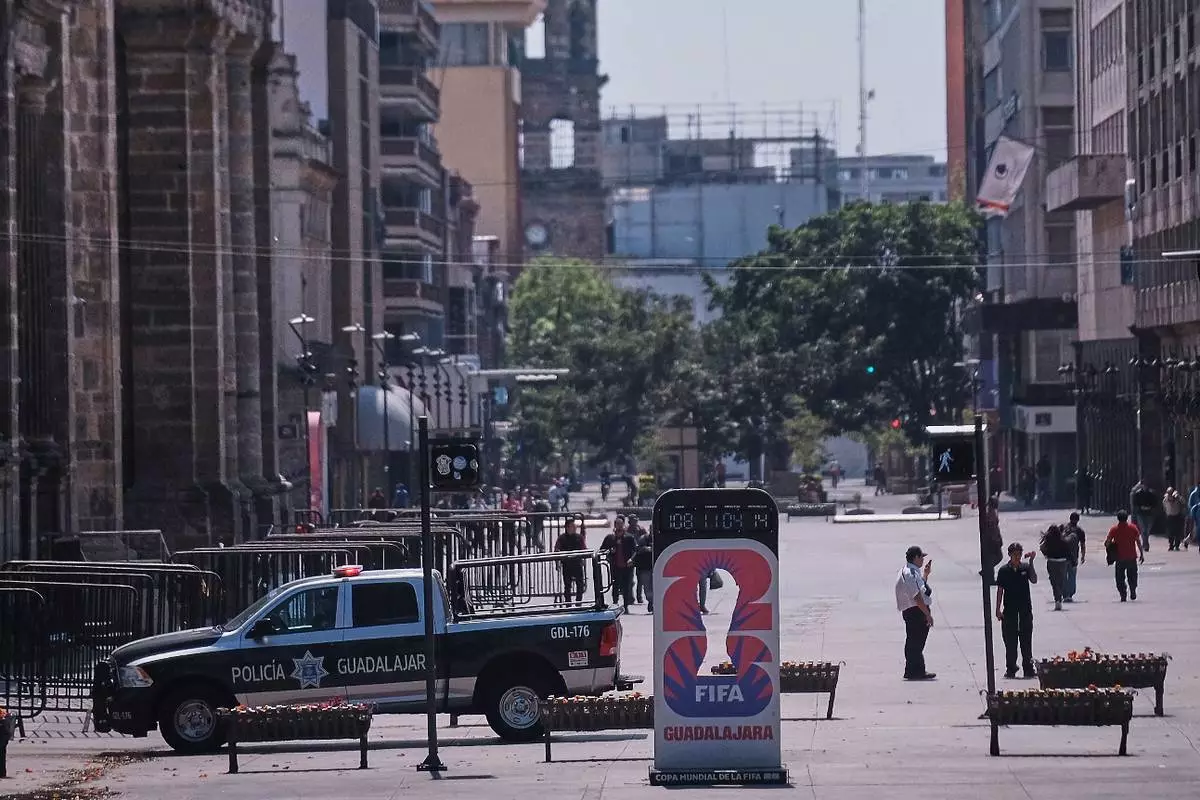
Police officers stand guard in downtown Guadalajara, Jalisco state, Mexico, Sunday, Feb. 22, 2026, after the death of the leader of the Jalisco New Generation Cartel, Nemesio Oseguera Cervantes, known as "El Mencho." (AP Photo/Alejandra Leyva)
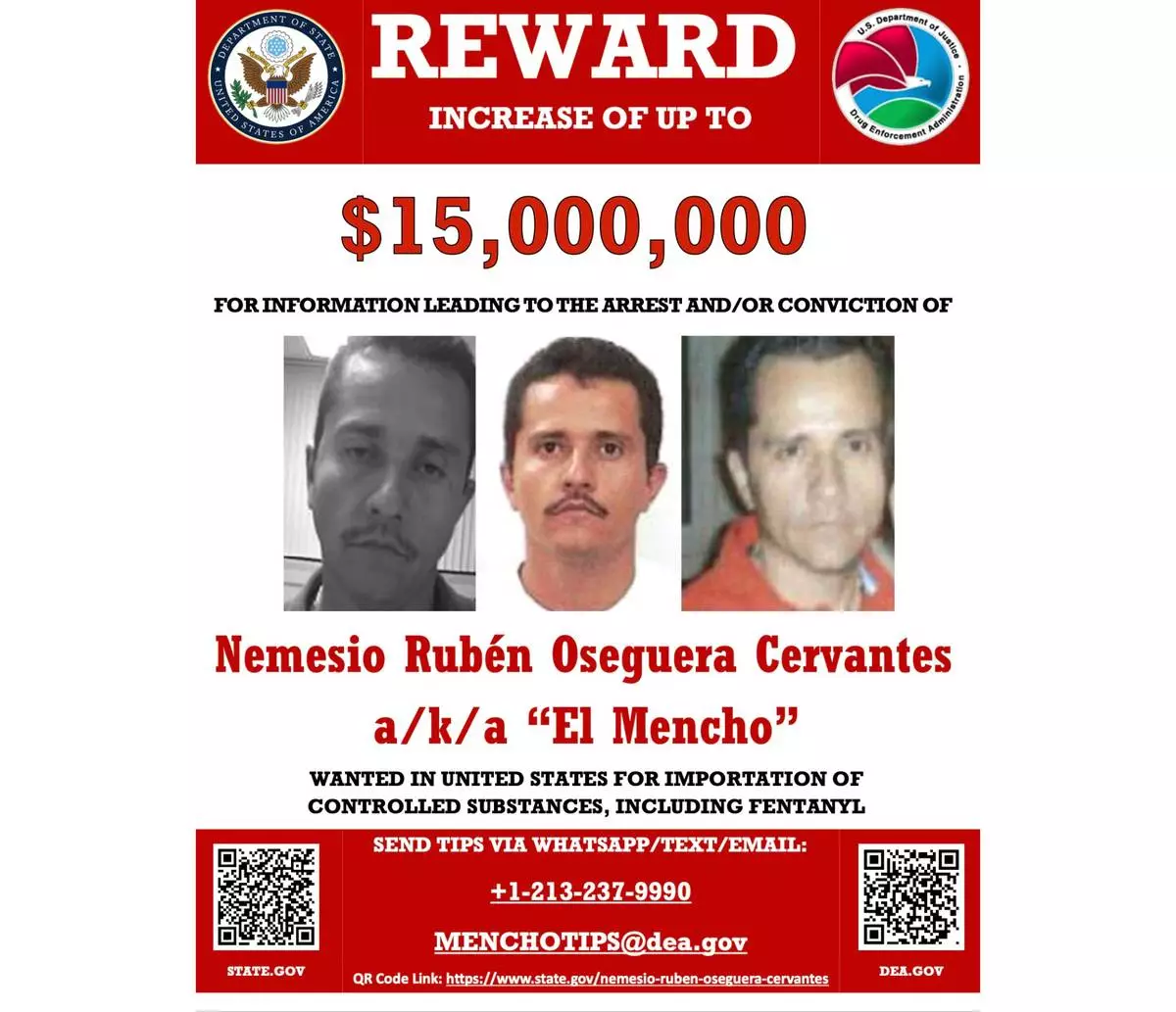
This wanted poster released on Dec. 4, 2024 on the U.S. State Department website shows leader of the Jalisco New Generation Cartel, Nemesio Rubén Oseguera Cervantes, known as “El Mencho.” (U.S. State Department via AP)
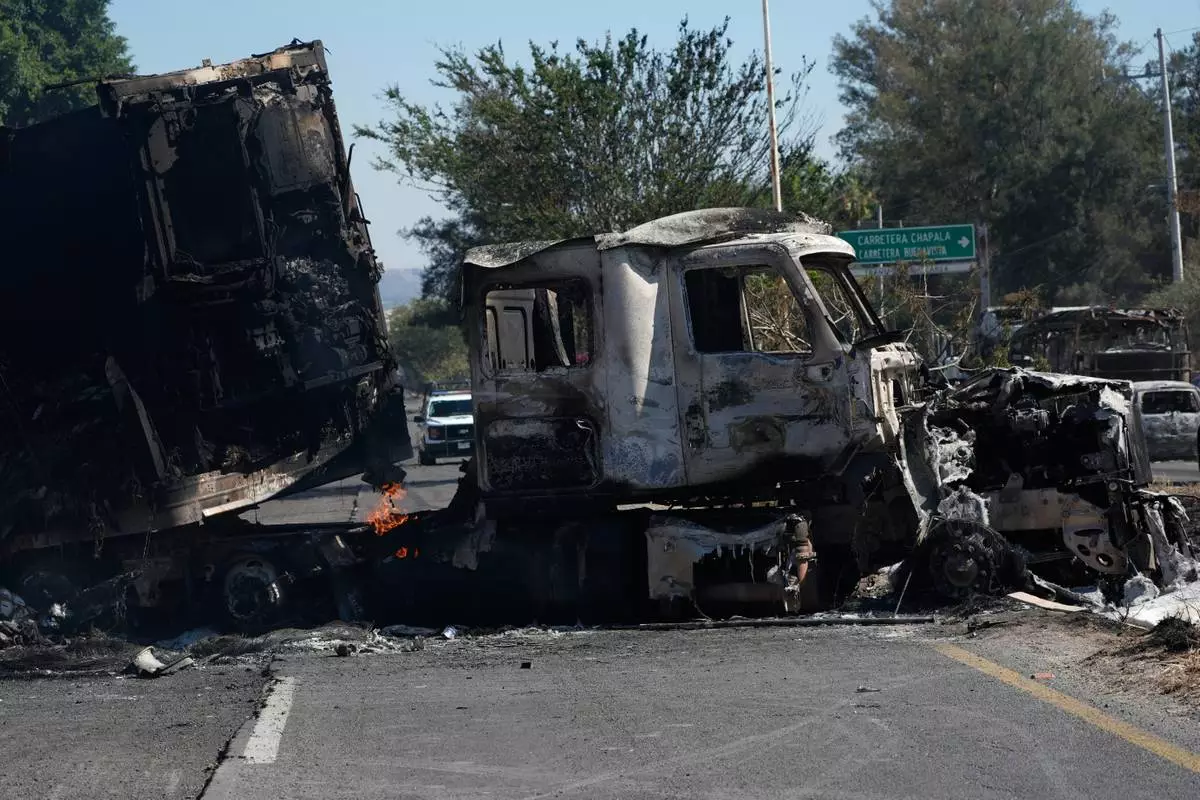
A charred truck blocks a road the day after the Mexican army killed Jalisco New Generation Cartel leader Nemesio Oseguera Cervantes, known as "El Mencho," in Guadalajara, Mexico, Monday, Feb. 23, 2026. (AP Photo/Marco Ugarte)
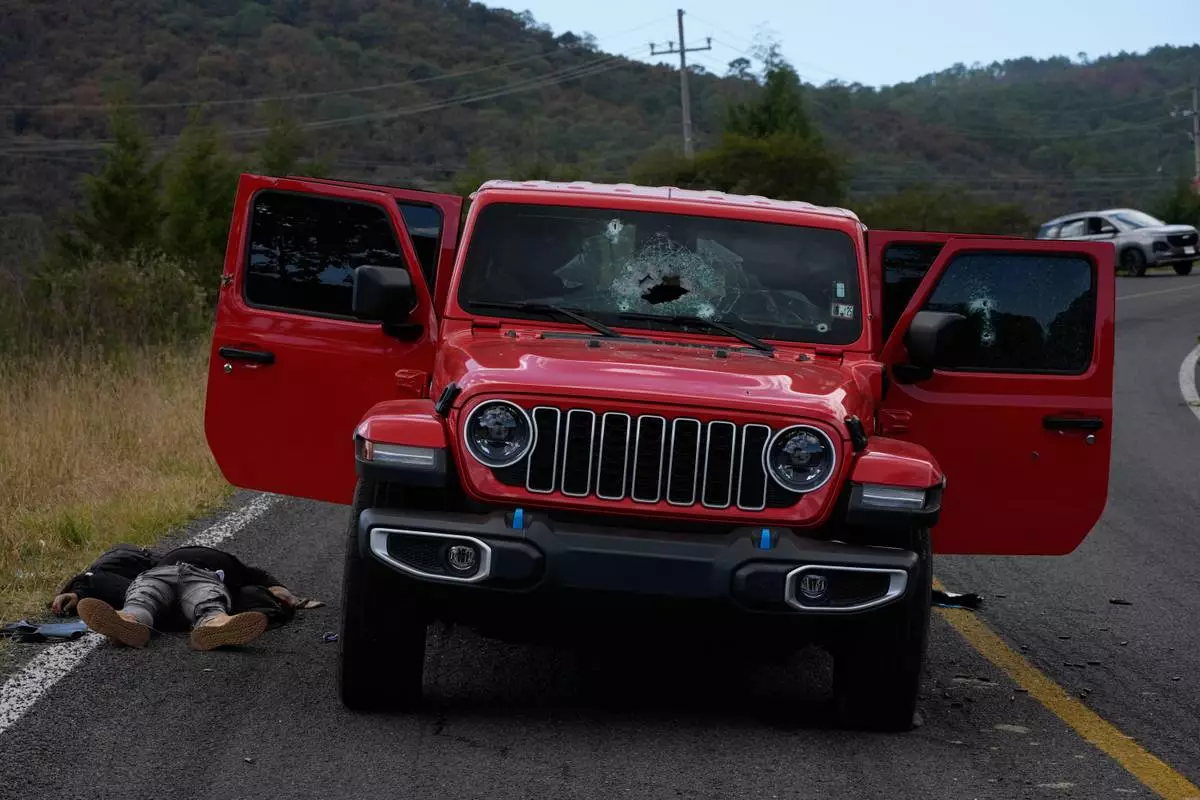
A body lies beside a bullet-riddled vehicle in Tapalpa, Mexico, Monday, Feb. 23, 2026, a day after the Mexican army killed Jalisco New Generation Cartel leader Nemesio Oseguera Cervantes, known as "El Mencho." (AP Photo/Marco Ugarte)
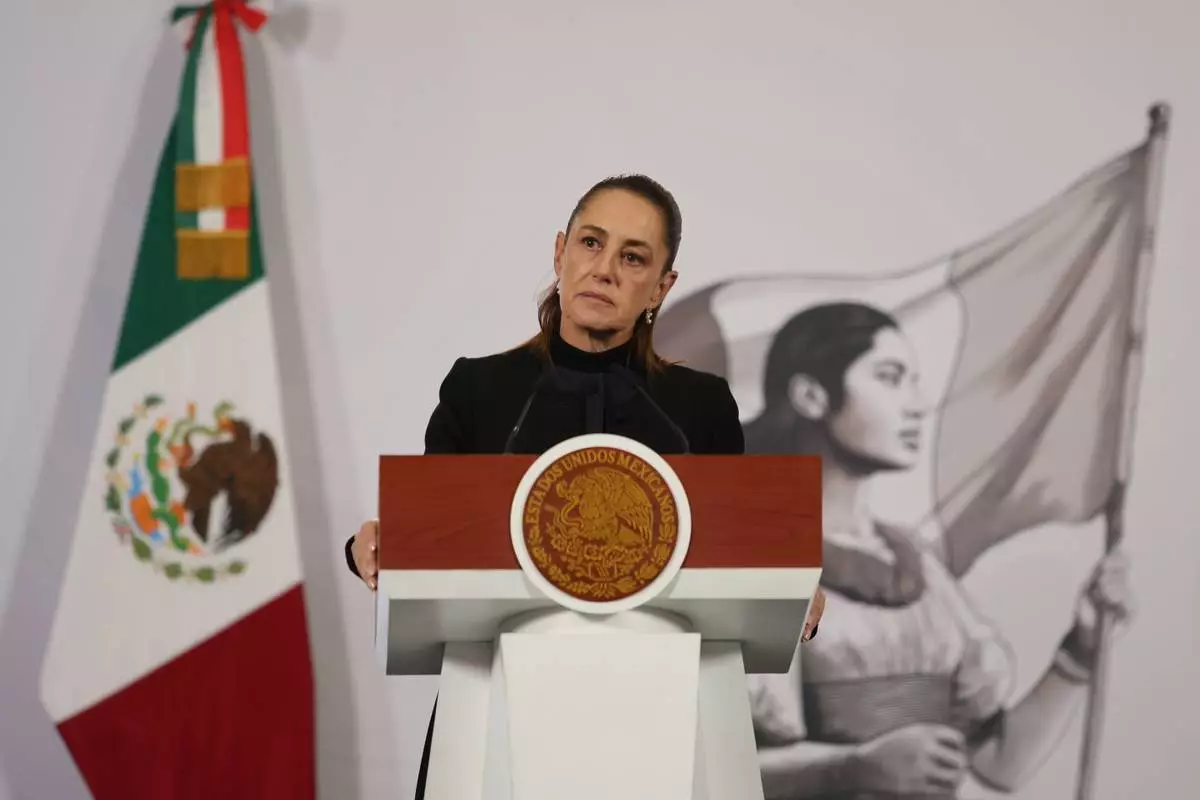
Mexican President Claudia Sheinbaum gives her the daily, morning news conference at the National Palace in Mexico City, Monday, Feb. 23, 2026, the day after the Mexican army killed Jalisco New Generation Cartel leader Nemesio Oseguera Cervantes, known as "El Mencho." (AP Photo/Ginnette Riquelme)
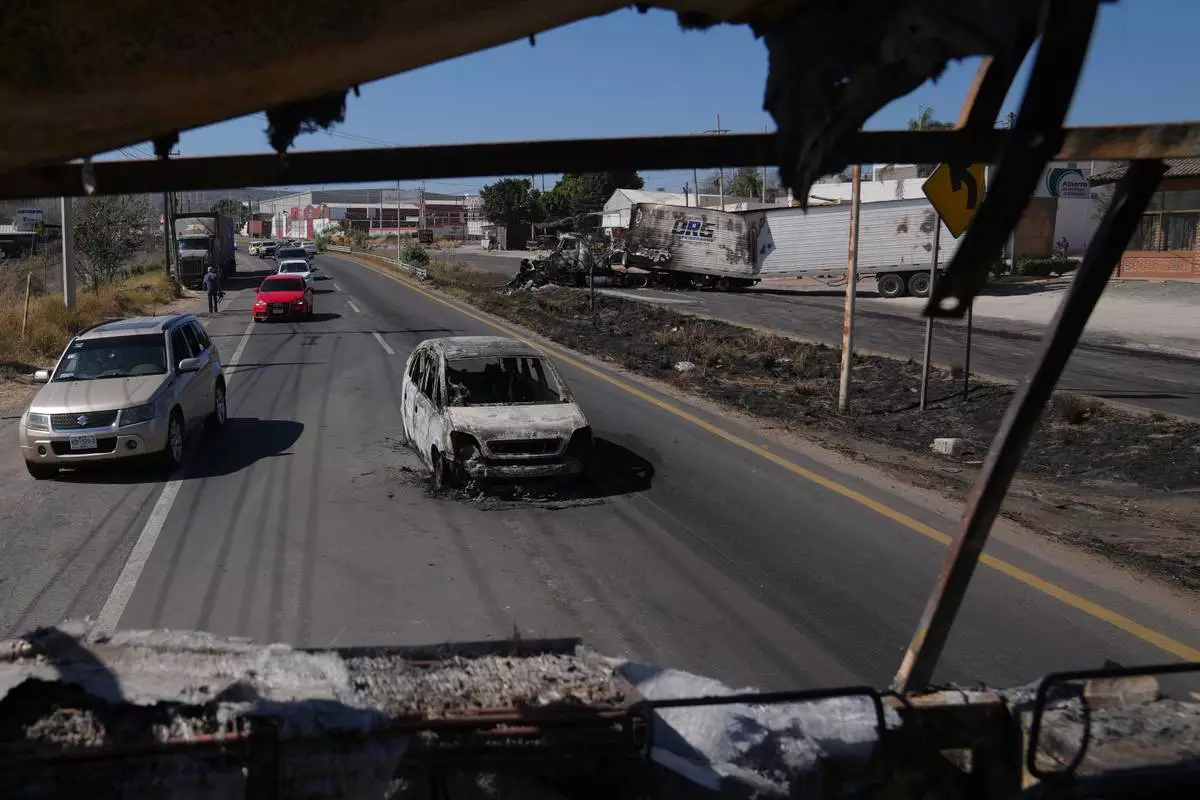
Vehicles pass a burned car a day after the Mexican army killed the leader of the Jalisco New Generation Cartel, Nemesio Oseguera Cervantes, known as "El Mencho," in Guadalajara, Mexico, Monday, Feb. 23, 2026. (AP Photo/Marco Ugarte)