PARIS (AP) — The Louvre Museum's director resigned Tuesday after months of pressure following the October theft of the French crown jewels, as the world's most visited museum faced widening scrutiny over security failures, labor unrest and a suspected ticket fraud scheme.
Laurence des Cars quit after a punishing year for the former royal palace — the high-profile jewels heist from the Apollo Gallery, a mid-February burst pipe near the “Mona Lisa,” water leaks damaging priceless books, staff walkouts and a wildcat strike over overcrowding and understaffing.
The landmark has faced a widening narrative of an institution spiraling out of control.
And that pressure deepened in recent weeks when French authorities revealed a suspected decadelong ticket fraud operation linked to the museum that investigators say may have cost the Louvre 10 million euros ($11.8 million).
President Emmanuel Macron accepted des Cars’ resignation as “an act of responsibility” at a moment when the Louvre needs “calm” and new momentum for security upgrades, modernization and other major projects, according to a statement from his office.
Macron wants to give des Cars a new mission during France’s presidency of the Group of Seven leading industrialized nations, focused on cooperation among major museums, the statement said.
For many in France’s cultural world, the resignation answers months of head-scratching over why no top official had fallen after the heist: a daylight robbery that many in the country saw as the most humiliating breach of French heritage security in living memory.
It also came as lawmakers and cultural officials widened scrutiny of the museum’s leadership and security practices in the months since the breach.
Thieves took less than eight minutes in October to steal crown jewels valued at 88 million euros ($102 million) from the Louvre, in a weekend operation that stunned visitors, exposed glaring vulnerabilities and left one of France's most symbolically charged collections in criminal hands.
Several suspects were later arrested, but the stolen pieces remain missing.
Des Cars, one of the most prominent museum directors in Europe, had offered to resign on the day of the robbery, but it was initially refused by the culture minister.
In remarks after the theft, she described the moment as a “tragic, brutal, violent reality” for the Louvre and said that, as the person in charge, it had felt right to offer her resignation.
In an interview published on Tuesday by daily newspaper Le Figaro, des Cars said that she had tried to steer the Louvre through the fallout from the heist, but had concluded that she could no longer carry out the museum’s transformation in the current institutional climate.
Staying on, she said, would have meant managing the status quo when the museum still needs deep reform.
“I was there to take the lightning” as museum director, she said.
Des Cars also said that the October break-in exposed problems that she had been warning about since taking office, including aging infrastructure, obsolete technical systems and severe congestion.
She had led the Louvre since 2021, taking over one of the museum world’s most prestigious jobs as the institution emerged from the coronavirus pandemic and mass tourism returned.
In June, a wildcat strike by front-of-house staff and security workers forced the Louvre to halt operations, stranding thousands of visitors outside the glass pyramid and underscoring the depth of anger among employees over overcrowding, understaffing and what unions called untenable working conditions.
Workers said that the pressure of daily visitor flows — particularly around the “Mona Lisa” — had become unmanageable and that promised reforms were arriving too slowly. There were growing complaints that the infrastructure and staffing of the crumbling medieval structure haven’t kept pace with the crowds pouring through its galleries.
The resignation came at an especially punishing moment, less than two weeks after French authorities revealed the separate ticket fraud scheme.
That case widened scrutiny beyond the jewels robbery and toward the museum’s day-to-day controls.
Prosecutors say tour guides are suspected of — up to 20 times a day — reusing the same tickets to bring in different visitor groups, at times allegedly with the help of Louvre employees, in a system investigators believe operated for a decade.
In a rare interview just days ago with The Associated Press after the fraud case was made public, the Louvre's No. 2, general administrator Kim Pham, said that fraud at an institution the size of the Louvre was “statistically inevitable.”
He argued that the museum’s sheer scale — millions of visitors, multiple checkpoints and a sprawling historic complex — makes it uniquely exposed.
But he also acknowledged shortcomings, and said that the museum had tightened validation checks and increased controls.
The succession of crises has put new political weight on a project Macron has heavily championed: the Louvre’s sweeping overhaul plan, branded the “Louvre New Renaissance.”
Unveiled by Macron in January 2025, the renovation, which could take up to a decades, aims to modernize a museum widely seen as overstretched and physically worn down by mass tourism.
The plan includes a new entrance near the Seine River to ease pressure on I.M. Pei’s pyramid, new underground spaces and a dedicated room for the “Mona Lisa” with timed access — all intended to improve crowd flow and reduce the daily crush that has become a symbol of the Louvre’s success and its dysfunction.
The project is expected to cost roughly 700 million-800 million euros ($826 million-$944 million), with funding from ticket revenue, state support, donations and Louvre Abu Dhabi-related income.
The scale and cost of that plan now loom over the search for des Cars’ successor.
Macron has framed the overhaul as a national priority, comparing its ambition to other landmark French restoration efforts and casting it as part of a broader defense of French cultural prestige.
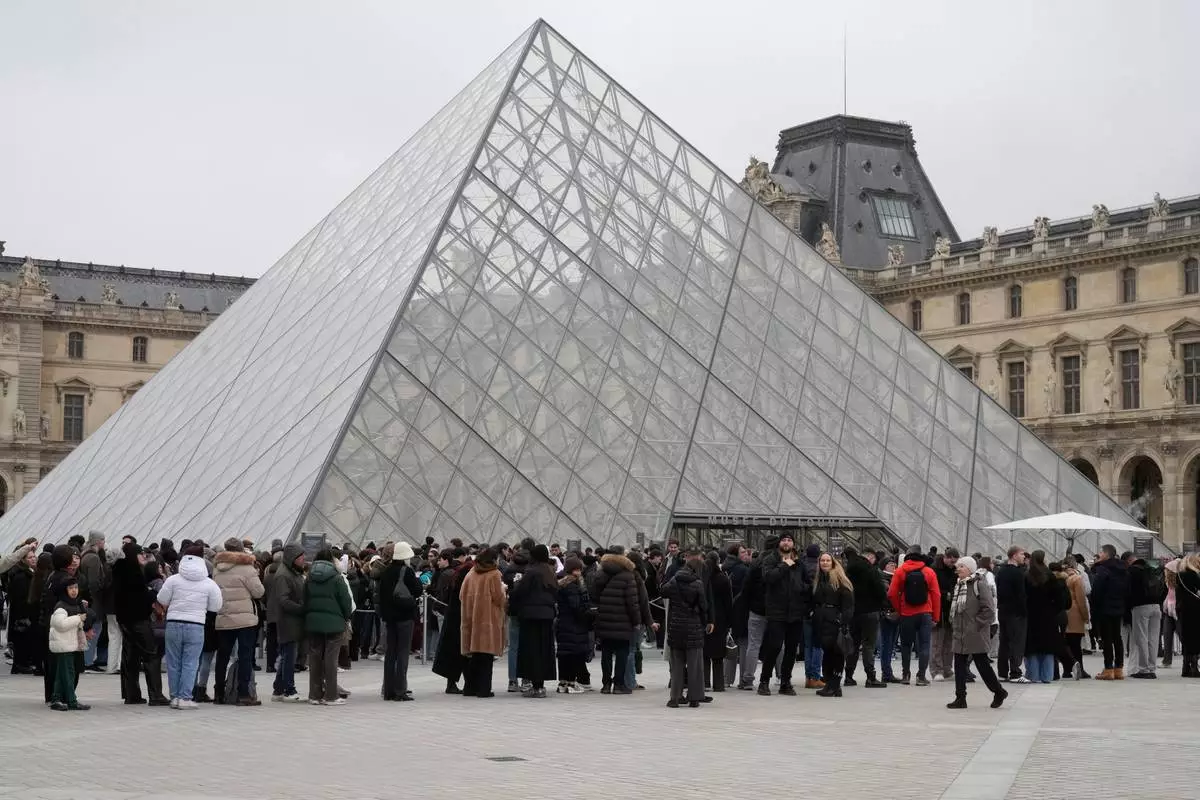
People queue outside the Louvre museum, in Paris, France, Friday, Feb. 13, 2026. (AP Photo/Michel Euler)
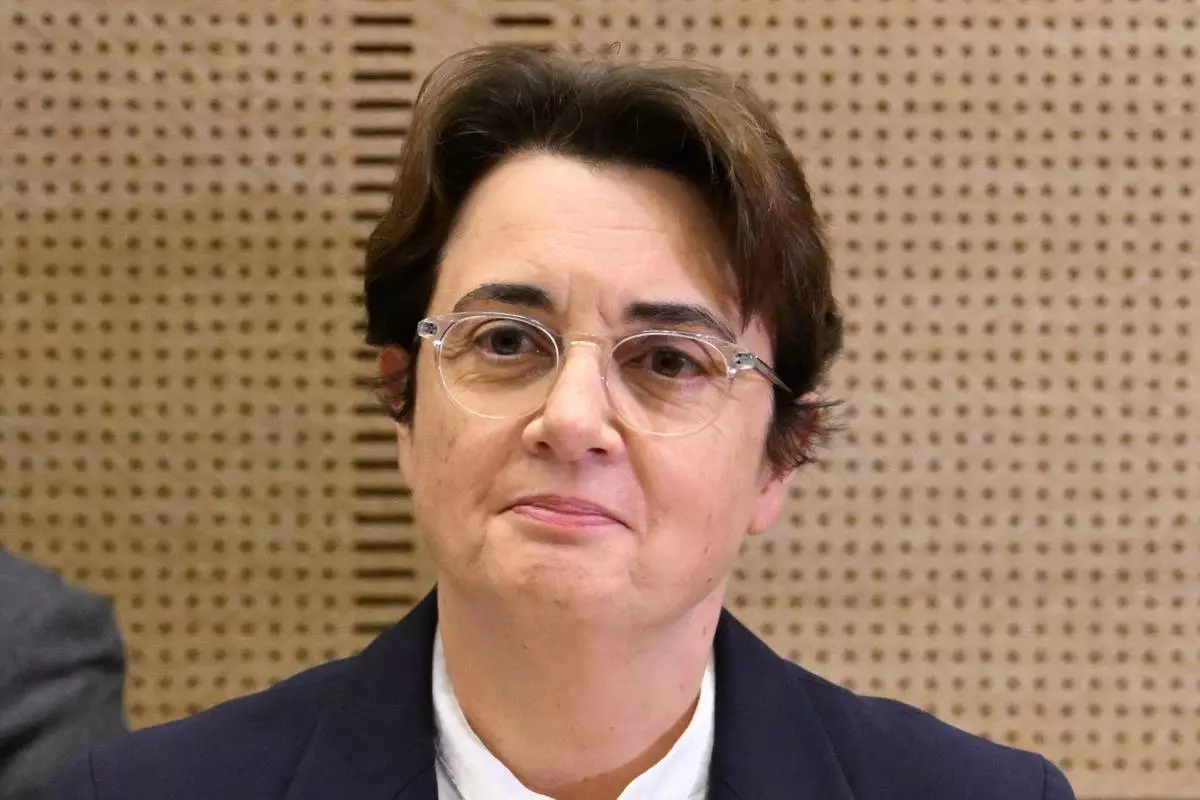
FILE - Laurence des Cars, director of Le Louvre museum, poses before a hearing at the Culture commission of the Senate, three days after historic jewels were stolen in a daring daylight heist, Oct. 22, 2025 in Paris. (AP Photo/Emma Da Silva, File)
KYIV, Ukraine (AP) — Ukrainian President Volodymyr Zelenskyy declared Tuesday that Russia has not “broken Ukrainians” nor triumphed in its war, four years after an invasion that has severely tested the resolve of Kyiv and its allies and fueled European fears about the scale of Moscow’s ambitions.
In a show of support, more than a dozen senior European officials headed to the Ukrainian capital to mark the grim anniversary of the conflict, which has killed tens of thousands of people, upended life for millions of Ukrainians, and created instability far beyond its borders.
Zelenskyy said his country has withstood the onslaught by Russia’s bigger and better equipped army, which over the past year of fighting captured just 0.79% of Ukraine’s territory, according to the Institute for the Study of War, a Washington-based think tank. Russia now holds nearly 20% of Ukraine.
“Looking back at the beginning of the invasion and reflecting on today, we have every right to say: We have defended our independence, we have not lost our statehood,” Zelenskyy said on social media, adding that Russian President Vladimir Putin has “not achieved his goals.”
“He has not broken Ukrainians; he has not won this war,” Zelenskyy said.
Despite the show of defiance, Ukraine has struggled to hold off Russia's onslaught, and the war has brought widespread hardship for Ukrainian civilians. Russia’s aerial attacks have devastated families and denied civilians power and running water.
Putin made no mention of the anniversary nor did he say how the war was going when he spoke at a meeting in Moscow of top officials of the Federal Security Service, or FSB, on Tuesday.
However, he told them that the threat of Ukrainian attacks on Russian soil has grown. Ukraine has increasingly deployed long-range drones that it has developed to strike oil refineries, fuel depots and military logistics hubs more than 1,000 kilometers (600 miles) inside Russia.
As the war of attrition enters its fifth year, a U.S.-led diplomatic push to end the largest conflict on the continent since World War II appears no closer to a peace deal.
Negotiations are stuck on what happens to the Donbas, eastern Ukraine’s industrial heartland that Russian forces mostly occupy but have failed to seize completely, and the terms of a postwar security arrangement that Kyiv is demanding to deter any future Russian invasion.
The U.N. General Assembly called Tuesday for an immediate ceasefire and a comprehensive peace in Ukraine, rejecting a U.S. attempt to eliminate language stressing the country’s sovereignty and territorial integrity.
Washington supports an immediate ceasefire, U.S. Deputy Ambassador Tammy Bruce said before the vote, but opposed language stressing Ukraine’s territorial unity because it would “distract” from the peace talks.
The 193-member General Assembly approved the original wording 107-12, with the United States among the 51 countries abstaining.
At a makeshift memorial in Kyiv’s central square, where thousands of small flags and portraits show photos of fallen soldiers, Zelenskyy said he would like U.S. President Donald Trump to visit and witness for himself Ukrainian suffering.
“Only then can one truly understand what this war is really about,” Zelenskyy said. When later asked how four years of war had changed him, Zelenskyy said, “I don't have time for friends or friendships.”
Trump, who once vowed to end the war in a day, has repeatedly changed his tone toward Putin and Zelenskyy over the past year: sometimes criticizing the Ukrainian leader's negotiating position while reaching out to the Russian leader and at others lashing out at Putin for heavy barrages and appearing more sympathetic to the Ukrainian predicament.
Kremlin spokesperson Dmitry Peskov said that the invasion would continue in pursuit of Moscow's goals. They include a demand that Ukraine renounce its bid to join NATO, sharply cut its army, and cede vast swaths of territory.
Zelenskyy said he expected a fresh round of U.S.-brokered talks with Russia within the next 10 days.
The number of soldiers killed, injured or missing on both sides could reach 2 million by spring, with Russia sustaining the largest number of troop deaths for any major power in any conflict since World War II, a report last month from the Center for Strategic and International Studies estimated.
European leaders see their countries’ own security at stake in Ukraine amid concerns that Putin may target them next.
German Chancellor Friedrich Merz wrote on X that “for four years, every day and every night has been a nightmare for the Ukrainians — and not just for them, but for us all. Because war is back in Europe.”
“We will only end it by being strong together, because the fate of Ukraine is our fate,” he added.
Putin believes that time is on the side of his bigger army, Western officials and analysts say — and that Western support will trail off and that Ukraine’s military resistance will eventually crumble. Already Trump has ended new military aid to Ukraine — though other NATO countries now buy American weapons and give them to Kyiv.
But French President Emmanuel Macron described the war as “a triple failure for Russia: military, economic, and strategic.” The war “has strengthened NATO — the very expansion Russia sought to prevent — galvanized Europeans it hoped to weaken, and laid bare the fragility of an imperialism from another age,” Macron said on X.
The European Union has also sent financial aid, but has sometimes met with reluctance from members Hungary and Slovakia.
While NATO countries have come to Ukraine’s aid, Russia has been helped by North Korea, which has sent thousands of troops and artillery shells; Iran, which has provided drone technology; and China, which the United States and analysts say has provided machine tools and chips.
Among the European officials visiting Kyiv on Tuesday were President of the European Commission Ursula von der Leyen and Finnish President Alexander Stubb, as well as seven prime ministers and four foreign ministers.
Zelenskyy later said von der Leyen assured him that Ukraine would receive the first tranche of a 90 billion euro loan by the spring despite Hungary's attempts to block it.
The only American listed among the official guests in Kyiv ceremonies was Lt. Gen. Curtis Buzzard, a U.S. officer who represents NATO in Ukraine.
British Armed Forces Minister Al Carns said Russia's war on Ukraine was “the most defining conflict” in decades, bringing a “revolution in military affairs,” especially through the rapid development of drone technology. Drones now cause the vast majority of battlefield casualties, he said.
Both sides face challenges in finding enough troops and are increasingly turning to uncrewed aerial drones that can attack far from the front lines, the London-based International Institute for Strategic Studies said in its annual report on the global military situation.
“Given both sides’ reliance on external support for materiel, decisions taken in foreign capitals will play an important role in shaping the war’s trajectory,” the think tank added.
The United Kingdom on Tuesday announced a new package of military and humanitarian support for Ukraine, including sending teams of British military medics to instruct their Ukrainian counterparts.
The cost of rebuilding war-battered Ukraine would amount to almost $588 billion over the next decade, according to World Bank, the European Commission, the United Nations and the Ukrainian government. That is nearly three times the estimated nominal GDP of Ukraine for last year, they said in a report Monday.
Associated Press reporters across Europe contributed to this story.
Follow AP’s coverage of the war in Ukraine at https://apnews.com/hub/russia-ukraine
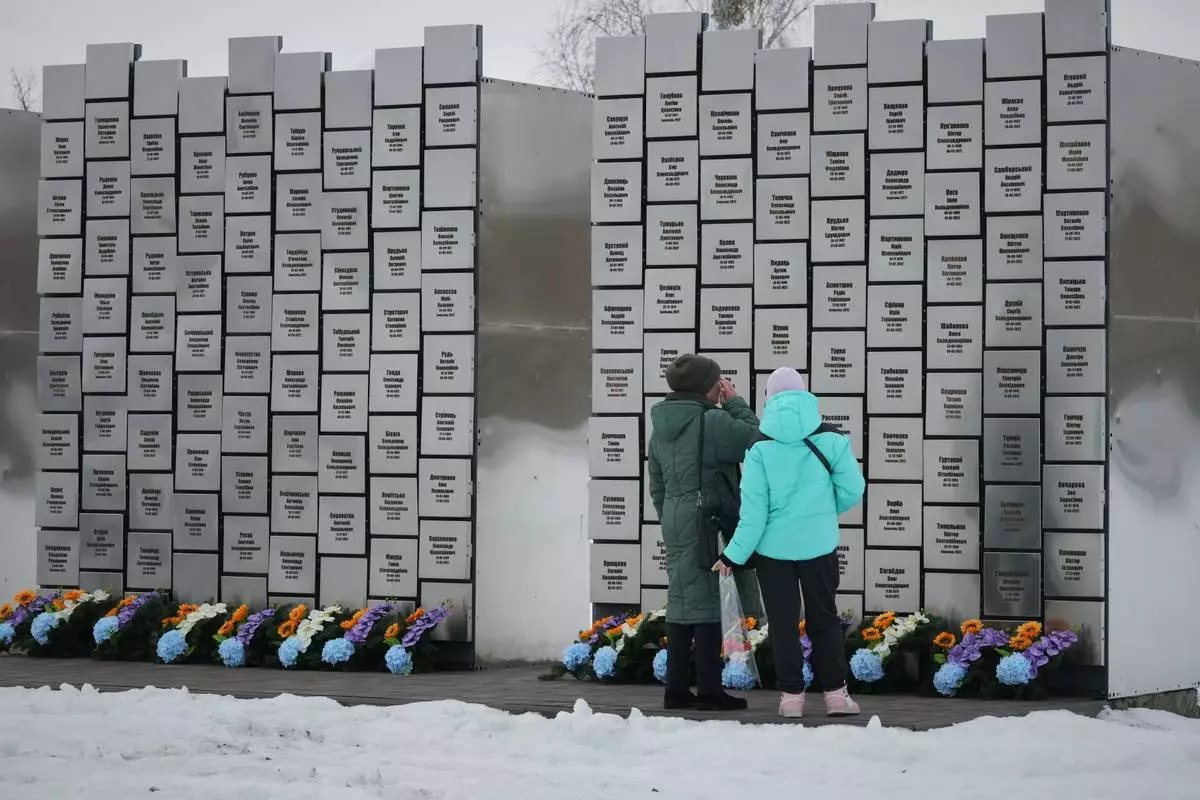
Relatives of those killed during the Russian occupation stand near the Wall of Remembrance during a ceremony to mark the fourth anniversary of the Russian invasion of Ukraine, in Bucha, Ukraine, Tuesday, Feb. 24, 2026. (AP Photo/Sergei Grits)
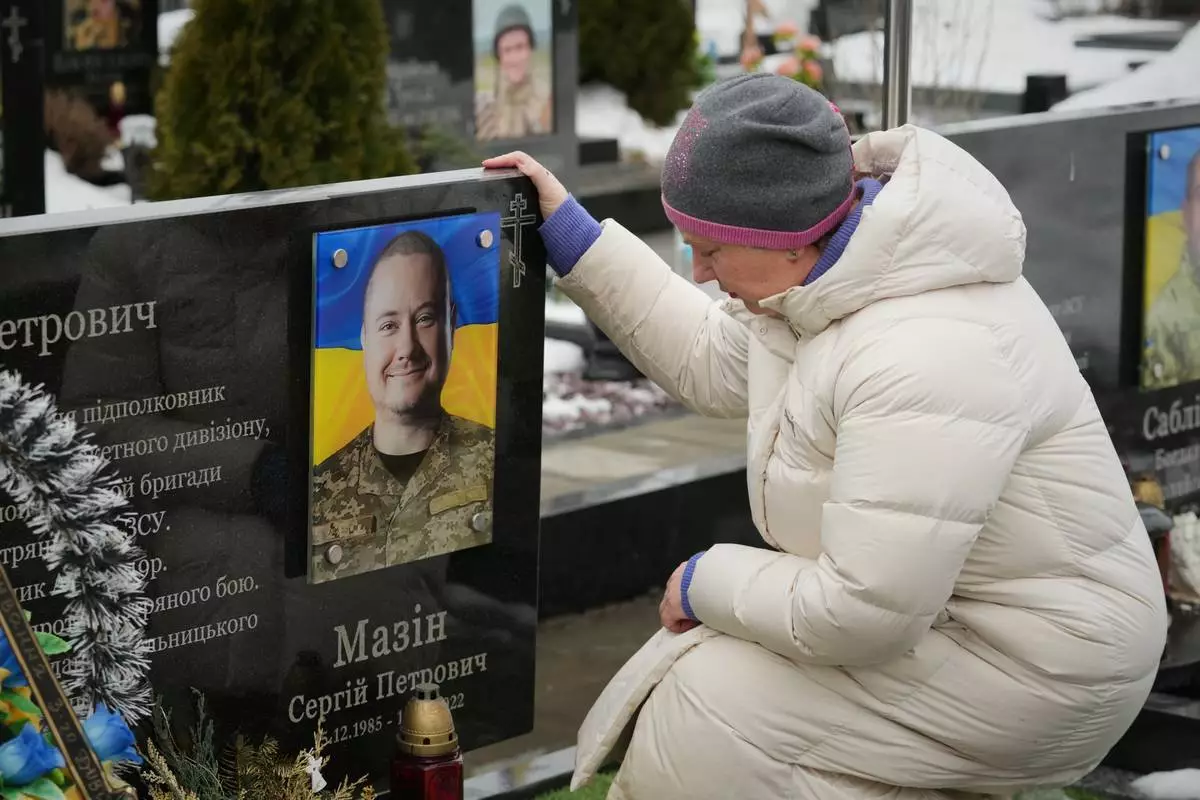
A woman sits in front of a grave of her relative during memorial service for fallen Ukrainian soldiers during a ceremony to mark the fourth anniversary of the Russian invasion of Ukraine, in Bucha, Ukraine, Tuesday, Feb. 24, 2026. (AP Photo/Sergei Grits)
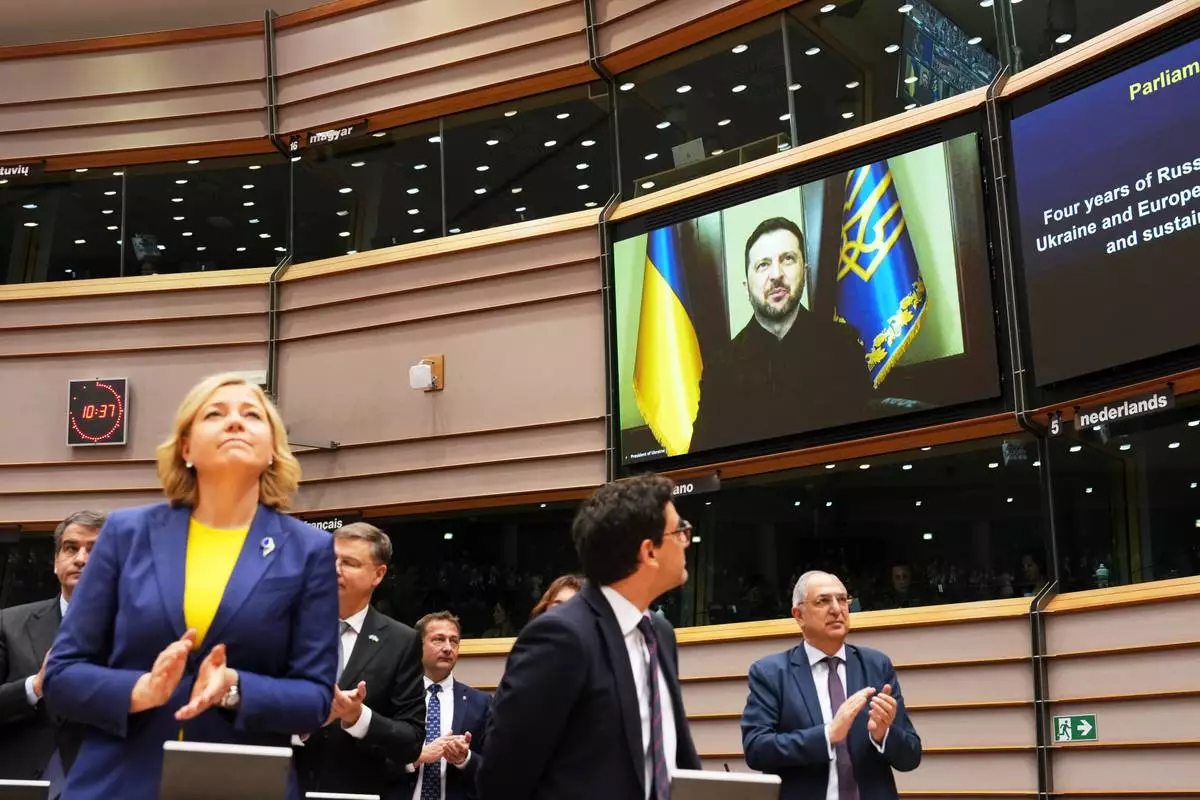
European Commissioner for Tech Sovereignty, Security and Democracy Henna Maria Virkkunen, left, and European Commissioner for Prosperity and Industrial Strategy Stephane Sejourne, center, stand after an address by Ukraine's President Volodymyr Zelenskyy via video link, during an extraordinary plenary session held for the fourth anniversary of Russia's invasion of Ukraine, at the European Parliament in Brussels, Tuesday, Feb. 24, 2026. (AP Photo/Marius Burgelman)
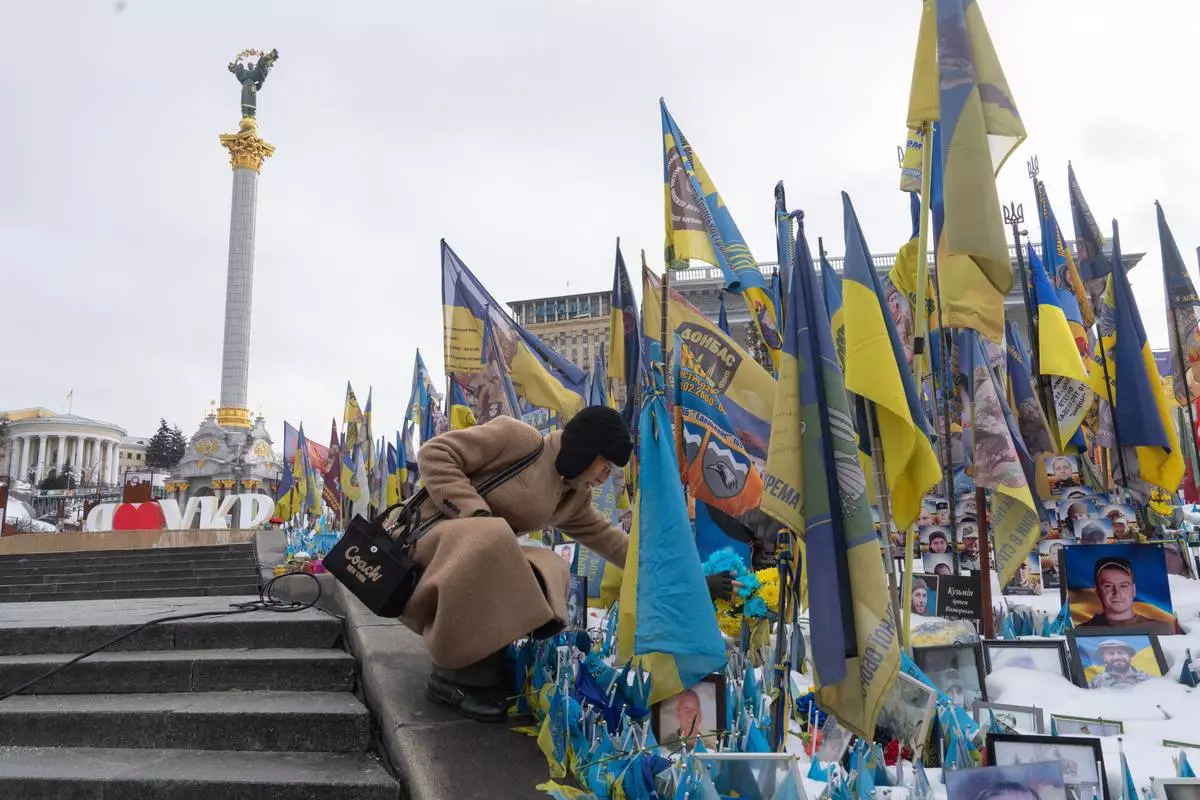
A woman place flowers at the memorial to the fallen Ukrainian soldiers on Independence Square to mark the fourth anniversary of Russia's full-scale invasion in Kyiv, Ukraine, Tuesday, Feb. 24, 2026. (AP Photo/Efrem Lukatsky)
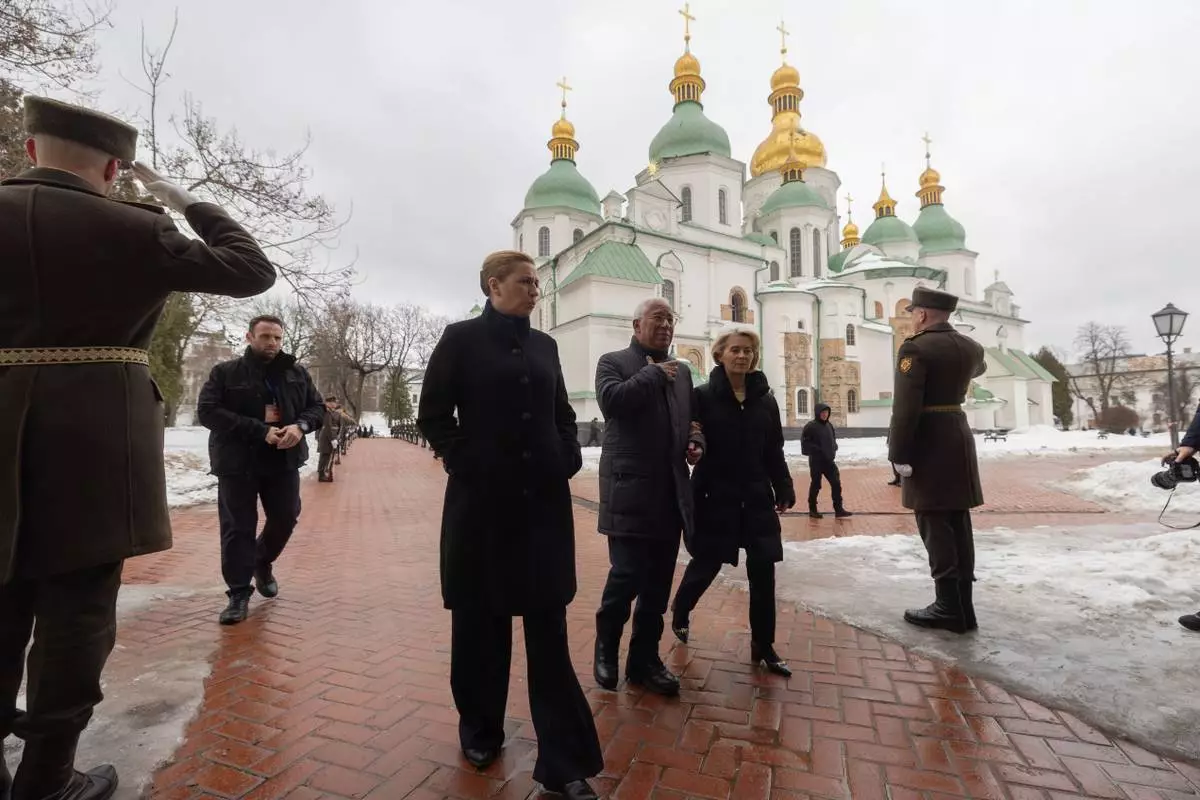
In this photo provided by the Ukrainian Presidential Press Office, Denmark's Prime Minister Mette Frederiksen, left, European Council President Antonio Costa, center, and European Commission President Ursula von der Leyen pass by St. Sophia Cathedral in Kyiv, Ukraine, Tuesday, Feb. 24, 2026. (Ukrainian Presidential Press Office via AP)
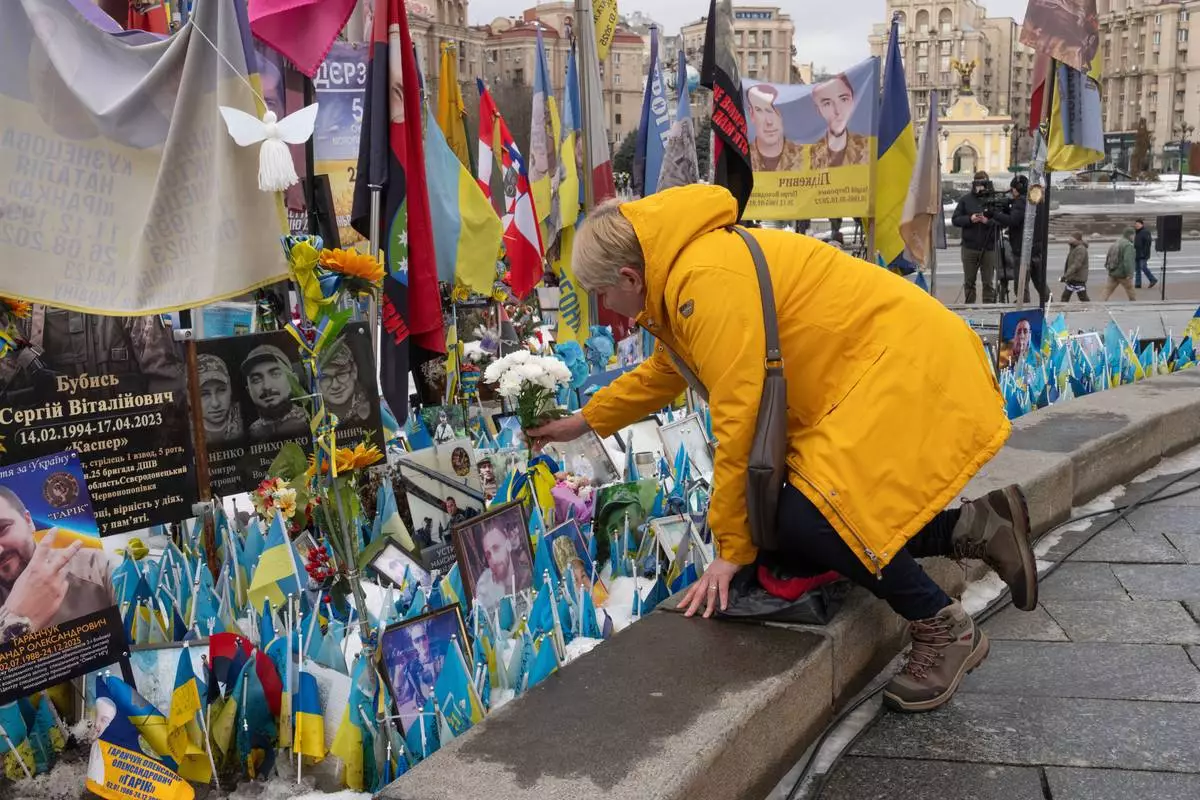
A woman place flowers at the memorial to the fallen Ukrainian soldiers on Independence Square to mark the fourth anniversary of Russia's full-scale invasion in Kyiv, Ukraine, Tuesday, Feb. 24, 2026. (AP Photo/Efrem Lukatsky)
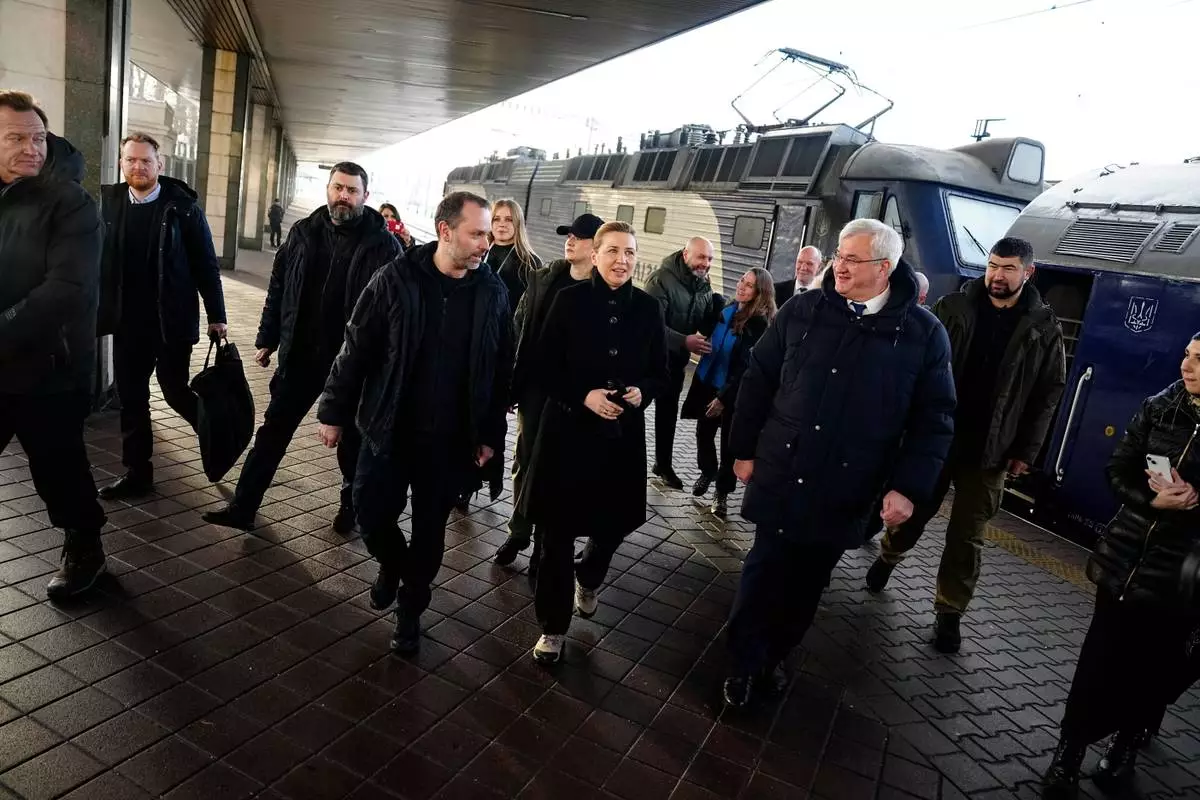
Denmark's Prime Minister Mette Frederiksen, centre, is welcomed by Ukraine's Foreign Minister Andrii Sybiha, centre right, as she arrives in Kyiv, Ukraine, Tuesday, Feb. 24, 2026. (Mads Claus Rasmussen/Ritzau Scanpix via AP)
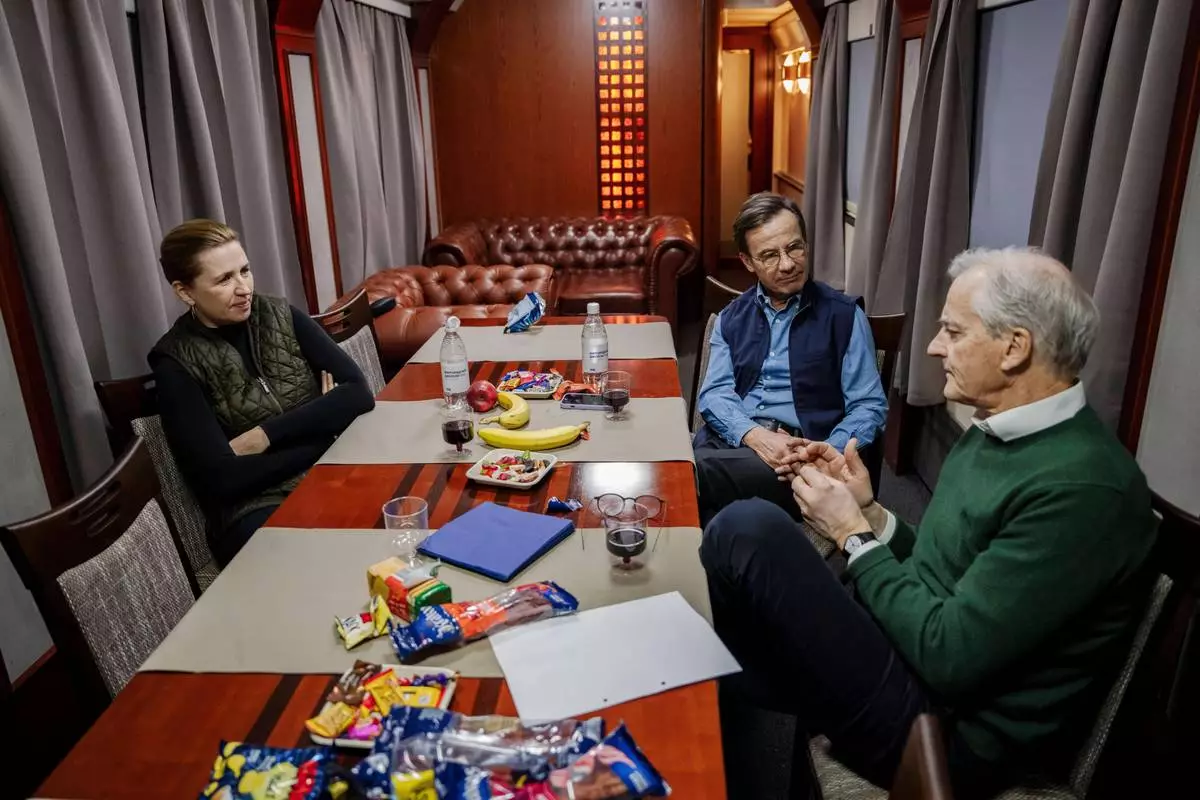
From left: Denmark's Prime Minister Mette Frederiksen, Sweden's Prime Minister Ulf Kristersson and Norway's Prime Minister Jonas Gahr Stoere talk in the train during their journey from Poland's Medyka to Kyiv, Ukraine, Tuesday, Feb. 24, 2026. (Mads Claus Rasmussen/Ritzau Scanpix via AP)
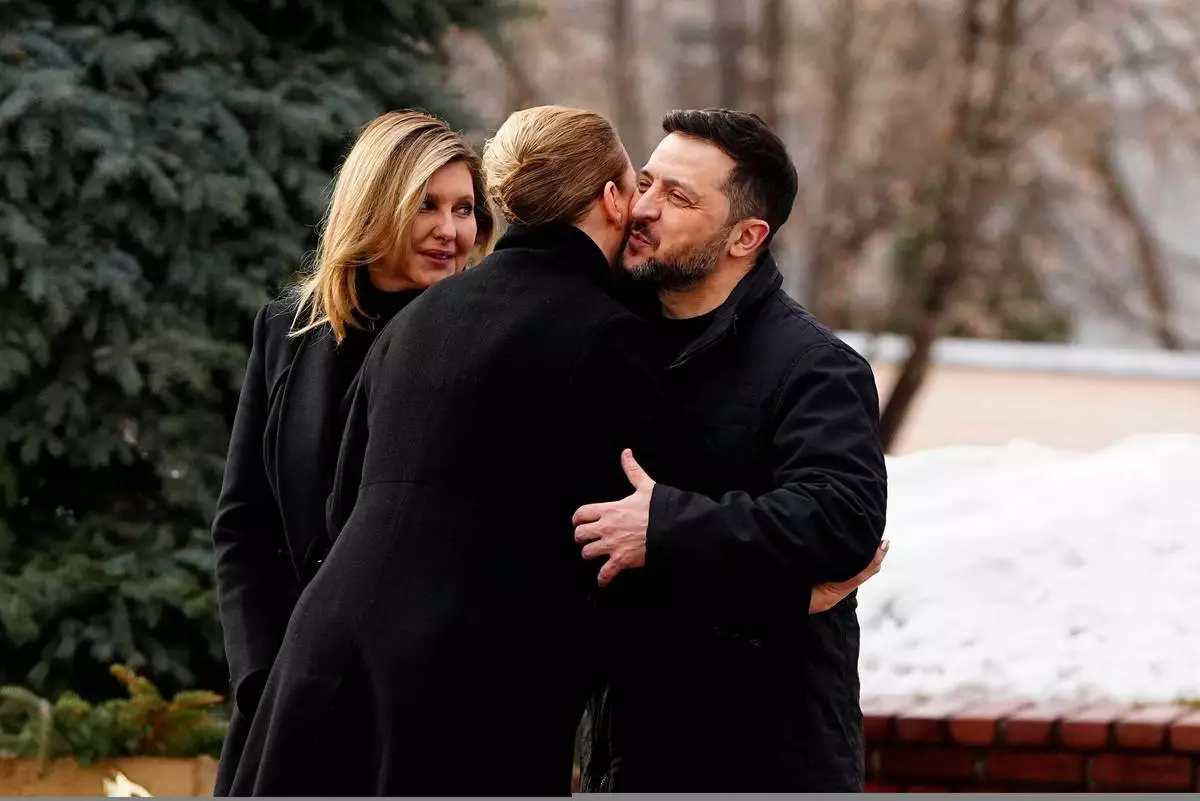
Denmark's Prime Minister Mette Frederiksen, centre, is welcomed by Ukraine's President Volodymyr Zelenskyy and his wife Olena Zelenska, left, before a service at St. Sophia Cathedral in Kyiv, Ukraine, on Tuesday, Feb. 24, 2026. (Mads Claus Rasmussen/Ritzau Scanpix via AP)