WASHINGTON (AP) — The American consumer’s confidence in the U.S. economy improved slightly in February after cratering a month earlier.
The Conference Board said Tuesday that its consumer confidence index rose to 91.2 in February from an upwardly revised 89 last month.
A measure of Americans’ short-term expectations for their income, business conditions and the job market rose four points to 72, remaining well below 80, the marker that can signal a recession ahead. It’s the 13th consecutive month that reading has come in under 80.
The measure of consumers’ assessments of their current economic situation fell by 1.8 points to 120.
Respondents’ references to prices and inflation were little changed but remain elevated. Mentions of trade and politics increased, while references to labor market conditions eased as perceptions of the job market improved modestly this month.
The country’s labor market has been stuck in a “low hire, low fire” state, economists say, as businesses stand pat due to uncertainty over Trump’s tariffs and the lingering effects of elevated interest rates.
Earlier this month, the government reported that employers added a surprisingly strong 130,000 nonfarm jobs in January. Still, the economy gained just 584,000 jobs in 2025, about one-fourth of the more than 2 million added in 2024.
The softening job market comes even as the U.S. economy keeps growing, often beyond projections.
U.S. economic growth slowed in the final three months of last year, dragged down by the six-week shutdown of the federal government and a pullback in consumer spending. The weaker fourth-quarter growth of 1.4% followed stronger-than-expected figures of 4.4% in the July-September quarter and 3.8% in the quarter before that.
According to the Conference Board's February survey, consumers’ plans to buy big-ticket items over the next six months rose, with plans to buy used cars, furniture, TVs, and smartphones leading the way.
Home-buying expectations were little changed in February, generally a slow time for the housing market, which has been mired in a yearslong slump.

FILE - A shopper checks out at a cash register in a grocery store in Schaumburg, Ill., Monday, Feb. 9, 2026. (AP Photo/Nam Y. Huh, File)
Neighbors, government workers and a powerful railroad snow-clearing machine nicknamed “Darth Vader” have been digging out from a brutal storm that forecasters are calling the strongest in a decade. It dumped more than two feet of snow across much of the northeastern United States, and a record three feet in Warwick, Rhode Island.
Thousands of flights were cancelled and hundreds of thousands of people lost power. As roads begin to reopen and mass transportation comes back online, New York City Mayor Zohran Mamdani insisted on schools reopening Tuesday. Meanwhile forecasters warn that another big winter storm could be on its way.
The Latest:
The agency said early Tuesday that Rhode Island gets top honors for 37.9 inches, a preliminary state record, at the airport in Providence. And as of 3 a.m., snow totals weren’t complete for Connecticut, Maine, Massachusetts, New Hampshire and Rhode Island, where the storm’s remnants were passing through. Other top state accumulations so far:
White House press secretary Karoline Leavitt says the Federal Emergency Management Agency is “on the ground” working with state and local authorities to restore power, even though the agency is operating without a budget.
More than 350,000 customers in the Northeast were without electricity Tuesday morning, according to Poweroutage.com, which tracks outages nationwide.
“The Trump administration is on it,” Leavitt said, when asked for the administration’s message to those getting by without electricity.
A fight in Congress over federal immigration officers has led to a lapse in funding for the Department of Homeland Security, which houses FEMA.
Roughly 2,200 flights in and out of the United States were canceled Tuesday, according to the flight tracking website FlightAware.
Most of the cancellations involved Boston and the New York City area’s three major airports, affecting about half of all departing flights. About 14 percent of departing flights were canceled at Reagan National Airport in Washington, D.C.
Rhode Island’s T.F. Green International Airport’s operational pause remained in effect Tuesday as authorities assessed conditions. The airport paused all flights Monday as it dealt with nearly 38 inches (97 centimeters) of snow, according to the Weather Service, breaking a record of 28.6 inches (72.6 centimeters) set in 1978. The airport is in Warwick, six miles south of Providence, the state capital.
The nor’easter may have moved on, but there are still a lot of power outages.
More than 350,000 customers in the Northeast were without electricity Tuesday morning, according to Poweroutage.com, which tracks outages across the country. Outages reached over 600,000 during the peak of the storm Monday. Most are in Massachusetts.
Cape Cod, Martha’s Vineyard and other coastal communities experienced the worst of the storm and suffered the most severe damage, Eversource said. Power restoration was expected to take multiple days, the utility said.
About 20% of Massachusetts households depend on electricity for heating. Most heat their homes with natural gas, and another 20% use fuel oil or kerosene, according to Census estimates.
This is just a regular school day in New York City for more than a million students in the nation’s largest public school system — the mayor said so, and invited kids to pelt him with snowballs over his decision.
Many students and their caregivers seemed open to taking Mamdani up on that snowball idea as they scrambled over mountainous snow banks and dodged salt spreaders during the Tuesday morning drop-off.
“We’re walking on thin ice here. One more day would’ve been fine,” said Danielle Obloj, the parent of a Brooklyn 5th grader. “They should never have let these kids come back to school.”
Others, meanwhile, hailed the city’s efforts at snow-clearing.
“It was much better than last time — an easy commute, no problems whatsoever,” said Raul Garcia, as he exited a cab with his three school-age children. “We thought it was going to be really bad walking, but looking at the streets, they’re so clean.”
A massive snowball fight erupted Monday in New York City’s Washington Square Park as the blizzard wound down, but it wasn’t all fun and games.
A viral video showed two very outnumbered police officers being pelted by snowballs — and shoving some of the people throwing them — in frustration as they tried to get away.
City police commissioner Jessica Tisch posted that the NYPD is aware of the video, calling the behavior “disgraceful” and “criminal.”
Mayor Zohran Mamdani announced that schools would be back in person on Tuesday, drawing questions about how feasible that is with snow still piled along sidewalks.
Staten Island Borough President Vito Fossella said schools should remain closed, while Michael Mulgrew, president of the United Federation of Teachers, described the situation as “a big mess.”
“There’s going to be low attendance of students, you’re going to have low attendance of staff because people don’t know if they can travel, if they can get to schools,” he said.
Mamdani's schools chief, Chancellor Kamar Samuels, said in a post on X, “We are confident in our decision to reopen.”
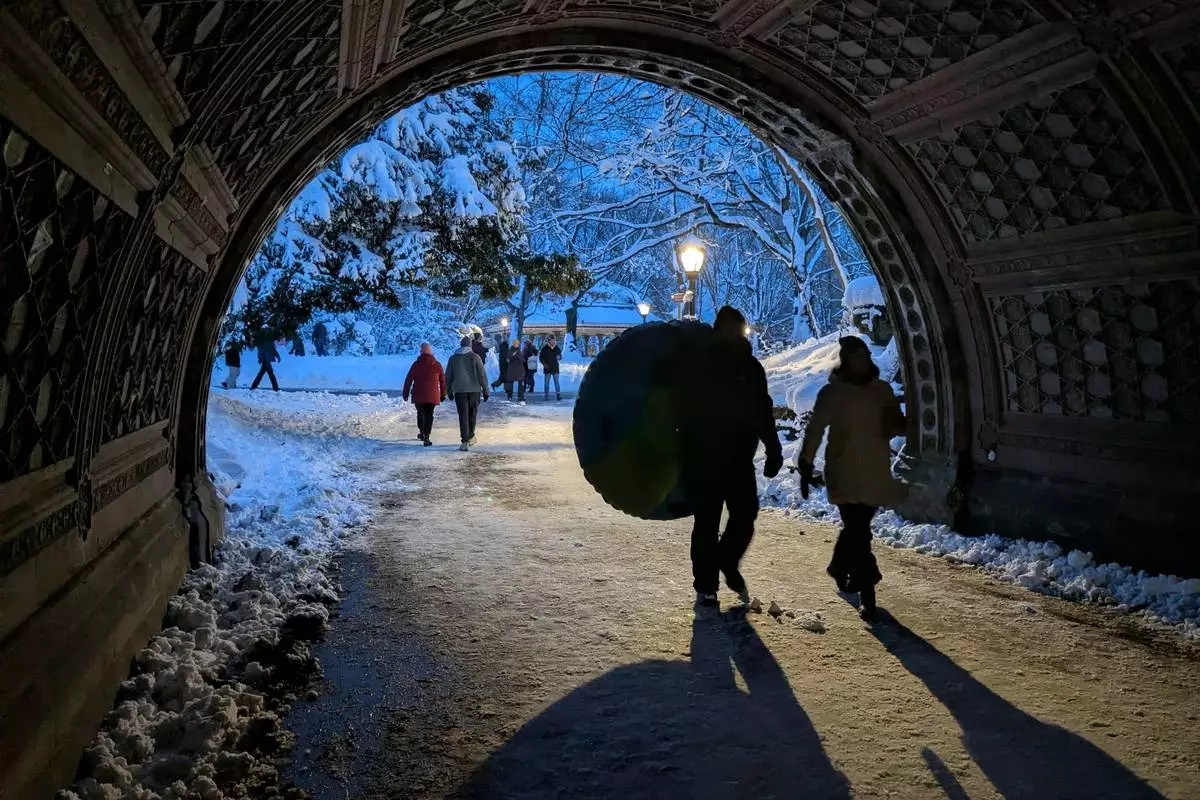
A man carries an inflatable inner-tube for snow sledding in Prospect Park in the borough of Brooklyn, New York, on Monday, Feb. 23, 2026. (AP Photo/Drew Callister)
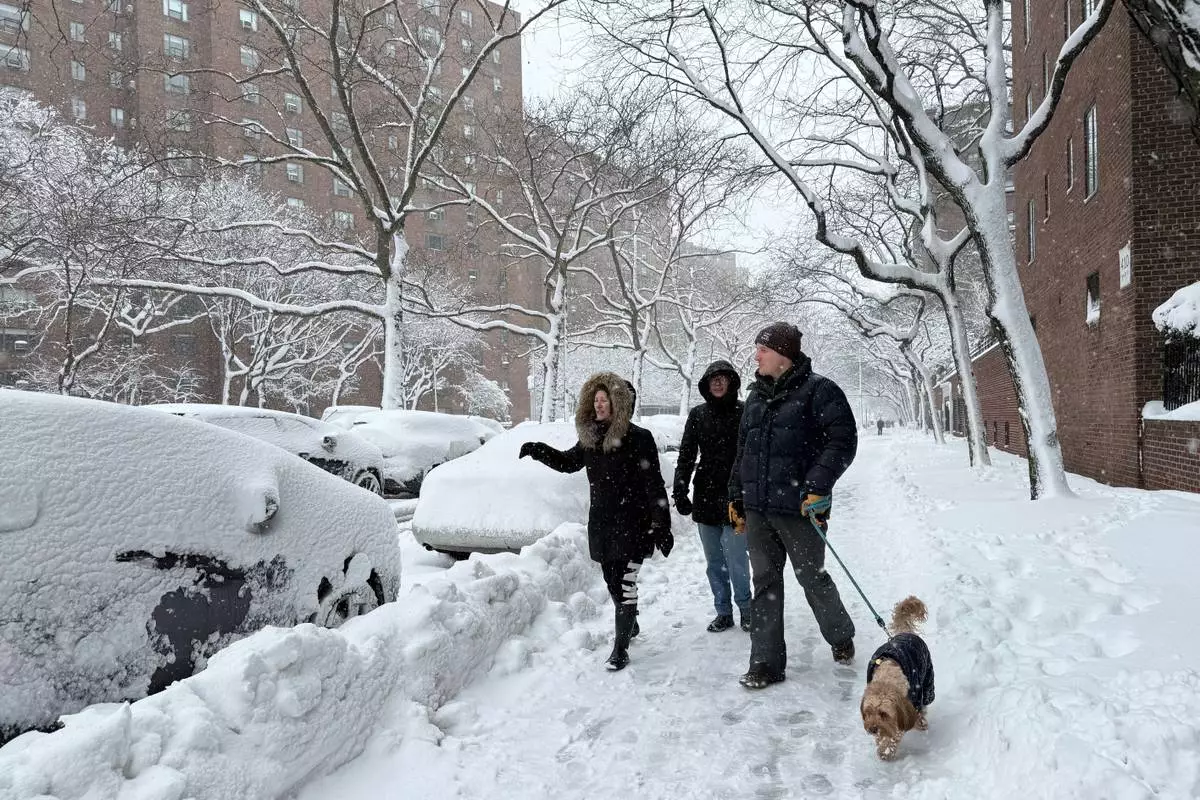
People walk with a dog alongside snow laden parked cars in a snowstorm, Monday, Feb. 23, 2026, in New York. (AP Photo/Pamela Hassell)
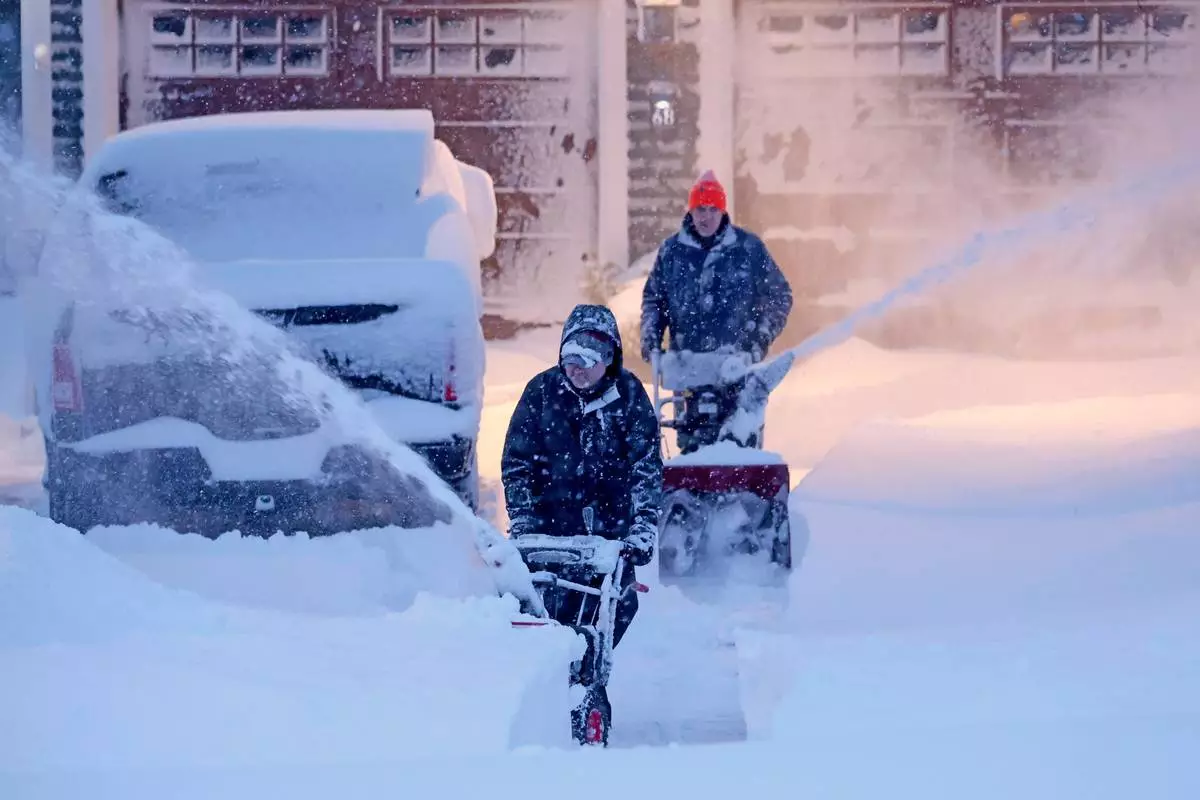
Neighbors team up to clear a driveway, Monday, Feb. 23, 2026, in North Attleborough, Mass. Over two feet of snow fell on the area after a blizzard passed through. (AP Photo/Mark Stockwell)
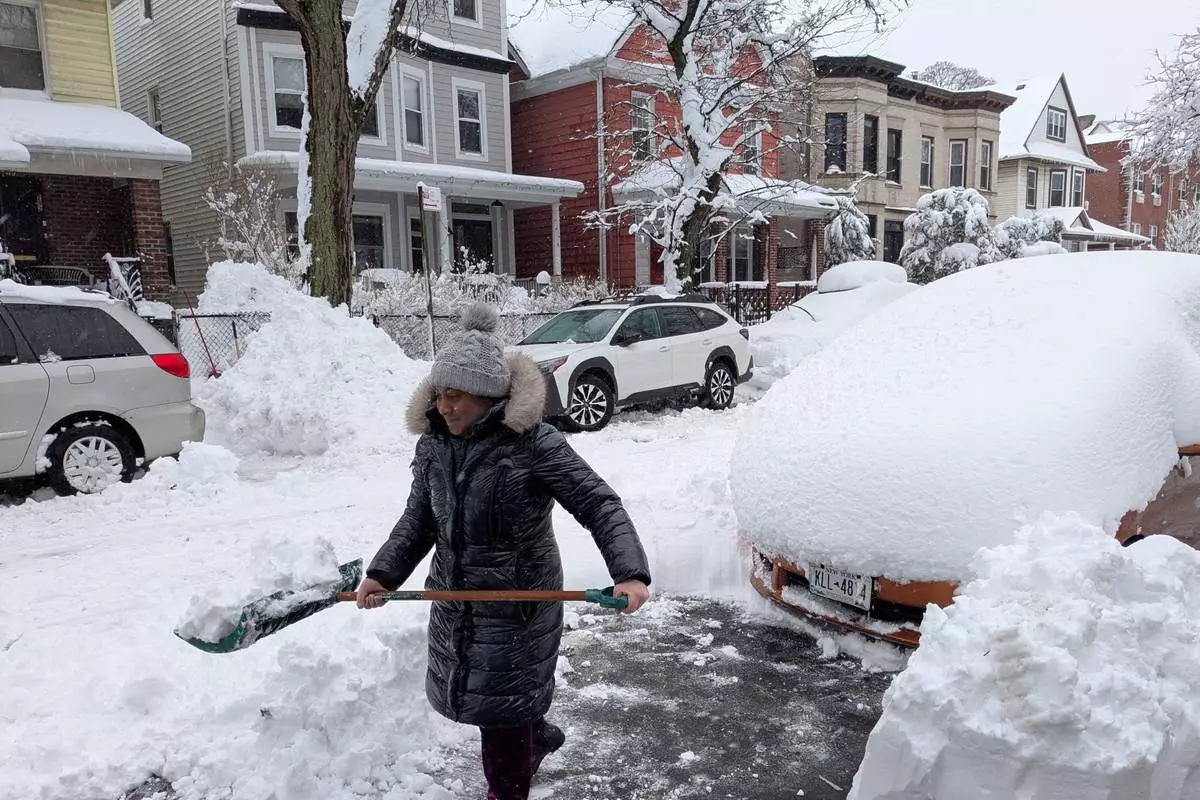
Christa Prince shovels snow during a blizzard in the borough of Brooklyn, New York, on Monday, Feb. 23, 2026. (AP Photo/Drew Callister)
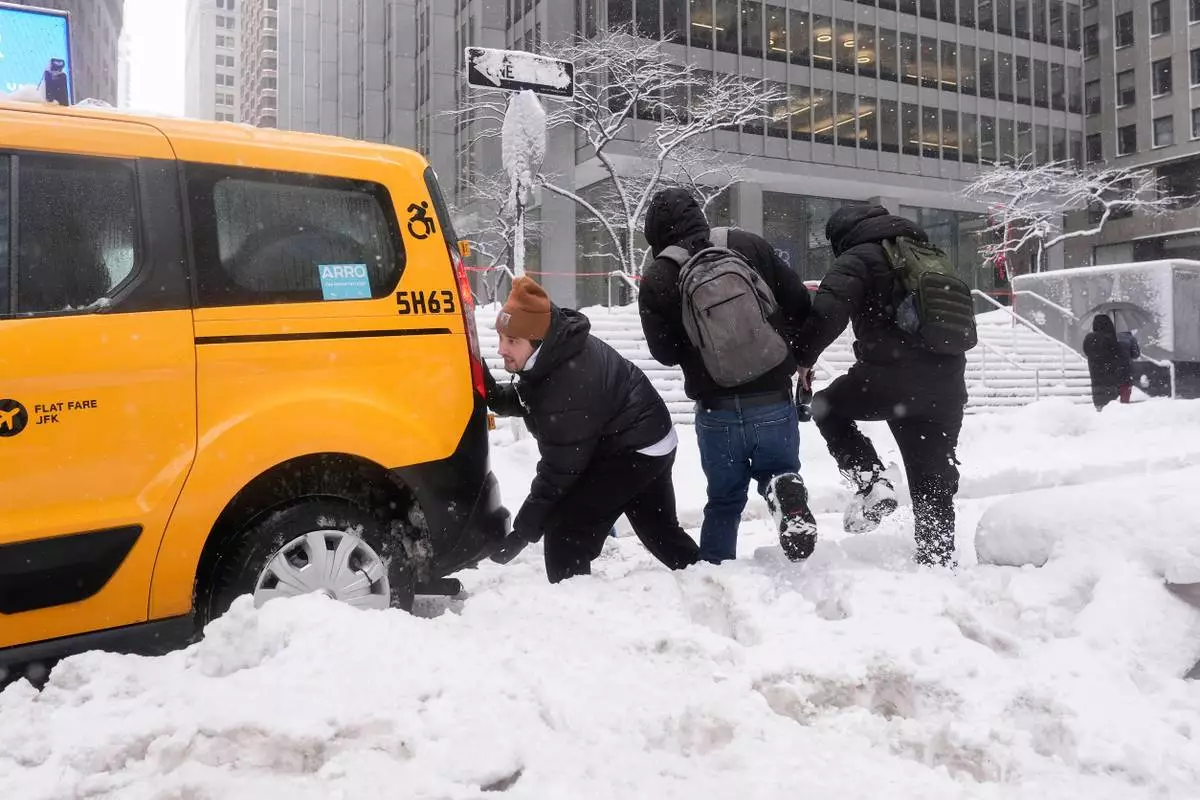
Cameron Betz helps push a taxi stuck in the snow during a snow storm, Monday, Feb. 23, 2026, in New York. (AP Photo/Seth Wenig)