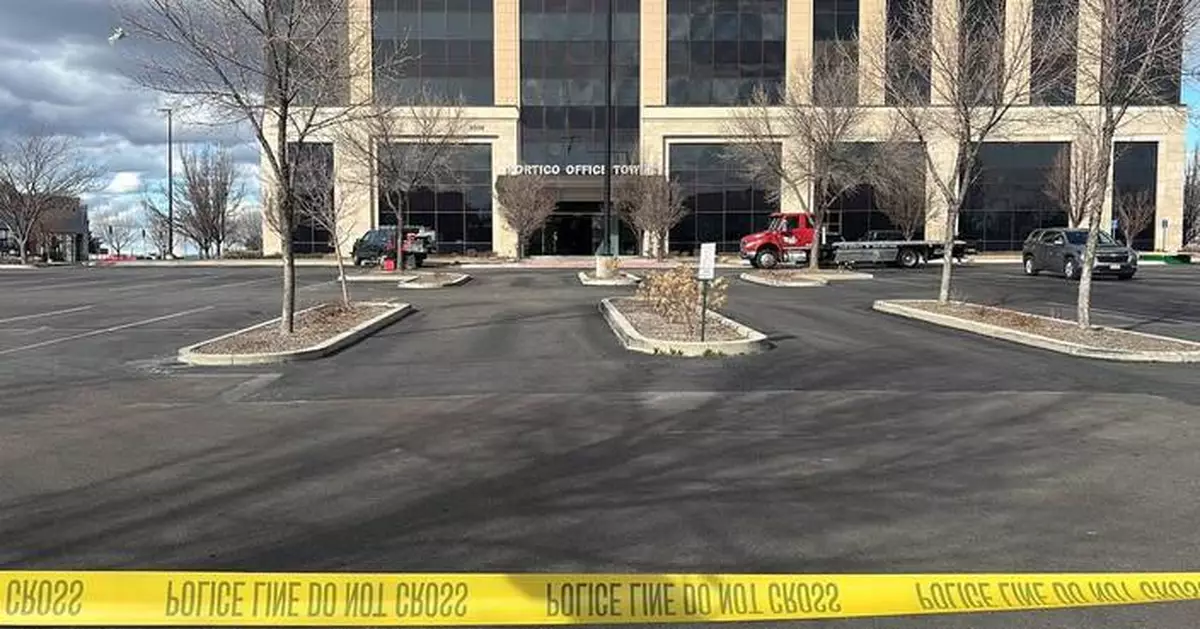
BOISE, Idaho (AP) — A Boise, Idaho woman has been charged with malicious destruction of federal property by fire after prosecutors said she stole an ambulance, drove it into a building that houses U.S. Department of Homeland Security offices and then poured accelerant inside the property.
Sarah Elizabeth George, 43, was scheduled to be arraigned Tuesday afternoon in U.S. District Court in Boise.
In court documents, FBI special agent Daniel Ramirez said a suspect believed to be George stole a Canyon County Paramedics ambulance from St. Luke's Hospital Emergency Center in the Boise bedroom community of Meridian late on Feb. 18. Ramirez said the suspect then drove the ambulance to a nearby parking lot, loaded at least two gas jugs and a plastic bag into the vehicle and then drove the ambulance through the front doors of a nearby office building before getting out and pouring the contents of the jugs on the lobby floor.
The building is owned by St. Luke's Health System and the hospital has faced criticism for leasing space in the building to the Department of Homeland Security while President Donald Trump’s administration carries out his immigration enforcement crackdown.
Messages were left Tuesday for a public defender listed as George’s attorney and at a number listed for George.
Meridian Police Chief Tracy Basterrechea said during a press conference shortly after the incident that responding agencies apparently scared off the suspect before the accelerant was ignited. Police were unable to locate the suspect at the time, but Ramirez wrote in court documents that investigators were able to identify George after reviewing footage from closed-circuit cameras in the area. Camera footage and receipts from stores in the area also showed George purchased gas jugs and gas shortly before the ambulance was stolen, Ramirez said.
George's Facebook page included a post with the words, “If it can be destroyed by the truth then it should be destroyed; it was built in lies anyways,” above an image depicting the White House in flames, Ramirez wrote in court documents.
George is also charged with malicious destruction of property used or affecting interstate or foreign commerce, according to court documents. She has not yet had the opportunity to enter a plea.
Each charge carries a maximum penalty of up to 20 years in prison.
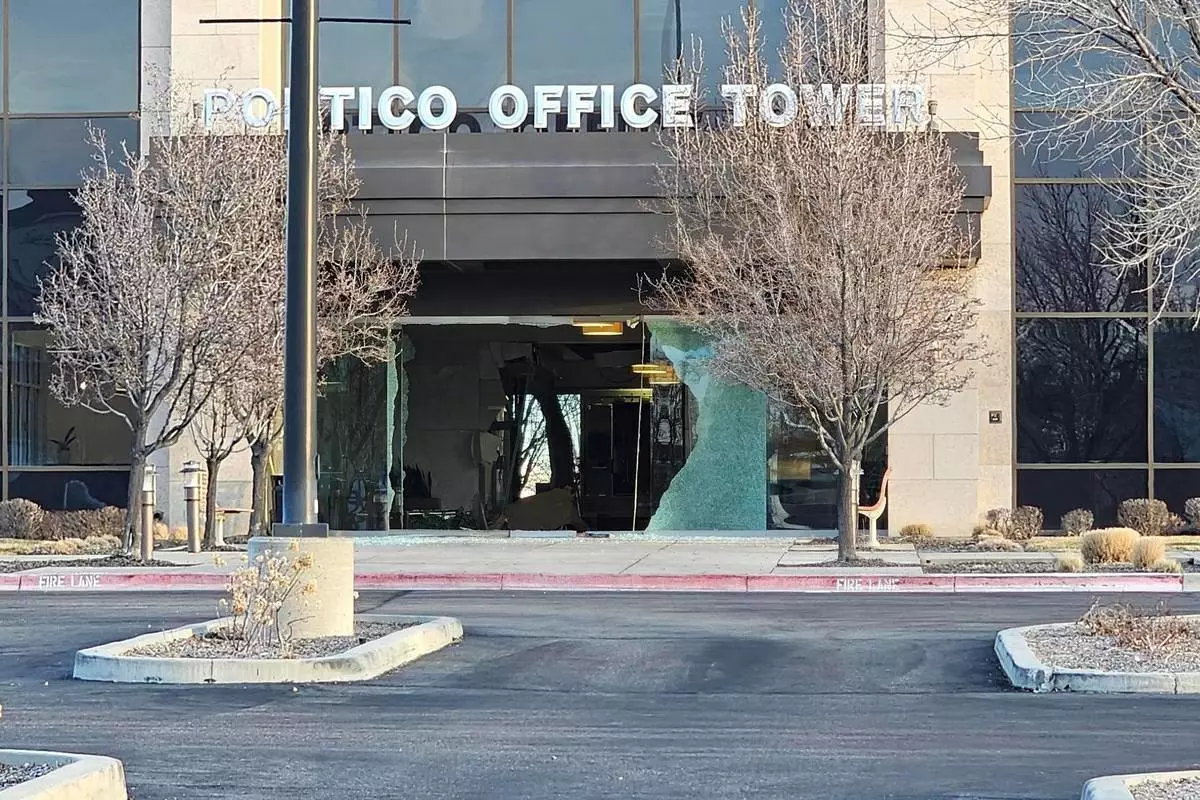
This photo provided by Idaho News 6 shows the aftermath of a stolen ambulance being driven into the Portico North building Thursday, Feb. 19, 2026, in Meridian, Idaho. (Idaho News 6 via AP)
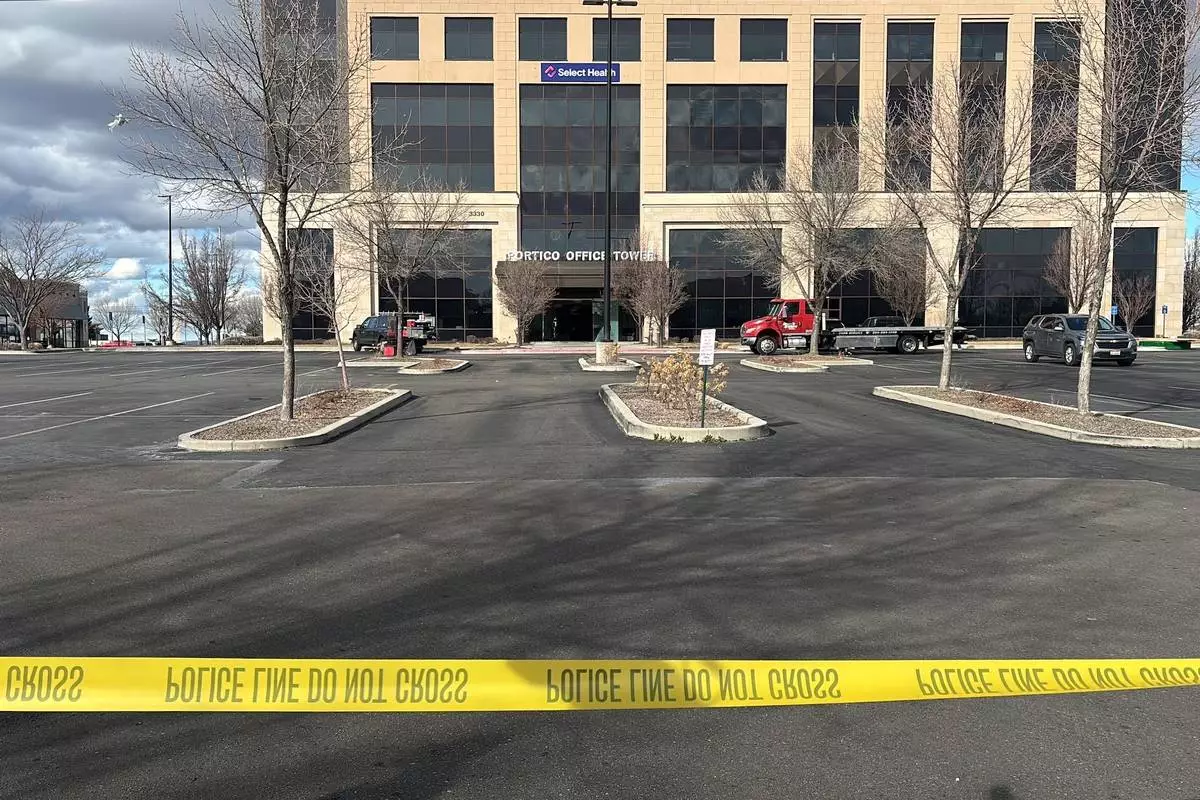
This photo provided by Idaho News 6 shows police tape on the scene where a stolen ambulance was driven into the Portico North building Thursday, Feb. 19, 2026, in Meridian, Idaho. (Idaho News 6 via AP)
PARIS (AP) — The Louvre Museum's director resigned Tuesday after months of pressure following the October theft of the French crown jewels, as the world's most visited museum faced widening scrutiny over security failures, labor unrest and a suspected ticket fraud scheme.
Laurence des Cars quit after a punishing year for the former royal palace — the high-profile jewels heist from the Apollo Gallery, a mid-February burst pipe near the “Mona Lisa,” water leaks damaging priceless books, staff walkouts and a wildcat strike over overcrowding and understaffing.
The landmark has faced a narrative of an institution spiraling out of control.
And that pressure deepened in recent weeks when French authorities revealed a suspected decadelong ticket fraud operation linked to the museum that investigators say may have cost the Louvre 10 million euros ($11.8 million).
President Emmanuel Macron accepted des Cars’ resignation as “an act of responsibility” at a moment when the Louvre needs “calm” and new momentum for security upgrades, modernization and other major projects, according to a statement from his office.
Macron wants to give des Cars a new mission during France’s presidency of the Group of Seven leading industrialized nations, focused on cooperation among major museums, the statement said.
For many in France’s cultural world, the resignation answers months of head-scratching over why no top official had fallen after the heist: a daylight robbery that many in the country saw as the most humiliating breach of French heritage security in living memory.
It also came as lawmakers and cultural officials widened scrutiny of the museum’s leadership and security practices in the months since the breach.
Thieves took less than eight minutes in October to steal crown jewels valued at 88 million euros ($102 million) from the Louvre, in a weekend operation that stunned visitors, exposed glaring vulnerabilities and left one of France's most symbolically charged collections in criminal hands.
Several suspects were later arrested, but the stolen pieces remain missing.
Des Cars, one of the most prominent museum directors in Europe, had offered to resign on the day of the robbery, but it was initially refused by the culture minister.
In remarks after the theft, she described the moment as a “tragic, brutal, violent reality” for the Louvre and said that, as the person in charge, it had felt right to offer her resignation.
In an interview published on Tuesday by daily newspaper Le Figaro, des Cars said that she had tried to steer the Louvre through the fallout from the heist, but had concluded that she could no longer carry out the museum’s transformation in the current institutional climate.
Staying on, she said, would have meant managing the status quo when the museum still needs deep reform.
“I was there to take the lightning” as museum director, she said.
Des Cars also said that the October break-in exposed problems that she had been warning about since taking office, including aging infrastructure, obsolete technical systems and severe congestion.
She had led the Louvre since 2021, taking over one of the museum world’s most prestigious jobs as the institution emerged from the coronavirus pandemic and mass tourism returned.
In June, a wildcat strike by front-of-house staff and security workers forced the Louvre to halt operations, stranding thousands of visitors outside the glass pyramid and underscoring the depth of anger among employees over overcrowding, understaffing and what unions called untenable working conditions.
Workers said that the pressure of daily visitor flows — particularly around the “Mona Lisa” — had become unmanageable and that promised reforms were arriving too slowly. There were growing complaints that the infrastructure and staffing of the crumbling medieval structure haven’t kept pace with the crowds pouring through its galleries.
The resignation came at an especially punishing moment, less than two weeks after French authorities revealed the separate ticket fraud scheme.
That case widened scrutiny beyond the jewels robbery and toward the museum’s day-to-day controls.
Prosecutors say tour guides are suspected of — up to 20 times a day — reusing the same tickets to bring in different visitor groups, at times allegedly with the help of Louvre employees, in a system investigators believe operated for a decade.
In a rare interview just days ago with The Associated Press after the fraud case was made public, the Louvre's No. 2, general administrator Kim Pham, said that fraud at an institution the size of the Louvre was “statistically inevitable.”
He argued that the museum’s sheer scale — millions of visitors, multiple checkpoints and a sprawling historic complex — makes it uniquely exposed.
But he also acknowledged shortcomings, and said that the museum had tightened validation checks and increased controls.
The succession of crises has put new political weight on a project Macron has heavily championed: the Louvre’s sweeping overhaul plan, branded the “Louvre New Renaissance.”
Unveiled by Macron in January 2025, the renovation, which could take up to a decades, aims to modernize a museum widely seen as overstretched and physically worn down by mass tourism.
The plan includes a new entrance near the Seine River to ease pressure on I.M. Pei’s pyramid, new underground spaces and a dedicated room for the “Mona Lisa” with timed access — all intended to improve crowd flow and reduce the daily crush that has become a symbol of the Louvre’s success and its dysfunction.
The project is expected to cost roughly 700 million-800 million euros ($826 million-$944 million), with funding from ticket revenue, state support, donations and Louvre Abu Dhabi-related income.
The scale and cost of that plan now loom over the search for des Cars’ successor.
Macron has framed the overhaul as a national priority, comparing its ambition to other landmark French restoration efforts and casting it as part of a broader defense of French cultural prestige.
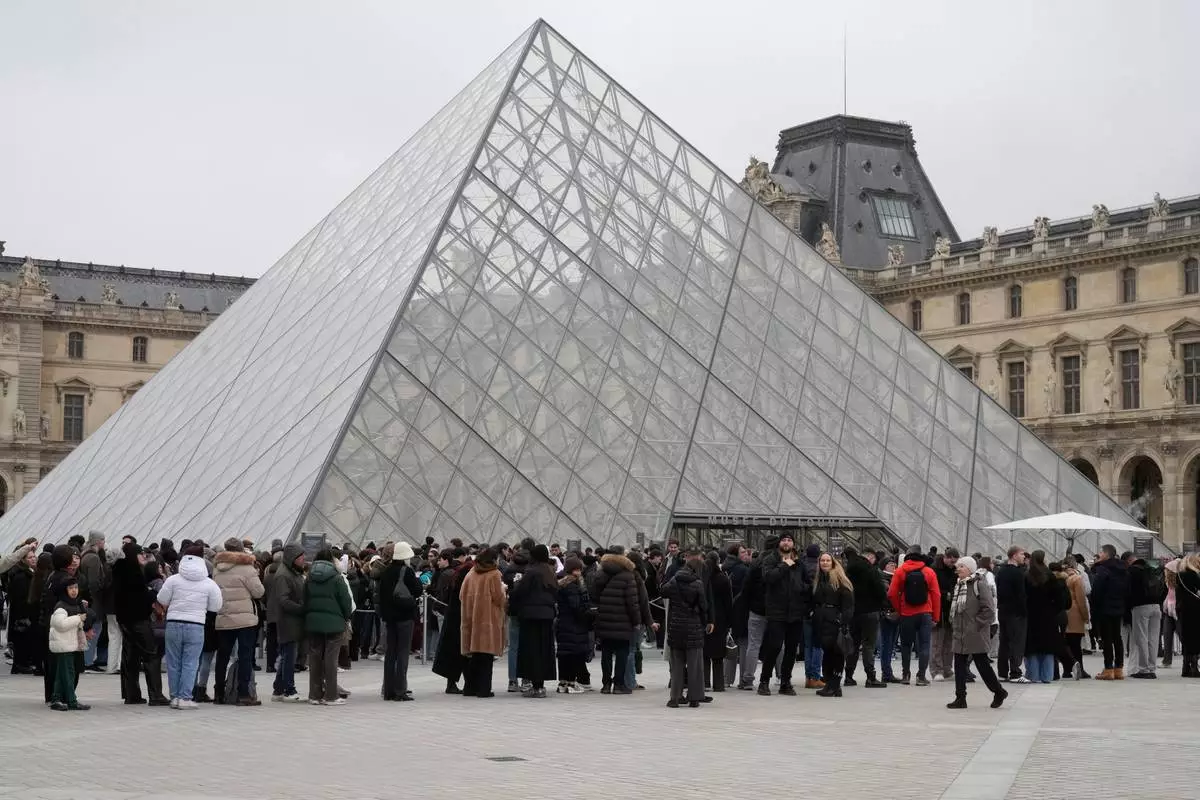
People queue outside the Louvre museum, in Paris, France, Friday, Feb. 13, 2026. (AP Photo/Michel Euler)

FILE - Laurence des Cars, director of Le Louvre museum, poses before a hearing at the Culture commission of the Senate, three days after historic jewels were stolen in a daring daylight heist, Oct. 22, 2025 in Paris. (AP Photo/Emma Da Silva, File)