|
ARMONK, N.Y., Feb. 25, 2026 /PRNewswire/ -- IBM (NYSE: IBM) today released the 2026 X-Force Threat Intelligence Index, revealing that cybercriminals are exploiting basic security gaps at dramatically higher rates, now accelerated by AI tools that help attackers identify weaknesses faster than ever. IBM X‑Force observed a 44% increase in attacks that began with the exploitation of public-facing applications, largely driven by missing authentication controls and AI-enabled vulnerability discovery.
Some of the key highlights include:
- Active ransomware and extortion groups surged (49%) year over year, marking ecosystem fragmentation, while publicly disclosed victim counts rose roughly 12%.
- Large supply chain and third-party compromises nearly quadrupled since 2020, as attackers increasingly exploit environments where software is built and deployed or SaaS integrations.
- Vulnerability exploitation became the leading cause of attacks, accounting for 40% of incidents observed by X-Force in 2025.
"Attackers aren't reinventing playbooks, they're speeding them up with AI," said Mark Hughes, Global Managing Partner for Cybersecurity Services, IBM. "The core issue is the same: businesses are overwhelmed by software vulnerabilities. The difference now is speed. With so many vulnerabilities requiring no credentials, attackers can bypass humans and move straight from scanning to impact. Security leaders need to shift to a more proactive approach, using agentic-powered threat detection and response to identify gaps and catch threats before they escalate."
AI's Mounting Identity Problem
Infostealer malware led to the exposure of over 300,000 ChatGPT credentials in 2025, signaling that AI platforms have reached the same credential risk as other core enterprise SaaS solutions.
Compromised chatbot credentials create AI-specific risks beyond simple account access. Attackers can manipulate outputs, exfiltrate sensitive data or inject malicious prompts. This underscores the need to assess enterprise-wide AI adoption and enforce strong authentication, and conditional access controls.
AI, Leaked Tooling Lower Barriers to Ransomware Ecosystem
In 2025, X-Force observed a 49% increase in active ransomware groups compared to the prior year, as smaller, transient operators whose low volume campaigns complicate attribution. This trend is accelerated by collapsing barriers to entry as threat actors reuse leaked tooling, rely on established playbooks and increasingly tap AI to automate operations. As multimodal AI models mature, X-Force expects adversaries to automate complex tasks like reconnaissance and advanced ransomware attacks, driving faster-moving, more adaptive threats.
Pressure on Supply Chains Poised to Grow
X-Force identified a nearly 4X increase in large supply chain or third-party compromises since 2020, mainly driven by attackers exploiting trust relationships and CI/CD automation across development workflows and SaaS integrations. With AI-powered coding tools accelerating software creation, and occasionally introducing unvetted code, the pressure on pipelines and open‑source ecosystems is expected to grow in 2026.
This rise is also attributed to the blurring line between nation-state and financially motivated actors. As tactics and techniques spread across underground forums, and AI streamlines reconnaissance and exploitation, techniques once reserved for nation-state actors are now being adopted by financially motivated groups.
Additional findings from the 2026 report include:
- AI accelerating attacker lifecycle. Attackers are using AI to speed research, analyze large data sets and iterate on attack paths in real time. For example, North Korean IT worker schemes are using AI to scale operations, including AI-driven image manipulation for synthetic identities and translation tools to interact across global marketplaces.
- Security fundamentals still lacking. X-Force Red penetration tests reveal persistent weaknesses in credential hygiene and software configuration, with misconfigured access controls as the most common entry point for these engagements.
- Manufacturing tops the target list for the fifth year. The sector accounted for 27.7% of incidents observed by X-Force, with data theft being the most common.
- North America emerged as the most‑attacked region. Accounting for 29% of total cases observed by X-Force, and up from 24% in 2024, North America became the most attacked region for the first time in 6 years.
Additional resources:
- Read the full IBM X-Force Threat Intelligence Index 2026.
- Sign up for the IBM X-Force Threat Intelligence 2026 webinar on March 17 at 11 am ET.
- Connect with the IBM X-Force team for a tailored review of the findings.
- Read more about the report's top findings in this blog.
About IBM
IBM is a leading provider of global hybrid cloud and AI, and consulting expertise. We help clients in more than 175 countries capitalize on insights from their data, streamline business processes, reduce costs and gain a competitive edge in their industries. Thousands of governments and corporate entities in critical infrastructure areas such as financial services, telecommunications and healthcare rely on IBM's hybrid cloud platform and Red Hat OpenShift to affect their digital transformations quickly, efficiently and securely. IBM's breakthrough innovations in AI, quantum computing, industry-specific cloud solutions and consulting deliver open and flexible options to our clients. All of this is backed by IBM's long-standing commitment to trust, transparency, responsibility, inclusivity and service. Visit www.ibm.com for more information.
Media Contact:
Michele Brancati
IBM Communications
Mbrancati@ibm.com
ARMONK, N.Y., Feb. 25, 2026 /PRNewswire/ -- IBM (NYSE: IBM) today released the 2026 X-Force Threat Intelligence Index, revealing that cybercriminals are exploiting basic security gaps at dramatically higher rates, now accelerated by AI tools that help attackers identify weaknesses faster than ever. IBM X‑Force observed a 44% increase in attacks that began with the exploitation of public-facing applications, largely driven by missing authentication controls and AI-enabled vulnerability discovery.
Some of the key highlights include:
- Active ransomware and extortion groups surged (49%) year over year, marking ecosystem fragmentation, while publicly disclosed victim counts rose roughly 12%.
- Large supply chain and third-party compromises nearly quadrupled since 2020, as attackers increasingly exploit environments where software is built and deployed or SaaS integrations.
- Vulnerability exploitation became the leading cause of attacks, accounting for 40% of incidents observed by X-Force in 2025.
"Attackers aren't reinventing playbooks, they're speeding them up with AI," said Mark Hughes, Global Managing Partner for Cybersecurity Services, IBM. "The core issue is the same: businesses are overwhelmed by software vulnerabilities. The difference now is speed. With so many vulnerabilities requiring no credentials, attackers can bypass humans and move straight from scanning to impact. Security leaders need to shift to a more proactive approach, using agentic-powered threat detection and response to identify gaps and catch threats before they escalate."
AI's Mounting Identity Problem
Infostealer malware led to the exposure of over 300,000 ChatGPT credentials in 2025, signaling that AI platforms have reached the same credential risk as other core enterprise SaaS solutions.
Compromised chatbot credentials create AI-specific risks beyond simple account access. Attackers can manipulate outputs, exfiltrate sensitive data or inject malicious prompts. This underscores the need to assess enterprise-wide AI adoption and enforce strong authentication, and conditional access controls.
AI, Leaked Tooling Lower Barriers to Ransomware Ecosystem
In 2025, X-Force observed a 49% increase in active ransomware groups compared to the prior year, as smaller, transient operators whose low volume campaigns complicate attribution. This trend is accelerated by collapsing barriers to entry as threat actors reuse leaked tooling, rely on established playbooks and increasingly tap AI to automate operations. As multimodal AI models mature, X-Force expects adversaries to automate complex tasks like reconnaissance and advanced ransomware attacks, driving faster-moving, more adaptive threats.
Pressure on Supply Chains Poised to Grow
X-Force identified a nearly 4X increase in large supply chain or third-party compromises since 2020, mainly driven by attackers exploiting trust relationships and CI/CD automation across development workflows and SaaS integrations. With AI-powered coding tools accelerating software creation, and occasionally introducing unvetted code, the pressure on pipelines and open‑source ecosystems is expected to grow in 2026.
This rise is also attributed to the blurring line between nation-state and financially motivated actors. As tactics and techniques spread across underground forums, and AI streamlines reconnaissance and exploitation, techniques once reserved for nation-state actors are now being adopted by financially motivated groups.
Additional findings from the 2026 report include:
- AI accelerating attacker lifecycle. Attackers are using AI to speed research, analyze large data sets and iterate on attack paths in real time. For example, North Korean IT worker schemes are using AI to scale operations, including AI-driven image manipulation for synthetic identities and translation tools to interact across global marketplaces.
- Security fundamentals still lacking. X-Force Red penetration tests reveal persistent weaknesses in credential hygiene and software configuration, with misconfigured access controls as the most common entry point for these engagements.
- Manufacturing tops the target list for the fifth year. The sector accounted for 27.7% of incidents observed by X-Force, with data theft being the most common.
- North America emerged as the most‑attacked region. Accounting for 29% of total cases observed by X-Force, and up from 24% in 2024, North America became the most attacked region for the first time in 6 years.
Additional resources:
- Read the full IBM X-Force Threat Intelligence Index 2026.
- Sign up for the IBM X-Force Threat Intelligence 2026 webinar on March 17 at 11 am ET.
- Connect with the IBM X-Force team for a tailored review of the findings.
- Read more about the report's top findings in this blog.
About IBM
IBM is a leading provider of global hybrid cloud and AI, and consulting expertise. We help clients in more than 175 countries capitalize on insights from their data, streamline business processes, reduce costs and gain a competitive edge in their industries. Thousands of governments and corporate entities in critical infrastructure areas such as financial services, telecommunications and healthcare rely on IBM's hybrid cloud platform and Red Hat OpenShift to affect their digital transformations quickly, efficiently and securely. IBM's breakthrough innovations in AI, quantum computing, industry-specific cloud solutions and consulting deliver open and flexible options to our clients. All of this is backed by IBM's long-standing commitment to trust, transparency, responsibility, inclusivity and service. Visit www.ibm.com for more information.
Media Contact:
Michele Brancati
IBM Communications
Mbrancati@ibm.com
** The press release content is from PR Newswire. Bastille Post is not involved in its creation. **

IBM 2026 X-Force Threat Index: AI-Driven Attacks are Escalating as Basic Security Gaps Leave Enterprises Exposed
|
MONTREAL, April 16, 2026 /PRNewswire/ -- April 16, 2026 – Sydney, Australia
Koch Technology Solutions, part of Koch Inc., to evaluate advanced processing pathways for PMET's globally significant caesium resource
Highlights
- Strategic caesium testwork program launched with Koch Technology Solutions, a division of Koch Inc. – one of the largest privately held companies in the United States.
- The testwork program aims to convert Shaakichiuwaanaan caesium-rich pollucite concentrates into various high-value caesium chemical products.
- The program will evaluate Koch Technology Solutions' innovative recovery techniques, using proprietary methods for caesium chemicals production.
- This strategic approach provides a potential pathway into critical US industrial supply chains for defense, space, energy and advanced electronics.
- Founded in 1940, Koch Inc. operates in sectors including refining, chemicals, energy and technology, with over 120,000 employees globally.
- The program supports the potential development of a new high-margin product stream from Shaakichiuwaanaan alongside lithium, building commercial momentum following PMET's caesium discovery.
- Following the publication of its caesium Resource, PMET has continued to explore both commercial and supply chain pathways aimed at maximizing the discovery's value.
PMET CEO, President, and Managing Director Ken Brinsden comments: "Shaakichiuwaanaan hosts what we believe to be the most significant caesium discovery globally, marked both by incredible scale and high grades – and this program represents a major step towards unlocking its full commercial potential. Working with Koch Technology Solutions provides access to industry expertise, including demonstrated capabilities in critical minerals, and a portfolio of innovative processing technologies.
"Importantly, this initiative will allow us to explore pathways to produce high-value caesium chemicals, which could ultimately position PMET as a cornerstone supplier to critical industries including defence, aerospace, energy and advanced technologies.
"Through this program, PMET furthers its exposure to the significance of critical minerals in the key U.S. market, providing us with an opportunity to capture substantially greater value from this rare and strategically important discovery by working alongside a US industry participant," added Mr. Brinsden.
Garrett Krall, Critical Minerals Business Leader at Koch Technology Solutions says: "This program brings together the distinct strengths of KTS and PMET to advance an innovative approach in critical minerals extraction. The project reflects the kind of challenge that KTS is uniquely positioned to solve, by applying our process technology and technical expertise alongside PMET to advance an approach to help unlock the value of an important critical mineral supply base."
PMET Resources Inc. (the "Company" or "PMET") (TSX: PMET) (ASX: PMT) (OTCQX: PMETF) (FSE: R9GA) is pleased to announce the commencement of a strategic testwork program with Koch Technology Solutions ("KTS"), a division of leading US conglomerate Koch Inc., to evaluate advanced processing pathways for caesium chemicals derived from pollucite concentrates at its 100%-owned Shaakichiuwaanaan Project, in the James Bay region of Quebec, Canada.
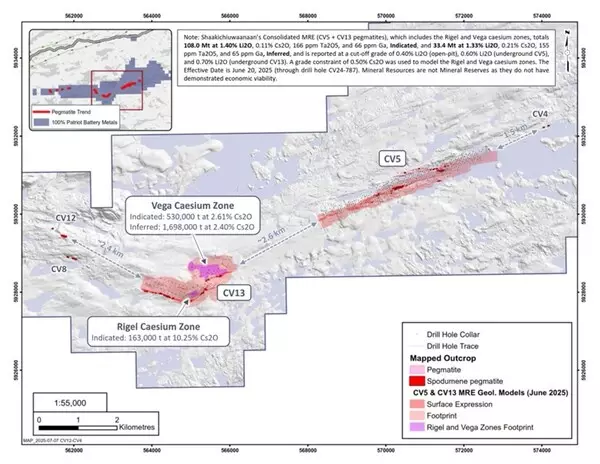
In addition to being one of the largest lithium-tantalum pegmatite Mineral Resources1 and lithium pegmatite Mineral Reserves2 globally, the Shaakichiuwaanaan Property also hosts the world's largest in-situ pollucite-hosted caesium pegmatite Mineral Resource, with 0.69 Mt at 4.40% Cs2O (Indicated) and 1.70 Mt at 2.40% Cs2O (Inferred). The CV13 Pegmatite, host to the caesium Mineral Resource, is located ~3 km along trend from the CV5 Pegmatite, which is situated approximately 13 km south of the regional Trans-Taiga Road and powerline infrastructure corridor, and is accessible year-round by road (Figure 1).
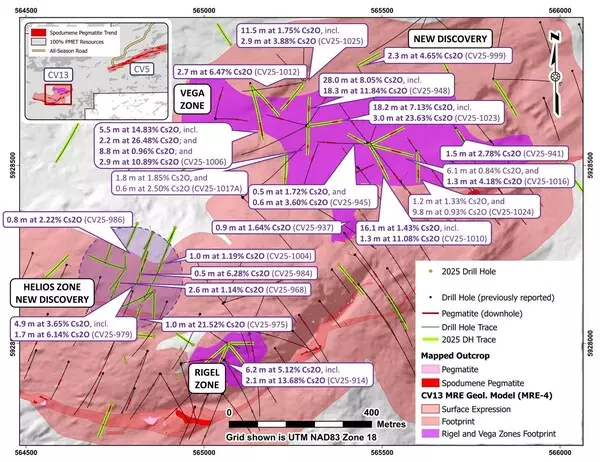
Pollucite mineralization (the host mineral for caesium) occurs in multiple zones within the CV13 Pegmatite – Vega, Rigel, and Helios (Figure 2). Drilling to date has demonstrated remarkable scale and grade, with mineralization remaining open in several areas (see news release March 18, 2026). This unique endowment positions the Company as a potential future leader in the supply of caesium – one of the rarest and most strategically important critical minerals globally.
The testwork program with KTS has been developed as part of a strategic relationship that has evolved following the Company's investigations of the caesium industry, commercial engagement, and research. The program will leverage KTS's demonstrated capabilities in engineering, development and commercialization of critical minerals extraction technologies to produce a range of value-added caesium chemical compounds.
| ___________________________ |
| 1 The Consolidated MRE (CV5 + CV13 pegmatites), which includes the Rigel and Vega caesium zones, totals 108.0 Mt at 1.40% Li2O, 0.11% Cs2O, 166 ppm Ta2O5, and 66 ppm Ga, Indicated, and 33.4 Mt at 1.33% Li2O, 0.21% Cs2O, 155 ppm Ta2O5, and 65 ppm Ga, Inferred, and is reported at a cut-off grade of 0.40% Li2O (open-pit), 0.60% Li2O (underground CV5), and 0.70% Li2O (underground CV13). A grade constraint of 0.50% Cs2O was used to model the Rigel and Vega caesium zones. Effective Date is June 20, 2025 (through CV24-787). Mineral Resources are not Mineral Reserves as they do not have demonstrated economic viability. Mineral Resources are inclusive of Mineral Reserves. |
| 2 Probable Mineral Reserve of 84.3 Mt at 1.26% Li2O at the CV5 Pegmatite with a cut-off grade is 0.40% Li2O (open-pit) and 0.70% Li2O (underground). Underground development and open-pit marginal tonnage containing material above 0.37% Li2O are also included in the statement. The Effective Date is September 11, 2025. See Feasibility Study news release dated October 20, 2025. |
The proposed testwork program – to be executed over approximately the next four months – is expected to create pathways for the conversion of Shaakichiuwaanaan pollucite concentrates to various value-added caesium chemical compounds.
The Company is motivated to consider caesium value-added chemical production (with key partners) to determine the best pathway to unlock maximum value from its globally significant caesium resource and the pollucite concentrates (host mineral for caesium) that could be produced at site.
About Koch Technology Solutions
Koch Technology Solutions is a leader in technology licensing, delivering operating efficiency and capital productivity for licensees deploying the technologies in our portfolio. With a global network and rich history of domain experience and expertise, KTS gains additional strength from its position within Koch Engineered Solutions (KES). This backing enhances the ability to partner with companies developing chemical process technologies, create attractive licensing solutions for commercial deployment, and bring the next generation of technologies to the market.
About Koch Inc.
Koch Inc. is one of the largest privately held companies in the world, headquartered in Wichita, Kansas, with annual revenues that have exceeded US$125 billion. It owns a diverse group of companies involved in manufacturing, agriculture, pulp and paper, packaging, consumer products, building materials, glass, automotive components, refining, renewable energy, chemicals and polymers, electronics, software, network solutions, health care technology, engineered technology, project services, recycling, supply chain and logistics, commodities trading, real estate, and investments. Since 2003, Koch companies have invested more than $190 billion in growth and improvements. With a presence in more than 50 countries, Koch companies employ about 120,000 people worldwide, with nearly half of those in the United States. For more news and information, visit www.kochinc.com.
Next Steps
The testwork program developed in partnership with Koch Technology Solutions is anticipated to occur over approximately the next four months, after which preliminary process pathways are expected to have been developed to produce value-added caesium chemicals from Shaakichiuwaanaan pollucite concentrates.
In parallel, and building on the relationship developed with Koch Inc the Company will continue to assess both potential future products and their interplay with the downstream caesium market. This will include product pathways in industrial sectors like the oil and gas, catalysts, and pharmaceuticals industries.
Further investigations are also underway for the potential utilization of caesium value-added products for the emerging terrestrial solar panel industry, where next-generation panels can include caesium to enhance energy generation efficiency.
At CV13, exploration and resource development will continue as part of the Company's proposed 2026 drill campaign to further delineate and expand upon the previously announced discoveries at Vega, Rigel, and Helios. An updated Mineral Resource Estimate for the caesium zones, incorporating all the drilling through 2025, is anticipated to be announced in the second half of 2026.
Qualified/Competent Person
The technical and scientific information in this news release that relates to the Mineral Resource Estimate and exploration results for the Company's properties is based on, and fairly represents, information compiled by Mr. Darren L. Smith, M.Sc., P.Geo., who is a Qualified Person as defined by National Instrument 43-101 – Standards of Disclosure for Mineral Projects ("NI 43-101"), and member in good standing with the Ordre des Géologues du Québec (Geologist Permit number 01968), and with the Association of Professional Engineers and Geoscientists of Alberta (member number 87868). Mr. Smith has reviewed and approved the related technical information in this news release.
Mr. Smith is an Executive and Vice President of Exploration for PMET Resources Inc. and holds common shares, Restricted Share Units (RSUs), Performance Share Units (PSUs), and options in the Company.
The information in this news release that relates to the Mineral Reserve Estimate and Feasibility Study is based on, and fairly represents, information compiled by Mr. Frédéric Mercier-Langevin, Ing. M.Sc., who is a Qualified Person as defined by NI 43-101, and member in good standing with the Ordre des Ingénieurs du Québec. Mr. Mercier-Langevin has reviewed and approved the related technical information in this news release.
Mr. Mercier-Langevin is the Chief Operating and Development Officer for PMET Resources Inc. and holds common shares, RSUs, PSUs, and options in the Company.
About PMET Resources Inc.
PMET Resources Inc. is a pegmatite critical mineral exploration and development company focused on advancing its district-scale 100%-owned Shaakichiuwaanaan Property located in the Eeyou Istchee James Bay region of Quebec, Canada, which is accessible year-round by all-season road and proximal to regional hydro-power infrastructure.
In late 2025, the Company announced a positive lithium-only Feasibility Study on the CV5 Pegmatite for the Shaakichiuwaanaan Property and declared a maiden Mineral Reserve of 84.3 Mt at 1.26% Li2O (Probable)3. The study outlines the potential for a competitive and globally significant high-grade lithium project targeting up to ~800 ktpa spodumene concentrate using a simple Dense Media Separation ("DMS") only process flowsheet. Further, the results highlight Shaakichiuwaanaan as a potential North American critical mineral powerhouse with significant opportunity for tantalum and caesium in addition to lithium.
The Project hosts a Consolidated Mineral Resource4 totalling 108.0 Mt at 1.40% Li2O and 166 ppm Ta2O5 (Indicated) and 33.4 Mt at 1.33% Li2O and 155 ppm Ta2O5 (Inferred), and ranks as a top ten lithium pegmatite globally in size. Additionally, the Project hosts the world's largest pollucite-hosted caesium pegmatite Mineral Resource at the Rigel and Vega zones with 0.69 Mt at 4.40% Cs2O (Indicated), and 1.70 Mt at 2.40% Cs2O (Inferred).
For further information, please contact us at info@pmet.ca or by calling +1 (604) 279-8709, or visit www.pmet.ca. Please also refer to the Company's continuous disclosure filings, available under its profile at www.sedarplus.ca and www.asx.com.au, for available exploration data.
This news release has been approved by
"KEN BRINSDEN"
Kenneth Brinsden, President, CEO, & Managing Director
| ___________________________ |
| 3 See Feasibility Study news release dated October 20, 2025. Probable Mineral Reserve cut-off grade is 0.40% Li2O (open-pit) and 0.70% Li2O (underground). Underground development and open-pit marginal tonnage containing material above 0.37% Li2O are also included in the statement. Effective Date of September 11, 2025. |
| 4 The Consolidated MRE (CV5 + CV13 pegmatites), which includes the Rigel and Vega caesium zones, totals 108.0 Mt at 1.40% Li2O, 0.11% Cs2O, 166 ppm Ta2O5, and 66 ppm Ga, Indicated, and 33.4 Mt at 1.33% Li2O, 0.21% Cs2O, 155 ppm Ta2O5, and 65 ppm Ga, Inferred, and is reported at a cut-off grade of 0.40% Li2O (open-pit), 0.60% Li2O (underground CV5), and 0.70% Li2O (underground CV13). A grade constraint of 0.50% Cs2O was used to model the Rigel and Vega caesium zones. The Effective Date is June 20, 2025 (through drill hole CV24-787). Mineral Resources are not Mineral Reserves as they do not have demonstrated economic viability. Mineral Resources are inclusive of Mineral Reserves. |
Disclaimer for Forward-Looking Information
This news release contains "forward-looking statements" and "forward-looking information" within the meaning of applicable securities laws.
All statements, other than statements of present or historical facts, are forward-looking statements. Forward-looking statements involve known and unknown risks, uncertainties and assumptions and accordingly, actual results could differ materially from those expressed or implied in such statements. You are hence cautioned not to place undue reliance on forward-looking statements. Forward-looking statements are typically identified by words such as "aims to", "to be", "plan", "development", "growth", "continued", "intent", "expectations", "emerging", , "anticipated", "potential", "ability", "additional", "prospects", "estimated", , "target", "believes", "next steps", "underway" or variations of such words and phrases or statements that certain actions, events or results "may", "could", "would", "might" or "will" be taken, occur or be achieved.
Forward-looking statements include, but are not limited to, statements concerning the ability to convert caesium-rich pollucite concentrates into various high-value caesium chemical products, the existence of a potential pathway into critical US industrial supply chains for defense, space, energy and advanced electronics, the ability to support the potential development of a new high-margin product stream from Shaakichiuwaanaan alongside lithium, the ability to unlock the full commercial potential of Shaakichuwaanaan caesium discovery, the ability to produce value-added caesium chemicals from Shaakichiuwaanaan pollucite concentrates, the potential for future products and their interplay with the downstream caesium market and the potential utilization of caesium value-added products for the emerging terrestrial solar panel industry, where next-generation panels can include caesium to enhance energy generation efficiency.
Forward-looking statements are based upon certain assumptions and other important factors that, if untrue, could cause actual results to be materially different from future results expressed or implied by such statements. There can be no assurance that forward-looking statements will prove to be accurate. Key assumptions upon which the Company's forward-looking information is based include, without limitation, the accuracy of reserve and resource estimates, the classification of resources and the assumptions on which the reserve and resource estimates are based, long-term demand for lithium (spodumene), tantalum (tantalite), and caesium (pollucite) supply, and that exploration and development results continue to support management's current plans for Property development.
Forward-looking statements are also subject to risks and uncertainties facing the Company's business, any of which could have a material adverse effect on the Company's business, financial condition, results of operations and growth prospects. Readers should review the detailed risk discussion in the Company's most recent Annual Information Form filed on SEDAR+, for a fuller understanding of the risks and uncertainties that affect the Company's business and operations.
Although the Company believes its expectations are based upon reasonable assumptions and has attempted to identify important factors that could cause actual actions, events or results to differ materially from those described in forward-looking statements, there may be other factors that cause actions, events or results not to be as anticipated, estimated or intended. There can be no assurance that forward-looking information will prove to be accurate. If any of the risks or uncertainties mentioned above, which are not exhaustive, materialize, actual results may vary materially from those anticipated in the forward-looking statements.
The forward-looking statements contained herein are made only as of the date hereof. The Company disclaims any intention or obligation to update or revise any forward-looking statements, whether as a result of new information, future events or otherwise, except to the extent required by applicable law. The Company qualifies all of its forward-looking statements by these cautionary statements.
Competent Person Statement (ASX Listing Rules)
The information in this news release that relates to the Feasibility Study ("FS") for the Shaakichiuwaanaan Project, which was first reported by the Company in a market announcement titled "PMET Resources Delivers Positive CV5 Lithium-Only Feasibility Study for its Large-Scale Shaakichiuwaanaan Project" dated October 20, 2025 (Montreal time) is available on the Company's website at www.pmet.ca, on SEDAR+ at www.sedarplus.ca and on the ASX website at www.asx.com.au. The production target from the Feasibility Study referred to in this news release was reported by the Company in accordance with ASX Listing Rule 5.16 on the date of the original announcement. The Company confirms that, as of the date of this news release, all material assumptions and technical parameters underpinning the production target in the original announcement continue to apply and have not materially changed.
The Mineral Resource and Mineral Reserve Estimates in this release were first reported by the Company in accordance with ASX Listing Rules 5.8 and 5.9 in market announcements titled "World's Largest Pollucite-Hosted Caesium Pegmatite Deposit" dated July 20, 2025 (Montreal time) and "PMET Resources Delivers Positive CV5 Lithium-Only Feasibility Study for its Large-Scale Shaakichiuwaanaan Project" dated October 20, 2025 (Montreal time) and are available on the Company's website at www.pmet.ca, on SEDAR+ at www.sedarplus.ca and on the ASX website at www.asx.com.au. The Company confirms that, as of the date of this news release, it is not aware of any new information or data verified by the competent person that materially affects the information included in the relevant announcement and that all material assumptions and technical parameters underpinning the estimates in the relevant announcement continue to apply and have not materially changed. The Company confirms that, as at the date of this announcement, the form and context in which the competent person's findings are presented have not been materially modified from the original market announcement.
The Exploration Results in this release were first reported by the Company in accordance with ASX Listing Rule 5.7 in market announcements dated March 18, 2026, and are available on the Company's website at www.pmet.ca, on SEDAR+ at www.sedarplus.ca and on the ASX website at www.asx.com.au. The Company confirms that, as of the date of this news release, it is not aware of any new information or data verified by the competent person that materially affects the information included in the relevant announcement. The Company confirms that, as at the date of this announcement, the form and context in which the competent person's findings are presented have not been materially modified from the original market announcement.
Olivier Caza-Lapointe, Head, Investor Relations, T: +1 (514) 913-5264, E: ocazalapointe@pmet.ca
Photo - https://mma.prnasia.com/media2/2957511/PMET_Resources_Inc__PMET_Launches_Relationship_with_Koch_Technol.jpg?p=medium600
Photo - https://mma.prnasia.com/media2/2957512/PMET_Resources_Inc__PMET_Launches_Relationship_with_Koch_Technol.jpg?p=medium600
Photo - https://mma.prnasia.com/media2/2957515/PMET_Resources_Inc__PMET_Launches_Relationship_with_Koch_Technol.jpg?p=medium600
MONTREAL, April 16, 2026 /PRNewswire/ -- April 16, 2026 – Sydney, Australia
Koch Technology Solutions, part of Koch Inc., to evaluate advanced processing pathways for PMET's globally significant caesium resource
Highlights
- Strategic caesium testwork program launched with Koch Technology Solutions, a division of Koch Inc. – one of the largest privately held companies in the United States.
- The testwork program aims to convert Shaakichiuwaanaan caesium-rich pollucite concentrates into various high-value caesium chemical products.
- The program will evaluate Koch Technology Solutions' innovative recovery techniques, using proprietary methods for caesium chemicals production.
- This strategic approach provides a potential pathway into critical US industrial supply chains for defense, space, energy and advanced electronics.
- Founded in 1940, Koch Inc. operates in sectors including refining, chemicals, energy and technology, with over 120,000 employees globally.
- The program supports the potential development of a new high-margin product stream from Shaakichiuwaanaan alongside lithium, building commercial momentum following PMET's caesium discovery.
- Following the publication of its caesium Resource, PMET has continued to explore both commercial and supply chain pathways aimed at maximizing the discovery's value.
PMET CEO, President, and Managing Director Ken Brinsden comments: "Shaakichiuwaanaan hosts what we believe to be the most significant caesium discovery globally, marked both by incredible scale and high grades – and this program represents a major step towards unlocking its full commercial potential. Working with Koch Technology Solutions provides access to industry expertise, including demonstrated capabilities in critical minerals, and a portfolio of innovative processing technologies.
"Importantly, this initiative will allow us to explore pathways to produce high-value caesium chemicals, which could ultimately position PMET as a cornerstone supplier to critical industries including defence, aerospace, energy and advanced technologies.
"Through this program, PMET furthers its exposure to the significance of critical minerals in the key U.S. market, providing us with an opportunity to capture substantially greater value from this rare and strategically important discovery by working alongside a US industry participant," added Mr. Brinsden.
Garrett Krall, Critical Minerals Business Leader at Koch Technology Solutions says: "This program brings together the distinct strengths of KTS and PMET to advance an innovative approach in critical minerals extraction. The project reflects the kind of challenge that KTS is uniquely positioned to solve, by applying our process technology and technical expertise alongside PMET to advance an approach to help unlock the value of an important critical mineral supply base."
PMET Resources Inc. (the "Company" or "PMET") (TSX: PMET) (ASX: PMT) (OTCQX: PMETF) (FSE: R9GA) is pleased to announce the commencement of a strategic testwork program with Koch Technology Solutions ("KTS"), a division of leading US conglomerate Koch Inc., to evaluate advanced processing pathways for caesium chemicals derived from pollucite concentrates at its 100%-owned Shaakichiuwaanaan Project, in the James Bay region of Quebec, Canada.
In addition to being one of the largest lithium-tantalum pegmatite Mineral Resources1 and lithium pegmatite Mineral Reserves2 globally, the Shaakichiuwaanaan Property also hosts the world's largest in-situ pollucite-hosted caesium pegmatite Mineral Resource, with 0.69 Mt at 4.40% Cs2O (Indicated) and 1.70 Mt at 2.40% Cs2O (Inferred). The CV13 Pegmatite, host to the caesium Mineral Resource, is located ~3 km along trend from the CV5 Pegmatite, which is situated approximately 13 km south of the regional Trans-Taiga Road and powerline infrastructure corridor, and is accessible year-round by road (Figure 1).
Pollucite mineralization (the host mineral for caesium) occurs in multiple zones within the CV13 Pegmatite – Vega, Rigel, and Helios (Figure 2). Drilling to date has demonstrated remarkable scale and grade, with mineralization remaining open in several areas (see news release March 18, 2026). This unique endowment positions the Company as a potential future leader in the supply of caesium – one of the rarest and most strategically important critical minerals globally.
The testwork program with KTS has been developed as part of a strategic relationship that has evolved following the Company's investigations of the caesium industry, commercial engagement, and research. The program will leverage KTS's demonstrated capabilities in engineering, development and commercialization of critical minerals extraction technologies to produce a range of value-added caesium chemical compounds.
___________________________
1 The Consolidated MRE (CV5 + CV13 pegmatites), which includes the Rigel and Vega caesium zones, totals 108.0 Mt at 1.40% Li2O, 0.11% Cs2O, 166 ppm Ta2O5, and 66 ppm Ga, Indicated, and 33.4 Mt at 1.33% Li2O, 0.21% Cs2O, 155 ppm Ta2O5, and 65 ppm Ga, Inferred, and is reported at a cut-off grade of 0.40% Li2O (open-pit), 0.60% Li2O (underground CV5), and 0.70% Li2O (underground CV13). A grade constraint of 0.50% Cs2O was used to model the Rigel and Vega caesium zones. Effective Date is June 20, 2025 (through CV24-787). Mineral Resources are not Mineral Reserves as they do not have demonstrated economic viability. Mineral Resources are inclusive of Mineral Reserves.
2 Probable Mineral Reserve of 84.3 Mt at 1.26% Li2O at the CV5 Pegmatite with a cut-off grade is 0.40% Li2O (open-pit) and 0.70% Li2O (underground). Underground development and open-pit marginal tonnage containing material above 0.37% Li2O are also included in the statement. The Effective Date is September 11, 2025. See Feasibility Study news release dated October 20, 2025.
The proposed testwork program – to be executed over approximately the next four months – is expected to create pathways for the conversion of Shaakichiuwaanaan pollucite concentrates to various value-added caesium chemical compounds.
The Company is motivated to consider caesium value-added chemical production (with key partners) to determine the best pathway to unlock maximum value from its globally significant caesium resource and the pollucite concentrates (host mineral for caesium) that could be produced at site.
About Koch Technology Solutions
Koch Technology Solutions is a leader in technology licensing, delivering operating efficiency and capital productivity for licensees deploying the technologies in our portfolio. With a global network and rich history of domain experience and expertise, KTS gains additional strength from its position within Koch Engineered Solutions (KES). This backing enhances the ability to partner with companies developing chemical process technologies, create attractive licensing solutions for commercial deployment, and bring the next generation of technologies to the market.
About Koch Inc.
Koch Inc. is one of the largest privately held companies in the world, headquartered in Wichita, Kansas, with annual revenues that have exceeded US$125 billion. It owns a diverse group of companies involved in manufacturing, agriculture, pulp and paper, packaging, consumer products, building materials, glass, automotive components, refining, renewable energy, chemicals and polymers, electronics, software, network solutions, health care technology, engineered technology, project services, recycling, supply chain and logistics, commodities trading, real estate, and investments. Since 2003, Koch companies have invested more than $190 billion in growth and improvements. With a presence in more than 50 countries, Koch companies employ about 120,000 people worldwide, with nearly half of those in the United States. For more news and information, visit www.kochinc.com.
Next Steps
The testwork program developed in partnership with Koch Technology Solutions is anticipated to occur over approximately the next four months, after which preliminary process pathways are expected to have been developed to produce value-added caesium chemicals from Shaakichiuwaanaan pollucite concentrates.
In parallel, and building on the relationship developed with Koch Inc the Company will continue to assess both potential future products and their interplay with the downstream caesium market. This will include product pathways in industrial sectors like the oil and gas, catalysts, and pharmaceuticals industries.
Further investigations are also underway for the potential utilization of caesium value-added products for the emerging terrestrial solar panel industry, where next-generation panels can include caesium to enhance energy generation efficiency.
At CV13, exploration and resource development will continue as part of the Company's proposed 2026 drill campaign to further delineate and expand upon the previously announced discoveries at Vega, Rigel, and Helios. An updated Mineral Resource Estimate for the caesium zones, incorporating all the drilling through 2025, is anticipated to be announced in the second half of 2026.
Qualified/Competent Person
The technical and scientific information in this news release that relates to the Mineral Resource Estimate and exploration results for the Company's properties is based on, and fairly represents, information compiled by Mr. Darren L. Smith, M.Sc., P.Geo., who is a Qualified Person as defined by National Instrument 43-101 – Standards of Disclosure for Mineral Projects ("NI 43-101"), and member in good standing with the Ordre des Géologues du Québec (Geologist Permit number 01968), and with the Association of Professional Engineers and Geoscientists of Alberta (member number 87868). Mr. Smith has reviewed and approved the related technical information in this news release.
Mr. Smith is an Executive and Vice President of Exploration for PMET Resources Inc. and holds common shares, Restricted Share Units (RSUs), Performance Share Units (PSUs), and options in the Company.
The information in this news release that relates to the Mineral Reserve Estimate and Feasibility Study is based on, and fairly represents, information compiled by Mr. Frédéric Mercier-Langevin, Ing. M.Sc., who is a Qualified Person as defined by NI 43-101, and member in good standing with the Ordre des Ingénieurs du Québec. Mr. Mercier-Langevin has reviewed and approved the related technical information in this news release.
Mr. Mercier-Langevin is the Chief Operating and Development Officer for PMET Resources Inc. and holds common shares, RSUs, PSUs, and options in the Company.
About PMET Resources Inc.
PMET Resources Inc. is a pegmatite critical mineral exploration and development company focused on advancing its district-scale 100%-owned Shaakichiuwaanaan Property located in the Eeyou Istchee James Bay region of Quebec, Canada, which is accessible year-round by all-season road and proximal to regional hydro-power infrastructure.
In late 2025, the Company announced a positive lithium-only Feasibility Study on the CV5 Pegmatite for the Shaakichiuwaanaan Property and declared a maiden Mineral Reserve of 84.3 Mt at 1.26% Li2O (Probable)3. The study outlines the potential for a competitive and globally significant high-grade lithium project targeting up to ~800 ktpa spodumene concentrate using a simple Dense Media Separation ("DMS") only process flowsheet. Further, the results highlight Shaakichiuwaanaan as a potential North American critical mineral powerhouse with significant opportunity for tantalum and caesium in addition to lithium.
The Project hosts a Consolidated Mineral Resource4 totalling 108.0 Mt at 1.40% Li2O and 166 ppm Ta2O5 (Indicated) and 33.4 Mt at 1.33% Li2O and 155 ppm Ta2O5 (Inferred), and ranks as a top ten lithium pegmatite globally in size. Additionally, the Project hosts the world's largest pollucite-hosted caesium pegmatite Mineral Resource at the Rigel and Vega zones with 0.69 Mt at 4.40% Cs2O (Indicated), and 1.70 Mt at 2.40% Cs2O (Inferred).
For further information, please contact us at info@pmet.ca or by calling +1 (604) 279-8709, or visit www.pmet.ca. Please also refer to the Company's continuous disclosure filings, available under its profile at www.sedarplus.ca and www.asx.com.au, for available exploration data.
This news release has been approved by
"KEN BRINSDEN"
Kenneth Brinsden, President, CEO, & Managing Director
| ___________________________ |
| 3 See Feasibility Study news release dated October 20, 2025. Probable Mineral Reserve cut-off grade is 0.40% Li2O (open-pit) and 0.70% Li2O (underground). Underground development and open-pit marginal tonnage containing material above 0.37% Li2O are also included in the statement. Effective Date of September 11, 2025. |
| 4 The Consolidated MRE (CV5 + CV13 pegmatites), which includes the Rigel and Vega caesium zones, totals 108.0 Mt at 1.40% Li2O, 0.11% Cs2O, 166 ppm Ta2O5, and 66 ppm Ga, Indicated, and 33.4 Mt at 1.33% Li2O, 0.21% Cs2O, 155 ppm Ta2O5, and 65 ppm Ga, Inferred, and is reported at a cut-off grade of 0.40% Li2O (open-pit), 0.60% Li2O (underground CV5), and 0.70% Li2O (underground CV13). A grade constraint of 0.50% Cs2O was used to model the Rigel and Vega caesium zones. The Effective Date is June 20, 2025 (through drill hole CV24-787). Mineral Resources are not Mineral Reserves as they do not have demonstrated economic viability. Mineral Resources are inclusive of Mineral Reserves. |
___________________________
3 See Feasibility Study news release dated October 20, 2025. Probable Mineral Reserve cut-off grade is 0.40% Li2O (open-pit) and 0.70% Li2O (underground). Underground development and open-pit marginal tonnage containing material above 0.37% Li2O are also included in the statement. Effective Date of September 11, 2025.
4 The Consolidated MRE (CV5 + CV13 pegmatites), which includes the Rigel and Vega caesium zones, totals 108.0 Mt at 1.40% Li2O, 0.11% Cs2O, 166 ppm Ta2O5, and 66 ppm Ga, Indicated, and 33.4 Mt at 1.33% Li2O, 0.21% Cs2O, 155 ppm Ta2O5, and 65 ppm Ga, Inferred, and is reported at a cut-off grade of 0.40% Li2O (open-pit), 0.60% Li2O (underground CV5), and 0.70% Li2O (underground CV13). A grade constraint of 0.50% Cs2O was used to model the Rigel and Vega caesium zones. The Effective Date is June 20, 2025 (through drill hole CV24-787). Mineral Resources are not Mineral Reserves as they do not have demonstrated economic viability. Mineral Resources are inclusive of Mineral Reserves.
Disclaimer for Forward-Looking Information
This news release contains "forward-looking statements" and "forward-looking information" within the meaning of applicable securities laws.
All statements, other than statements of present or historical facts, are forward-looking statements. Forward-looking statements involve known and unknown risks, uncertainties and assumptions and accordingly, actual results could differ materially from those expressed or implied in such statements. You are hence cautioned not to place undue reliance on forward-looking statements. Forward-looking statements are typically identified by words such as "aims to", "to be", "plan", "development", "growth", "continued", "intent", "expectations", "emerging", , "anticipated", "potential", "ability", "additional", "prospects", "estimated", , "target", "believes", "next steps", "underway" or variations of such words and phrases or statements that certain actions, events or results "may", "could", "would", "might" or "will" be taken, occur or be achieved.
Forward-looking statements include, but are not limited to, statements concerning the ability to convert caesium-rich pollucite concentrates into various high-value caesium chemical products, the existence of a potential pathway into critical US industrial supply chains for defense, space, energy and advanced electronics, the ability to support the potential development of a new high-margin product stream from Shaakichiuwaanaan alongside lithium, the ability to unlock the full commercial potential of Shaakichuwaanaan caesium discovery, the ability to produce value-added caesium chemicals from Shaakichiuwaanaan pollucite concentrates, the potential for future products and their interplay with the downstream caesium market and the potential utilization of caesium value-added products for the emerging terrestrial solar panel industry, where next-generation panels can include caesium to enhance energy generation efficiency.
Forward-looking statements are based upon certain assumptions and other important factors that, if untrue, could cause actual results to be materially different from future results expressed or implied by such statements. There can be no assurance that forward-looking statements will prove to be accurate. Key assumptions upon which the Company's forward-looking information is based include, without limitation, the accuracy of reserve and resource estimates, the classification of resources and the assumptions on which the reserve and resource estimates are based, long-term demand for lithium (spodumene), tantalum (tantalite), and caesium (pollucite) supply, and that exploration and development results continue to support management's current plans for Property development.
Forward-looking statements are also subject to risks and uncertainties facing the Company's business, any of which could have a material adverse effect on the Company's business, financial condition, results of operations and growth prospects. Readers should review the detailed risk discussion in the Company's most recent Annual Information Form filed on SEDAR+, for a fuller understanding of the risks and uncertainties that affect the Company's business and operations.
Although the Company believes its expectations are based upon reasonable assumptions and has attempted to identify important factors that could cause actual actions, events or results to differ materially from those described in forward-looking statements, there may be other factors that cause actions, events or results not to be as anticipated, estimated or intended. There can be no assurance that forward-looking information will prove to be accurate. If any of the risks or uncertainties mentioned above, which are not exhaustive, materialize, actual results may vary materially from those anticipated in the forward-looking statements.
The forward-looking statements contained herein are made only as of the date hereof. The Company disclaims any intention or obligation to update or revise any forward-looking statements, whether as a result of new information, future events or otherwise, except to the extent required by applicable law. The Company qualifies all of its forward-looking statements by these cautionary statements.
Competent Person Statement (ASX Listing Rules)
The information in this news release that relates to the Feasibility Study ("FS") for the Shaakichiuwaanaan Project, which was first reported by the Company in a market announcement titled "PMET Resources Delivers Positive CV5 Lithium-Only Feasibility Study for its Large-Scale Shaakichiuwaanaan Project" dated October 20, 2025 (Montreal time) is available on the Company's website at www.pmet.ca, on SEDAR+ at www.sedarplus.ca and on the ASX website at www.asx.com.au. The production target from the Feasibility Study referred to in this news release was reported by the Company in accordance with ASX Listing Rule 5.16 on the date of the original announcement. The Company confirms that, as of the date of this news release, all material assumptions and technical parameters underpinning the production target in the original announcement continue to apply and have not materially changed.
The Mineral Resource and Mineral Reserve Estimates in this release were first reported by the Company in accordance with ASX Listing Rules 5.8 and 5.9 in market announcements titled "World's Largest Pollucite-Hosted Caesium Pegmatite Deposit" dated July 20, 2025 (Montreal time) and "PMET Resources Delivers Positive CV5 Lithium-Only Feasibility Study for its Large-Scale Shaakichiuwaanaan Project" dated October 20, 2025 (Montreal time) and are available on the Company's website at www.pmet.ca, on SEDAR+ at www.sedarplus.ca and on the ASX website at www.asx.com.au. The Company confirms that, as of the date of this news release, it is not aware of any new information or data verified by the competent person that materially affects the information included in the relevant announcement and that all material assumptions and technical parameters underpinning the estimates in the relevant announcement continue to apply and have not materially changed. The Company confirms that, as at the date of this announcement, the form and context in which the competent person's findings are presented have not been materially modified from the original market announcement.
The Exploration Results in this release were first reported by the Company in accordance with ASX Listing Rule 5.7 in market announcements dated March 18, 2026, and are available on the Company's website at www.pmet.ca, on SEDAR+ at www.sedarplus.ca and on the ASX website at www.asx.com.au. The Company confirms that, as of the date of this news release, it is not aware of any new information or data verified by the competent person that materially affects the information included in the relevant announcement. The Company confirms that, as at the date of this announcement, the form and context in which the competent person's findings are presented have not been materially modified from the original market announcement.
Olivier Caza-Lapointe, Head, Investor Relations, T: +1 (514) 913-5264, E: ocazalapointe@pmet.ca
Photo - https://mma.prnasia.com/media2/2957511/PMET_Resources_Inc__PMET_Launches_Relationship_with_Koch_Technol.jpg?p=medium600
Photo - https://mma.prnasia.com/media2/2957512/PMET_Resources_Inc__PMET_Launches_Relationship_with_Koch_Technol.jpg?p=medium600
Photo - https://mma.prnasia.com/media2/2957515/PMET_Resources_Inc__PMET_Launches_Relationship_with_Koch_Technol.jpg?p=medium600
** This press release is distributed by PR Newswire through automated distribution system, for which the client assumes full responsibility. **
PMET Launches Relationship with Koch Technology Solutions to Advance Value-Added Caesium Chemicals from Shaakichiuwaanaan
PMET Launches Relationship with Koch Technology Solutions to Advance Value-Added Caesium Chemicals from Shaakichiuwaanaan